Location| Poznan, Poland: Thinking About the Future of Avant-Garde Studies

Poznan public graffiti art I photographed near the conference site
My time in Poland the past several days was spent attending an academic conference organized by the European Network for Avant-garde and Modernism Studies, hosted at Adam Mickiewicz University. The purpose of the gathering was to explore the question of “high” and “low” culture through an examination of the influence of popular and consumer culture on the output of avant-garde art producers. Glancing at the programme, the range and diversity of topics reveals how much this area of study has changed over the years, moving beyond the expected topics related to the predominantly and historical Western European movements (such as German Expressionism, Futurism, Surrealism, and Dada) and opening up new avenues of discussion around an expanded and increasingly global approach to defining and locating the avant-garde in “other” times and places. The session I participated in, “High, Low or Middle Brow? Photography in and against Modernism and the Avant-garde” formed part of this alternative approach and was organized by Elena Gualiteri from the University of Sussex. I am happy to report that my paper “The Limits of Utopia: Exploring Intersections of the Photographic and Cinematic in the Disconnected Network of the Budapest Avant-Garde” was able to contribute to the excellent panel discussion and I met some wonderful new scholars that I look forward to corresponding with as a result.

But apart from meeting the fabulous group that made up my panel (and enjoying a lovely el fresco dinner with them in the Old Town square the final night of my stay--thanks to Aleksandra for the excellent Polish restaurant selection!), the highlight of the conference for me was finally getting to see Peter Bürger, the man who quite literally wrote the book on avant-garde theory (yes, academics also have “stars”). He formed part of a distinguished group participating in a round table discussion examining the future of avant-garde studies. For those of you attending FPA 111 last week, you might recall that my first lecture of the year introduced a definition for the term “avant-garde,” emphasizing the importance of the artistic movement as a deliberate provocation or “shaking up” of the mainstream culture, highlighting the importance of reintegrating some notion of everyday life and all of its attendant material concerns to the production of art.

The final outcome of this panel was quite revealing since almost everyone agreed that the current state of world affairs—with an increasingly difficult to apprehend global economic structure and fraught political landscape—was demanding that scholars pay even more attention to the participatory model and the close connection between art and political activism modeled by the historical avant-garde. More specifically, the spaces of the World Wide Web and the potential for social networking were cited as dynamic sites for deploying these strategies today and in the future (witness the grassroots Obama phenomenon as one recent example of how these systems can be used in the service of public action). I just wish we had more practicing artists on hand to develop and respond to this idea. Jet lag aside (as I write this entry, I am sitting in Frankfurt airport bracing myself for the long journey home) I did leave Poland hopeful that what we talked about in theory could be put into some kind of meaningful practice.

Location| Poznan, Poland: A Study in Contrasts

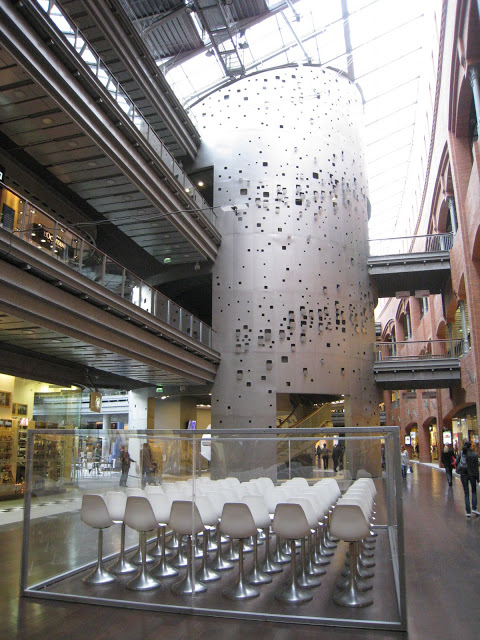
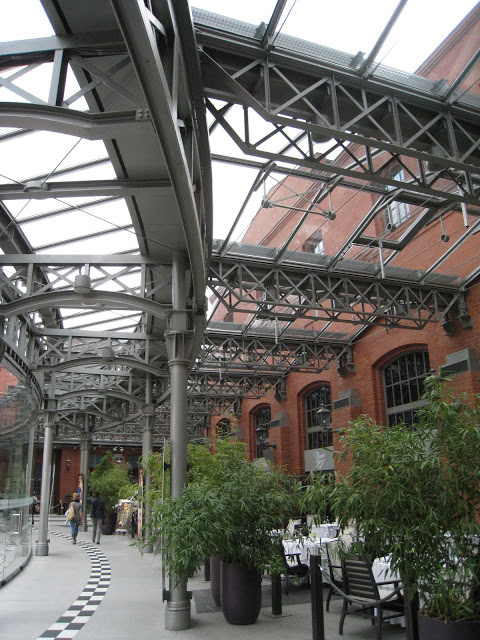
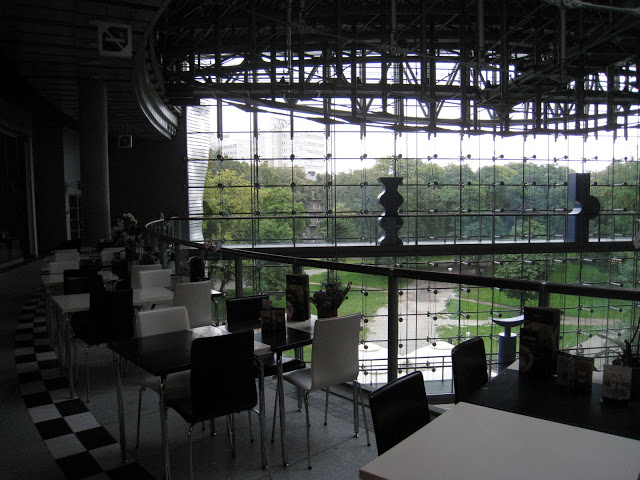
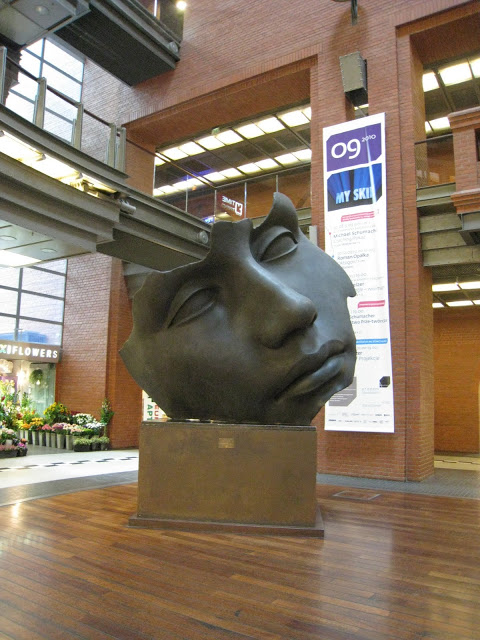
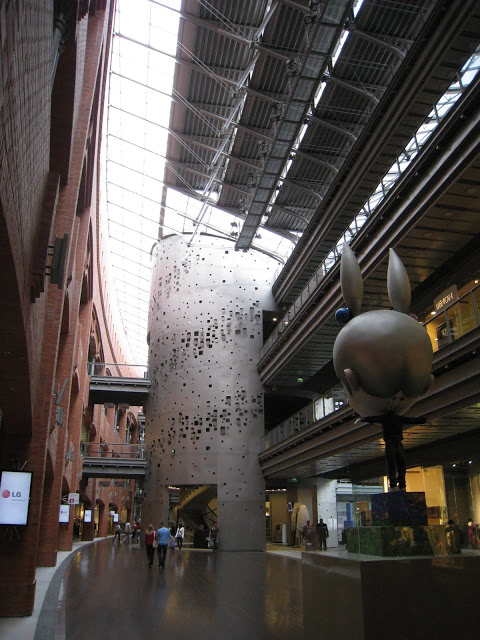
Interior shot from today at the Stary Browar Mall (my photo),
Installation work Wavefunction by Rafael Lozano-Hemmer, first shown at
the Venice Biennale in 2007, now on permanent display in Poznan.
Upon checking into my hotel in Poznan, the young front desk clerk grew enthusiastic when he found out I was from Vancouver, “I loved the Olympics” he said, “your city looks so new and beautiful on TV.” We chatted briefly and he helped me with some basic navigation questions to see the older Polish buildings and monuments I had on my list. When I asked about a place to get a bite, he paused for a moment and asked with some surprise if I realized that I was staying directly across the street from one of the biggest and most modern malls in Europe. I smiled politely thinking to myself that he was really doing a great job promoting his home town—he must not realize I live in the land of the West Edmonton Mall and have spent more time than I care to admit in so-called "large and modern" shopping centres, from Caesar’s Palace Forum in Las Vegas to the Mall of America in Minnesota (another conference side trip). But then as I popped across the street to investigate, I was literally stopped in my tracks. He wasn’t kidding.

Stary Browar is the name of the complex which opened in 2003 as a combination of retail space and (as I was about to find out to my delight) dedicated art space. In fact, once I got inside and reviewed the list of artists’ work on display-- including photo works by Vanessa Beecroft and Spencer Tunick, installation pieces by Rafael Lozano-Hemmer and Sebastian Hempel, and fantastic works by contemporary Polish artists I was excited to learn more about-- I immediately wondered who was behind the project. As it turns out, all of this would be explained to me in a private tour that was immediately offered to me when I inquired about the art works in the lobby of the swank hotel anchoring the mall. A number of the smaller works are located there and my guide Peter was happy to show me around. Perhaps most impressive was the multi-media installation created by Lozano-Hemmer as a special commission for the hotel, serving as a digitally "immersive" waiting area (recall that Lozano-Hemmer designed the spectacular interactive light show Vancouverites enjoyed during the Olympics). I was not allowed to take photos, so check this link. I was told that the financier for the mall, the art collection, and the art foundation that supports Polish contemporary art talent, was Poland’s wealthiest individual, Grazyna Kulczyk (a woman no less).

As I wandered around the mall and took approved photographs of the interior architecture, I must admit that there was something strangely satisfying about discovering some familiar stores, such as the French-owned beauty outlet Sephora, in the mall. In this sense, Poznan shares with Vancouver the same cultural marks of global place-making and all the attendant anxieties that send subtle signals to visitors. I recall when friends and I discussed how it was possible that Calgary had gotten a Sephora in their city ahead of Vancouver (sorry Alberta, but it truly was confusing). It is as if the presence of certain flagship global brands--or in this case, recognized international artists-- declare just how “with it” and cosmopolitan a city is.

Now I know how deeply ironic it is that I have traveled all this way to a city associated with old Poland to blog about a shopping mall, but I have decided to comment about the city’s modernity since it seems exactly what many of the Poles I have met want to emphasize. Perhaps it is also apropos since the conference I am attending is concerned with exploring the relationship between high and low culture in the history of European modernism (more on this tomorrow). Now I am wondering if the conference organizers ever thought of highlighting Poznan’s famous mall as one of the stops on the traditional city tour.

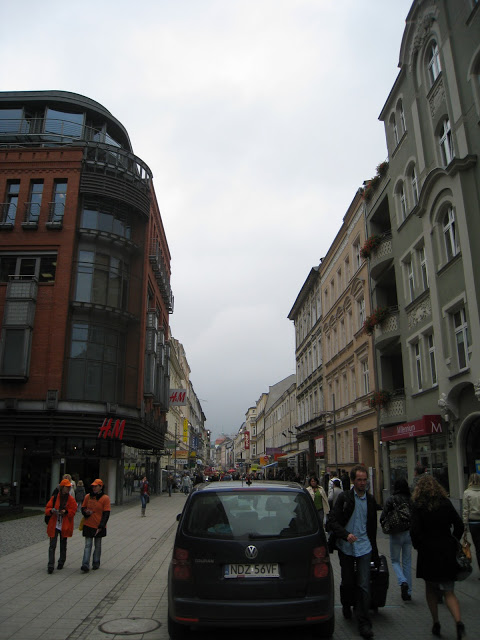
Poznan Flash Mob (2007) Video from YouTube with great interior shots of Stary Browar. See more of my photos of the mall and Poznan city streets after the jump.


Tate Britain| Eadweard Muybridge: A Timely Exhibition

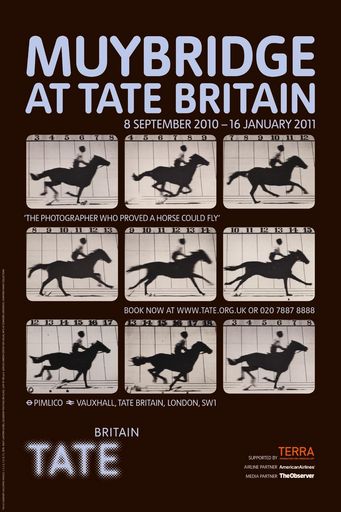
Tate Britain Muybridge Poster, from the Tate website
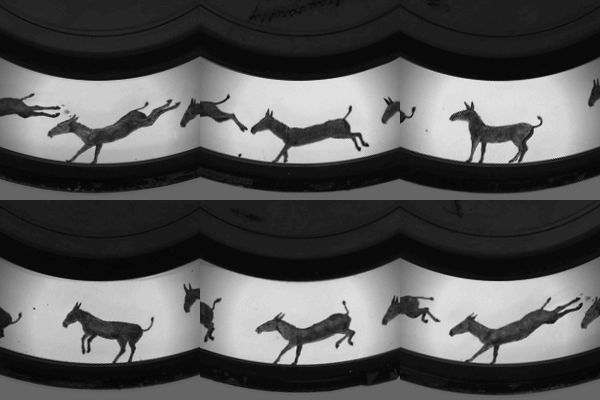
Having landed in Europe today as I prepare to attend an academic conference in Poland, I regret that I was unable to stop over in London and take in the new Eadweard Muybridge exhibition at the Tate Britain (my economy ticket had me flying via Montreal and Frankfurt to Poznan, a twelve hour itinerary I do NOT recommend). For those of you who have noticed my minor obsession with the galloping horse gif that I have incorporated into my email signature over the years, and now acting as the unofficial “mascot” for this blog, you will already recognize the aesthetic stamp of a Muybridge picture—photographic images captured through the use of multiple cameras, or images projected with his invention the zoopraxiscope, the pre-cursor to the first movie projector.

It is not surprising to me that a focus and interest in Muybridge’s contributions and experiments in proto-filmic techniques have emerged in the past few years. The Tate Exhibition, originating with the Muybridge retrospective Helios: Eadweard Muybridge In a Time of Change staged at the Corcoran Gallery of Art in Washington D.C. this past spring, is part of a broader re-examination of the roots of early film and photographic history, or more specifically their intersections. With the rise of new media and accompanying technologies to enhance and manipulate images in our own world, studying Muybridge helps us recall and critically examine the spirit of experimentation and new possibilities that underwrote the visual culture of his times. In 2006, the Department of Theatre, Film and Creative Writing at UBC debuted a production of a new play by Kevin Kerr called Studies in Motion: The Hauntings of Eadweard Muybridge that explored these very themes, and I was asked to contribute an essay to the catalogue where I also considered the connections between the machinery of viewing and altered perception that Muybridge’s works provoke.

The Tate as usual has done a marvelous job on their website of giving a virtual look and feel to the actual exhibition, offering a peek into the various rooms and individual works on display. They also provide useful information and resources for those interested in exploring the life and career of one of the most important and innovative contributors to the history of photography and moving images. As I write this, I am feeling very much in the spirit of Muybridge—here was an individual whose career was marked by travel and international exchange of ideas. I am happy to report that the exhibition will also be on the move. The Corcoran notes on their website that the retropsective will be showing at the San Francisco Museum of Modern Art in February and be on display until June. Maybe I will drive there instead.

Muybridge zoopraxiscope image

Lady Gaga's Meat Joy

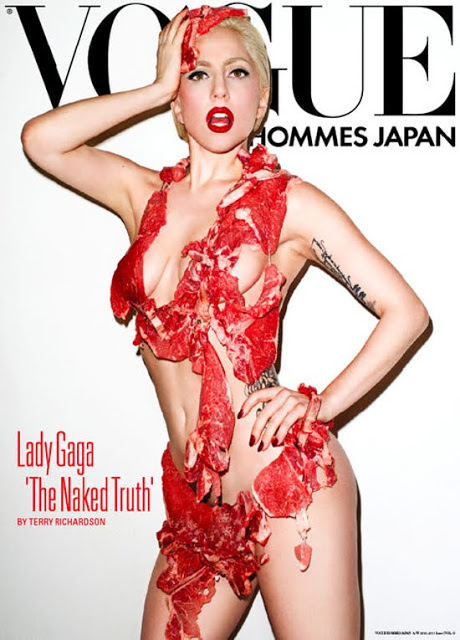
Lady Gaga on the cover of Vogue Hommes Japan, image from Huffington Post
I find it very intriguing that I get asked my opinion about Lady Gaga....a lot. There is no doubt that her provocative and controversial aesthetic sensibilities beg the question of how much her work verges on performance art rather than mere spectacle or celebrity shock. And I know this will certainly not be the first time I blog about her-- I have already mentioned the quandary of following her on Twitter-- but it is just a matter of picking the right moments to weigh in. Case in point is the news that circulated today about the latest cover of Vogue Hommes Japan, which features Gaga wearing what looks like a disintegrating carpaccio bikini.

Much of the discussion as I can discern so far has focused on PETA (People for the Ethical Treatment of Animals) and their reaction. They are naturally none too pleased. The organization's president, Ingrid Newkirk, told the New York Daily News, "Lady Gaga's job is to do outlandish things, and this certainly qualifies as outlandish because meat is something you want to avoid putting on or in your body." Beyond that, the celebrity blogs and news outlets have generally focused on the transgression of boundaries and the notion that she has come up with something completely outrageous and even more "out there" than her infamous muppet outfit.

But has she really?

For those of us who know our history of performance art-- and I want to note here that Lady Gaga in her earlier life, as Stefani Joanne Angelina Germanotta, had attended NYU's Tisch School of the Arts and likely took her share of art history classes-- we would be reminded of  Carolee Schneemann's Meat Joy, first performed at the First Festival of Free Expression in Paris in May of 1964 (see screen grab below). In the performance, Schneemann together with a group of male and female participants, rolled around on the floor with raw poultry, meat, fish, and other materials while grooving to the soundtrack of popular 1960's rock and roll hits. UbuWeb incidentally has a great film clip of this performance.

Of the work, Schneemann has suggested that the transgression of boundaries relates to explorations around flesh, gender, and social ritual: "Meat Joy is an erotic rite -- excessive, indulgent, a celebration of flesh as material: raw fish, chicken, sausages, wet paint, transparent plastic, ropes, brushes, paper scrap. Its propulsion is towards the ecstatic -- shifting and turning among tenderness, wildness, precision, abandon; qualities that could at any moment be sensual, comic, joyous, repellent." In other words, the themes suggested in Gaga's "shocking" photo-- the juxtaposition of beauty and raw cow flesh, sexy pin-up pose and ridiculous context-- find some resonance with these same notions. Famed avant-garde filmmaker Jonas Mekas sums up the importance of Schneemann's provocations slightly differently in a 1965 essay saluting Carolee Schneemann ("In Praise of the Surface"): "Carolee Schneemann’s Meat Joy brings us back to the touch, smell, to the surfaces of things and bodies; it accepts, with love, everything that our insistence on ideas (certain ideas) kept us away from; even what was “repellent,” like “raw” meat, or chicken guts, what we usually dread and fear to touch...Schneemann removes the social context or, rather, the familiar social contexts, to break us open, to expose our senses, to bring us back to our senses—and to get rid of prescribed meanings."

Gaga has discussed at length her goals of building love, acceptance, and tolerance for people who feel like social outcasts and freaks (as she claims to have at many points in her life) and affectionately refers to her fans as "my little monsters." Perhaps then it is worth thinking about Gaga's latest act as one of transgression--yes--but also one that carries the weight and memory of a far more profound idea.
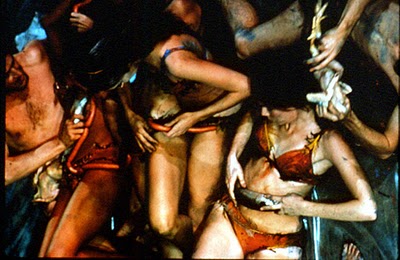

Screen Grab from Schneemann's Meat Joy (1964) 
Further reading:

Morgan, Robert C. "Carolee Schneemann: The politics of eroticism." Art Journal 56.4 (1997): 97.

Schneemann, Carolee. "Aphrodite Speaks: on the Recent Performance Art of Carolee Schneemann." New Theatre Quarterly 16.62 (2000): 155.

Focus on Tech| Instant Boss, An Old Gem

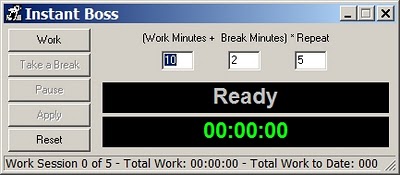
Simple, efficient, interval based timer

Simple, efficient, interval based timer

One of the goals of my blog is to share and discuss some of the various tech and software tools that are out there to help students and researchers make better and more efficient use of their time. I will begin featuring these under the title category: Focus on Tech. If these tools and apps are free, even better in my books. Since it is officially the first day of the academic year (quick reminder), I thought I would begin with one of my very favourite applications-- a free productivity tool that times work and break cycles with alarm reminders to help you get your work done while allowing for much needed rest and recovery.

Instant Boss is sort of like interval training for the mind. I discovered this simple tool when writing my dissertation in grad school. Through much trial and error, I realized that the key to productive writing and studying was found through the discipline of actually committing and setting focused  time to do it, but also working in much needed breaks for reflection and re-energizing. With a world of distractions (email, social networking, web-surfing, chatting with friends on the phone, cleaning out your desk etc..) that can derail your focus when trying to study and write, a tool like this can come in very handy. And like a great pair of old jeans that cannot be parted with, I have continued to use this tool for several years since I have yet to find a better replacement.

What really sets Instant Boss apart, unlike other time based tools, is that it organizes the much needed breaks into useful intervals to remind you when to work and when to relax. After a quick download, set the amount of time you want to work, how long your breaks should be, and how many times you want it to repeat the cycle. Then just click the "Work" button and Instant Boss will remind you when to "Take A Break" and when to get "Back to Work." The key is to focus only on working when the timer is set, and make yourself stop and take a break when the timer goes off. For anyone that does interval training physical exercise, you know how efficient this kind of regime can be. For an added fun feature, you are reminded to take a break with the sound of a coffee cup being filled, and then told to return to work by this cartoon boss:

I have recommended this simple tool to many students over the years who are looking for ways to establish solid writing and studying habits (the sooner the better I say-- don't wait until grad school) and avoid the dreaded (and in the end futile) all-nighter. Here is a great tutorial overview of the application. The defaults are 10 minutes of work, 2 minutes of break, and this is repeated 5 times for a total of 1 hour, but these values can be changed to suit your needs (I usually reduce the breaks and make them slighty longer in any given work period so that I can check my email or get a snack).

I would love to hear of any other applications or tools that you are using that are similar or updates to this-- I realize Instant Boss is a bit dated (and only for Windows, and not be confused with this), but as I said, I cannot find a better replacement.