The Fight for Legitimacy| Adobe's 24/7 Internet Museum and the Politics of Digital Art

A screen shot of the "disembodied eye" that helps viewers navigate
Adobe's new Museum of Digital Media 
The new Adobe Museum of Digital Media opened its virtual doors last week, raising once again the question of influence and power relationships in the world of digital art. Created by US software giant Adobe Systems, the museum is billed as a “unique virtual space” and the first Internet museum of its kind. On its website, the statement of purpose describes Adobe's aims:

Our mission is to showcase and preserve groundbreaking digital work and expert commentary to illustrate how digital media shapes and impacts today's society. Here, artists and innovators have a unique freedom to create work that wouldn't be possible in a traditional museum. Unlike traditional museums, AMDM is open 365 days a year, 24 hours a day and is accessible everywhere.

The high stakes battle continues
Adobe’s move to create an internet museum is of course not just grounded in altruism.  The Adobe Flash multimedia platform has long existed as the industry standard for delivering video and for adding animation and interactivity to web pages (I have several Flash elements added to this very blog), and artists have long used Adobe’s graphics editing program Photoshop to retouch and manipulate digital images. But for several years now, Adobe has been entrenched in a very public fight with Apple Inc. and CEO Steve Jobs about the efficiency of the Flash platform, especially on Apple mobile products like the iPhone, iPad and iPod.  Jobs posted his “Thoughts on Flash” this past April on the Apple website explaining his position, building a case around the need to move beyond a “PC” world. In response, many industry leaders and experts have suggested Jobs simply doesn’t want to be “held hostage to another company’s proprietary software,” noting that Jobs himself has been accused of attempting to monopolize and control digital media software for several years now. Jobs’ push to have developers and artists create applications in HTML5 (recall The Wilderness Downtown Project I blogged about last month) is also regarded as largely short-sighted since it could take years for the platform to match Flash's capabilities.
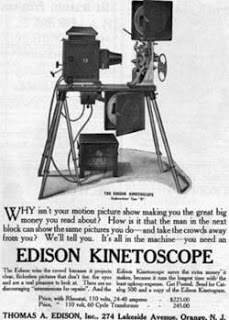
Early cinema history sheds interesting
light on the current state of the digital media tech wars.
Edison and Apple/Adobe may have something in common.
Interestingly enough, many of these recent debates about new technology are not unlike the tech wars in the history and development of early cinema when powerful moguls, industry executives, and suppliers of movie and film equipment engaged in the high stakes game of establishing industry standards for the art of filmmaking. Much of this activity resulted in the famous anti-trust case of 1915 when a small group of minor film companies in Hollywood took down the Edison Trust (a group of powerful East Coast centered film stock and filmmaking companies). That same group of Hollywood companies would go on to create a huge monopoly of their own from the 1930-50’s and spark another series of anti-trust cases that would lead to the eventual dismantling of the vertically integrated Hollywood studio system. In other words, this business between Apple and Adobe (and Apple and Microsoft for that matter) is really just déjà vu.

All of this now begs the question of how digital media artists will proceed. Back in the day of early filmmaking, the process of experimentation and underground strategizing by creative individuals interested in the artistry of making moving images helped determine what the industry standards would ultimately be. Simply put, the artists and their relationship with the audience lead the charge. Adobe’s move to create the first Internet museum can therefore be understood in a similar light. Even with the air of legitimacy that the notion of a “museum” brings to the world of art and its audiences, Adobe’s move is not unlike the Hollywood moguls who created the Academy of Motion Picture Arts and Sciences to award Oscar awards and generate a kind of legitimacy and institution for an “art” that was not seen as such at the time. The act began with the industry and the establishment of a core legitimacy and then the artists took greater control. Adobe’s move is very similar in my mind and just another example (in case we needed one more) of the intersecting worlds of art and commerce. 

Here is the promo video for the new Adobe Museum:
Ai Weiwei and the Art of Activism: 100 Million Seeds, 100 Million Voices

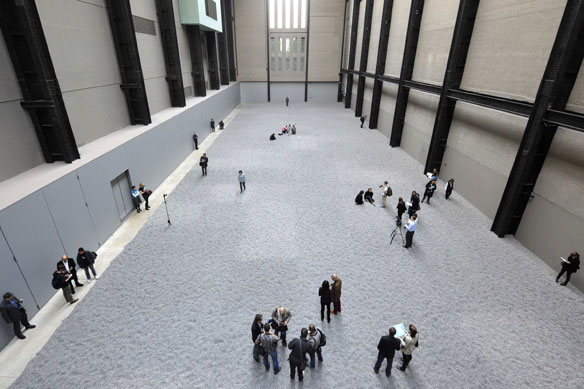
Ai Weiwei filled Tate Modern's Turbine Hall with 100 million porcelain sunflower seeds
which he encourages visitors to experience with all of their senses. Photo: CBC News Arts
This past week the Nobel Peace Prize was awarded to imprisoned Chinese dissident Liu Xiabo, a Chinese intellectual, university professor, writer, and human rights activist who participated in the Tiananmen Square protests of 1989 and helped establish a Human Rights Report of China that he published online and for which he was eventually imprisoned in 2008. During the award ceremony, the Norwegian Nobel Committee praised Liu’s “long and non-violent struggle for fundamental human rights” and said of China that it had an obligation as a growing economic and political power to take more responsibility to protect the fundamental rights of its citizens. China has since denounced the awarding of the Prize to Liu Xiaobo, insisting that the political prisoner is a “criminal who has been sentenced by Chinese judicial departments for violating Chinese law.”  In short, the award is an embarrassment to China, but has successfully placed a massive spotlight on the state of the freedom and the restraints on the exchange of information in China.

Observing these events unfold, I thought it was difficult not to reflect upon how Chinese artists, filmmakers, writers and cultural producers who circulate their art works beyond China to an increasingly global marketplace and audience will react. In the past several years, the Chinese contemporary art market and the number of individual Chinese collectors showing an interest in global art has exploded, opening up dialogue and debate in the country about the kinds of artistic traditions and global influences (many avant-garde, postmodern, conceptual, and/or anti-institutional in nature) that are inspiring a new generation of visual artists and those who follow and are interested in them.  Among them, conceptual artist Ai Weiwei has emerged as a leading figure of Chinese contemporary art and his high profile exhibition at the Tate Modern in London opening during the same week as the awarding of the Noble Prize is either calculated brilliance or the most amazing and ironic coincidence.

Ai Weiwei (artist, curator, architectural designer, activist)
 posing with a handful of seeds
Ai Weiwei was born in Beijing in 1958, the son of a poet exiled during the Cultural Revolution who spent time with his father in labour camps as a child. As a student, Ai enrolled in film school and helped form an avant-garde artist association that was later disbanded when he left for New York in 1983. It was in the United States that he studied at the Parsons School of Design and would apply his interest in Dadaism and Marcel Duchamp’s ready-mades to his practice. Returning to China in the 1990’s when his father fell ill, Ai’s art also began to show signs of reaction and commentary on the brewing social and political tensions within China, creating art works that explore the history and discourse of modernism/modernity and how they have been deployed in his homeland. This direction has proved controversial to say the least. For example, during the preparations for the 2008 Olympic Games in Beijing, Ai famously withdrew support for his design that inspired the final “Bird’s Nest” stadium, claiming that the use of the building to promote China’s forward-looking modernism was nothing short of a “pretend smile.” 
Ai Weiwei was the artistic consultant on the spectacular building
project that became the symbol of the 2008 Olympics in Beijing--
a project from which he later withdrew his support.
As a result of the artist's outspoken commentary and heightened profile in the global art world, Ai's studio has since been put under surveillance and his blogs deleted by Chinese authorities (his website and blogs have subsequently existed on US servers that cannot be viewed in China). His most recent activism concerns the 2008 Sichuan earthquake where the death of school children in badly built schools was partly the result of funds for school building costs being taken by local Chinese officials. In the earthquake’s aftermath, the Chinese government attempted to downplay and cover up the severity of the event both in China and around the world. In response, Ai published the list of students on his blog and organized a one day boycott of the government mandated Green Dam spyware that was to be sold with every personal computer sold in China to prevent full access to the Internet (the initiative has since been postponed due in no small part to the artist’s efforts and the near impossibility of implementing a fully controlled Internet ban). At that time, Ai connected his art practice even more directly with his social concerns stating that: “As an artist, I will never be satisfied if I cannot reach…the nation’s problems. My activism is a part of me. If my art has anything to do with me, then my activism is part of my art.”

What then can we make of the artist’s exhibition and the centerpiece of 100 million porcelain sunflower seeds spread across the Tate’s famed Turbine hall? It is reported that Ai commissioned 1600 artisans specializing in traditional porcelain making in one small Chinese city to produce each individual seed, challenging audiences to think in new ways about the ubiquitous "Made in China" label attached to many consumer goods. As Guardian art critic Adrian Searle suggested in a review Monday, the “undifferentiated field of grey” seems at first somewhat “disappointing.” Upon closer inspection and engagement however, Searle points out how the many layers of meaning speak to the process of silencing and capital expansion that China seems to be currently engaged with:  “Ai Weiweireadymade and Warhol's multiples and turned them into a lesson in Chinese history and western modernisation, and the price individuals in China pay for that. Every unique seed is homogenised into a sifting mass. Most contemporary Chinese art is a product made for western consumption, just as willow-pattern plates or porcelain vases were shipped out in huge quantities for the western market.” An important part of the exhibition thus shifts to the artist’s concern to give voice to the “masses” represented in his work. Visitors are encouraged to record and share their opinions and dialogue with the artist in an open format that is then circulated via the Internet—it is the kind of freedom and circulation of information that reflects the spirit of the new Nobel Peace Prize participant, a work of art that Liu Xiabo would no doubt endorse. 

Check out these two great video clips, the first a Tate short featuring interviews with Ai Weiwei and a documentary showing how the seeds were produced and their symbolic significance to Chinese culture, and the second a glimpse inside the Tate's Turbine hall with the sights and sounds of 100 million seeds.


Weekly Twitter Round Up| Click and Muse (Banksy Tags The Simpsons!)


Happy Thanksgiving! Enjoy the last of your long weekend with a few great tweets from the past week. Thanks as well to those who participated in the "Click and Muse" poll. 76% of you thought art critics should only write about artists/curators that they are not professionally involved with (wow, if that were actually the case, I am not sure who would be working!). Check out this week's poll dovetailing with Jenna's terrific guest blog about graffiti art and the public sphere. Coincidentally, the graffiti and underground artist Banksy mentioned by Jenna was featured last night on The Simpsons when he "tagged" the opening sequence of the show. I have tried to find a stable YouTube link, but 20th Century Fox keeps deleting them for copyright reasons. I hope the embedded link I added stays up for a while so you can check out this unique bit of pop culture history in the making!

Work depicting Jesus in compromising position fuels attendance surge, protests in Loveland, Co.
"The length of the human attention span is about the length of a Beatles song. After that we're off to a new link or a different window."
Mythologizing Facebook: Too soon?: In today’s harried world, our rush to idealize the recent past borders on ridiculous

Memories of John Lennon


PHOTOS: 16 Prettiest Cities In The World!
Website posts ultra-high resolution images of famous paintings, up to a staggering 28 billion pixels each


James Franco's frantic behavior—could be ADD. He plots his next film.


Banksy storyboards the darkest Simpsons opening credits sequence ever 


Guest Blog | Jenna Kirouac: Graffiti as Vandalism-- The War on Love

Guest Blogger Jenna Kirouac is Avant-Guardian Musings Vancouver Arts Correspondent. To see her previous posts, please click here.

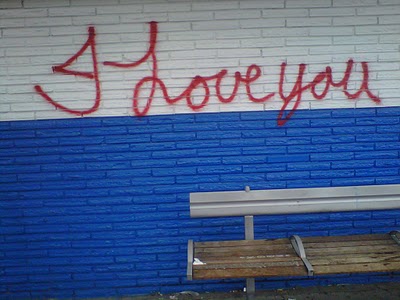
Local Vancouver "I Love You" graffiti (photo by Jenna Kirouac)
Have you noticed the graffiti workings of some young Vandal Romeo professing “I Love You” on the sides of buildings that have been popping up all over downtown Vancouver? I have spotted at least four of them now, although some have been painted over as quickly as the next day.  They are all, no doubt, done by the same hand. All workings bear the same style of sloppy spray paint cursive. I know that I am not the only one who is intrigued and amused by his/her efforts as I recently spotted a spray painted “We Love You” as some other amateur vandal’s response just two blocks down from one of the original tags.

The efforts sparked a few different thoughts:

The “I Love You” tags reminded me of the long-standing battle most Canadian municipalities have had with graffiti. The subject is a sensitive one because tax money is spent on funding for public murals that are sometimes horrible (in my opinion) and by the same token, money is put into covering up work that wasn’t commissioned by the city in the name of vandalism--work that is sometimes better than the professional murals. For example, when the Beatty Street mural that had been commissioned by the city in 2007 was covered up for the Olympics, there was a public outcry.  What was wrong with the mural? Nothing. The city painted over it the custom cobalt blue that matched the visually appropriate propaganda for the games. At first, I was a bit ticked off. I liked that mural and I had to look at the blue wall of nothingness everyday when I stepped out my front door. However, I loved the Olympics and quickly forgave the city for their bad behavior when the announcement of a new mural was soon to come.  Well, that time has arrived and the new mural has emerged. What do I think of it? Meh.

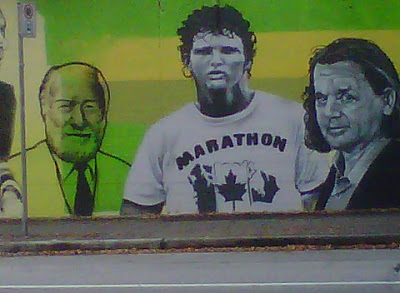
Beatty Street Mural (photo by Jenna Kirouac)
There are parts of it that look great and there are other parts that look so amateur. I cannot believe that the city commissioned a mural in such a high traffic area that was executed so poorly! The portrait of Terry Fox looks like he has Down’s Syndrome (sorry). I can only hope the mural is not yet completed (although I think it is) and in that case I will eat my words. Graffiti raises some tough questions that need examining when we think about modern art. Art is inherently subjective and therefore some people will hate what others really love. Far more importantly, there is the question of hate-speech and the stigma that comes with politically fueled semiotics such as a Swastika. So if we could probably all agree that a spray painted Swastika needs to be covered up then where do we stop agreeing? I don’t think we should claim a slippery slope and enforce a zero-tolerance policy. After all, who gets to decide what murals adorn our public spaces? If these shot-callers implemented the recent Beatty Street mural, then perhaps the least they could do is grant the residents of Vancouver a say in what stays and what goes in terms of graffiti.

Canadian cities are not the only places that tend to have a zero-tolerance policy for graffiti, but there are lots of major metropolitan areas that have a different relationship with it than we do. However, regardless of which city you find yourself in, the critical issue is always centered largely on the aesthetic quality of the graffiti in question; especially as some of you would be quick to agree that graffiti work like that of the famous Banksy is worth keeping intact. After all, his work usually carries a powerful political message. Well for those of you who stake that claim, Ok fine. Then what about “I Love You?” Could there be a more powerful and positive message?  Do we paint over it just because it wasn’t written pretty enough or because it wasn’t done by a famous artist? Before you decide, check out these two YouTube videos. One is a trailer for a documentary on the origins of graffiti and the other is a clip from an unofficial documentary on Banksy. How do you like them apples?