
Kanye West's "Beautiful Dark Twisted Fantasy": Vanity Project or Work of Art?

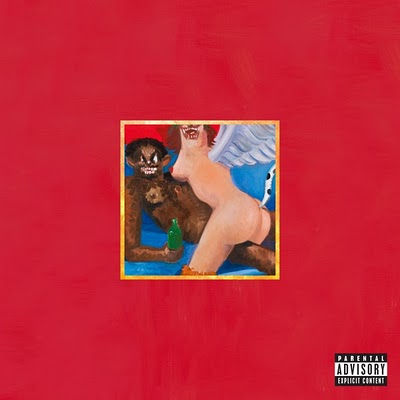
One of five album covers (this one a portrait of Kanye West) reportedly chosen
for the hip hop artist's newest album. Artwork by George Condo 
Much like Lady Gaga, hip hop artist Kanye West has positioned himself as something of a performance artist, establishing a kind of carefully honed visual aesthetic that incorporates references to both the world of contemporary art and the art of the historical avant-garde. As such, it is an aesthetic that is recognizable to many in the art world as evidence of West’s engagement and understanding of many of its core questions. He did after all attend the American Academy of Art in Chicago briefly before dropping out to focus on his career, a theme that runs all the way through the conceptual grounding of his music in albums titled The College Dropout (2004), Late Registration (2005), and Graduation (2007). But it is also an aesthetic that I would argue has mostly been deployed without much criticality and often to extend and magnify what many also argue is one giant vanity project celebrating (and profiting from) all that is “Mr. Kanye West.” Simply Googling his name immediately results in stories of West’s outrageous behaviour--especially it seems at music award shows-- where West has made a spectacle of himself attempting to capture audience attention at the expense of his colleagues. But is this perhaps just part of his performance? Can we actually take Kanye West's aesthetic vision seriously?

Takashi Murakami's artwork was featured on
Kanye West's Graduation (2007) album
Over the past week, the questions of West’s artistic integrity have once again surfaced with two separate but related visual arts projects that form part of the release of his fifth studio album My Beautiful Dark Twisted Fantasy. The first concerns the controversial art work he chose to feature on the album itself (see image at top of post), and the second relates to the half hour music video--or “art film” as West calls it-- that he produced to feature all nine of the album’s songs. Some of you may recall West’s collaboration with Japanese pop artist Takashi Murakami on Graduation (2007) where he asked the artist to help represent his alter-ego “dropout bear” chased by demons and moving through obstacles to make it to his graduation ceremony. In a similar way, West’s latest album is also a portrait, although this time a more literal one with direct representation of the artist himself. Working with artist George Condo, an individual who came of age in the New York art scene of the 1980's and whose art practice centers on themes of surreal sexual energy filled with existential angst, Kanye is presented as a reclining nude straddled by an armless winged white female.

Nudity and provocative posing aside (the main reason for the broader public’s raised eyebrow), the image is filled with loaded art historical references and problematic juxtapositions of academic nudes, the black body, a winged goddess, and complex mythological and cultural symbolism. Lots and lots to unpack here. For West however, the implied narrative is completely personal as he suggests in a recent New York Magazine interview: "It's the story of a phoenix fallen to Earth, and I make her my girlfriend, and people discriminate against her and eventually she has to burn herself alive and go back to her world…I've been feeling the idea of the phoenix. It's been in my heart for a while. It's maybe parallel to my career. I threw a Molotov cocktail on my career last year, in a way, and I had to come back as a better person."
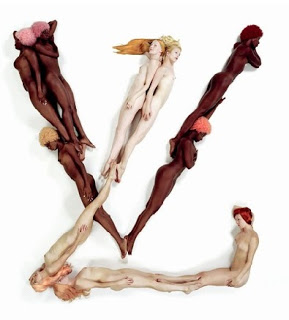
Vanessa Beecroft's own controversial fusion of the world of art
and fashion makes her collaboration with West a perfect match 
West’s video for the album Runaway emerges as a visual extension of the album cover and is said to be inspired by not one, but two, cinema directing legends: Frederico Fellini and Stanley Kubrik. To add further visual complications, the film's screenplay and visual treatment is co-written with controversial contemporary artist Vanessa Beecroft, who is best known for her large scale performance artworks featuring nude fashion models and a narcissistic impulse not unlike Kanye West’s. The casting of Victoria Secret model Selita Ebanks, who has walked the runway in the lingerie company's signature angel wings, also activates a particular kind of spectatorship of the nude and winged phoenix she plays in the film. With each of these disparate influences, the hip hop artist creates a visual landscape for his music that links high fashion, high art, film noir, and epic irony in highly evocative but also deeply troubling ways. I will leave it for you to decide and decipher (I have provided the short video version of the production below; you can see the full version here), but for me the film ends up much like his overdetermined album cover. They are both engaged in visual and conceptual overdrive. Too much going on, too much to absorb, too much to unpack. As NPR music critic Jacob Ganz correctly summed up this past week in his review of the video (and by extension Kanye West’s aesthetic vision), it is all very beautiful but also completely “interminable.” 

Quick Compare| Andy Warhol and Lou Reed

Andy Warhol in 1964
Lou Reed in 1974
As an artist, Andy Warhol perfected the persona of the apathetic slacker to a tee. During a moment when a new generation of postwar American artists sought to counter the individuated and elitist "high art" discourse around abstract expressionism, Warhol adopted the stance of refusing to comment directly upon his pop art and allowing its intended and strategic superficiality to speak and operate for itself. After showing the following clip of Warhol responding to questions about his work in tones of banal indifference in a lecture yesterday, I was sent a video clip of Lou Reed (lead singer of The Velvet Underground, a band promoted heavily by Warhol in the early 1960's) doing essentially the same sort of thing exactly ten years later. Thanks Will for pointing out the fascinating comparison-- it is truly uncanny!


Directors Defending their Craft: CBC RetroBites

I love watching interviews with filmmakers, especially directors, since so many of them reveal that distinct discomfort that comes with changing their usual role as "picture maker" and becoming the object of the camera's attention. Luckily for us, the CBC has compiled a fascinating series of videos on YouTube called RetroBites which features an archival treasure trove of past interviews with famous individuals from the world of art and film.

CBC RetroBites is a fascinating glimpse into
the Canadian broadcaster's interview archives
I have chosen three of my favourite CBC RetroBites interviews with filmmakers to highlight for this post: 1) Orson Welles defending against the claim of superficiality in his later films; 2) Leni Riefenstahl defending her position working under Hitler; and 3) David Cronenberg discussing a controversial casting decision. I have juxtaposed each interview clip with a relevant scene/trailer from each of the individual director's body of work. Watch and enjoy how these famous directors defend their craft.

Orson Welles CBC Interview (1965) and film clip from The Trial (1962)


Leni Riefenstahl CBC Interview (1965) and film clip from Olympia (1938)


David Cronenberg CBC Interview (1979) and trailer from Rabid (1977)


Further Reading:

Barnett, Vincent L. "Cutting Koerners: Floyd Odlum, the Atlas Corporation and the Dismissal of Orson Welles from RKO." Film History 22.2 (2010): 182-198.

Lowenstein, Adam. "Promises of Violence: David Cronenberg on Globalized Geopolitics." 199-208. Duke University Press, 2009.

Tegel, Susan. "Leni Riefenstahl: Art and Politics." Quarterly Review of Film & Video 23.3 (2006): 185-200. 

Weekly Twitter Round Up| Click and Muse


Marking, marking, marking, marking (did I mention I was marking?). It is midterm time again and the Vancouver rains have indeed arrived as if on cue. The Twitterverse however has continued to buzz all week long providing a much needed diversion. Grab a cup of coffee and check out a few of my favourites, and if you get a chance, take the "Click and Muse" poll (look to the right of your screen, click on the image for some context and then vote and see if others agree with you) concerning the YouTube Play Biennial co-sponsored by the Guggenheim Museum. The last poll concerning Banksy's opening sequence for the Simpsons was almost unanimous with 90% considering it Pop art and loving it!

Where Art Meets Trash And Transforms Life: The photographer Vik Muniz and his 2008 “Pictures of Garbage,”
More than 100 Brillo boxes by Andy Warhol have been declared “copies” by Warhol Authentication Board
My answers to this week's Twitter Q&A are here 
Ubu's first new content since the hack. Marina Abramoviç "Dangerous Games" color, 3 min. 34 sec. (2008):


We are not just Art for Michelangelo to carve, he can't rewrite the agro of my furied heart
Doug Coupland to design Terry Fox memorial 


Art World Relieved As Thieves Steal Pretty Terrible Late Period Renoir Work
For Sale: Successful Ivy League applications—only $19.99. Transparent? Or revolting?

Guest Blog | Jenna Kirouac: Magical Realism in Vancouver and the Salazar Film Collective

Guest Blogger Jenna Kirouac is Avant-Guardian Musings Vancouver Arts Correspondent. To see her previous posts, please click here.

I don’t even remember how I first came across the Salazar Film Collective and their work, but I do remember how impressed I was with the content of the videos, the creative representations of media, and the overall quality of the cinematography.  What’s even better is that the group is based out of Vancouver and much of their work is done right here.

I have posted some of the videos to share with you all and so you can see for yourself (click on each image to link to full video on Vimeo browser).

Salazar Demo Reel 2010
Salazar for Lifetime Collective Clothing Spring/Summer 2011
What do you think of them? Yes I realize that a lot of Salazar’s works are essentially constructed as commercials. The important questions to ask however are:

  • What kind of visual worlds do the films construct? (i.e.-what sort of messages do they project?)

  • Are the films purely entertaining or do they have any other meanings ascribed to them?

Salazar does a great job of twisting plot within their videos, leaving the viewer thinking about the mysterious endings long after the story is over. My personal favorite is the recent video Salazar produced for the Vancouver based D.J. Babe Rainbow and the title track from his latest album Shaved. The dark mood of the title song is really captured well in the video. Also the imagery evokes a bit of Canadiana without being overt or obnoxious unlike many of the Canadian symbols of identity we are so used to.

Salazar for Babe Rainbow Shaved (2010)
Salazar Film Collective’s website doesn’t give away too much. There isn’t a lengthy manifesto or vision statement, but their page does offer this explanation of their craft:

“Salazar is a small band of directors collaborating to create unique and progressive films. Strongly influenced by distinctive environments and inspired by magical realism we combine visually stunning locations with quietly emotional content.”

Wait. Stop. Let’s take a second and review what magical realism is. No, don’t wiki it. I have saved you the trouble and looked it up in the Oxford English Dictionary online. Magical Realism is “any artistic style in which realistic techniques such as naturalistic detail, narrative, etc., are similarly combined with surreal or dreamlike elements.” To be sure, there is an element of mystery and of the supernatural in Salazar’s work that seems quite fitting to this genre. Through the mundane, ordinary images and objects are given an almost supernatural representation, and Salazar presents the viewer with a new reality (and a new perception of Vancouver).  A good way to think about magical realism is summed up by film historian Gary McMahon in a recent article on the topic in Film International, “The lateral thinking of magical realism expands our perceptions of what on earth reality is about.”