James Franco, Performance Art, and the Question of Pretentiousness.

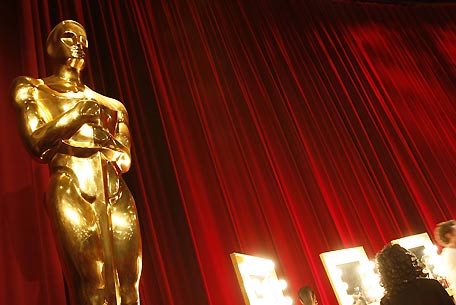
James Franco behind the scenes at the Oscars-- a Twitpic posted on his new blog
What happens when a graduate student becomes a celebrity performance artist and then agrees to host the Oscars? This and this and this is what happens-- and it is all happening to James Franco right now. Last year I pondered the cultural zeitgeist that had gathered around this seemingly midrange Hollywood actor who had catapulted himself to the center of attention in the New York art world. At that time, I posted about Franco’s uncanny ability to initiate dialogue about significant art theory discourse in unexpected ways and his apparent goal of subverting and exposing the mechanisms of celebrity culture. One of my students who is now working on an essay concerning the enigma of Franco’s approach to avant-garde gesture found a great YouTube clip where the actor’s appearance on General Hospital even includes the word and concept of “dialectic” in the script (see below). Franco, who plays the reoccurring role of the fictional "Franco" a multimedia artist like himself, has cleverly utilized the declining soap opera format as a stage upon which to enact his performative and possibly even Situationist inspired detournements. As Franco himself explains in a statement about his approach to art-making, “Performance art can seem pretentious, but it can also be quite mischievous and playful.”

Anne Hathaway and James Franco co-hosting the awards
was all about appealing to a "young and hip" demographic.
Franco tweeted and streamed live images from the event
(image courtesy of PopEater
But this approach clearly backfired Sunday night. Franco’s appearance as co-host at the Academy Awards (fitting with the “young and hip” demographic that the Academy is now targeting) resulted in some of the most scathing and personal attacks on any individual agreeing to the position, eclipsing even Ricky Gervais’s controversial performance at the Golden Globes last month. Part of the problem stemmed from Franco’s apparent disinterest and apathy with his duties, along with claims that he was unprepared, or worse yet, stoned. Clearly, for anyone who is familiar with Franco’s personal style and way of speaking on camera as himself, he was simply being himself. In that sense, it is unfair to think he would have magically transformed for the event, especially if asked to appear as a host.

Yet at another level, there was a way in which Franco appeared to deliberately thumb his nose at the traditions of the Oscars, and this was what sent most observers over the edge. But would anyone expect anything less of a self-declared performance artist working in the tradition of the avant-garde? His low-key and banal approach, his ironic tweets and live pics posted between commercial breaks, and his departure from Los Angeles immediately following the awards to get back to his PhD studies were not surprising moves. Still, his actions were mostly interpreted as signs of an overinflated ego and yes, indications of pretentiousness. Should he have pulled a Jean-Luc Godard and refused to participate? Perhaps. In any case,  it is clear that he may have underestimated how difficult it would be to navigate the clear contradiction of his chosen roles as Hollywood actor and contemporary artist in front of a billion people on live television.
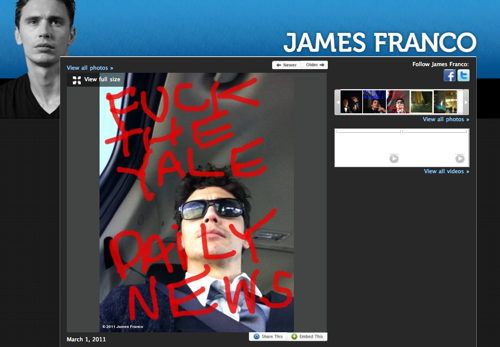
Franco's colourful (and graffiti inspired) response to the Yale Daily News and a student critic
(image courtesy of IvyGate)

Not surprisingly, the most bitter commentary the past few days has come from within academia itself prompting questions concerning Franco’s integrity and aims as a visual/performance artist. The Yale Daily News (the college newspaper of Franco’s current university home) published a blog post critical of Franco and his intended use or overuse of social media, prompting Franco to post his own reply with a NSFW graffitied Twitpic (see above). Cokey Cohen, the student columnist who originally wrote the blog, responded by stating that “combined with his Oscars hosting performance and in accordance with the opinion of commenters on my last blog, I'm becoming convinced that James Franco's whole life is a form of postmodern performance art. In that context, his Twitter fits right in.” The Chronicle of Higher Education also joined the charge by publishing a series of sarcastic tweets about Franco created under the ironically titled #JamesFrancoFacts. Most telling however have been the comments appearing under all of these collective posts debating the merits of Franco as artist and cultural provocateur.

Once again, I am left to conclude as I did with my first post on Franco last year that I have taken the time to blog about all of this, so his strategies are still clearly paying off. And even if Franco damages his Hollywood career and academic reputation with what he pulled at the Oscars, only time will tell if he is in fact contributing to a successful practice as a performance artist. The conversations concerning art and subversion continue, and as long as they do, he succeeds.

James Franco as Franco on General Hospital followed by an assessment of James Franco as himself on Sunday night's Oscar telecast.


Weekly Twitter Round Up


With the Academy Awards only an hour or so away and the Middle East still shaken by protest, the Twitterverse continues to pulse with activity and information exchange, be it life altering or merely superficial.  Hands down, my favourite tweet of the week comes from the ever eloquent Yoko Ono who wrote: “To the youth who think they are silenced by the media and alienated from the world: The future is yours. And ours, actually.” Enjoy your Sunday night whether spent with Oscar or pouring over your homework (or a bit of both) and check out a few of my other favourites from around the Twitterverse:

Fascinatingly bleak: Visual evidence that movies are getting worse


Canada reverses brain drain by spending freely on research


The 15 Most Trivial Things We Learned on the Oscar Campaign Trail


Things could be worse: 12 dystopian novels you should read


Is Facebook justified in censoring users who post classic art nudes to their pages?


Film professors offer their predictions on who should win the


Oscar the Grouch predicts the Oscars. WATCH! 

Academy Award Preview | Documentary Feature Films 2010


As with the foreign language film nominees for the Academy Awards that I previewed yesterday, the selections for Best Documentary Film reflect the excellence of filmmaking outside the limited scope of mainstream Hollywood features. Documentary films, especially over the past decade, have also continued to probe highly controversial and often political subject matter, pushing the possibilities for wider social action. I was especially thrilled to see Waste Land nominated in this category, a film that was among my top picks from the Vancouver International Film Festival and a film that I highlighted and reviewed for its close connections to contemporary artist Vik Muniz. When director Lucy Walker appeared in Vancouver during VIFF to promote the film, I was especially captivated with her discussion of how much Waste Land had shifted the public perception within Brazil of homelessness, class divisions, and the very real concerns about the country’s giant landfills in the short time since it had been screened. I continue to believe that documentary films are to our generation what large scale history paintings were to many nineteenth century audiences—representations to help bring into discourse the most pressing social and political concerns of the moment.


WASTE LAND: The film documents two years of work of Brazilian contemporary modern artist Vik Muniz in creating art with the cooperation of garbage pickers working at Jardim Gramacho, one of the world's largest landfills, serving the metropolis of Rio de Janeiro in Brazil. Official Website | New York Times Review


EXIT THROUGH THE GIFT SHOP: A film directed by Banksy, Exit Through the Gift Shop tells the story of Thierry Guetta, a French immigrant in Los Angeles, and his obsession with street art. Official Website | Guardian Review


GASLAND: The film focuses on communities in the United States impacted by natural gas drilling and, specifically, a stimulation method known as hydraulic fracturing. Official Website | Globe and Mail Review


INSIDE JOB: the subject of Inside Job is the global financial crisis of 2008. It features research and extensive interviews with financial insiders, politicians, journalists, and academics. Official Website | New York Times Review


RESTREPO: The film follows the deployment of the 2nd Platoon of Battle Company on a fifteen month deployment in the Korengal Valley of northeast Afghanistan. It chronicles the lives of the men from their deployment to the time of their return back home. Official Website | New York Times Review


Academy Awards Preview | Foreign Language Films 2010


With all of the hype surrounding Sunday night’s Academy Awards—James Franco and Banksy already providing me two reasons to tune in—I am glad to see that the nominated Foreign Language Films reflect the excellent range of filmmaking from the past year. Having seen two of these films at the Vancouver International Film Festival already, I thought it would be worth the time to reassemble the list here with links to trailers and critical reviews for those of you wanting to check out and preview five of the most celebrated foreign films of 2010. Of course, this list only reflects a narrow range of international films selected by the American Academy of Motion Picture Arts and Sciences (for a more comprehensive list of foreign film selections, see the Cannes Film Festival website), but for many people watching Sunday, these movies will provide a gateway to the diverse world of filmmaking beyond Hollywood. I will preview the Documentary Feature nominees tomorrow.


BIUTIFUL (Mexico):  Biutiful is the story of Uxbal, a cancer-ridden single father who struggles to reconcile fatherhood, love, spirituality, crime, guilt and mortality amidst the dangerous underworld of modern Barcelona -- all before his time is up. Official Website| Guardian Review


DOGTOOTH (Greece):  A married couple and their three young adult children, a son and two daughters, live at the outskirts of a city in a large compound with a garden and a swimming pool. A tall fence surrounds the property and the children have never been on the other side of it, for their parents have kept them unaware of the outside world. Official Website | New York Times Review


IN A BETTER WORLD (Denmark):  Anton is a doctor who commutes between his home in an idyllic town in Denmark, and his work at an African refugee camp. In these two very different worlds, he and his family are faced with conflicts that lead them to difficult choices between revenge and forgiveness. Official Website | Variety Review


INCENDIES (Canada):  Adapted from Wajdi Mouawad's play, "Scorched", Incendies follows two young adults' voyage to the core of deep-rooted hatred, never-ending wars and enduring love. Official Website | Globe and Mail Review 


OUTSIDE THE LAW (Algeria):  Taking place between 1945 and 1962, Outside the Law focuses on the lives of three Algerian brothers in France, set to the backdrop of the Algerian independence movement and the Algerian War. Official Website | New York Times Review


And the Oscar Goes To...... Banksy?

Street art attributed to Banksy began popping up in Los Angeles this week
signed by Mr. Brainwash-- the tagging name of Thierry Guetta in the film Exit Through the Gift Shop
(image courtesy of Doro Design)
One of the most entertaining moments of the Oscar Awards ceremony Sunday might occur if the enigmatic street artist Banksy wins the best documentary feature film category for Exit Through the Gift Shop. Speculation has been running high for days about whether or not Banksy (who is nominated as the film's director) would attend the Oscars after officials refused him permission to attend in disguise. As the Academy's executive director stated, "The fun but disquieting scenario is that if the film wins and five guys in monkey masks come to the stage all saying, 'I'm Banksy,' who the hell do we give it to?" To add confusion to the matter, many in the press have now been openly speculating and reporting that the main character of Banksy's documentary, Thierry Guetta, is the "real" Banksy. This claim however seems both unlikely and not in keeping with Banksy's history, as blogger Alissa Walker at Fast Company argued in a great piece about Banksy last year.

With the award ceremony fast approaching, graffiti works attributed to Banksy, but signed by Guetta's tag name "Mr. Brainwash" have been appearing around Los Angeles. In Guetta's first extended interview with the LA Times published today, he maintains that the "movie is 100% real" and goes on to credit Banksy with helping to tell his story, claiming that "Banksy captured me becoming an artist... In the end, I became his biggest work of art."

We will now have to wait until Sunday to see how Banksy may have to pull off his biggest prank of all-- collecting an Academy Award without revealing his true identity. As he told the Guardian after receiving word of the nomination, "I don't agree with the concept of award ceremonies, but I'm prepared to make an exception for the ones I'm nominated for," adding: "The last time there was a naked man covered in gold paint in my house, it was me."

The following graffiti images, credited to Banksy, appeared around Los Angeles this week (images courtesy of NBC Photoblog)


Trailer for Banksy's Oscar Nominated Documentary: