An unexpected and refreshing look at the
world of contemporary art from a
sociologist/art historian's perspective
This past week I ended my contemporary art survey class with an examination of the art market and the place of the collector in the circulating discourses concerning "value" and "hype" in the art world. As I blogged about just this past week, the record breaking prices paid at auction for modern and contemporary art appears to have picked up steam once again. This despite Ben Lewis's predictions two years ago of the declining market value for these works in his documentary The Great Contemporary Art Bubble (see trailer below). That is not to say Lewis was entirely wrong in his claims that the bubble for contemporary art would burst following the recent global economic downturn-- declines have been seen in many parts of the market-- but the general consensus is that the world of art collecting is a strange and enigmatic one with its own rules and insider experts.
Around the time I saw Lewis's documentary at the Vancouver Film Festival two years ago, I was introduced to a fascinating, unique, and very entertaining book titled Seven Days in the Art World via a wonderful teaching assistant Erin (now instructor of visual design and a terrific artist in her own right) who gifted me a copy following one of my lectures where we had been talking about art markets. Written by sociologist/art historian Sarah Thornton (an intriguing hybrid), the book is structured into seven chapters that explore and offer critical insights into seven interrelated facets of the art world seen through The Auction, The Crit, The Fair, The Prize, The Magazine, The Studio Visit, and The Biennale.
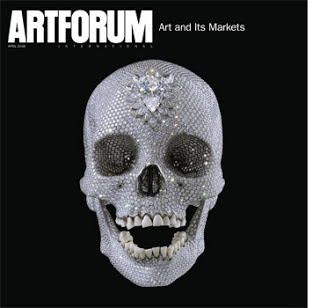
Thornton explores the influence of Artforum
and considers the impact of art "superstars" like Damien Hirst (his diamond skull pictured) in the book.
Reading the book is not unlike eavesdropping on "real" conversations and gaining access to the kinds of full disclosure not necessarily made in the open about the terms of art reception, criticism, production, and circulation. For the book, Thornton interviewed over 250 art insiders from a varitety of fields and spent five years gathering the information for the final book (she discusses this in an interview below). And while some critics have asked whether Thornton has produced enough of a viewpoint with her "fly on the wall" narratives, I find the book both refreshing and insightful for those wanting to understand more closely the deeply connected and often eccentric subcultures of the contemporary art world. I do know that since reading the book many people in my field have admitted to both owning it and especially enjoying the chapters where Thronton explores the sometimes mysterious dynamics of the art crit (she reports on this from the California Institute of Arts) and the often intimidating annual art history College Art Association Conference.
In the end, I listed this book on my essential reading list because it offers a nice counterpart to the more academic and theory derived texts I have already reviewed. Thornton even manages to profile art historian Thomas Crow in an unexpected and enjoyable way-- showing the human dimension of an eminent academic who has had such profound influence in the field. Overall a great read, and especially for the end of term!
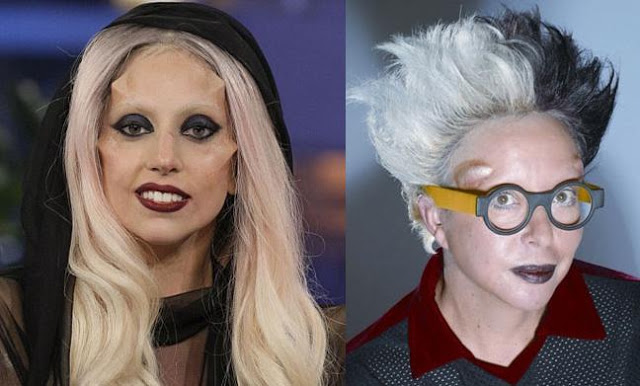
Lady Gaga's most recent "body implants" are reminiscent of the body modification
performances of the controversial French artist Orlan.
The representation of female beauty and the idealized nude body constitute two of the most potent and persistent themes of the visual arts. As a result, female artists, especially those who make themselves the subject of their art works or performances, often struggle with how best to situate and represent their own physical appearance into their practice. Looking to the history of performance art, we can find a legacy of female artists (Carolee Schneemann, Valie Export, Adrian Piper, and Marina Abramovic come to mind immediately) who have had to contend with this key issue as they made themselves both the subject and object of their art practice.
These are some of the ideas that I raised in an earlier blog post when Lady Gaga first donned her infamous meat dress on the cover of Vogues Hommes Japan last year. Many people misread the act as something merely spectacular, when in fact she was carefully referencing a long tradition of female performance art that sought to transgress and reconfigure carefully established boundaries around flesh, gender, and social ritual. In her most recent iteration of this theme, Gaga’s “Born This Way” aesthetic has tapped into another legendary female performance art icon—that of the French artist Orlan.
Orlan's performance "Accouche d'elle m'aime" (Orlan gives birth
to her beloved self) is very similar to Lady Gaga's visual motifs
in her recent "Born This Way" video and stage performances.
Orlan rose to prominence in the art world during the mid 1960’s as an artist who used her own body to explore and measure the spaces around her. Through a long series of performances, installations, and photo works, Orlan consistently examined her own female form and persona in comparison and contrast to the traditions within art history that sought to isolate and represent women’s experience. In the 1990’s, Orlan took this examination to a more radical level by undergoing a series of plastic surgeries to further explore the standards of beauty established by centuries of male artists. As she explains in an interview with the Guardian in 2009: “my goal was to be different, strong; to sculpt my own body to reinvent the self. It's all about being different and creating a clash with society because of that. I tried to use surgery not to better myself or become a younger version of myself, but to work on the concept of image and surgery the other way around. I was the first artist to do it."
In her final series of surgeries, Orlan resurfaced with the now infamous “horns” (normally used to enhance cheek bones) that are pictured in the image of Orlan at the beginning of this post. These implants are not entirely unlike the “shocking” implants that appeared on Lady Gaga’s face (and on other parts of her body) in her most recent series of performances accompanying the “Born This Way” album release. Once again, I believe that Gaga is taking her goal of raising awareness of difference and unique beauty to a very conceptual level with this move, and it is clear that the notion of carnal art—described by Orlan as the “not against cosmetic surgery, but rather against the conventions carried by it and their subsequent inscription”—is also at the core of her recent efforts.
See the following clips concerning Orlan's notion of "carnal art" (warning: some may find content disturbing) and compare to the visual world created by Lady Gaga in her dramatic "Born This Way" video:
This time of year is harrowing for many fine and performing arts students as they weigh their career options and plans for the future. An uncertain economic future and shifting tide in how the arts are delivered to audiences poses many challenges, but also potential opportunities to a new generation of artists. In particular, I am very fortunate to work with many talented film students and artists utilizing motion pictures and filmic elements in their practice. Their challenges are unique in that they are navigating a field of artistic practice that is fast changing and facing technological transformation and incursion from related fields (animation, digital design, and social media platforms) at an unprecedented rate. In this sense it is clear how important innovation and the exchange of ideas are to the contemporary filmmaker.
With these thoughts in mind, I sat down a few weeks ago to watch a panel that was posted on the New School’s YouTube Channel (an absolutely fantastic resource that I have already blogged about here) and sponsored by the Tribeca Film Institute. Provocatively titled “How to Make a Living as a Filmmaker or How to Make a Living and Still Be a Filmmaker”, the panel explores the career options, challenges, and opportunities available to film students and artists involved with producing new media projects in a very pragmatic Q&A format.
Moderated by Sharon Badal, the head short film programmer for the Tribeca Film Festival and author of Swimming Upstream: A Lifesaving Guide to Short Film Distribution, the panel includes: Sandi DuBowski, Director/Producer of Trembling Before G-d and Producer of A Jihad for Love; Moon Molson, an M.F.A. graduate from Columbia University, where he won the New Line Cinema Outstanding Achievement in Filmmaking Award for his thesis film Pop Foul; and Buboo Kakati, a three-time Emmy winning writer, director, and producer (her work has aired on NBC and SHOWTIME) with over 13 years of experience developing and producing documentaries, television series and films. Keeping in mind that many art school programs neglect to discuss the realities of the job market and arts industry with their graduates, this kind of panel is both eye-opening and inspiring.
A week chock full of events-- film screenings, artist talks, student crits, student meetings, exhibition openings, end of year evaluations etc.. etc.. I have also been enjoying all of the amazing plans that students have been sharing with me about summer travel and employment. So much energy in the air! After all of the activity, I was finally able to enjoy some R&R this weekend, breathing in the calm of a walk along the ocean and then home to an afternoon of personal projects. I am glimpsing the end of term and the freedom it will soon bring!
I know many of you are still in the thick of writing-- so take pause, grab a coffee, and enjoy a few of my favourite tweets from around the Twitterverse:
Lady Gaga Googles Herself
Loving Liz 18 ways: Elizabeth Taylor in artnet auctions
Wrote about democracy & contemporary art in the Middle East
Why the Google Books setback is an opportunity to reassert academic values
OMG! in new Oxford English Dictionary
Almost certainly the most fascinating book I'll read this year, will especially make art lovers consider new contexts
I've donated IMAGINE by John Lennon to #SongsForJapan iTunes album Download NOW Proceeds → JapaneseRedCross
An image capturing the sale of a Warhol Elizabeth Taylor portrait in 2007--
Actor Hugh Grant famously sold this copy for an $18.5 million dollar profit.
How soon can someone profit from a deceased celebrity’s image? This question appears to have been answered this week with the passing of movie legend Elizabeth Taylor and the announcement some 24 hours following her death of the auction of one of the most iconic Warhol portraits bearing her famous face and more infamous “violet eyes.” Currently owned by New York hedge-fund manager Steven Cohen, the 1963 silkscreen (Liz #5) will be sold May 12th as the Wall Street Journalreported today at the auction house of Phillips de Pury and is estimated to fetch in excess of $20 million dollars.
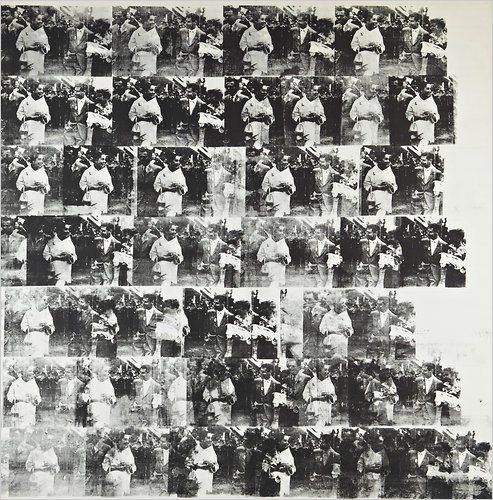
Warhol's Men in Her Life (1962) sold this past November
for a staggering $71.7 million dollars at auction
Just this past November, another of Warhol’s works featuring Elizabeth Taylor sold for a staggering $63.4 million dollars through the same firm, becoming the second highest price paid at auction for a Warhol (the record of $71.7 million for Green Car Crash was paid in 2007). Men in Her Life is a seven-foot tall black and white painting based on a Life Magazine photograph of Taylor with third husband Mike Todd and future husband Eddie Fisher. Fisher, like Taylor, had only recently passed away (in September 2010), when the painting went to auction.
Representing the personal drama of a public celebrity played out in Warhol’s famous mode of repetition, the painting and its high valuation has as much to expose about our own perverse focus on celebrity culture and the price we are all willing to pay for glimpses behind the carefully constructed representations of their “perfect” lives. No doubt, the Taylor-Todd-Fisher scandal has its resonance with today’s Jolie-Pitt-Aniston spectacle and the endless repetition of images accompanying their “real-life” story.
The public's desire for images and stories of celebrity's
"imperfect" lives continues as Warhol predicted
Seen in another light, the high profile auction of this category of art works reminds us once again of the often taboo subject of the art market and those commercial interests that persistently intersect with the production and circulation of art. It is also a reminder of the “umbilical cord of gold” connecting elites and art producers that art critic Clement Greenberg spoke about in his famous 1939 essay “Avant-Garde and Kitsch”, written against the backdrop of escalating interest and valuation in works of modern art during the inter-war period of the twentieth century. In this sense, the upcoming sale of Warhol’s Elizabeth Taylor portrait exposes the reality of art as commodity connected to the public’s insatiable desire for celebrity in its most stark, opportunistic, and highly profitable light.