Focus On Tech| CBC Radio Gadget and Apps


Is it a cliché that I am an academic and I like to listen to the CBC? Perhaps, but when I am working at my computer answering emails, writing, or trying to get through stacks of exams, I am much happier doing it to the sound of jazz or classical music. For this next instalment of my "Focus on Tech" series, I want to share this free gadget (and in the case of Mac and iPhone users, an app) that provides a quick way to access jazz and classical music, without having to open and browse through your music or iTunes files looking for appropriate studying tunes. And because CBC radio can be listened to internationally, the added bonus for travelers and non-Canadians alike is that you can enjoy CBC programming wherever you happen to be (I have the CBC on my laptop just for this very purpose). For Windows users, the gadget I recommend can be added to the sidebar on your desktop. I have it positioned in the bottom right hand side of my screen (see image below), ready to press play whenever I need a hit of music.

Screen shot of my desktop computer
(yes, that is Muybridge on my background)
The nice added feature is that you can right-click and hit “options” to change to any of the available CBC news stations across Canada in addition to the commercial and commentary free CBC Radio 2 Classical and Jazz stations that I frequently alternate. For Mac, iPhone and iPad users, I have been told the CBC Radio app works in a similar way, which I must admit I have not seen in use, so I welcome any comments or feedback as to its utility.

As some of you may already know, studies suggest that classical music (especially Mozart and baroque music with a 60 beats per minute pattern that stimulates your right and left brain) is optimal for maximizing learning and retaining information for later use. This kind of music is great when you are studying or going over notes from your classes. Jazz, on the other hand, is linked to increased creativity and enhanced self-expression, the perfect music as studies suggest to play when you are writing and outlining papers, blogging (I am playing jazz right now) or having a meeting with a study group. Rapid beat music like techno and some forms of rap and hip-hop can increase your pulse, so studies remain mixed on the benefits. I recommend this type of music for an impromptu break or for those mundane tasks like email and Facebooking. Bottom line, it appears more advantageous to work to the sound of music than to the sound of silence.

Murakami Exhibition Opening Today at Versailles: Exclusive Pictures from ARTINFO

Press interviewing Murakami at Versailles this past week
(photo courtesy of ARTINFO)
While I was away in Europe this past weekend, all of the cultural buzz on the English-speaking news networks related to the Murakami show opening today in France. A preview of the show and interviews with Murakami were made available this past Thursday to members of the international press and ARTINFO put together an exclusive photo gallery of the show. As for Murakami, the controversy that I posted about two weeks ago is only getting more heated, with even members of the Japanese press and art community taking aim at his choice of venue and the curatorial decisions surrounding the final works displayed in the exhibition: "All of this stems from misunderstanding," Murakami said of the opposition to the show. "Let’s take baseball or soccer. When one team scores, there are always people who are unhappy, get angry, and voice this. I respect that, but my task is entirely different. I wouldn’t make even the slightest change to my creations. This is not a time for bowing and trying to please everyone. Mine is a work of confrontation between the old and the new."

Remember to take the "Click and Muse" poll on the home page to weigh in on whether you think Murakami's work is "high art" or "commodity fetish."

In-Flight Movies and the Captive Audience

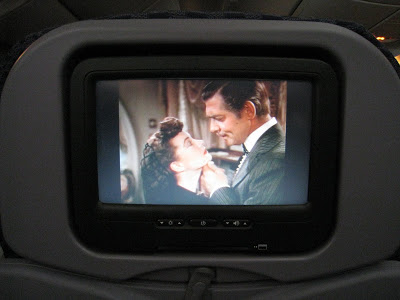
My in-flight movie screen on United Airlines flight from Frankfurt to Houston--
Clark Gable and Vivien Leigh in Gone With the Wind (1939)
I have a confession to make-- I have never seen Gone with the Wind. Sure, I know the basic plot summary and context surrounding the production, and have seen important sections of the film and those many iconic clips that are routinely played at the Oscars almost every year, but much like my relative dislike for James Cameron movies (i.e. Titanic (1997) or more recently Avatar (2009)), I prefer to engage with these kinds of movies on a “need to know for the purposes of film history” kind of level.

In the case of Gone with the Wind (1939), I have held a particular aversion to the film for the combination of its length (3.5 hours) and its melodramatic take on the American civil war—watching Scarlet O’Hara played by Vivien Leigh makes me squirm and I much prefer the hilarious send up of the actress’s performance made famous by Carol Burnett in a skit many claim is the best ever in comic television (see YouTube clip below). Normally, I will only invest that kind of time and focused attention on epic films of the Kubrick Spartacus (1960) or Coppola Godfather (1972) variety. But it is amazing what a 10.5 hour flight and a drained battery on my Kindle will do to force a change in viewing habits.

Getting to my seat on a United Airlines flight from Frankfurt to Houston yesterday, I was thrilled to discover a new state-of-the-art personal entertainment system that was preloaded with hundreds of new release, foreign, independent and classic films like Citizen Cane (1941), Casablanca (1942), Bonnie and Clyde (1967), Dr. Strangelove (1964), and A Streetcar Named Desire (1951) to name but a few. Call it captive audience syndrome, but with serious time to kill and nowhere to reasonably escape, I quickly resolved to finally watch Gone With the Wind in its entirety--what the heck I thought, I am on my way to George Bush Airport in the deep South after all-- and assembled my list for an impromptu DIY film festival.

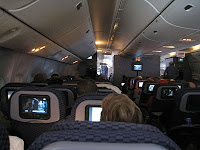
View from my seat
As I settled in and sat watching the films and the time ticked by, there was something a bit disturbing about seeing dozens of people watching individual movies on individual mini movie screens on the flight; the eerie glow on many jet-lagged faces in their own little worlds with complimentary drinks and pretzels in hand. I remember when in-flight movie screenings felt more like going to the traditional movie theatre, and the collective laughter and sense of communal viewing made watching the films feel like all of us were enduring the length and boredom of the long flight together. The films themselves were usually unimportant (and often quite bad) and it was more a tool to clock the flight’s duration. The new entertainment systems however are much more reflective of our current culture of TV and film viewing, which increasingly atomizes the experience based on personal taste and time preferences. In my case, I tempered the 3.5 hours of Gone With the Wind with 3 hours of Fellini’s La Dolce Vita (1960) and a couple of episodes of some hilarious TV show from Japan that I will likely never see again. Somehow this balanced things out and made the whole experience OK. But with the eventual adoption of Internet access to international flights in the months and years to come (already available on many US continental flights today) and the increasing ability to bring one’s own entertainment on board via the iPad and netbook, I am left wondering if the in-flight movie will disappear altogether?

Carol Burnett Show and the classic TV skit Went With the Wind (1970's)-- this is part one of two parts, enjoy!

Location| Poznan, Poland: Thinking About the Future of Avant-Garde Studies

Poznan public graffiti art I photographed near the conference site
My time in Poland the past several days was spent attending an academic conference organized by the European Network for Avant-garde and Modernism Studies, hosted at Adam Mickiewicz University. The purpose of the gathering was to explore the question of “high” and “low” culture through an examination of the influence of popular and consumer culture on the output of avant-garde art producers. Glancing at the programme, the range and diversity of topics reveals how much this area of study has changed over the years, moving beyond the expected topics related to the predominantly and historical Western European movements (such as German Expressionism, Futurism, Surrealism, and Dada) and opening up new avenues of discussion around an expanded and increasingly global approach to defining and locating the avant-garde in “other” times and places. The session I participated in, “High, Low or Middle Brow? Photography in and against Modernism and the Avant-garde” formed part of this alternative approach and was organized by Elena Gualiteri from the University of Sussex. I am happy to report that my paper “The Limits of Utopia: Exploring Intersections of the Photographic and Cinematic in the Disconnected Network of the Budapest Avant-Garde” was able to contribute to the excellent panel discussion and I met some wonderful new scholars that I look forward to corresponding with as a result.

But apart from meeting the fabulous group that made up my panel (and enjoying a lovely el fresco dinner with them in the Old Town square the final night of my stay--thanks to Aleksandra for the excellent Polish restaurant selection!), the highlight of the conference for me was finally getting to see Peter Bürger, the man who quite literally wrote the book on avant-garde theory (yes, academics also have “stars”). He formed part of a distinguished group participating in a round table discussion examining the future of avant-garde studies. For those of you attending FPA 111 last week, you might recall that my first lecture of the year introduced a definition for the term “avant-garde,” emphasizing the importance of the artistic movement as a deliberate provocation or “shaking up” of the mainstream culture, highlighting the importance of reintegrating some notion of everyday life and all of its attendant material concerns to the production of art.

The final outcome of this panel was quite revealing since almost everyone agreed that the current state of world affairs—with an increasingly difficult to apprehend global economic structure and fraught political landscape—was demanding that scholars pay even more attention to the participatory model and the close connection between art and political activism modeled by the historical avant-garde. More specifically, the spaces of the World Wide Web and the potential for social networking were cited as dynamic sites for deploying these strategies today and in the future (witness the grassroots Obama phenomenon as one recent example of how these systems can be used in the service of public action). I just wish we had more practicing artists on hand to develop and respond to this idea. Jet lag aside (as I write this entry, I am sitting in Frankfurt airport bracing myself for the long journey home) I did leave Poland hopeful that what we talked about in theory could be put into some kind of meaningful practice.

Location| Poznan, Poland: A Study in Contrasts

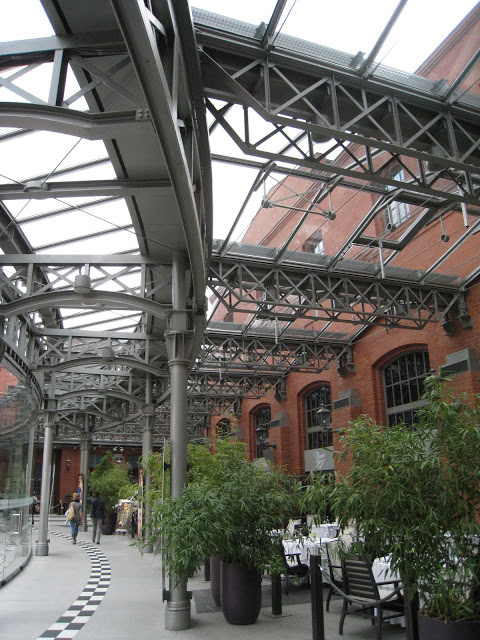
Interior shot from today at the Stary Browar Mall (my photo),
Installation work Wavefunction by Rafael Lozano-Hemmer, first shown at
the Venice Biennale in 2007, now on permanent display in Poznan.
Upon checking into my hotel in Poznan, the young front desk clerk grew enthusiastic when he found out I was from Vancouver, “I loved the Olympics” he said, “your city looks so new and beautiful on TV.” We chatted briefly and he helped me with some basic navigation questions to see the older Polish buildings and monuments I had on my list. When I asked about a place to get a bite, he paused for a moment and asked with some surprise if I realized that I was staying directly across the street from one of the biggest and most modern malls in Europe. I smiled politely thinking to myself that he was really doing a great job promoting his home town—he must not realize I live in the land of the West Edmonton Mall and have spent more time than I care to admit in so-called "large and modern" shopping centres, from Caesar’s Palace Forum in Las Vegas to the Mall of America in Minnesota (another conference side trip). But then as I popped across the street to investigate, I was literally stopped in my tracks. He wasn’t kidding.

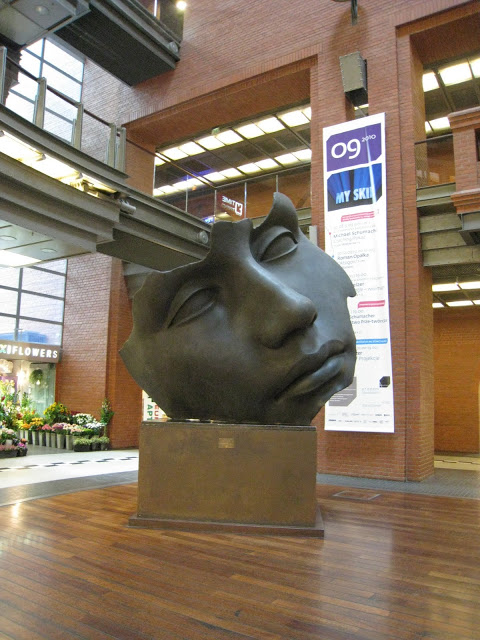
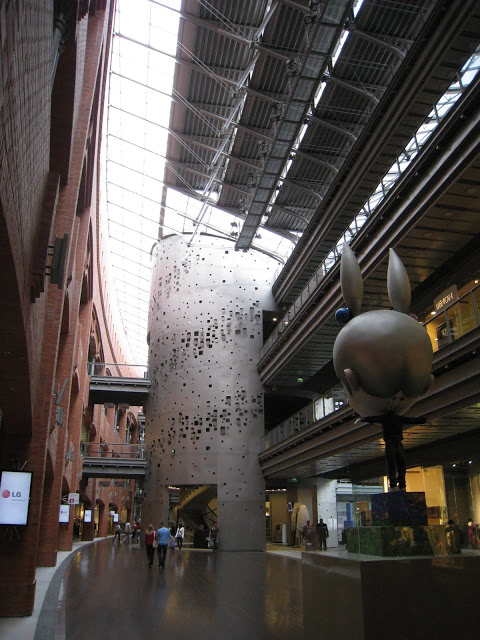
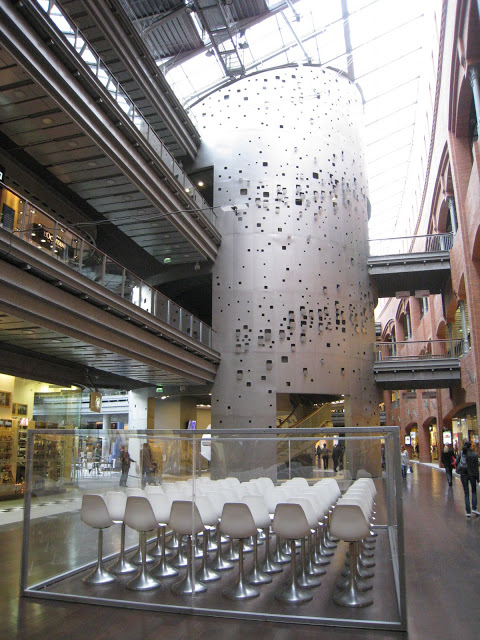
Stary Browar is the name of the complex which opened in 2003 as a combination of retail space and (as I was about to find out to my delight) dedicated art space. In fact, once I got inside and reviewed the list of artists’ work on display-- including photo works by Vanessa Beecroft and Spencer Tunick, installation pieces by Rafael Lozano-Hemmer and Sebastian Hempel, and fantastic works by contemporary Polish artists I was excited to learn more about-- I immediately wondered who was behind the project. As it turns out, all of this would be explained to me in a private tour that was immediately offered to me when I inquired about the art works in the lobby of the swank hotel anchoring the mall. A number of the smaller works are located there and my guide Peter was happy to show me around. Perhaps most impressive was the multi-media installation created by Lozano-Hemmer as a special commission for the hotel, serving as a digitally "immersive" waiting area (recall that Lozano-Hemmer designed the spectacular interactive light show Vancouverites enjoyed during the Olympics). I was not allowed to take photos, so check this link. I was told that the financier for the mall, the art collection, and the art foundation that supports Polish contemporary art talent, was Poland’s wealthiest individual, Grazyna Kulczyk (a woman no less).

As I wandered around the mall and took approved photographs of the interior architecture, I must admit that there was something strangely satisfying about discovering some familiar stores, such as the French-owned beauty outlet Sephora, in the mall. In this sense, Poznan shares with Vancouver the same cultural marks of global place-making and all the attendant anxieties that send subtle signals to visitors. I recall when friends and I discussed how it was possible that Calgary had gotten a Sephora in their city ahead of Vancouver (sorry Alberta, but it truly was confusing). It is as if the presence of certain flagship global brands--or in this case, recognized international artists-- declare just how “with it” and cosmopolitan a city is.

Now I know how deeply ironic it is that I have traveled all this way to a city associated with old Poland to blog about a shopping mall, but I have decided to comment about the city’s modernity since it seems exactly what many of the Poles I have met want to emphasize. Perhaps it is also apropos since the conference I am attending is concerned with exploring the relationship between high and low culture in the history of European modernism (more on this tomorrow). Now I am wondering if the conference organizers ever thought of highlighting Poznan’s famous mall as one of the stops on the traditional city tour.

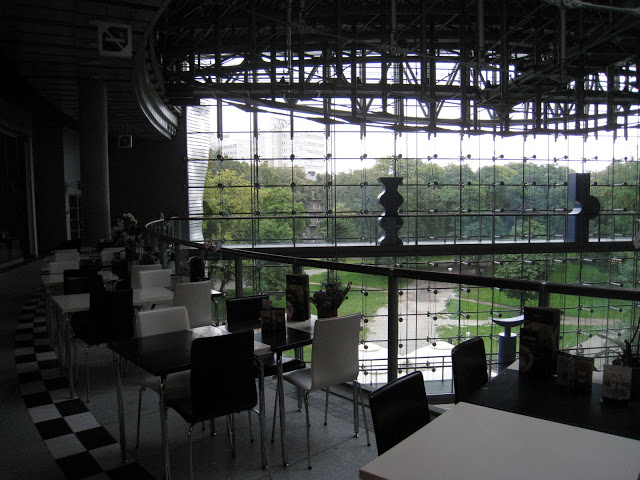
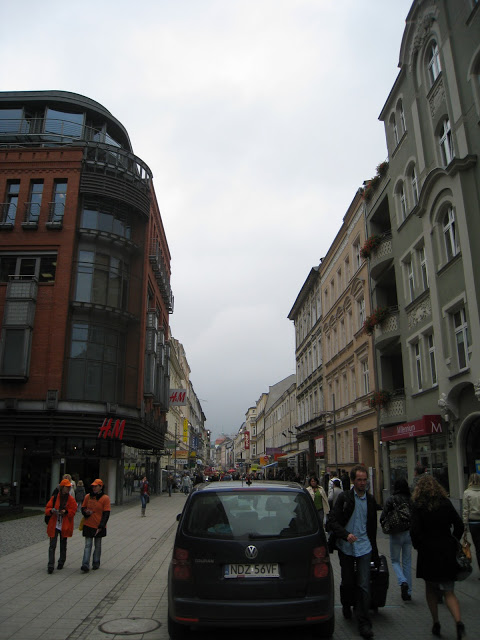
Poznan Flash Mob (2007) Video from YouTube with great interior shots of Stary Browar. See more of my photos of the mall and Poznan city streets after the jump.