Sherman's Untitled 153 (1981) broke the record this week for the most expensive photograph sold at auction
A significant milestone was reached last week when a Cindy Sherman photograph displaced Andreas Gursky’s previous record as the most expensive photograph ever sold at auction. Sold for a staggering 3.89 million dollars, the art work in question, Untitled 153, features a stunning self-portrait of Sherman clutching a personal ad in her right hand as she reclines seductively on a kitchen floor (see image above). At first glance, an image like this may be mistaken for any number of similar self-portrait projects that permeate contemporary art exhibitions today—the subtle pose, the air of the banal, and the deliberate play of cinematic lighting and staging that translates a snap shot image to something of greater substance or implied narrative meaning. The image’s performative gesture however is also crucial as the viewer’s awareness is focused on the careful staging that goes into the final photograph. This is a photograph that declares its constructed nature-- it is a photograph about the nature of photography.
But the date of the work – 1981—reminds us just how long-standing, influential, and thoroughly relevant the aesthetic of Sherman’s photographic self-portrait projects remain. These are images that speak to a culture of accelerated technological mediation and the tension between real life and “on-line” identities. As art historian Amelia Jones argues in her research related to the self-portrait photograph as a technology of embodiment, “The photographic self‐portrait is like history or the memory that forms it: it never stands still but, rather, takes its meaning from an infinite stream of future engagements wherein new desires and fascinations produce new contours for the subject depicted.”
Andreas Gursky, 99 Cent II (2001)
In this sense, Sherman’s photograph has many thematic connections to the work it ceremoniously displaced, Gursky’s 99 Cent II (2001). Gursky’s is a photographic work focused on the superficial display of consumer goods, digitally manipulated to reduce perspective. In many ways, it is a self-portrait of a different kind, carefully reflecting the process of reification and new subjectivities engendered by our contemporary culture. It is also a meta-narrative that acts as a nice counterpoint to the much more intimate portrait provided by Sherman’s Untitled 153. Whatever the case may be, female artists and photography enthusiasts alike can rejoice for the moment in the landmark valuation of both the medium and one of its most important contemporary pioneers.
Public Stoning by Edward Ruscha for James Frey (2007)
Oh James Frey.......why? That is all I could think as I sat down yesterday to watch the first part of a two-part interview he agreed to do with Oprah Winfrey. It was like déjà vu all over again watching him sit and visibly squirm discussing the details of the now infamous controversy surrounding his memoir A Million Little Pieces and his appearance on the Oprah show in 2006 where he faced the accusations. Last year, I had reflected on Frey’s predicament in a blog post exploring the possibility of creating a conceptual piece of literature that could operate something like a conceptual piece of visual art. At that time, Frey had captured media attention once again for launching Full Fathom Five, which amounts to a book-churning company on an Andy Warhol model of art production. His immediate goal was to hire young writers and create an assembly line for the creation of young-adult novels (among the fastest growing genre in the book market today). Needless to say, many observers were less than impressed with his application of an art factory model to the task of writing.
The book that sparked all the controversy
Perhaps that is why it was somewhat surprising to see Frey appear on Oprah again. He had long ago appeared to give up apologizing or even trying to defend his decision to market A Million Little Pieces as a memoir. In fact, Frey had in the past several years crafted a well rehearsed argument about the limitations and inherent problems with the genre—posing the very valid question of just how far the truth and reality of a memoir could be bent or manipulated for the sake of literary art. In many ways, the genre and the discourse surrounding his book had been critical in signaling the crisis within our broader culture about the limits and reliability of representing events that are claimed as “real.” I mean, have you watched a “reality show” lately?
In any case, what was apparent in the interview yesterday was that Frey had come to admit that what he did was somehow wrong. In true Oprah confessional fashion, the show was promoted, presented, and edited to capture Frey as truly repentant (see sensationalized promo clip below). Frey spoke of his regret in continuing to discuss the book as completely non-fictional, and he even apologized to Oprah for not being completely truthful about the details surrounding the book’s publication as a memoir. Even so, Frey was strategic in pointing out how his fate in the public sphere following the book controversy was one of the misunderstood artist. It was at this point in the interview that he spoke of his retreat into the art world with friends that understood him best. He even spoke of leaving the US for several months following the Oprah show controversy and living in France as part of a self-imposed exile.
On the one hand, I suppose there is something very sincere about what Frey is doing in revealing the strategy he took to sell his book. The bottom line is that no publisher was interested in publishing A Million Little Pieces as fiction. This is a crucial point that Oprah did very little to push or explore. On the other hand, Frey is continuing to leave open the question of what the artist owes its public. In one fascinating segment of the interview, Frey discussed how he had collaborated with famed conceptual artist Edward Ruscha on an art work that reflected Frey’s position following his memoir debacle. Titled Public Stoning (see image at top of post) the stark canvas with minimal text acts as another kind of powerful yet failed representation of what actually happened. I must admit that I even smiled a little when Oprah said that she had seen the painting at an exhibition and was left confused. Perhaps there is some method to James Frey’s madness in doing such a public appearance again. Part Two of the interview will air today, and no doubt I will be watching.
James Frey in Part One of his interview with Oprah (an excerpt only):
I will make this short and sweet since I am literally running out the door to watch what will hopefully be the epic first game of the Stanley Cup Western Conference final starring our much beloved Vancouver Canucks. First time in 17 years that this will be happening, so the city is buzzing. Yes, I am an art historian, but I am also a true Canadian hockey fan! Here are a few of my favourites from around the Twitterverse this past week, and in case you want to follow the game via Twitter, check out the Canucks official Twitter page.
Cannes 2011: live blog - weekend update
Art Speech: A Symposium on Symposia
Up Close and Personal: Art by street artists in and for a NYC apartment
Twitter meets the Breakfast Club
#TATEDEBATE Pere Portabella is a filmmaker who suffered censorship & political exile. Can filmmaking still be political?
Cool story! 1790 library book found in CA, returned to Camden, ME library after 150+ years!
Are you a digital addict? Take our quiz to find out. And learn more next Thurs on the #doczone
Ai Weiwei in Tiananmen Square in 2009 on the 20th anniversary of the massacre.
(Image source: Randomculture)
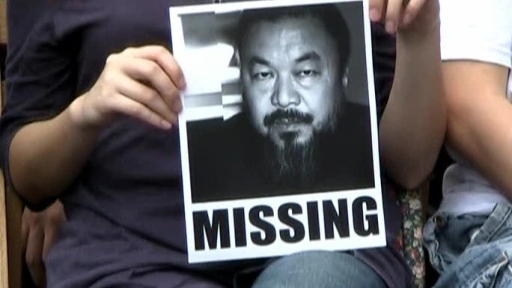
This past week the news concerning Ai Weiwei’s continued imprisonment by Chinese authorities took on a very disturbing tone. With his detention moving beyond the critical thirty day mark—a maximum time for similar detentions of this kind-- Ai’s 78 year old mother Gao Ying spoke out in an interview with CBC news expressing her fears and mounting concerns about the state of her son’s mental and physical condition. With allegations of torture and fear that the artist may be forced towards some measure of confession, the entire incident has reached a new and urgent impasse. When asked why her son was targeted, Ying responded:
"I think in reality, he was taken because he was protecting the rights of ordinary citizens and speaking for them. With many things that happened, he just had to speak out-he said a lot, criticizing the government for not abiding by the rule of law in dealing with certain incidents. He wanted to speak for ordinary citizens, he wanted (people) to be responsible for lives, and he wanted to find a solution so that this would not happen in the future. His goal was not to go against his country. He wants this country to develop on a healthy path. I think because of this, he offended people in power and they hate him, so now they are looking for an opportunity to take him down-this what I believe."
(image source: Reuters)
Art institutions around the world have continued to dedicate special shows in the artist’s honour. Most notably this week, the sculptor Anish Kapoor dedicated his largest art work ever—an installation sculpture set to open at the Paris Monumenta exhibition called Leviathan—to the missing artist. Several incidents of art activism and consciousness raising have also taken place via street art interventions, and the high profile action of British protester Charlotte Eaton, who walked naked across the Turbine Hall sunflower exhibit with the words “thank you Ai Weiwei” and “freedom” painted on her body, kept the news in the mainstream press. A wonderful set of YouTube videos even made the rounds of art students at the Tate who collectively jumped the barrier to play in the seeds that had been deemed too unsafe to disturb (see video below). U.S. Secretary of State Hilary Clinton even took the bold step (finally) to publicly question the Beijing authority’s human rights record, referring directly to the Ai Weiwei detention.
But what really caught my attention amidst the continued discussion and call for protest was an eloquently written op-ed piece by author Salman Rushdie that has been circulating widely after its intitial publication in The Telegraph a few weeks back. In the essay, Rushdie—a man who became the flashpoint for similar calls to protest following the death threats made against him by the leader of Iran upon the publication of The Satanic Verses in 1988—positions Ai Weiwei’s current situation in a much wider context, reminding all of us of the stakes involved:
"The lives of artists are more fragile than their creations. The poet Ovid was exiled by Augustus Caesar to a little hell-hole on the Black Sea called Tomis. He spent the rest of his days begging to be allowed to return to Rome. So Ovid’s life was blighted. But the poetry of Ovid has outlasted the Roman Empire. The poet Mandelstam was murdered by Stalin’s executioners, but the poetry of Mandelstam has outlived the Soviet Union. The poet Lorca was killed by the thugs of Spain’s Generalissimo Franco, but the poetry of Lorca has outlived Franco’s tyrannical regime. We can perhaps bet on art to win over tyrants. It is the world’s artists, particularly those courageous enough to stand up against authoritarianism, for whom we need to be concerned, and for whose safety we must fight….
When artists venture into politics the risks to reputation and integrity are ever present. But outside the free world, where criticism of power is at best difficult and at worst all but impossible, such figures as Ai Weiwei and his colleagues are often the only ones with the courage to speak the truth against the lies of tyrants. We needed the samizdat truth-tellers to reveal the ugliness of the USSR. Today China’s government has become the world’s biggest threat to freedom of speech, so we need Ai Weiwei, Liao Yiwu and Liu Xiaobo."
Official movie poster for Herzog's latest film project
Werner Herzog is one of those rare contemporary individuals who can claim the title "Renaissance Man" without much dispute. A director, producer, actor, screenwriter, opera director, and even reluctant film theorist—he co-authored Herzog on Herzog, a book that successfully challenges many of the theories associated with his films while revealing his own unique perspective—Herzog is believed by many critics to be among the most important filmmakers alive today.
Herzog calls the Chauvet cave a "proto-cinematic" experience.
Perhaps not surprisingly then, Herzog’s latest film project The Cave of Forgotten Dreams pays homage to what he calls the "proto-cinematic" experience. In his estimation, this can be found in cave paintings—images of movement, dynamic space, and the tension between memory and fantasy. Set in the famous Chauvet cave in the south of France first discovered in 1994, Herzog's documentary provides viewers with a rare chance to explore one of the most important Western cultural treasures on the planet. This is not an understatement since cave painting represents the literal place where art history constructs its starting point (“cave painting to the Renaissance” is the shorthand description for part one of most typical art history survey courses) and for good or for ill, French caves have come to be known as the richest prehistoric art sites in the world.
Herzog in 3D glasses-- a sight to behold!
(image source: filmjunk.com)
For Herzog, however, it was not enough to meet the already serious challenge of getting the French government to agree to his filming of the caves (which he did). He went to the next level and made the controversial decision to shoot the entire film in 3D. In an insightful interview with Archaeology, the official academic journal of the Archeological Institute of America, Herzog describes his decision to enhance the viewer’s experience of the film through the immersive technique of 3D:
"3-D was imperative because I initially thought there were flat walls and paintings in the cave. But there are no flat areas. The drama of the bulges and niches was actually used by the artists. They did it with phenomenal skill, with great artistic skill, and there was something expressive about it, a drama of rock transformed and utilized, in the drama of paintings. This is why it was imperative to shoot in 3-D…"
Herzog goes on to elaborate aspects of his filmic vision for the documentary in this other revealing interview with Empire Magazine (see clip below):
Reviews of the film have been mixed—the subject of beauty and spirituality associated with the “birth of art” (and in France) suggested in this film will always disturb any number of critics. But the consensus remains that Herzog has provided “a gift” to audiences who will likely never see the caves with their own eyes as it remains closed to the public. The Cave of Forgotten Dreams premiered at the Toronto International Film Festival last year and plans are already in place to distribute the film in North America through IFC Films and the History Channel. For Vancouverites, the rare opportunity to preview the film on the big screen in 3D before wider release has been made possible by DOXA organizers, and the film has been ceremoniously chosen as the closing night film. As of this post’s publication, the Saturday night screening has been sold out for advance tickets and a second screening has been added for Sunday morning.
Cave of Forgotten Dreams will be screening at DOXA on Saturday, May 14th at 7:00pm and Sunday May 15th at 11:00 am at the Park Theatre.