Location| Paris: Meet Field School Blogger Courtney Burt

Meet Courtney! Having some fun with the Eiffel tower optics
around the city. 
Tell us a little bit about yourself—school, background, major, reasons for taking this trip, anything else interesting you want to share.

parisyay-17
Courtney discovering the bottom end of the famous Louvre pyramid
in the underground entrance to the museum.
(photo courtesy: Kyubo Yun)
Hey, my name is Courtney Burt and I am a fourth year Bachelor of Fine Arts student studying at Kwantlen Polytechnic University. It was in kindergarten when I won my first award after a drawing I had done at school was submitted to a contest juried in China. I continued to submit artworks to this contest throughout my primary school years never failing to achieve some sort of acknowledgement. This was where my passion and love for creating started. I never really knew exactly what it was that I wanted to do or what I wanted to be-- growing up I focused my time on playing sports and taking art classes, none of which I saw offering a career path. However, my doubts have subsided and doing what I love has lead me to where I am today in my art practice and study. I chose to be a part of this Paris trip because as a traveler I believe that there is a different, a more substantial, unique experience offered within each country. I am learning and experiencing the culture, city and way of life in a way that just being a tourist does not provide. This is my second time traveling with school, my first trip being a semester abroad in Auckland, New Zealand, studying and practicing art at UNITEC. Traveling with school and an open purpose of education is how I see myself continuing my travels for the future, fulfilling my life goal of traveling the world. 
parisblog-9
Taking a break at the gardens. From left to right: Rosaura, Courtney, Alison, Tessa.
(photo courtesy: Kyubo Yun)
What has met or exceeded your expectations or surprised you about Paris so far?
The city of Paris has not shocked me as much as I had predicted. The city itself, as beautiful as it is, does look like every photo or image I have ever seen of it, which I find disappointing. However, what I have found to be most amazing is the city’s transportation system. There is this underground world that is dirty and impressive beyond anything that I have ever experienced. This is my first experience traveling on public transit underground and it is both invasive and congruous at the same time. An intricate maze of metro lines form a busy world beneath a world. You can go from one end of the city to the other without even seeing the city. As sad as it is to travel through the city and not even ever see any of it, the metro system has impressed me substantially, especially being a foreigner and not speaking the language, the metro has provided me with an easy direct way of getting from place to place. I have had many experiences that I will never forget on and getting to the metro. I do want to also bring light to, not only the convenience of the underground, but to the situation that travelers are warned about, what the cities of Europe are known for, pick pocketing. So far in my metro traveling I have witnessed two situations where a young girl has pick pocketed someone and either been caught and taken down by authorities or has accidentally failed and dropped the wallet being stolen (thankfully recovered by the owner). It is one thing to hear the stories about the metro systems in these countries but to actually have your personal space become a stranger’s personal space is the most shocking aspect of the way of life in Paris. If I could describe Paris in one word it would be Invasive.
Paris at night along the Seine.
Give us some insight into your assigned art work from the Musee d’ Orsay. After seeing the work in person, what struck you most about it and/or how did the art work’s form, content, and context shift for you when seeing it?
Gustave Courbet, The Spring (1868)
For this semester and trip I was assigned the art work The Spring by Courbet. I had to search more than others to find my painting in the Orsay as it was located in a room behind a room. This was the first indication that there was a lot more to the context of my painting then I expected, not to mention it was also in the same room as his painting The Origin of the World. Despite the illuminating nature of that painting I was too excited to see my own painting to even notice any others. It was an indescribable moment seeing my painting in real life. In order to fully experience it formally and contextually I grabbed a seat in the middle of the room on the floor and became a part of the entire situation or conversation. My understanding of the images sexual content before the trip was re-emphasized while being in that room because of the other paintings it was placed in presence with. Formally, there is much more of a painterly quality and the colours are brighter, fleshier, and pinker within the nude’s skin. What stood out to me the most is the black halo surrounding the females figure. I am still wondering to myself if this is an intentional quality painted by Courbet and if so what he is saying. This aspect of playing with flatness and depth is also very apparent in the entire painting. I could feel the struggle between them as my eye moved in and out of the image. The top left corner, in the text book images, appears with a lot of depth into a meadow beyond the forest trees, however; in person this area of the painting is completely flat. This creates a fighting struggle with the bottom of the painting, where the left leg of the female penetrates the water, is painted with a realistic reflection that creates realistic depth and entrance for the audience. Seeing the painting in person allows for so much more interpretation and rethinking many aspects of its context.

Today’s activity ended up being at the Catacombs for you. What were your impressions?  What will you take away of the experience?  What, if any are the memorable moments for you?
Miles of skulls and human bones on display at the Catacombs of Paris.
Today’s activity actually became a mish mash of galleries being closed so as an alternative I went to see the Catacombs. What used to be Paris’s stone mines have been renovated and are now known as The Catacombs which is located south of the former city gate, the “Barrière d’ Enfer”. Since 1874 this ossuary has held the remains of about six million people. Today we visited this tunnel that twists and turns underneath one of Paris’s districts. I instantly thought of the relationship between these tunnels and the metro, underground worlds. I just think that it’s interesting how Paris had to resort to life underground, during the renovation, to make room for the ordered structure above ground. After descending down a narrow spiral stone stairwell of nineteen meters we reached the chilling darkness and silence that resides in the long narrow tunnels. Beyond the halls I came upon an opening with the inscription "Arrêt! C’est ici l’empire da la Mort, meaning Halt!" "This is the Empire of the Dead, above the arch way." This was the entrance to the walls and caverns that hold the carefully arranged bones, skulls and femurs. During my experience underground I felt a bit sad, sad that these people were buried once and then dug up from their graves within the city and moved underground and also sad that it was an attraction. I felt though I was invading their spirits or burial grounds. I will make one last connection to these underground Catacombs and the city of Paris, the way the bones were lined up and meticulously placed against the walls in rows and rows reminds me of Haussmannization in the city, rows and rows of buildings all perfectly aligned, not one out of place. Not one bone or skull, not one human being out of place. 
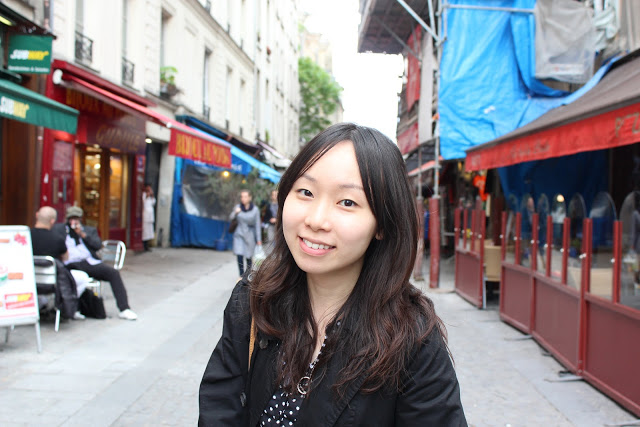
Location | Paris: Meet Field School Blogger Wei Heng Liu

Meet Wei!
Tell us a little bit about yourself—school, background, major, reasons for taking this trip, anything else interesting you want to share.

paristwo
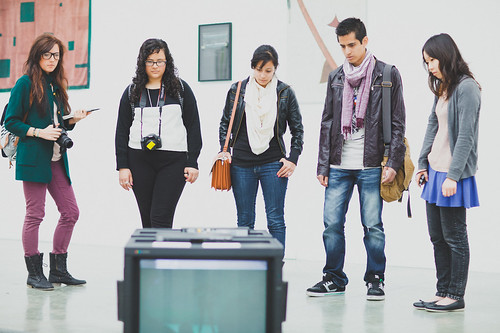
Looking at a video installation at the Palais De Tokyo,
from left to right: Courtney, Rosaura, Erin, Andres and Wei.
(Photo courtesy: Kyubo Yun)
Hi everyone, I am Wei Heng. I am a 4th year Bachelor of Fine Arts student at Kwantlen Polytechnic University. Painting is my favorite medium to use in my art works, but I often question myself about doing paintings because it is challenging to come up with a new image which has not been done by others. The innovative invention in technology also makes traditional art mediums seem less effective and powerful. Therefore, I am taking both history and studio classes in Paris Fine Arts Field School to see how other contemporary artists express their ideas in their art works, and to experience a different culture outside of Canada. I am excited to explore Paris where I have never been to before, and I believe this trip will give me lots of inspiration for my future art practices. Plus, I am finishing my last two courses at Paris to complete my degree. My time at Kwantlen will end perfectly with full of wonderful memories at Paris with my instructors and classmates.


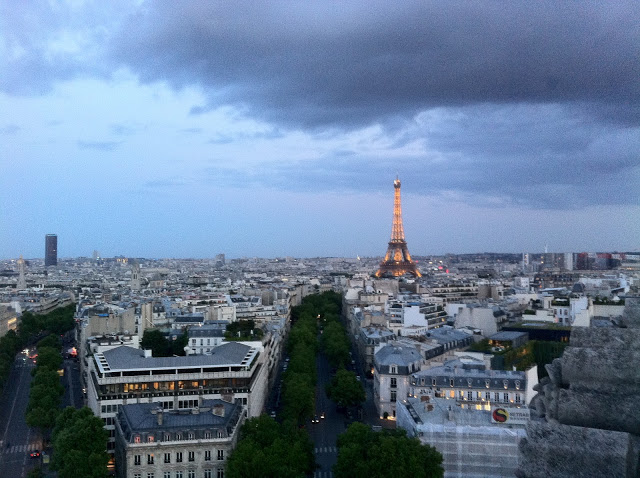
Seeing the buildings of Paris from atop the Arc de Triomohe helps set the city plan in perspective.
What has met or exceeded your expectations or surprised you about Paris so far?

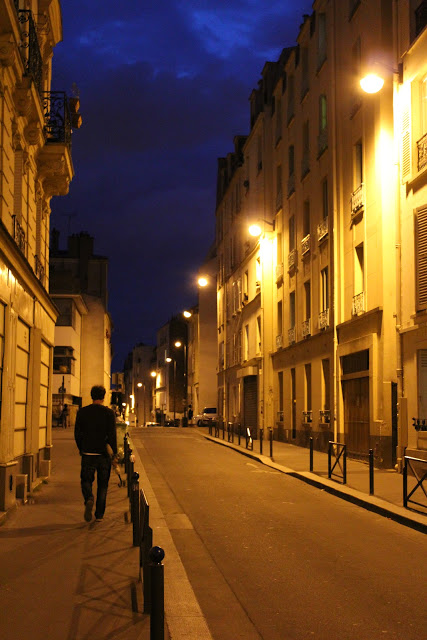
The street leading up to our hotel in the 19th District of Paris.
I am surprised by the architecture in Paris. There are many beautiful antique buildings in the city. They create a romantic atmosphere. Their apartment buildings have one big wooden entrance door which has a security panel beside it, and there are tiny balconies and spiral pattered railings on each floor. Some of the first floor is used as business space, such as stores, restaurants, and cafes. I think it is fascinating to see how those antique buildings function as part of the modern city. Moreover, I was surprised by how the buildings are organized when I got to see the view of Paris at the top of the Arc de Triomphe. Except for the humongous Eiffel Tower, all the buildings have the similar height and aligned to the wide boulevards. I also saw some modern skyscrapers at a far distance, and the view of sunset was amazingly beautiful.

Give us some insight into your assigned art work from the Musee d’ Orsay. After seeing the work in person, what struck you most about it and/or how did the art work’s form, content, and context shift for you when seeing it?

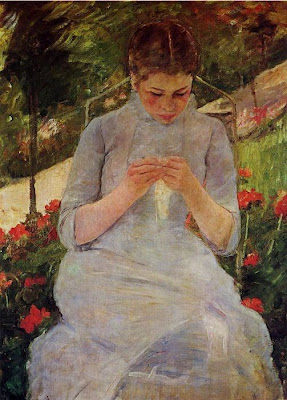
Mary Cassatt, Girl in the Garden (1880-82)
My assigned artwork in the Orsay is Mary Cassatt's Girl in the Garden (1880-1882). Cassatt, an American painter, focuses on the subject matter, women, from a female point of view. When I found my painting located at a corner in the top floor, there was a woman standing in front of the painting and copying it in oil painting with her easel and sitting on a stool. I felt quite angry because she blocked my view, but at the same time, I was happy to see there was another person who really appreciated this painting. I was disappointed about the location of the painting because I think this very important painting deserves a bigger space for display. It was too closed to other paintings. I think the colors and brush strokes that Cassatt achieved struck me the most. The figure is luminous, especially her glossy dress. I saw details of her dress which had various colors and tones in layers, such as green, purple, blue, and white. I actually started to appreciate the quick sketchy background of the painting because it made an interesting contrast with the vivid depiction of the figure. I felt the painting become more lively, colorful and three dimensional when I saw it in person.

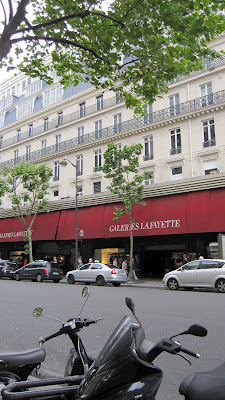
Today’s activity was at the Galeries LaFayette Department Store. What were your impressions?  What will you take away of the experience?  What, if any are the memorable moments for you?
Exterior shot of Galeries LaFayette, a place
that drew many different reactions from students
Today's activity was at the Galeries Lafayette to observe the commodity culture in Paris. When I entered the department store, I felt excited to see the luxuries on the display counter. They looked attractive and glamourous. The lighting in each store focused on the items, and the space was comfortable to walk through. Everything has its own brand name. I also saw an expensive dress which costs 7,0000 Euros. When I saw people lining up to buy those luxuries, I wanted to question the true value and the necessity of those luxuries in our daily life. Comparing Lafayette with other vintage stores, which are small and full of unorganized things, I felt I was free to search what I want in the vintage stores, but in Lafayette, I was constantly aware of other customers' and staff's gazes. I was afraid and anxious to touch the items on the shelves. The experience in Lafayette was very interesting and unique.

Location | Paris: Meet Field School Blogger Kenny Chui

Meet Kenny!
Tell us a little bit about yourself—school, background, major, reasons for taking this trip, anything else interesting you want to share.

Hi, I am Kenny Chui. I have just graduated from the Bachelor of Fine Arts program at Kwantlen Polytechnic University in May, 2012. There's no better way to finish my degree than to go to Paris, the city with such a rich art history. I have seen the famous paintings through textbooks or online, but never in person. In the first few years in Kwantlen, painting was my favourite medium. However, due to various reasons, I started focusing more on making digital art rather than painting in the past two years. Even though I mainly do digital art, I have always wanted to paint again. There is something about painting that makes it so unique, whether it is the story behind the painting, the scale, the colors, or the applicant of paint. It amazes me how “random” strokes on a canvas can become recognizable objects in a painting. That is one of the main reasons why I wanted to go; I wanted to study the brushstrokes on these famous paintings that I have studied.

paristwo-12
Having fun at the Palais De Tokyo inside an art installation.
From left to right: Rosaura, Charis, Wei, Andres, Amanda, and of course Kenny.
What has met or exceeded your expectations or surprised you about Paris so far?

There is an elementary school across of our hotel; therefore, there are always kids and teenagers  playing on the road between the two buildings. Every morning, one of the first things I do is to open the window and listen to the kids play. I don't understand French, but it is the sound of joy that makes me enjoy it so much. Back in Canada, even though I live near an elementary school, I don't see or hear little kids play out in public on a daily basis like this. Although the kids and teenagers are quite loud, as I can still hear them with my window closed, the sounds of the ball bouncing, kids running, screaming and laughing make this place so much warmer to live in. Another thing I noticed is that the people here do not rely on mobile devices as much as the people in Vancouver. In Vancouver, everyone is constantly checking their cellphones or tablets, whether they are on the train, at a restaurant, waiting in line, etc. They constantly need to be distracted or entertained. However, I notice that people here in Paris do not rely on their mobile devices as much. I am pleasantly surprised to see that the people here are not constantly staring at a digital screen, or typing on a mobile device.
Children playing outside Field School hotel in Paris, a truly delightful sound.
Give us some insight into your assigned art work from the Muse d’ Orsay. After seeing the work in person, what struck you most about it and/or how did the art work’s form, content, and context shift for you when seeing it?

Georges Seurat, The Circus 
When I finally saw Georges Seurat's The Circus in person, my first reaction was that the painting is a lot larger than I imagined. What really surprised me was the position of the painting in the room and how much attention it gets. The painting is located in one of the smaller rooms, but it was definitely the center of attention. It is the first painting the viewer sees when entering the room. The paintings next to it are all figureless and a lot smaller. Without a doubt, the Orsay wanted the Circus to be the main attraction of that room. Circus was done in pointillism, Seurat used oval-like strokes to create this painting. When I entered the room and approached this painting, I did not notice the strokes at first; but as I walk closer to it, it felt as if the painting was breaking apart into little strokes right in front of my eyes. I knew that Seurat painted the blue frame on the painting, but I did not know that he used pointillism on the frame as well. It isn't just one shade of blue as I originally thought, it is actually darker near the center and lighter towards the edge. I was fascinated at the color choice made for the strokes. Seurat did not use black paint at all in the Circus. He used a combination of colors to produce the illusion of the color black. As for the white areas, Seurat actually dotted white strokes on the white canvas, even though they are nearly impossible to notice. Finally, I was surprised that the Orsay put the sketch of Circus in the same room with the actual work as well. I was able to learn more about the Circus from studying the sketch. Seurat wanted to paint the blue frame since the beginning. I was able to tell what was important to Seurat, his sketch focuses more on the foreground. He only placed minimal amount of the audience in the background just to figure out the composition; otherwise, he left the background quite empty. The only thing I question about this work is the extra golden frame that was used. I felt that the extra frame is not necessary. Seurat already added the blue frame on Circus, which is probably a commentary on the idea of painting already, an extra frame contradicts it in my opinion.
           
Today’s activity was at the Galeries Lafayette. What were your impressions? What will you take away of the experience?  What, if any are the memorable moments for you?

Galeries Lafayette is one of the oldest department stores of Paris
and the students were asked to think about how the French
invented the modern day shopping experience.
Today, we went to the Galeries Lafayette. It is a seven stories tall department store and each floor is dedicated to one or two specific category. All the different brands are located on the same floor, if I want a specific kind of item, I don't need to walk in and out of different shops to find it. Also, there are restaurants, cafes and salon inside the building. The luxury of a department store is that you can do and get everything you want yet you do not need to step out of it. The first few floors were all selling female products, such as perfumes, bags, and other female clothes. The Galeries Lafayette is definitely targeting female shoppers. One of the first things I noticed about the shoppers was that there are a lot more tourists in Galeries Lafayette. Interestingly, the shoppers here do a lot more “eyeing” and less touching. They walk around the items and just look at them, they do not really interact with the items as much as I thought. It seems to me that people are supposed to behave a certain way inside the department store. The department store is very well organized. The use of vibrant colors and well lit products attracts attention immediately. Also with the large-scale advertisements on the walls and columns, everything is so glamourous. However, I did not really enjoy my time there at Galeries Lafayette. One of the reasons is that most of the products are made for females. The other reason for that is because I grew up in Hong Kong, where department stores are popular there too. When I was in Galeries Lafayette, I felt like I have been in it many times before. It just did not excite me as much as the little vintage or second hand shops that we went to afterwards. My classmates and I were digging through stuff looking for little treasures that did not necessarily have to be a specific brand. We were a lot happier with our findings at the little shops than at the department store.
Students enjoyed shopping the many vintage shops dotting the city far more than the large department stores.

Location | Paris: Meet Field School Blogger Shelly Leroux

Meet Shelly! Sketching in a Parisian rose garden.

Tell us a little bit about yourself—school, background, major, reasons for taking this trip, anything else interesting you want to share.

My name is Shelly Leroux and I am a Fine Arts student who works in many mediums, but my main focus is on conceptual work dealing with social and environmental issues. I am super excited about being a part of the Paris Fine Arts Field Trip because I am currently graduating from Kwantlen University and thought a trip to Paris would be the best way to celebrate my dedication to earning a degree. When I was a child, I lived in Europe for four years with my family, and I had so many great memories and experiences, so coming back to Europe was a really special opportunity. I am mostly looking forward to attending Documenta because I have never been to an international art celebration before, and I am extremely curious of how Canadian artists will compare on an international level. I have been involved with the Surreyalists Collective for the last two years and I invite all of you to our ‘Altered’ Show which opens at 7pm, July 6, at Chapel Arts in Vancouver, BC.
Tiny storefronts with painted art works dot the side streets around Paris.
What has met or exceeded your expectations or surprised you about Paris so far?

There are many things that surprised me about Paris. The first thing that surprised me would be the low cost of food and alcohol. The first night we were here, our group purchased bottles of wine that ranged from $1 -$6, which was a very pleasant surprise! The second thing about Paris that I found surprising is the tiny storefronts that exist along little winding roads.  Some of us discovered a little area with commercial art galleries that were all along a small strip of shops that would be comparable to the Granville street shops, only that they are smaller!
paristwo-5
Shelly photographing art works at the Palais de Tokyo
(Photo courtesy: Kyubo Yun-- spot him in the cubed mirror!)
Give us some insight into your assigned art work from the Muse d’ Orsay. After seeing the work in person, what struck you most about it and/or how did the art work’s form, content, and context shift for you when seeing it?

Edouard Manet, The Balcony (1868)
The assigned painting I received was Edouard Manet’s The Balcony (1868). This painting reflects the modernity and changes happening to Parisians during this time. Each person is fashionably modern and appears to be looking out and watching the spectacle of Paris. Even the dog is so distracted by the commotion that he neglects his ball. Manet used his friends (including Berthe Morisot) and fabricated a balcony scene using a railing and shutters in his studio space. What I found significant in this painting is that the male flaneur is holding his cigarette. This is essential because Paris was experiencing a booming industry in cigarettes during this time. My immediate response to seeing this painting in the Orsay Museum would be that it is larger than I had imagined. This painting is on the right hand side of the room, and it is situated in a way so that it looks centered in a room full of Manet’s paintings. The Balcony is situated between two other Manet paintings, Grosse Mer A Etretat is on the left side, and La Pie on the right side. During my research of my assigned painting, I used Google Art to ensure that I saw everything I needed to create my analysis. After seeing the painting in life, I would declare that Google Art was incredibly accurate and allowed me to spot every detail on the canvas, including the boy in the dark apartment, and the details of the interior space that is not viewable in textbooks.

Today’s activity was at the Palace of Versailles. What were your impressions?  What will you take away of the experience?  What, if any are the memorable moments for you?

The masses descend on Versailles Palace!
Students Shannon, Kyubo and Rhea sketching and drawing
a crowd in in the Mirror room at Versailles Palace
Today’s activity was the Chateau de Versailles. It was an overly embellished castle with every luxury imaginable. It would reflect a present day Donald Trump home dashing with mirrors, chandeliers, and lots of gold.  The special configuration of Versailles and the movement of the people through the palace contributed to the creation of ‘tourist rage’. A social phenomenon that makes tourists act aggressively. While our group waited in line another group merged and declined to go to the back, which caused frenzy, a spectacle, and an awkward wait to the entrance. This is something that is comparable to the spectacle and the flaneur that French bourgeois experienced during their times of leisure.  During our long wait in an insanely long and winding line-up, I imagined how the bourgeois would act while waiting in line for the spectacle at the morgue, or wax museum. I wondered what kinds of rages occur in a line-up full of various classes merging together, standing closely, and occasionally bumping into one another.

Location | Paris: Meet Field School Blogger Jessica Hood


Meet Jessica!
Tell us a little bit about yourself—school, background, major, reasons for taking this trip, anything else interesting you want to share.

At Jessica's much beloved Opera house. From left to right: Andres, Yvonne,
Jessica, Rosaura, Rhea, Courtney, Tessa, Kyubo, Amanda
(Photo courtesy: Dorothy Barenscott)
My name is Jessica Hood and I am currently a third year theatre performance student at Simon Fraser University. The reason I am a theatre major and the reason why I am on this trip to Paris both stem from the same story. When I was twelve years old, my father took me and my family to the San Francisco Orpheum to watch The Phantom of the Opera. I was immediately engrossed. I went home that night and played the entire original recording over and over in my bedroom so that I could learn the songs. I knew from that point on I would be a performer and I would go to Paris. Because the story still fascinated me in high school (and even today), I chose to research The Phantom of the Opera by reading the novel of the same name by Gaston Leroux along with comparing historical events to the fictionalized versions in the book. After reading about the Opéra Garnier and its construction, I knew I had to see it in person. Now, I am making these dreams come true. I am a performer, I am in Paris, and I have seen, and touched the Opera House. 

What has met or exceeded your expectations or surprised you about Paris so far?

Paris is a beautiful city and it is such a wonder to actually be here. I still have moments where I have to stop and remind myself that I am here. I have been most surprised by the efficiency and simplicity of the metro. Getting around this city has not been difficult and I am doing pretty well, in my opinion. Some of the stations can actually be quite pretty too when they're not filthy with rat infestation or urine. I am also surprised at the cost of food. I was expecting it to be very expensive, but luckily getting groceries has been more reasonably priced than back home in Vancouver. Sure, eating at restaurants can be pricey, but that's not an every meal kind of activity. Plus, when I have gone to restaurants to eat, I have managed to find decent prices and ways to share entrees so as not to be paying as much. I expected the city to be dirty, filled with cigarette smoke and other smells, and crowded in the tourist areas. These are all true, but the amount of each still surprised me nonetheless. I did not expect, however, for there to be so little green space or for the existing green spaces to be so manicured that people are not allowed to walk on the grass. Despite these oddities, I am very much enjoying my time here and the chance to discover this city. 
pariswow
Jessica, Shannon and Yvonne mastering the Metro system in Paris
(Photo courtesy: Kyubo Yun)
Give us some insight into your assigned art work from the Muse d’ Orsay. After seeing the work in person, what struck you most about it and/or how did the art work’s form, content, and context shift for you when seeing it?

Honore Daumier, The Laundress (1863)
After waiting in line for about a half hour, we finally made it to the Musée d'Orsay. Dorothy started leading us to "something we had to see" and on the way I caught the first glimpse of my assigned painting - The Laundress by Honoré Daumier (1863). I jumped and squealed and pointed from excitement. After going through many of the exhibits, I decided to take a better look at the painting. It was located in the first room dedicated to Daumier works on the main floor. There were three caricatures, twenty caricature-like sculptures, and about ten of his paintings. The second was mine. I was so happy that I could see a lot more of the colours because the slide photos were so dark that I had no idea they were even there. Despite the presence of colour, I noticed it was not a very detailed painting. The faces of the woman and her child are blurry and the background is very geometric. It made me think that he was depicting an example of the masses, one pair of nonspecific people to represent all the others like them. I also wondered if the unevenness of the buildings in the background signified the demolition of old Paris into the new Haussmannized ones. It was nice to see the brushstrokes in person. His are even and vertical. I also enjoyed comparing his painted work to that of his sculptures and caricatures. I started watching other people's reactions to his work as they entered. Most seemed more excited by the sculptures, since they were funny. Others seemed completely uninterested or maybe they were just tired. I think it was probably because they were excited to see the more well-known and larger pieces on display. For me, and those who know his work, it was so interesting to see this work I had studied and that was at the very start of the Impressionist movement. 

View of Versailles gardens from inside Palace
Today’s activity was at the Palace of Versailles. What were your impressions?  What will you take away of the experience?  What, if any are the memorable moments for you?

We went to Versailles today. The palace is huge and its golden gates shine in the distance. I had always assumed that the entrance to Versailles was preceded by the gardens, so I was surprised to see gates and a cobblestone courtyard. I also did not expect it to be surrounded by a little city, but I suppose that erupted because of tourism. Right as we entered the courtyard, we had to stand in a massive line to get into the palace. Forty minutes later, we were inside. It was packed with crowds of people. With some sections closed off and the rest open through narrow doors and hallways, it was like we were being herded through the rooms. I was barely even looking at the decorations while darting through people and being pushed by others. I was so frustrated that I nearly ran through the rest just so I could get outside to some open space. Seeing one room was enough to know what the rest looked like. The Hall of Mirrors was interesting because there were so many panes, which was so expensive at the time they were purchased, and the gardens were visible from the windows. More interesting than that was seeing graffiti on the mirrors. I saw one dated at 1949. It was refreshing to see how these people had rebelled against the symbol of opulence that the Versailles palace represents by carving their names into those mirrors. I only saw a part of the gardens because the entrance was an extra seven euros that I did not want to pay. I'm sure I would have enjoyed them if it had been included in the ticket price or if the weather had been nicer. I'm fairly certain that this monument is my least favourite activity of the trip because it was, in my opinion, over-rated and extremely over-crowded.
One of the many chandeliers at the Palace viewed from a more abstract position