• Fall 2025
  • Blog
  • Resources
  • Field School
  • Students
  • Feedly
  • About
Menu

Avant-Guardian Musings

  • Fall 2025
  • Blog
  • Resources
  • Field School
  • Students
  • Feedly
  • About
large monogram_2018-02-01_22-31-07.v1 (1).png
“Art is an outlet toward regions which are not ruled by time and space”
— Marcel Duchamp

Avant-Guardian Musings is a curated space of ideas and information, resources, reviews and readings for undergraduate and graduate students studying modern and contemporary art history and visual art theory, film and photography studies, and the expanding field of visual culture and screen studies. For students currently enrolled in my courses or the field school, the blog and associated social media links also serve as a place of reflection and an extension of the ideas and visual material raised in lecture and seminar discussion.

Blog RSS

Screenshot 2018-02-05 20.56.45.png
Blog
KPU FINE ARTS PARIS + VENICE BIENNALE FIELD SCHOOL (MAY/JUNE 2026)
about 2 months ago
"No Fun City" Vancouver: Exploring Emotions of Detachment in Palermo, Sicily at AISU
about 4 months ago
Making Sense of Art in the Age of Machine Learning—A Suggested Reading List
about 5 months ago
From the Archives | How (And Why) To Take Excellent Lecture Notes
about a year ago
Weekly Musings + Round Up... And A Few More Things
about 2 years ago

Screenshot 2018-02-05 20.56.51.png
As we start the week in a storm of activity, new beginnings, and global uncertainty, I am grounded in my word for 2026– INTENTIONAL 🩶— “done with purpose, willingness, deliberation, and consciousness.” I see this word represe
As we start the week in a storm of activity, new beginnings, and global uncertainty, I am grounded in my word for 2026– INTENTIONAL 🩶— “done with purpose, willingness, deliberation, and consciousness.” I see this word represented in the symbol of the heart, and for this reason and many others both personal and professional, I will be bringing this much needed energy to my year. The power of a yearly word is transformative. I started in 2019 and my words have guided and carried me through some important moments and life decisions. If you haven’t already, give it a try, but remember to choose very wisely ☺️ “Radiate” 2025 ✨ “Maintain” 2024 💪🏻 “Refine“ 2023 🙌🏻 “Acta non verba” 2022 🤐 “Audacious” 2021 💃🏼 “Fearless” 2020 😛 “Unapologetic” 2019 💅🏻 #happynewyear #wordoftheyear #intentional #monicavinader @monicavinader
Polar bear ride! 🐻‍❄️🏍️💨🏍️ First motorcycle outing of 2026 in the books. A balmy 4C 🥶We love you Vancouver— good to be home 💙😊Wishing everyone a very Happy New Year! 🥳 
.
.
.
#happynewyear #vancouver #motorcycle #motorcyclesofinstag
Polar bear ride! 🐻‍❄️🏍️💨🏍️ First motorcycle outing of 2026 in the books. A balmy 4C 🥶We love you Vancouver— good to be home 💙😊Wishing everyone a very Happy New Year! 🥳 . . . #happynewyear #vancouver #motorcycle #motorcyclesofinstagram #motocouple #husqvarna #vitpilen401 #svartpilen401 #motogirl #motogirls
2025... where did it go?! 😂 Like a ray of light, I was very much guided by my chosen word of the year “radiate”— to shine and send out beams of energy— and this allowed for a great deal of adventure, new experiences, ideas an
2025... where did it go?! 😂 Like a ray of light, I was very much guided by my chosen word of the year “radiate”— to shine and send out beams of energy— and this allowed for a great deal of adventure, new experiences, ideas and people and opportunities to flow back into my life. Above all else, I found myself very much on the move all year! Travel took me from New York to Lausanne, Paris to Seoul, and Palermo to Maui, while my motorcycling stayed more on the road and less on the track as Brian and I balanced our time, energy, and commitments. But as always, we found every spare moment to prioritize this shared passion and we hope to find a way back to the track in 2026. Professionally, the year was... A LOT... and highlighted by many new research partnerships, conferences, workshops, writing projects, some failed plans and sharp detours, but also the planting of new seeds for future ventures. In the classroom, AI brought many new challenges and opportunities to rethink the purpose of my teaching and courses, but overall I was inspired and at times surprised by what my students were able to accomplish with the new assessment models I put into place. All of this technological change remains very much a work in progress for academics, and I prefer to remain optimistic that the artists I work with will find a way to maintain their voice and vision in it all. The historian in me knows this to be true. Personally, I connected more to my heart and intuition in 2025, listening to that inner voice to guide many key decisions. Brian and I also kept up a decent health and fitness regime that had us energized and aiming for consistency to match our midlife pace. Use it or lose it is a reality in your 50s!!! Sending wishes of peace and love and a very Happy New Year to all! May your 2026 be filled with fun, awe, purpose, and good health and much happiness. Remember to be good to yourself so you can be good to others. I’m still working carefully on my 2026 word… but whatever it is, I know it will be the right one ❤️ . . . #happynewyear #yearinreview2025 #wordoftheyear #motorcyclelife #arthistorianlife
Resting, dreaming, and plotting the year ahead 💙✨😘
.
.
.
#maui #hawaii #vacationmode #newyear #planning
Resting, dreaming, and plotting the year ahead 💙✨😘 . . . #maui #hawaii #vacationmode #newyear #planning
Riding and chasing sunsets across Maui ✨💙🌺🌴🧡
.
.
.
#maui #hawaii #motorcycle #motorcyclesofinstagram #motogirl #vacationmode #sunsets
Riding and chasing sunsets across Maui ✨💙🌺🌴🧡 . . . #maui #hawaii #motorcycle #motorcyclesofinstagram #motogirl #vacationmode #sunsets

Screenshot 2018-02-05 20.57.02.png
  • November 2025 (1)
  • September 2025 (1)
  • August 2025 (1)
  • September 2024 (1)
  • February 2023 (1)
  • January 2023 (3)
  • August 2022 (1)
  • March 2022 (1)
  • February 2022 (3)
  • January 2022 (4)
  • November 2021 (2)
  • October 2021 (3)
  • September 2021 (3)
  • July 2021 (2)
  • June 2021 (1)
  • May 2021 (3)
  • April 2021 (3)
  • March 2021 (3)
  • February 2021 (4)
  • January 2021 (5)
  • December 2020 (3)
  • November 2020 (6)
  • October 2020 (4)
  • September 2020 (1)
  • July 2020 (1)
  • June 2020 (4)
  • May 2020 (9)
  • April 2020 (5)
  • December 2019 (2)
  • November 2019 (5)
  • October 2019 (3)
  • September 2019 (1)
  • July 2019 (6)
  • June 2019 (19)
  • April 2019 (2)
  • March 2019 (5)
  • September 2018 (2)
  • July 2018 (1)
  • June 2018 (4)
  • May 2018 (2)
  • April 2018 (5)
  • March 2018 (5)
  • February 2018 (8)
  • January 2018 (3)
  • December 2017 (4)
  • November 2017 (5)
  • October 2017 (7)
  • September 2017 (3)
  • July 2017 (6)
  • June 2017 (15)
  • April 2017 (2)
  • March 2017 (3)
  • February 2017 (1)
  • January 2017 (2)
  • November 2016 (2)
  • October 2016 (1)
  • September 2016 (3)
  • August 2016 (1)
  • June 2016 (2)
  • May 2016 (3)
  • April 2016 (2)
  • March 2016 (5)
  • February 2016 (7)
  • January 2016 (9)
  • November 2015 (1)
  • October 2015 (2)
  • September 2015 (3)
  • August 2015 (3)
  • July 2015 (1)
  • June 2015 (20)
  • May 2015 (4)
  • March 2015 (2)
  • January 2015 (1)
  • November 2014 (1)
  • October 2014 (2)
  • June 2014 (1)
  • May 2014 (4)
  • April 2014 (6)
  • February 2014 (1)
  • January 2014 (2)
  • November 2013 (1)
  • September 2013 (1)
  • July 2013 (3)
  • June 2013 (10)
  • December 2012 (1)
  • November 2012 (3)
  • October 2012 (6)
  • September 2012 (3)
  • August 2012 (1)
  • July 2012 (1)
  • June 2012 (25)
  • May 2012 (5)
  • April 2012 (4)
  • March 2012 (7)
  • February 2012 (11)
  • January 2012 (6)
  • December 2011 (5)
  • November 2011 (11)
  • October 2011 (11)
  • September 2011 (8)
  • June 2011 (9)
  • May 2011 (15)
  • April 2011 (9)
  • March 2011 (14)
  • February 2011 (17)
  • January 2011 (16)
  • December 2010 (11)
  • November 2010 (18)
  • October 2010 (24)
  • September 2010 (30)

Screenshot 2018-02-05 20.57.07.png

© Dorothy Barenscott, Avant-Guardian Musings, and dorothybarenscott.com, 2010-2023. Unauthorized use and/or duplication of this material without express and written permission from this blog’s author is strictly prohibited. Excerpts and links may be used, provided that full and clear credit is given to Dorothy Barenscott, Avant-Guardian Musings, and dorothybarenscott.com with appropriate and specific direction to the original content.

Meet field school blogger Shonel Kumar; here enjoying lunch at the Victoria and Albert Museum

Location | London: Meet Field School Blogger Shonel Kumar

June 17, 2019

Tell us a little bit about yourself—your background, major program of study, reasons for taking this trip, and anything else interesting you want to share (maybe something people might not know about you).

Hello, I am Shonel. I am a fourth year psychology major and counselling minor student at Kwantlen Polytechnic University. Aside from studying at KPU, I am also an active campus volunteer for various events and activities. I have an interest for art and art history therefore I decided to pursue this London/Venice field school. Also, I couldn’t pass on the opportunity of travelling to Europe for the first time while completing my degree! My perspective of art is often at the intersection of where: art + life + psychology, meet each other. I like to learn about the way an artist thinks; find psychological themes in works of art; and enjoy the therapeutic qualities of art. About a year ago I started painting for fun. I realized that time does not exist while creating art. For me art can mean, and be anything. It can be a journey, an escape or simply just a moment in time. I am making the most out of this field school, and I hope to return back home knowing more than I did before.

Panorama of the city from the top of the London Eye

What has met or exceeded your expectations or surprised you about London (or Venice) so far?

Shonel, a fourth year Psychology major at KPU (centre), pictured with Mel (left) and Elizabeth (right) riding the escalators on the London tube

I have spent 12 days in London so far. From my experience, I can say that it is a great city with a lot to offer. I am amazed by how many options there are for places to eat at, shop at, explore, and discover. There have been many instances on this trip where I have found places to eat at by simply walking past an intriguing sign or menu. My favourite British delight would be afternoon cream tea. This is essentially tea with scones, butter and jam. After experiencing my first cream tea service, I have not missed an afternoon tea service since! Aside from the pleasure of food, the accessibility is great. Everything is accessible by walking or using the city transport system. The busses here have definitely exceeded my expectations. My two favourites are walking or taking the bus. Both offer great ways to see the city, especially on a double decker bus! As someone who enjoys to explore on their own, this is a fairly safe city to do so. If you get lost, so be it. You will always find a way back is what I have learned. London is also very culturally diverse which I appreciate. Seeing people from all around the world within one city makes the London experience unique and interesting. 

What has surprised me about London is how so many museums and art galleries are free to the public. I think this is a great way to make the arts and culture accessible for everyone. I have also frequently seen groups of school aged children on field trips to the museums and galleries. I keep thinking what an amazing educational opportunity for kids here to learn about art and history by being in established spaces and seeing and engaging for themselves. Lastly I will say that aside from London, exploring the surrounding areas of London such as Oxford and Windsor has been an experience I will remember forever. Especially visiting Oxford which you will read about in the paragraphs to come.

Give us some insight into your assigned artwork from the Tate Modern. After seeing the work in person in London (and any other related art from the same artist or art movement associated with the assigned work), what struck you most about it and/or how did the artwork’s form, content, and context shift for you when seeing it.

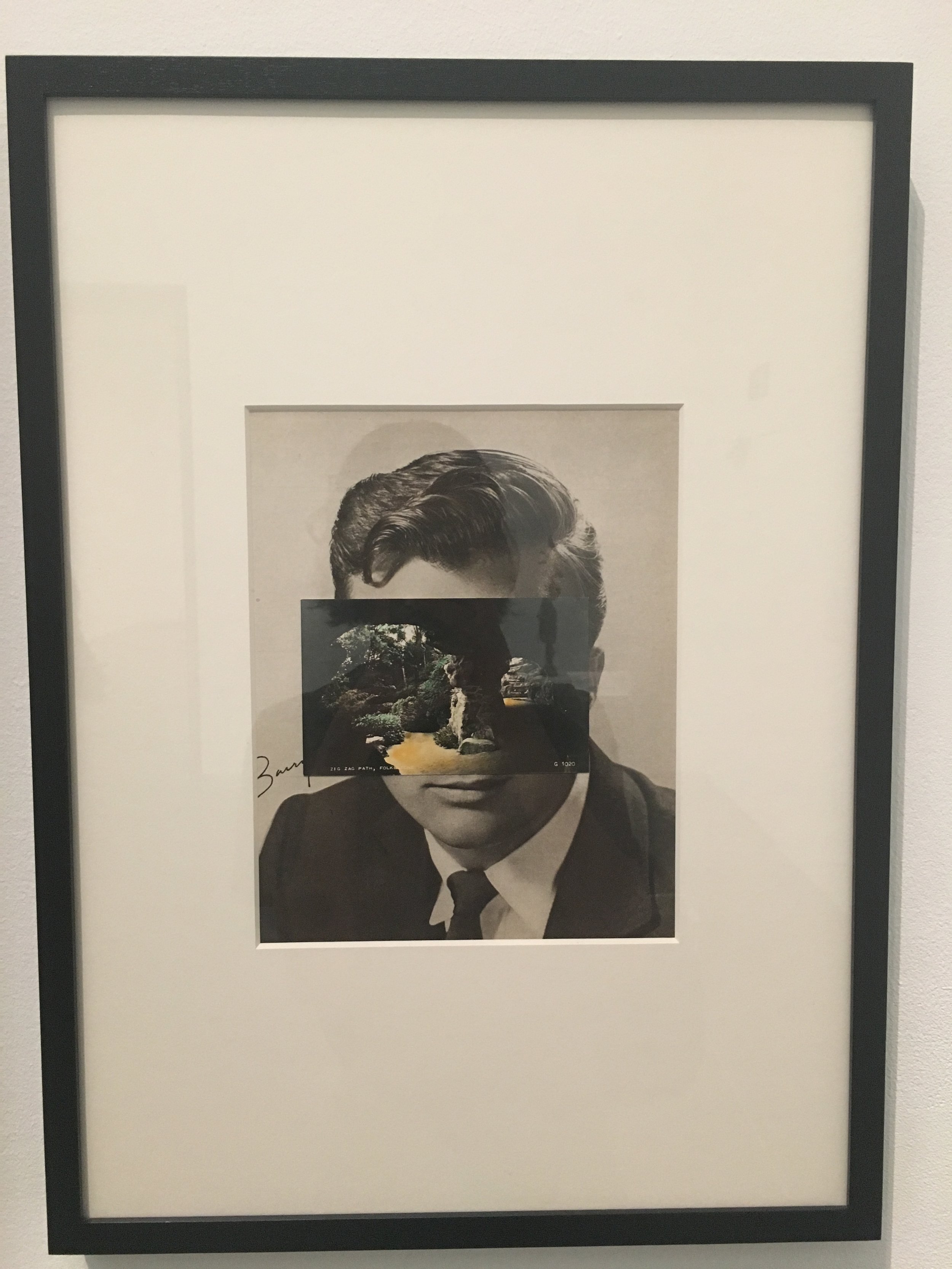
My assigned art works shown at the Tate Modern were The End of the Twentieth Century, (1983-85), by Joseph Beuys; and Mask XIV, (2006), by John Stezark (both images follow). After seeing Beuys’ installation which is made of Basalt rocks, clay and felt; I instantly noticed that the rocks in the installation have been moved all to one side of the gallery room. When I initially studied the installation, the rocks were spread out across the gallery room allowing the audience to walk through the installation. This new layout forced the audience, myself included, to observe from only the outside parameters. This was slightly disappointing, but I was still able to observe the art work in much more detail in person than through just an image. The form of the rock includes multiple colours such as greys, browns, and taupes. The colours really stood out to me. Also, the scale of the rock was put into better perspective. They are long, linear, horizontal rocks about average human length each. Something new that I learned was that this work was developed from a project to encourage an ecological awakening for humanity by planting 7000 oak trees in Kassel, Germany. In the project, basalt rocks were placed alongside the trees so in this installation the basalt rocks are used as a symbol for potential growth.
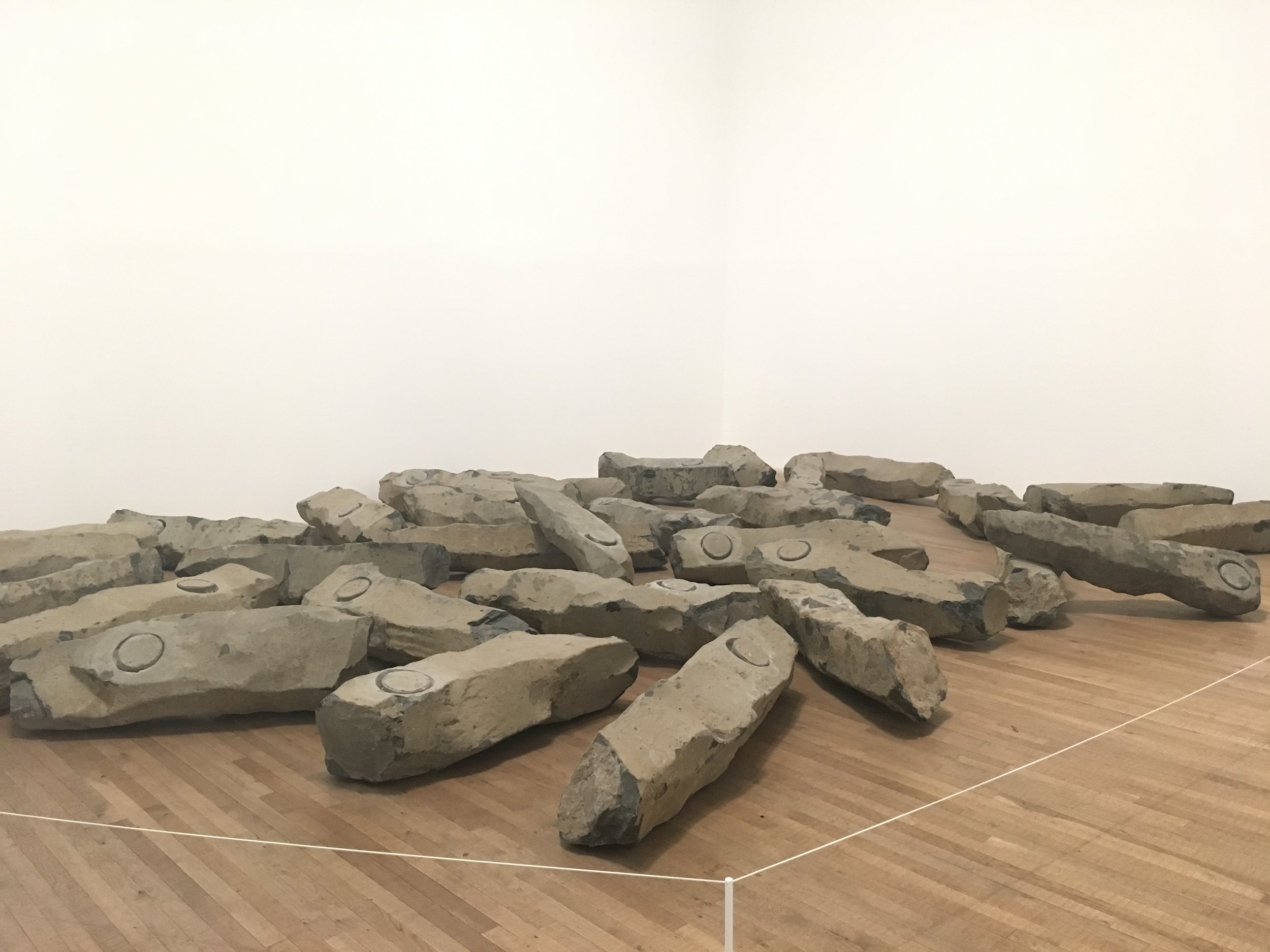
IMG_6324.JPG
IMG_6341.JPG

Seeing John Stezark’s work was exactly as I had expected to see. Mask VIX, is a postcard on paper on photo-etching on paper. It contains a portrait photo of an unidentifiable film star from the 1950’s with an image of a cavernous landscape covering the actors eyes and nose. The rock formation hollows where the eyes would be and forms a vertical line down the middle of the face as if it were the nose. This creates a mask like effect, but at the same time it opens up a window into another space. In person, I was able to see the outline of the edges of the postcard which is not possible through seeing this work in pictures.

Also, the scale was what I had in mind as it is a relatively small work in a thickly matted frame. What I coincidentally came across when we visited the National Gallery was more of Stezark’s work featured in two rooms. This gave me the opportunity to further explore and observe his work such as his Marriage series. I was also able to see his Marriage, (2018), HD video which struck me because it plays with the psychology of perception and it has to do with how the the brain identifies faces (see embedded video). I am appreciative that I had the chance to observe many works by Stezark; much more than I had anticipated.

Today’s activity was a free day activity. What were your impressions? What will you take away of the experiences of this day?  What are the most memorable moments for you?

Panoramic view of Oxford streets

The view of Sheldonian Theatre at Oxford, described by Shonel as associated with an important personal moment in his travel experience

On my free day, I made a trip to Oxford. I can genuinely say that I fell in love with Oxford and the university. I had the most perfect day starting off with lunch, then exploring the streets, the shops, library and multiple museums. The architecture is stunning, I spent most of the time looking up at all of Oxford’s historic buildings. I also enjoyed my afternoon cream tea with a view of the Sheldonian Theatre. During my tea I had a moment to myself where I realized that I truly earned my independence. I thought to myself—wow-- first off, I made it to Europe; but most importantly I have never been so independent in a different country doing things for myself before. I think this is a major accomplishment, and it requires being brave and believing in myself – something that I have found to be a challenge.

Oxford was the first trip I have planned entirely solo in a different country, and everything worked out beautifully. I think because of Oxford I have a reason to come back to England just to explore more things in Oxford that I did not have the time to see. Even aside from Oxford, I have done so much travelling by myself apart from our group which I have enjoyed. Going to Oxford alone gave me more confidence to go to Windsor Castle the following day. Windsor Castle is the Queen’s weekend getaway, and I can see why. The Castle and the grounds are absolutely stunning. Going inside the Staterooms I was amazed by the elaborate artwork, chandeliers and decor – definitely fit for the royals. My favourite part of Windsor Castle was discovering the rich history of the Castle and how the Castle has come to be what it is today after the built started in 1070! Both Oxford and Windsor are definite highlights of my trip to England, and are days that’s I will never forget.

Panoramic view of Windsor Castle

Picturesque view of Windsor Castle

To see more photos and impressions of London and Venice as the field school continues, check out our Instagram feed and follow us at #kpulondonvenice  

Comment
Meet field school blogger Ciska, posing here in front of the National Gallery.

Meet field school blogger Ciska, posing here in front of the National Gallery.

Location | London: Meet Field School Blogger Ciska Jans

June 16, 2019

Tell us a little bit about yourself—your background, major program of study, reasons for taking this trip, and anything else interesting you want to share (maybe something people might not know about you).

Ciska, a third year KPU Fine Arts student, on the London tube with Alison

Ciska, a third year KPU Fine Arts student, on the London tube with Alison

My name is Ciska Jans, and I am a third year Fine Arts student at Kwantlen Polytechnic University. As well as fine arts, I am studying psychology. At the end of my program, I will be attending Adler University for Art Therapy. I am attending this field school because I have been given multiple opportunities to travel abroad, and I continuously declined the chance. However after I heard about this program, I felt that I had to go, it was a once in a life time chance to travel abroad on my own and be able to see works of art that I adored and works of art that I have learned to adore. I have never been able to travel by myself before and it is a very terrifying experience, as well as exciting, being able to make your own decisions and follow your own agenda rather than somebody else’s is quite amazing. Outside of school, I am a server at a restaurant and a call taker at the Crisisline. I am attempting to achieve to find a job that gives me more purpose. I find myself to be a bubbly, passionate character, that has a lot of joy in their heart, as well as angry passion in their heart for human rights.

What has met or exceeded your expectations or surprised you about London (or Venice) so far?

I came into London with not many expectations at hand. I was expecting much more fashion forward people that put a lot of effort into their sense of style but I have not seen much otherwise. I was not expecting people to be rude on the sidewalks, with shoving and not being able to have the right of way. I have also learned how impatient drivers are on the road with speeding and using their horns excessively. Other small factors that have shocked me while in London were the variety of different bathroom door locks or the amount of homeless people that have dogs. I have also been shocked with the mixture of old buildings with new buildings, looking at an older church or an older structure with a brand-new sky rise with glorious windows and expansions in the background—it is quite overwhelming to the eyes. London is much more than British citizens—there are people from all over Europe who are coming to London either for pleasure or for permanence and it brings back that multi-cultural factor that Canada has held pride for, for years.  I was happily struck with the amount of free galleries that are in London, allowing all sorts of classes to be able to experience works that they can relate to their own lives/experiences.

Our group visiting the British Museum— we were happy to pose with First Nations totem poles from British Columbia.

Our group visiting the British Museum— we were happy to pose with First Nations totem poles from British Columbia.

Give us some insight into your assigned artwork from the Tate Modern. After seeing the work in person in London (and any other related art from the same artist or art movement associated with the assigned work), what struck you most about it and/or how did the artwork’s form, content, and context shift for you when seeing it.

When I saw Roy Lichtenstein’s Whaam! (1963) at the Tate Modern, I was shocked with the scale of the work. I was not expecting such a large panel for a work that was supposed to be depicted in a comic book. The colours were much more vibrant in person, the yellows and reds stuck out the most to me, as well as the pointillism. Lichtenstein has another work that was a Pop-Art explosion cut out, that at first glance thought belonged in the piece. I wish it had because it depicted the idea of a missile flying through the sky and exploding, which gave it a much more dramatic effect. The context from the work didn’t change from when I first saw it to when I saw it in person, because the work requires much more context that meets the eye. I didn’t feel joyed or overwhelmed when I saw the work (besides the size being beyond my expectations).

How did you approach the creative task of responding to your assigned artists in studio? What were your challenges as an artist to be in dialogue with the artwork and artist? Would you do anything differently now that you have seen the work in person?

Before seeing my assigned artists in person, I only felt a strong connection to Sarah Lucas’ work Pauline Bunny (1997) and only a mere interest in Roy Lichtenstein’s Whaam!. Lucas’ piece gave me an automatic response, being inspired by a woman being held down by their femininity and being objectified by men was something I could personally related to. With Lichtenstein I had a couple ideas run through my mind, but nothing I could directly relate to. Though I am a large advocate for basic human rights and using love over war, I cannot say I have personal experiences with those two factors that made Lichtenstein’s work so strong, and my response to that work wasn’t what it could have been. Seeing both the works in person, I felt overwhelmed with joy seeing Lucas’ work, and I wouldn’t have changed anything with the response I made because I find that it directly correlated with being objectified. I’m uncertain I would change anything about my work in response to Lichtenstein’s, possibly change the writing on the walls to comic style but otherwise I wouldn’t change anything.

View fullsize IMG_2198.jpg
View fullsize IMG_0308.JPG

Today’s activity was located at the British Museum. What were your impressions? What will you take away of the experiences of this day?  What are the most memorable moments for you?

Today’s activity was located at the British Museum. When I first laid eyes on the museum itself, it looked like a replica of the Parthenon. Inside were these beautiful scriptures of greek mythology and partially destroyed statues, and I was over the moon to see such phenomenal structures. Seeing Greek figures (such as Venus, Apollo, Hermes and the Centaur) it was amazing to invest time in viewing how they were depicted by the Greek artists. While inside the museum, I had found a smaller Greek temple replica that caught my interest, and I was in awe with what the structure had to hold. As I strolled through the gallery, the Egyptian works also caught my eyes. I love seeing the original Cleopatra  sarcophagus, as well as some mummified corpses. I felt some sort of sadness for the exposed corpses, it is a saddening thing to see a body that was once a human be surrounded by other humans taking photos and mocking their figure. On the bright side, I was completely in awe with the amount of Egyptian scriptures and memorial statues they had, and it made me feel excited since I’ve been learning about Egyptian culture for so many years. Later in the day was much more relaxed, I went on a stroll and fell upon a tunnel covered with street art, as well as some artists performing street art. There was a beautiful mixed combination of much more rendered portraits, to tagging, to line drawings. It was amazing to watch these artists and what seemed like a safe place for an artist to work. I found works relating to the AIDS crisis, to Brexit, to fun made-up cartoons. Later, I found a quaint restaurant that served the most delicious Portobello mushrooms with Brie cheese and other vegetables that gave me some nutrients back from constantly being on the run.  

View fullsize Image-13.png
View fullsize Image-14.png
View fullsize Image-12.png
View fullsize Image-11.png
View fullsize Image-17.png
View fullsize Image-16.png

To see more photos and impressions of London and Venice as the field school continues, check out our Instagram feed and follow us at #kpulondonvenice  

Comment

Meet field school blogger Alison, having some fun here posing inside an iconic London phone booth.

Location | London: Meet Field School Blogger Alison Curtis

June 14, 2019

Tell us a little bit about yourself—your background, major program of study, reasons for taking this trip, and anything else interesting you want to share (maybe something people might not know about you).

Hello! I’m Alison and I’m a fourth year Fine Arts student at KPU. I’m the Student Technician for the drawing and painting studios, as well as a senior leader on the Orientation Team, and a Women’s Ministry Leader at Calvary Grace Church. I’m specializing in acrylic painting, and although I’ve been training in realism, my paintings have grown increasingly more abstract over the last year. I like to include elements of the West Coast landscape, and push colour and pattern. I hope to become an artist, as well as an educator for a university in a Fine Arts program.

Alison is a fourth year Fine Arts student focused on a painting practice. Here she comes face to face with Marcel Duchamp’s Fountain (1917, replica 1964), considered by many art historians and artists to be among the most influential works of art in the 20th centiury.

I decided to go on this field school because every single artist and art professor that I talk to describes the privilege of seeing art around the world. Seeing the real thing instead of an image of it, seeing it in the context of the gallery. It is so much more inspiring to actually see a piece of art in front of you, especially after having studied the Powepoint images for years in class.

What has met or exceeded your expectations or surprised you about London (or Venice) so far?

I’m pleasantly surprised by how many impressive galleries there are in London. I thought for sure there would be at least a few that were lacking, but there is such an incredible variety of amazing classical, modern, and contemporary art. Each gallery and museum that we’ve visited

so far has been concisely curated, and I’ve already seen a full range of high and low brow art. And I don’t think I could talk about London without at least mentioning the beautiful buildings. Every street we walk down, we’re surrounded by a view of gorgeous architecture, and the older structures are complimented with new buildings.

I’m also enjoying seeing how large some of the pieces are, and now I understand that when we as students say that we’re “going big”, it’s not actually that big. We’re still working relatively small, and have to learn how to push past that to create truly large pieces. Our work will be so much more impactful on a larger scale, so I’m looking forward to seeing how quickly this trip will affect our scale.

Give us some insight into your assigned artwork from the Tate Modern. After seeing the work in person in London (and any other related art from the same artist or art movement associated with the assigned work), what struck you most about it and/or how did the artwork’s form, content, and context shift for you when seeing it.

My assigned artist from the Tate Modern is Doris Salcedo, and her project deals with group memory and trauma. She’s particularly examining the group trauma of her fellow Columbians under the rising pressures of a dictatorial government. Her work at the Tate Modern, Shibboleth II (2007) was a gigantic crack through the floor of the Turbine Hall, and has since then been refilled, leaving behind a scar in the floor. This is a nice parallel to the scars we acquire out of trauma. I already knew that since the crack had already been filled I would only get to see the scar; and although it was subtle, the sheer scale of the piece was massive (see picture below). This shifted the context for me because I’m not used to experiencing pieces of work that are overwhelming large in relation to my body, I’m used to looking at 8 foot wide wall works.

Alison pictured in the Tate Modern’s Turbine Hall sitting on the scar left behind by Doris Salcedo’s large scale project Shibboleth II (2007).

My assigned artist from the Tate Britain is David Hockney, who is an acrylic painter working with space and perspective. I found that seeing his work, Man in Shower in Beverly Hills (1964) was much more rewarding because it closer relates to my own practice. Seeing it in person gave my way more insight to his process, such as the pencil lines he had made and then filled in, or the layering of paint as he added new elements to the space.

Alison seeing her assigned David Hockney painting at the Tate Britain for the first time.

How did you approach the creative task of responding to your assigned artists in studio? What were your challenges as an artist to be in dialogue with the artwork and artist? Would you do anything differently now that you have seen the work in person?

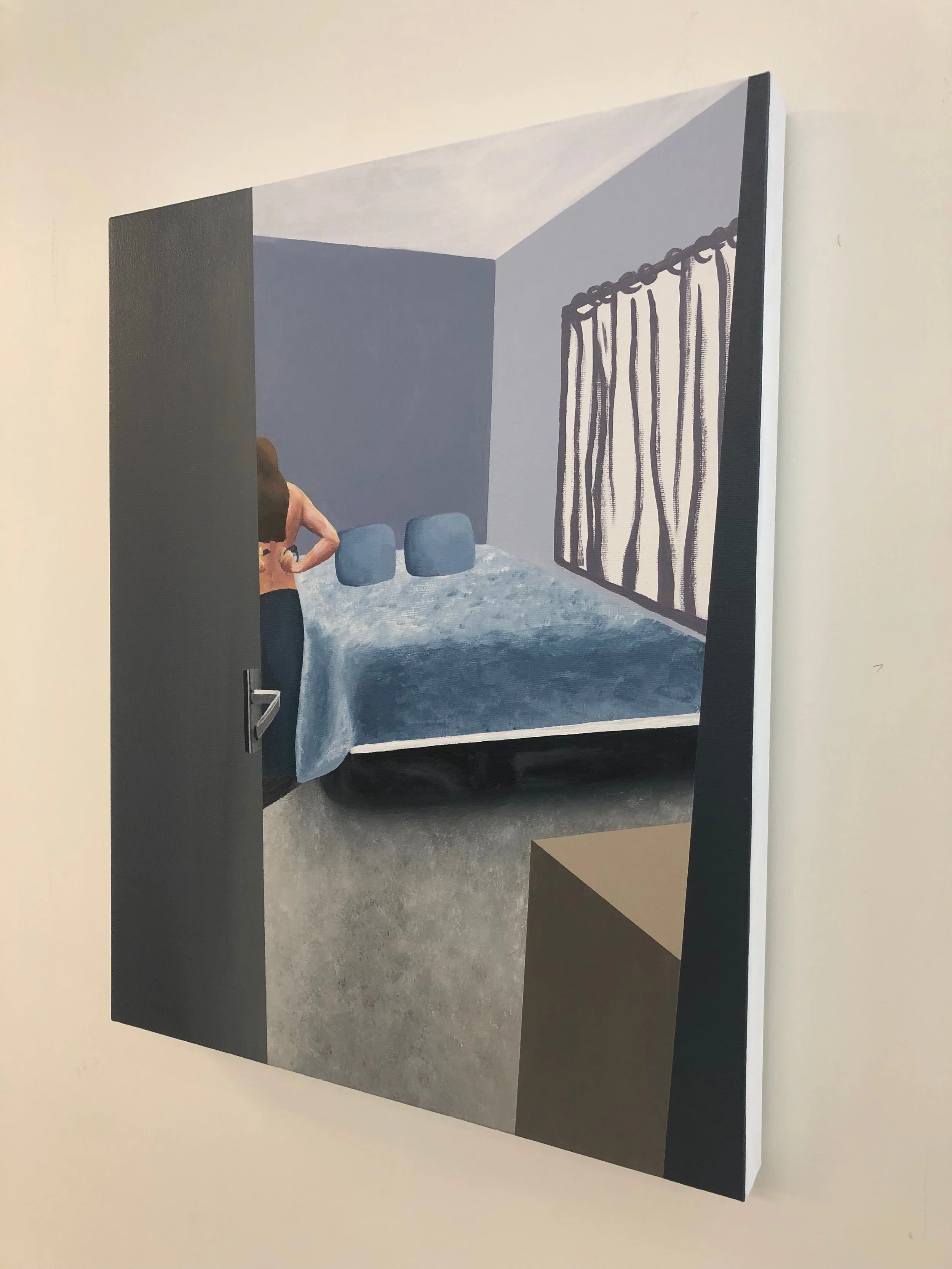
I found it a lot easier to respond to Hockney’s work than Salcedo’s. As an acrylic painter also experimenting with colour and space, I not only found Hockney’s work more aesthetically engaging, but also more interesting to formally examine. He creates depth with a combination of realistic tonal shifts and flat expanses of colour. For this response, I looked at creating an interior space from a reference image that my husband had taken of me in our bedroom, getting ready for bed (image below left). This allowed me to play with the specific perspective of an onlooker, and the idea of voyeurism. I had to be extremely precise with my colour selection, as each tone will add information about the light in the room, the form of the objects, or the angles of the walls.

View fullsize IMG_2188.jpg
View fullsize IMG_2325.jpg

For my response to Salcedo’s Shibboleth II, I honed her use use of wire to examine the idea of forced confinement, as well as the idea of group memory. I used the widely recognised form of the female reproductive system, and constructed a monstrously large, industrial uterus out of chicken wire, which now hangs off the wall at six feet tall and seven feet wide (image above right). I wanted to push myself with scale, and felt that this material would better suit the ideas of confinement than a painting would have. After seeing the scar of her work, there’s nothing I would have changed about my project, with the exception of adding direct lighting to reflect off of the metal.

Today’s activity was located at the National Gallery. What were your impressions? What will you take away of the experiences of this day?

Today’s activities were located at the National Gallery. The inside of the gallery was huge, I think the building itself is well suited for showing art as it doesn’t distract from the work, but is by no means a boring space. The interior of the building complements the work, and also facilitates the flow of foot traffic wonderfully. I loved getting to see such a wide array of modern artists such as Claude Monet and Georges Seurat, whose respective styles have both played a huge role in the way I handle paint on the surface of my works. And who could go to London without having afternoon tea? Fortunately for us, the National Gallery cafe hosted a wonderful high tea where we got to indulge, and recharge before continuing through the multitude of exhibitions. I’m so grateful that I took this opportunity to see art in person, and I know that it will have a huge impact in both the way I produce art and the way I view my professional practice.

View fullsize C5877B16-BF75-40DB-93A6-9C00B1CEDB0C.jpg
View fullsize 64348149_1269964413177998_3110049552053305344_n.jpg
View fullsize 62339355_634935933649944_9046774195802865664_n.jpg
View fullsize 61938077_435331810578856_118017785669353472_n.jpg

To see more photos and impressions of London and Venice as the field school continues, check out our Instagram feed and follow us at #kpulondonvenice  

Comment
Meet field school blogger Ronald Chan, here performing a portrait vivant with an 18th century painting at the National Gallery.

Meet field school blogger Ronald Chan, here performing a portrait vivant with an 18th century painting at the National Gallery.

Location | London: Meet Field School Blogger Ronald Chan

June 13, 2019

Tell us a little bit about yourself—your background, major program of study, reasons for taking this trip, and anything else interesting you want to share (maybe something people might not know about you).

Ronald is a fashion student in KPU’s Wilson School of Design entering the final year of his program. Here he is with Mel hanging out at the hostel.

Ronald is a fashion student in KPU’s Wilson School of Design entering the final year of his program. Here he is with Mel hanging out at the hostel.

Hello! My name is Ronald, and in the fall I will be going into my fourth year of the Fashion and Technology program at Kwantlen Polytechnic University’s Wilson School of Design. Something I constantly explore in my practice as a fashion student is the intersection of art and design - how are they different or similar? When, where, and how can they come together? Although my passion is, and always will be, fashion and design, a part of me has always longed to have a fine arts education - I took art courses all throughout high school, but decided fashion was what I wanted to pursue in post-secondary and as a career. It has also been a goal of mine to study abroad so this particular field school was the perfect opportunity for me to check off multiple things on my list: exploring the relationship between art and design, living out my dream to be an art student (at least for a little while), and going abroad.

I envision a creatively fulfilling career for myself and in the process of working towards a goal, I do not want to limit myself to either an artistic or design approach. I want them to work in relation to each other and belong in the same space. For the longest time I have only seen these crossovers through images and readings, other than an occasion trip to local galleries at home, so it will be really exciting to experience art and design on a larger scale, in context to historical tensions and consumerism, beyond a page from a book or a computer screen.

What has met or exceeded your expectations or surprised you about London (or Venice) so far?

What has surprised me most about London, so far, is how easy it is to get from point A to B, and everywhere in between. Everywhere we go is within walking distance or just a quick trip on the metro. We have only been here for a week but I already feel super comfortable exploring the city on my own - I took the metro by myself third day into the trip! As this is my first time travelling without family, I knew I would not have anyone to rely on or to look after me and I have had to adjust really quickly to being on my own. London is much bigger than Vancouver, so I worried I would have troubles getting around, but this has not been the case. Getting a good data plan definitely helped, and although there will be a bigger communication barrier when we are in Venice, I think the confidence I have gained from being on my own in London will transfer over. That being said, I have hopped on an eastbound train when I should have been on the westbound one, and turned a few corners before I realized I was going the wrong direction on multiple occasions!

Another thing that has surprised me about London, and this part of the world in general, is how many kids go to galleries and museums as part of their education and upbringing. It is truly jaw dropping to witness a group of children sitting on the floor of the National Gallery or the Tate Modern looking up at historical and contemporary works of art, taking notes and sketching. With this, I could not help but feel like I missed out on something in my childhood, as I wish more significance was placed on studying art and culture in school. Within art, there are so many cultural clues that inform us on the implications of our past and possible futures.

Give us some insight into your assigned artwork from the Tate Modern. After seeing the work in person in London (and any other related art from the same artist or art movement associated with the assigned work), what struck you most about it and/or how did the artwork’s form, content, and context shift for you when seeing it.

Barbara Kruger’s work Who owns what? (2012) is located in the Media Networks exhibition at the Tate Modern

Barbara Kruger’s work Who owns what? (2012) is located in the Media Networks exhibition at the Tate Modern

My assigned artwork in the Tate Modern is Who owns what? (2012) by Barbara Kruger. From my initial reading of the object and the assigned written work on the piece, I found that Kruger deals with social constructs of identity and gender, as well as commentary on consumerism and our culture as a whole. Her design background and experience in editorial work lends to her collage style, the layering of black-and-white images and bold typeface which is comparable to advertisements. Being a design student with some visual arts background, I can relate with Kruger’s process. By disrupting the metaphorical space of something commercial and familiar to the viewer, Kruger aims to uncover the power behind tensions that society is either unaware of avoid. In Who owns what?, it is clear that the question Kruger poses is directed at the viewer, the consumer. The subject of the piece is not specific, so whoever is viewing the work will interpret the meaning differently; for me, it makes me question my behaviours as a consumer as well as those who dictate consumer needs and wants. From the perspective of notions on identity, I also interpreted the question as ownership of ourselves; are we in control of our thoughts and actions and are we accountable for them?

The themes that Kruger touches on immediately resonated with me, as identity, gender, and consumerism are in my rotation of concentration and research. Although this connection to the assigned artwork was possible from just seeing it on a piece of paper and on a screen, seeing it in person for the first time puts into perspective how powerful the work actually is. Who owns what? is currently showcased in the Media Networks exhibit, which comments on the impact that mass media and digital technology has on contemporary art. Kruger’s piece pulled me into the room, literally and figuratively, and can be seen from the entrance to the room. The size of the piece speaks to the already confrontational characteristic and message of the work, making the work seem even more intimidating. By being a standalone piece, I was forced to look at just this one piece before I moved on to the next room. There is also a hypnotizing aspect to the scale of the work that made it hard for me to pull my gaze away from it, and when I finally did, the question it raises seemed to linger on for a bit longer than I anticipated. With this, I think Kruger is trying to bring awareness to the social tensions that make us uncomfortable and, ultimately, numb. By being more conscious of what makes us uncomfortable internally and externally, we can become less desensitized and more engaged.

How did you approach the creative task of responding to your assigned artists in studio? What were your challenges as an artist to be in dialogue with the artwork and artist? Would you do anything differently now that you have seen the work in person?

Ronald interacting with his assigned Anthea Hamilton work, Karl Lagerfeld Bean Counter (2012) at Tate Britain

Ronald interacting with his assigned Anthea Hamilton work, Karl Lagerfeld Bean Counter (2012) at Tate Britain

For my studio projects, I was also assigned Karl Lagerfeld Bean Counter by Anthea Hamilton in 2012, shown at the Tate Britain. With Hamilton’s work, I drew from themes that stuck out to me based on a blind reading of the piece and research on the artist. Similar to Kruger’s work, I found that Hamilton also challenges the comfort of the audience by subverting familiar objects, commenting on notions around identity and gender. Karl Lagerfeld Bean Counter depicts a young, suggestive image of the late designer along with beans and potatoes, questioning the emphasis we put on certain desires. I found Lagerfeld’s pose to be both sensual and egotistic. I felt invited in but also disgusted by his standoffish demeanour. With this, I also noticed masculine and feminine qualities in the work.

What I found difficult in responding to Hamilton’s work was defining the line between being in conversation with the assigned artwork while also fulfilling my own needs as an artist and designer, specifically in its overall aesthetic and the narrative I was trying to tell. Playing with the contrast of things that are both alluring and repulsive, I did a series of self portraits that document the parts of my identity and self discovery that makes me comfortable and uncomfortable (image below left). Like the ambiguous quality of Hamilton’s work, the blurring of gender in my photographs push for the audience (in this case, my peers) to come to their own conclusions.

View fullsize  Processed with VSCO with al1 preset

In response to Kruger’s work, I did an installation of thrifted clothing, undergarments, and accessories to explore the role that consumerism plays in our identities (image above right). Being a fashion student, I am aware of the impacts that the industry has on the environment and wanted to comment on consumerism from that perspective, where goods are seen as disposable. To tie back into my previous project of self portraits, I used stereotypically male and female garments to comment on the fixation that our society still holds on gender. The most challenging part about responding to Kruger’s work was that my aesthetic is much tamer and more calculated. Coming from an intense, practical design program, a lot of emphasis is placed on editing and being attentive to the smallest of details. Although I think I could have been more raw with my project, I am very proud of the end result because it was really creatively rewarding to do something that I felt was quite ambitious given the timeframe.

Today’s activity was located at White Cube Gallery and smaller galleries in Shoreditch. What were your impressions? What will you take away of the experiences of this day?  What are the most memorable moments for you?

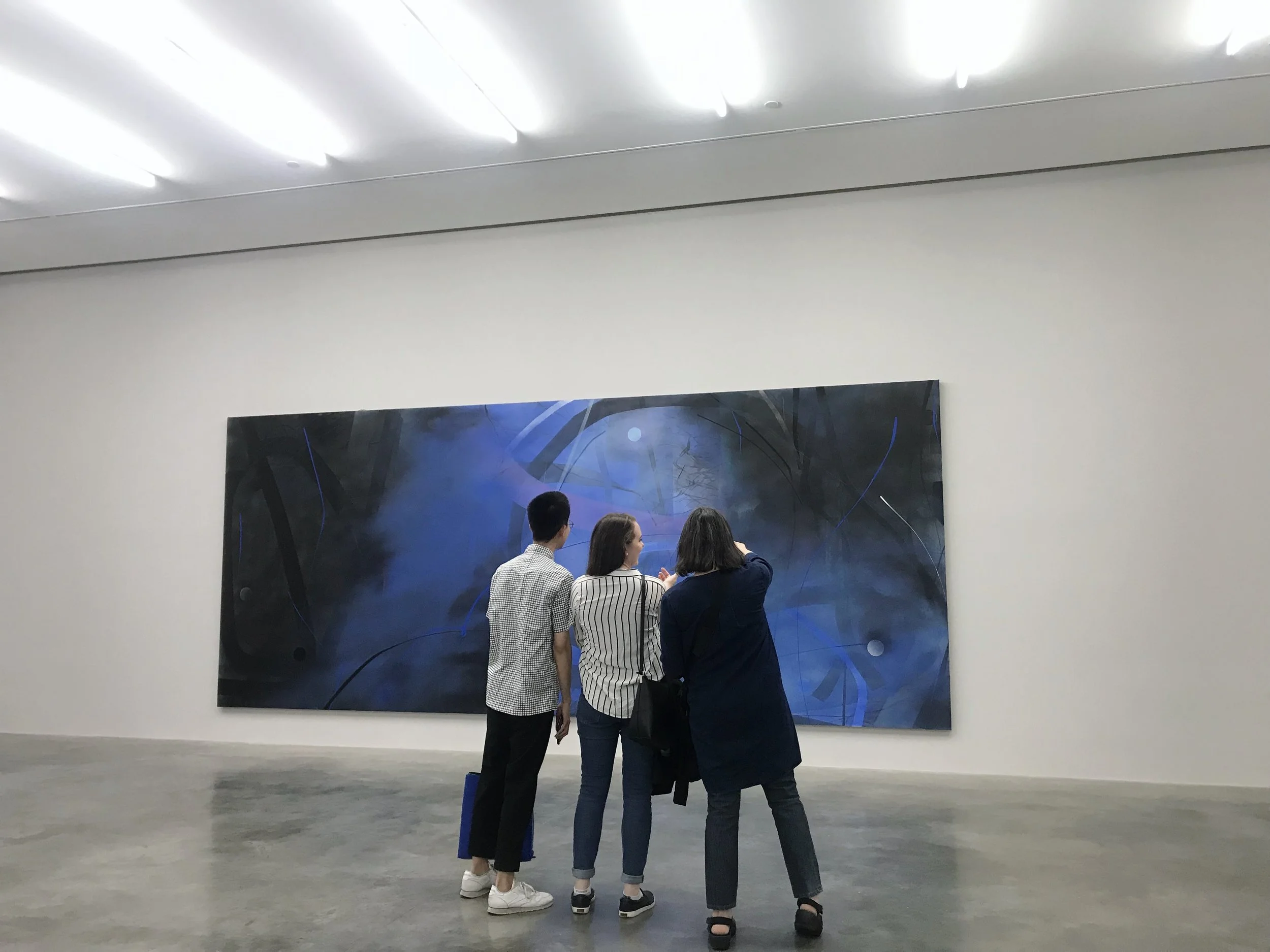
Compared to the “old” objects displayed at the Victoria and Albert Museum that we saw earlier in the trip, today we saw more contemporary artworks in the more trendy parts of London. Jumping between the old and the new each day is refreshing, our activities mimicking the physical landscape of London. We started the day at White Cube Gallery on Bermondsey Street, where works by Zhou Li and Sarah Morris were being displayed. I particularly liked Li’s work because of her colour palette and the mix of soft and hard strokes. Morris’ multimedia exhibit was also quite engaging. Another aspect of White Cube that I enjoyed was its architecture and as much as it complimented the works displayed inside, the building was a piece of art itself.

Ronald, Alison, and Elizabeth taking a closer look at a Zhou Li painting at the White Cube Gallery

Ronald, Alison, and Elizabeth taking a closer look at a Zhou Li painting at the White Cube Gallery

Before heading to Shoreditch, we stopped by Borough Market to visit The Anchor, an eight hundred year-old pub! There was a moment where I felt at home, as the market looked so much like Granville Island in Vancouver. After a few pints of Guinness, a cheeky conversation with the bartender, a small lunch and a quick stroll around the market, we were off again. The weather has had its ups and downs this week, but I don’t really mind the rain as it feels like home.

I was really excited to head back to Shoreditch as I was there with a friend a couple days before. Out of all the areas we have been to so far I think Shoreditch might be my favourite. It was interesting to see what I had missed the first time around, and by all the galleries and shops that are in this area it seems like I missed quite a bit. One of the galleries we visited was displaying works by Frank Bowling, and I thought it was interesting that he was showing works in a small, private gallery while also having a large retrospective exhibit at the Tate Britain. Another highlight of visiting the Shoreditch galleries was a Lola Flash exhibit, which explored the experiences of genderqueer and non-binary people through a series of portraits.

Ronald, far right, enjoying pints with the group at The Anchor, 800 year old English pub on the banks of the Thames

Ronald, far right, enjoying pints with the group at The Anchor, 800 year old English pub on the banks of the Thames

The day continued with a bit more exploring in Shoreditch (and sporadic photoshoots with my recent purchase from Saatchi Gallery the other day), a trip to Oxford Circus and some shopping, ending with a very lovely dinner at an Indian restaurant with the most eccentric server… I feel like I am forming genuine bonds with my peers. Although I knew I would make friends quickly during this field school, I came in feeling like the odd one out in a group of mostly fine art majors. But, feeling like an outsider quickly faded. With each day’s activities I become more acquainted with the city and I look forward to the week ahead of me!

View fullsize  Processed with VSCO with al1 preset
View fullsize  Processed with VSCO with a6 preset
View fullsize  Processed with VSCO with al1 preset

To see more photos and impressions of London and Venice as the field school continues, check out our Instagram feed and follow us at #kpulondonvenice  


Comment
Meet field school blogger Alycia, posing here in front of a fashion display at the Victoria and Albert Museum

Meet field school blogger Alycia, posing here in front of a fashion display at the Victoria and Albert Museum

Location | London: Meet Field School Blogger Alycia Barker

June 12, 2019

Tell us a little bit about yourself—your background, major program of study, reasons for taking this trip, and anything else interesting you want to share (maybe something people might not know about you).

Alycia, a fashion design student at KPU’s Wilson School of Design (left) posing with Ciska and an English Beefeater at the Tower of London

Alycia, a fashion design student at KPU’s Wilson School of Design (left) posing with Ciska and an English Beefeater at the Tower of London

My name is Alycia Barker, I am a fashion design student at The Wilson School of Design. I moved to Vancouver from Banff, Alberta two years ago to start my university career after hearing amazing things about the design program from alumni. My main interest when it comes to fashion is avant-garde and couture as well as costume design. I plan to study abroad in Australia next year at The Royal Melbourne Institute of Technology to elaborate my studies, getting a broader view of the fashion industry globally. My main interest in taking this course was to broaden my knowledge on art and art history. Contemporary art was never something I would have chosen to study in a classroom setting alone, and coming to London to experience it has given me a different perspective. I love Europe and see myself living and working here at one point in my career, being able to spend an extended amount of time here (I’ll be here for two months in total) will give me a sense of what life will be like if I lived and worked here full-time. I have dual citizenship with Ireland, so it will be interesting to see what restrictions are placed on my European citizenship once Brexit is finalized.

What has met or exceeded your expectations or surprised you about London (or Venice) so far?

London is a city I have visited before, so there wasn’t a whole lot new to me when I landed here. However, I would have never thought of going to galleries and museums such as the Tate Britain, Tate Modern, Saatchi Gallery, or the White Cube. I am someone who enjoys classical/modern artwork and historic costume rather than contemporary or postmodern. I also missed the Victoria and Albert museum last time I was in London, so that has been a highlight so far; I am very pleased that I was assigned this museum to review.

5DAD33DB-FC53-4492-BD9F-4390C2DA71AF.jpg
17EAC22D-E745-42CC-BB4C-11DD6139FA49.jpg
560341F0-10D3-4567-9BC9-C324E813481A.jpg
C4174836-75EA-4507-ACF0-F10DD2384FD2.jpg

Give us some insight into your assigned artwork from the Tate Modern. After seeing the work in person in London (and any other related art from the same artist or art movement associated with the assigned work), what struck you most about it and/or how did the artwork’s form, content, and context shift for you when seeing it.

My assigned artwork from the Tate Modern is Greer and Robert on the bed, NYC (1982) by Nan Goldin. I think I preferred doing research on her rather than seeing her work first hand. When reading about Ballad of Sexual Dependency, I was excited to see her collection of photos from what critics had reviewed and the conversations around her work. When it came time to see the images live, I was provoked with feelings of disgust and resentment towards it. I understand this was why her work was chosen for display at the Tate Modern; her work is meant to provoke these feelings as well as highlight the darker side of our minds as human beings—people feel repulsed, but continue to look.

Nan Goldin, Greer and Robert on the bed, NYC (1982) was Alycia’s assignment art work.

Nan Goldin, Greer and Robert on the bed, NYC (1982) was Alycia’s assignment art work.

Since she is a photographer, there was no difference to me in seeing her work hung up in a gallery to what I have seen on my computer screen. When I was reading and writing about the artist at first, I had a more positive opinion towards her art. However, I understand and appreciate the conversations around her work and her contributions to contemporary art and space she has created for society to open their minds to new concepts.

imageWerthnBrinco6.jpg
IMG_2938.jpg

I also found a conceptual artist at the Tate Modern whom I enjoyed named Judi Werthein. She designed shoes to help Mexican immigrants make the journey into America after a number of illegal immigrants died trying to cross the border in the 1970s. She had fashioned maps on the soles of the shoes along with pockets to hold money along with painkillers to assist people who had been bitten by snakes or suffered from a number of other injuries. The shoes are called Brinco, meaning jump in Spanish. It’s artwork like this that I appreciate because of my design background. I also love how she was poking fun at the fashion industry’s consumerist nature, selling the shoes for $240 US across the border, classifying them as designer shoes. Some people may argue that this design is assisting illegal immigrants entering America, but that is the whole point of her making these shoes; it's also saving the lives of individuals that are trying to escape terrible situations. This collection was part of the performance art section of the Tate Modern.

Today’s activity was located at the Victoria and Albert Museum and Saatchi Gallery. What were your impressions? What will you take away of the experiences of this day?

The activity I was asked to document was at the Victoria and Albert Museum and Saatchi Gallery. So far, this has been my favourite museum and am glad I was chosen to review it. My favourite aspect of the museum was the variety of things to see and experience, from ancient Greek sculptures to Buddhist statues and couture fashion house exhibits. I especially loved the blend of fashion, art, pottery, and overall history of so many civilizations and countries in one place; the building was absolutely amazing as well. I plan to return to that museum specifically to spend a few more hours taking everything in. I wasn’t able to see everything I needed to see in two hours. The most memorable part of this day was seeing different design houses in one room that spanned 200 years. I saw everything from the punk era of the 1970s to dresses designed by Dior in the 1940s. I also loved seeing the cast replicas of medieval caskets and cathedral arches that were on display as well as items from the Middle east. Growing up in a Western culture, there is minimal appreciation for Islamic artwork and culture. Seeing rugs and artifacts on display was interesting and refreshing, when I return to the V&A, I will definitely revisit this section to educate myself a bit more on what was shown.  

Seeing these dresses were so refreshing and inspiring to me as a designer because they are considered to be works from the masters of couture. So much skill and work goes into creating garments like these, and each one serves a function and purpose. I am thrilled to see society viewing fashion and design as something that is more than just a craft, instead viewing it as wearable artwork that holds value, just like works of art. Slow looking and mindful observation is crucial in everyday activities that the majority of us miss. As a society I think we are always so preoccupied with getting through the day as fast as possible, rarely taking the time to live in the moment. In Buddhist cultures, living in the moment is just as important as making money. As the Dhali Lama says, “If you are living in the past, you may be depressed, in the future, you may be anxious, but if you live in the present, you are at peace.”

+l5Md8hERL+EnQlijuvPGw.jpg
LAUYm+7sSQaIQxcEmyxRWQ.jpg
G9PsaSjdRrSDhiPYOdJDYA.jpg
siLXyvxSR8qYCLHb7NC8yA.jpg
oo7wOmNySHKAPQHO5fnD%Q.jpg
taKsye4XT6WcVY4zOB2Adg.jpg

Steven and I started a slow looking exercise introduced by guest speaker Sharon Greeno-- one of my KPU Fashion Marketing Instructors who was also visiting London and joined our group for the day. The exercise began by choosing individual artifacts to stand in front of with one of our backs turned. It was hard to describe the cast sculpture over ten minutes, and I only took around two minutes to describe what I saw. Looking at the piece, which was in three parts that imitated scenes from the bible, I noticed there were quite a few heads missing from the scenes. The carvings worked with negative space, carving out the multiple figures to depict the scene. This exercise allowed me to pay attention to how I am going about my day, staying in the moment and allowing myself to take the time to slow look and experience everything to the fullest.

Picture1.png
fMrbBzP8QL69kZe4Q2uPwQ.jpg
IMG_2662.jpg
Picture2.png

After the Victoria and Albert Museum, our group headed to the Saatchi Gallery, and along the way we saw a very cute kitty in a window of someone's apartment. I’m sure the residents didn't appreciate a big group of people swooning over their cat, but it was worth every moment. My favourite artist from the gallery was Tillman Keiser, especially his sculpture pieces Moontrap and Fotobox. These art pieces reminded me of something from outer space, I thought they were a clever creation, invoking nostalgia of wanting to travel to outer space as a young child. I do hope that in my lifetime I will be able to travel to the moon, but I’ll have to wait until it costs less than 5 million dollars. I also enjoyed his silkscreen paintings on canvas, the use of mixed media and methods of creating pieces like Gewinnspiel (Lottery) and City of The Weak Heart, it had so many different elements to the artwork that really got my attention and made me stay to look longer at his artwork.

Alycia and Leah enjoying summer roses at St. Paul’s

Alycia and Leah enjoying summer roses at St. Paul’s

After the Saatchi gallery, Ciska and I walked down some back streets in a very posh neighbourhood to this designer consignment store called Pandora. I can safely say it was the best second-hand luxury fashion store iv’e ever been to (and still couldn’t afford). They had a full rack of Chanel suits on sale for 1100-1700 pounds each, a steal if you have that money to spend.

Chanel suits spotted by Alycia in Knightsbridge consignment stores.

Chanel suits spotted by Alycia in Knightsbridge consignment stores.

To see more photos and impressions of London and Venice as the field school continues, check out our Instagram feed and follow us at #kpulondonvenice  

Comment
Newer / Older
Back to Top
Screenshot 2018-02-05 20.48.17.png

© Dorothy Barenscott, 2010-2025