Marina Abramovic: The Movie

Abramovic at MoMA, March 2010 (my photo)
This past spring, I had the pleasure of traveling to New York and visiting the much discussed Marina Abramovic retrospective at the Museum of Modern Art. Abramovic, often called the “grandmother of performance art” (she is thought to have coined the term herself) was then in the beginning phases of her longest ever solo performance, a seven week endurance piece called “The Artist is Present” where Abramovic sat silently at a table while museum visitors took the chair across from her and met her gaze for as long as they desired. The morning that I arrived at MoMA, I entertained the idea of standing in line and becoming part of the performance, but lost my patience when a young hipster presumably trained in marathon meditation took the seat across from Abramovic and did not get up for what seemed like over an hour. Later, I spotted him giving an interview to a reporter waiting outside the exhibition about his moment in the spotlight. If you look here, you can probably locate him among the portraits that were recorded of every museum goer who took part in the performance. Actress Sharon Stone (Day 18, portrait 10) and CNN reporter Christiane Amanpour (Day 34, portrait 7) even got into the act.

Abramovic performing at MoMA, March 2010
(a picture I took from one floor above the main action)
While weighing the option of getting back into line, I was able to climb the stairs to the top floor of the museum and take in the stunning retrospective which featured live “re-performances” of Abramovic’s most famous works by a group of young artists she had specially trained to participate in the show. These individuals, some completely naked, performed milestone Abramovic works such as Relation in Time (1977); Rest Energy (1980); Luminosity (1997); and The House with Ocean View (2002), bravely enduring the combination of probing eyes, difficult to hold poses, and mental tedium that is part and parcel of performance art. While I was there, a minor scandal erupted when one patron was ejected from the museum after inappropriately touching a male artist performing Imponderabilia (1977) --a performance where the public must navigate a very limited space between two naked performers to gain entry into another space.

All of the publicity surrounding Abramovic during and since the exhibition has once again raised important questions concerning the place of performance art in the public gallery and the role of performance art in the canon of art history. How are explorations into the limits and discipline of the body related to the current, and some argue limited, state of contemporary art? At what point does Abramovic’s work blur distinctions between spectacle and artistic performance? Does it matter that Abramovic herself is now seen as a kind of celebrity? It is notable that the Abramovic show stands as the largest and most substantial exhibition of performance art ever staged at MoMA, and it is clear that the large crowds surrounding her work are as much the result of human curiosity as they are the genuine interest in her artistic achievement since her early days working in communist Belgrade.

Perhaps some of these questions will finally be addressed in a new film that is currently in development and titled simply Marina. Unlike the highly conceptual and experimental fiction film Balkan Baroque produced by Pierre Coulibeuf in 1999, this film is far more documentary in its approach and includes fascinating interviews with Abramovic concerning her preparation exercises and training methods while planning and training artists for the MoMA exhibition (see film clip below). I for one have a great deal of respect for the discipline and the focus required to pull off the range of works Abramovic has accomplished over the four decade span of her career. I am just left wondering how much her message was lost during her much discussed and often misunderstood retrospective.

Marina Trailer from New York Times T Magazine


Further reading:

Kaplan, Janet A. "Deeper and Deeper: Interview with Marina Abramovic." Art Journal 58.2 (1999): 6.

Phelan, Peggy. "Marina Abramovic: Witnessing Shadows." Theatre Journal 56.4 (2004): 569-577.

Guest Blog| Jass Takhar: We've All Fallen in Love with an Ass

I am delighted to present our first guest blogger, Jass Takhar, Vancouver actor and student in Simon Fraser University's School for the Contemporary Arts and the founder and co-artistic director of Escaping Goat Productions: a new company interested in interdisciplinary practices and collaboration, covering a featured event at the Vancouver International Fringe Festival (running September 9-19).
Frances Kitson in TITANIA- Playing at Studio 16

The Vancouver International Fringe Festival visits Vancouver yearly and with it brings a plethora of new and exciting theatre to see. From the absolute absurd to the “real-est” of realism it has something to satisfy nearly everyone. This year it has TITANIA to delight and enthral audiences looking for comedy, deep audience engagement, insightful questions and an all around FUN time!

TITANIA; a one woman show was written by Frances Kitson, a graduate of the Simon Fraser University Contemporary Arts Program. I had the privilege of seeing the first “version” of her show in December of 2009 and was thrilled to hear it would be premiering at the Fringe Festival this September. I got the chance to sit down with this emerging and exciting young artist and ask her about her experience and trials in creating her delightful piece.

The first place we began was the history of the show and the length of the process:

Frances, at the age of fifteen when performing William Shakespeare’s, A Midsummer Night’s Dream with Arts and Umbrella (A Vancouver based children’s visual and performing arts society) discovered the play had quickly become a favourite of hers. However despite it becoming a favourite play there was also an element of frustration: Mainly the relationship between Oberon and Titania.

Frances states, “Oberon and Titania begin the play fighting over a child, and when Oberon doesn’t get his way he magics Titania and manipulates her into falling in love with an ass! When Titania is made better, she instantly forgives Oberon and doesn’t once mention the child! You can’t just ignore that-that was the conflict! And it’s just neatly packaged away at the end?”

Frances wouldn’t re-look at this issue until years later when writing an honours essay where she revisited the source of her frustration in her paper. Forty pages later, and it still wasn’t enough: Frances found a story to tell and finally when doing a directed studies for her BFA found something substantial in her first written piece-TITANIA. In total this project was being thought about and in the works for thirteen years!

With this much history you knew there must be a lot of critical work so we then moved on to the research and different artists’ influence on TITANIA:

“The most obvious artist this work is influenced by is William Shakespeare. It is the back story between Oberon and Titania that wasn’t seen in his Midsummer Night’s Dream. As for research, I looked at a lot of different artists renditions of fairies for imagery and inspiration, after all the play is about the Queen of Fairies. I also researched child birth; specifically what kind of complications cause a woman to die during childbirth, as I have a character that dies giving birth. I also played with pre-recorded music and how its utilization affects the show.”

As mentioned I originally saw the show in early December of last year, since then the show has been gone over, performed across the country and been revised and reworked. I asked Frances what kind of changes were made and why? How did this improve the art?

“There were some script changes based on feedback from audience members where certain small moments came across unclear in meaning. I really wanted to specify my framework and make sure it was as clear as possible. I also needed fresh eyes, I actually left the show alone for a bit and then came back to it when my spot in the Fringe was solidified. In the time performing it, I realized performance was a key discovery method as well. It definitely reshaped how I saw the show and gave it new meaning. Other than that, not much has changed.”

When first seeing the show, I was struck and intrigued by the usage of light as character, placing an interesting post-modern (Yup, I went there!) spin on the show. As an actor myself, I know how hard it is to play to an invisible scene partner so I asked Frances what that was like:

“It’s definitely hard; having to talk to someone who is not really there! I realized early on that I would have to write in “his” dialogue. To really know what he was saying and how he was responding to my words. There had to be a clear conversation, not just me saying words to air. Then there was a lot of work spent on creating the physical body of a person. I had to set height, weight, shape...I couldn’t be looking a little above me one time and then a good two feet another! Or swing my arm out one moment and end up having it go through what was earlier established as his throat or something! Consistency was definitely a needed factor. In terms of the scene partner you were talking about, I learned to discover it in my audience. At first I discover the audience and then I discover what kind of partner they will be. It keeps it interesting and fun for me because each audience is different and I really need to listen to them.”

Finally we got to the question that lays it all on the line-Why should people care about TITANIA? What does it offer as a work of art?

“The thing I wanted it to offer, and I feel I succeeded in this, is questions. Specifically questions about relationships and how we perceive them. I don’t want to preach to an audience, they’re smarter than that. Instead I want them to think for themselves about why we fall in love? And what does it mean to stay in love? How do we see our partners? Do we see them as they are? Or as we want them to be? I wanted to explore what may not have been a problem back in Shakespeare’s day (Manipulating your wife is okay because all will be forgiven!) and see how it differs to our time. But really why people should see this show is because it is Fun! Lots and lots of fun!”

I urge everyone to see this play as it will be well worth their time! I also thank Frances for sitting down with me during her immensely busy schedule and answering my questions.

-J Takhar

TITANIA runs at Studio 16 on 1555 W 7th Avenue in Vancouver

Show Dates are:

Tues Sept 14 @ 7:45
Thurs Sept 16 @ 5:00
Sun Sept 19 @ 8:25

$10 M-Th, $12 F/Sat/Sun, +$5 Fringe membership

For more information on the show and its history you can visit:

http://www.franceskitson.com/
http://www.facebook.com/home.php?#!/event.php?eid=146596572046690&ref=ts


Focus On Tech| CBC Radio Gadget and Apps


Is it a cliché that I am an academic and I like to listen to the CBC? Perhaps, but when I am working at my computer answering emails, writing, or trying to get through stacks of exams, I am much happier doing it to the sound of jazz or classical music. For this next instalment of my "Focus on Tech" series, I want to share this free gadget (and in the case of Mac and iPhone users, an app) that provides a quick way to access jazz and classical music, without having to open and browse through your music or iTunes files looking for appropriate studying tunes. And because CBC radio can be listened to internationally, the added bonus for travelers and non-Canadians alike is that you can enjoy CBC programming wherever you happen to be (I have the CBC on my laptop just for this very purpose). For Windows users, the gadget I recommend can be added to the sidebar on your desktop. I have it positioned in the bottom right hand side of my screen (see image below), ready to press play whenever I need a hit of music.

Screen shot of my desktop computer
(yes, that is Muybridge on my background)
The nice added feature is that you can right-click and hit “options” to change to any of the available CBC news stations across Canada in addition to the commercial and commentary free CBC Radio 2 Classical and Jazz stations that I frequently alternate. For Mac, iPhone and iPad users, I have been told the CBC Radio app works in a similar way, which I must admit I have not seen in use, so I welcome any comments or feedback as to its utility.

As some of you may already know, studies suggest that classical music (especially Mozart and baroque music with a 60 beats per minute pattern that stimulates your right and left brain) is optimal for maximizing learning and retaining information for later use. This kind of music is great when you are studying or going over notes from your classes. Jazz, on the other hand, is linked to increased creativity and enhanced self-expression, the perfect music as studies suggest to play when you are writing and outlining papers, blogging (I am playing jazz right now) or having a meeting with a study group. Rapid beat music like techno and some forms of rap and hip-hop can increase your pulse, so studies remain mixed on the benefits. I recommend this type of music for an impromptu break or for those mundane tasks like email and Facebooking. Bottom line, it appears more advantageous to work to the sound of music than to the sound of silence.

Murakami Exhibition Opening Today at Versailles: Exclusive Pictures from ARTINFO

Press interviewing Murakami at Versailles this past week
(photo courtesy of ARTINFO)
While I was away in Europe this past weekend, all of the cultural buzz on the English-speaking news networks related to the Murakami show opening today in France. A preview of the show and interviews with Murakami were made available this past Thursday to members of the international press and ARTINFO put together an exclusive photo gallery of the show. As for Murakami, the controversy that I posted about two weeks ago is only getting more heated, with even members of the Japanese press and art community taking aim at his choice of venue and the curatorial decisions surrounding the final works displayed in the exhibition: "All of this stems from misunderstanding," Murakami said of the opposition to the show. "Let’s take baseball or soccer. When one team scores, there are always people who are unhappy, get angry, and voice this. I respect that, but my task is entirely different. I wouldn’t make even the slightest change to my creations. This is not a time for bowing and trying to please everyone. Mine is a work of confrontation between the old and the new."

Remember to take the "Click and Muse" poll on the home page to weigh in on whether you think Murakami's work is "high art" or "commodity fetish."

In-Flight Movies and the Captive Audience

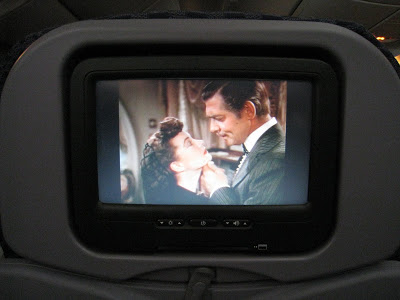
My in-flight movie screen on United Airlines flight from Frankfurt to Houston--
Clark Gable and Vivien Leigh in Gone With the Wind (1939)
I have a confession to make-- I have never seen Gone with the Wind. Sure, I know the basic plot summary and context surrounding the production, and have seen important sections of the film and those many iconic clips that are routinely played at the Oscars almost every year, but much like my relative dislike for James Cameron movies (i.e. Titanic (1997) or more recently Avatar (2009)), I prefer to engage with these kinds of movies on a “need to know for the purposes of film history” kind of level.

In the case of Gone with the Wind (1939), I have held a particular aversion to the film for the combination of its length (3.5 hours) and its melodramatic take on the American civil war—watching Scarlet O’Hara played by Vivien Leigh makes me squirm and I much prefer the hilarious send up of the actress’s performance made famous by Carol Burnett in a skit many claim is the best ever in comic television (see YouTube clip below). Normally, I will only invest that kind of time and focused attention on epic films of the Kubrick Spartacus (1960) or Coppola Godfather (1972) variety. But it is amazing what a 10.5 hour flight and a drained battery on my Kindle will do to force a change in viewing habits.

Getting to my seat on a United Airlines flight from Frankfurt to Houston yesterday, I was thrilled to discover a new state-of-the-art personal entertainment system that was preloaded with hundreds of new release, foreign, independent and classic films like Citizen Cane (1941), Casablanca (1942), Bonnie and Clyde (1967), Dr. Strangelove (1964), and A Streetcar Named Desire (1951) to name but a few. Call it captive audience syndrome, but with serious time to kill and nowhere to reasonably escape, I quickly resolved to finally watch Gone With the Wind in its entirety--what the heck I thought, I am on my way to George Bush Airport in the deep South after all-- and assembled my list for an impromptu DIY film festival.

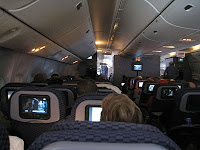
View from my seat
As I settled in and sat watching the films and the time ticked by, there was something a bit disturbing about seeing dozens of people watching individual movies on individual mini movie screens on the flight; the eerie glow on many jet-lagged faces in their own little worlds with complimentary drinks and pretzels in hand. I remember when in-flight movie screenings felt more like going to the traditional movie theatre, and the collective laughter and sense of communal viewing made watching the films feel like all of us were enduring the length and boredom of the long flight together. The films themselves were usually unimportant (and often quite bad) and it was more a tool to clock the flight’s duration. The new entertainment systems however are much more reflective of our current culture of TV and film viewing, which increasingly atomizes the experience based on personal taste and time preferences. In my case, I tempered the 3.5 hours of Gone With the Wind with 3 hours of Fellini’s La Dolce Vita (1960) and a couple of episodes of some hilarious TV show from Japan that I will likely never see again. Somehow this balanced things out and made the whole experience OK. But with the eventual adoption of Internet access to international flights in the months and years to come (already available on many US continental flights today) and the increasing ability to bring one’s own entertainment on board via the iPad and netbook, I am left wondering if the in-flight movie will disappear altogether?

Carol Burnett Show and the classic TV skit Went With the Wind (1970's)-- this is part one of two parts, enjoy!