An image capturing the sale of a Warhol Elizabeth Taylor portrait in 2007--
Actor Hugh Grant famously sold this copy for an $18.5 million dollar profit.
How soon can someone profit from a deceased celebrity’s image? This question appears to have been answered this week with the passing of movie legend Elizabeth Taylor and the announcement some 24 hours following her death of the auction of one of the most iconic Warhol portraits bearing her famous face and more infamous “violet eyes.” Currently owned by New York hedge-fund manager Steven Cohen, the 1963 silkscreen (Liz #5) will be sold May 12th as the Wall Street Journalreported today at the auction house of Phillips de Pury and is estimated to fetch in excess of $20 million dollars.
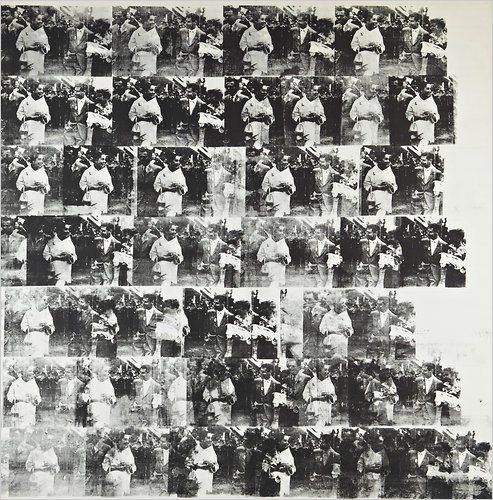
Warhol's Men in Her Life (1962) sold this past November
for a staggering $71.7 million dollars at auction
Just this past November, another of Warhol’s works featuring Elizabeth Taylor sold for a staggering $63.4 million dollars through the same firm, becoming the second highest price paid at auction for a Warhol (the record of $71.7 million for Green Car Crash was paid in 2007). Men in Her Life is a seven-foot tall black and white painting based on a Life Magazine photograph of Taylor with third husband Mike Todd and future husband Eddie Fisher. Fisher, like Taylor, had only recently passed away (in September 2010), when the painting went to auction.
Representing the personal drama of a public celebrity played out in Warhol’s famous mode of repetition, the painting and its high valuation has as much to expose about our own perverse focus on celebrity culture and the price we are all willing to pay for glimpses behind the carefully constructed representations of their “perfect” lives. No doubt, the Taylor-Todd-Fisher scandal has its resonance with today’s Jolie-Pitt-Aniston spectacle and the endless repetition of images accompanying their “real-life” story.
The public's desire for images and stories of celebrity's
"imperfect" lives continues as Warhol predicted
Seen in another light, the high profile auction of this category of art works reminds us once again of the often taboo subject of the art market and those commercial interests that persistently intersect with the production and circulation of art. It is also a reminder of the “umbilical cord of gold” connecting elites and art producers that art critic Clement Greenberg spoke about in his famous 1939 essay “Avant-Garde and Kitsch”, written against the backdrop of escalating interest and valuation in works of modern art during the inter-war period of the twentieth century. In this sense, the upcoming sale of Warhol’s Elizabeth Taylor portrait exposes the reality of art as commodity connected to the public’s insatiable desire for celebrity in its most stark, opportunistic, and highly profitable light.
Plagiarism is a serious academic offence that has become an increasing problem in the digitally mediated “cut and paste” world that students inhabit. The temptation to take another person’s ideas and insert them directly into your own essays is literally a click away, even while most overt plagiarism leaps off the page like a red flag to professors (trust me on this—most cut and pastes are easy to detect!). Still, what many students do not realize is how often their own unintended actions read as deliberate plagiarism. Consulting the "Actions That Might Be Seen as Plagiarism" chart, it is important to see just how wide ranging the act of plagiarism is.
The grey area of “building on someone’s ideas without citation” is the most common problem I see with student research papers, and I routinely encourage students to risk over-citing in their papers versus passing off ideas without proper recognition. Here is where the skill of paraphrasing comes in.
Paraphrasing is the act of re-stating ideas from a text or passage into your own words with proper acknowledgment.
At minimum, a failing grade on a paper is the most common action taken against plagiarism, intended or not.
It is a skill that will help you avoid the dreaded mistake of writing a research paper where you simply string together a series of quotes without proper introduction, analysis or citation (see Mistakes 2 and 3 in Top 10 Common Student Mistakes When Preparing Research Essays). Importantly, paraphrasing provides you with the opportunity to demonstrate your comprehension and analytical skills through the act of re-phrasing ideas that you come across in your research. There is of course a thin line between paraphrasing and plagiarism, but generally speaking, you can prevent this concern by reviewing examples of effective paraphrasing and ALWAYS citing the source of your paraphrase clearly and transparently.
The Purdue Online Writing Lab "Write It In Your Own Words" is an excellent source to check out to help you practice this skill. I also encourage you to avoid the perils of unintended plagiarism through a few common sense practices outlined beneath the chart linked above: 1) Avoid procrastinating when it comes to the actual writing of your papers—leaving this part of the process to the last minute leads to desperate acts of “cut and paste”; 2) give yourself ample time to revise and edit your paper to catch unintended plagiarism in sections of your writing; 3) proof-read, proof-read, proof-read and then buy a friend a coffee to do the same. Remember that even unintended plagiarism can be grounds for a failing grade and possible disciplinary action at your university. Academic integrity stands at the foundation of the university endeavour and most professors are on high-alert to identify and expose plagiarism when marking. Learn to guard yourself through improving your writing and citing skills.
March madness and all things end-of-term related continue, and so I will make my entry short and sweet.
Twitter celebrates its fifth birthday tomorrow-- the San Francisco based company has over 175 million registered users delivering a billion or so tweets a week. For those of you still unsure about how this form of social networking works, check out this informative essay "How Twitter Will Change the Way We Live" published two years ago by Time Magazine-- it is a very insightful and critical article that helps explain some of Twitter's "mystique".
As for me, I have to get back to work, but here are some of my favourites from around the Twitterverse this past week. Happy Sunday!
Leo Steinberg, Adventurous Art Historian, Dies at 90
For us, social media is more than just fluff. It (powered by you!) is helping us do important research
Graffiti artist's past is tagging behind him - Bellingham Herald
The most beautiful painting in the world?
How to Really Piss Off Your Facebook Friends
A discussion board which higlights favorite finds on UbuWeb. Really a great & useful selection
Luxist: Roman Abramovich was buyer of $106.5 mil Picasso. Probably.
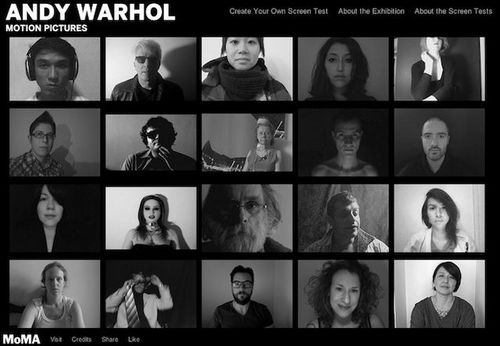
A screen grab from the Museum of Modern Art's Warhol: Motion Pictures Exhibition
featuring stills from the DIY Screen Test project.
With all of the discussion of celebrity artists and artists as celebrities in the contemporary art world, I was very intrigued with the Museum of Modern Art’s interactive component “Create Your Own Screen Test” as part of their popular Andy Warhol: Motion Pictures exhibition. Referencing the iconic Warhol project which captured hundreds of motion picture “living portraits” of famous and anonymous visitors to his studio between 1963 and 1966 (including the likes of Dennis Hopper, Bob Dylan, Lou Reed, Edie Sedgwick, and Allen Ginsberg), the do-it-yourself screen test featured on MoMA’s website provides everyday virtual visitors an opportunity to participate in what is described by the museum as “our modern update on Warhol’s process.” The four steps (outlined with very clear instructions) consists of 1) staging your film set; 2) recording your screen test; 3) uploading your screen test to Flickr; and 4) submitting it to MoMA.
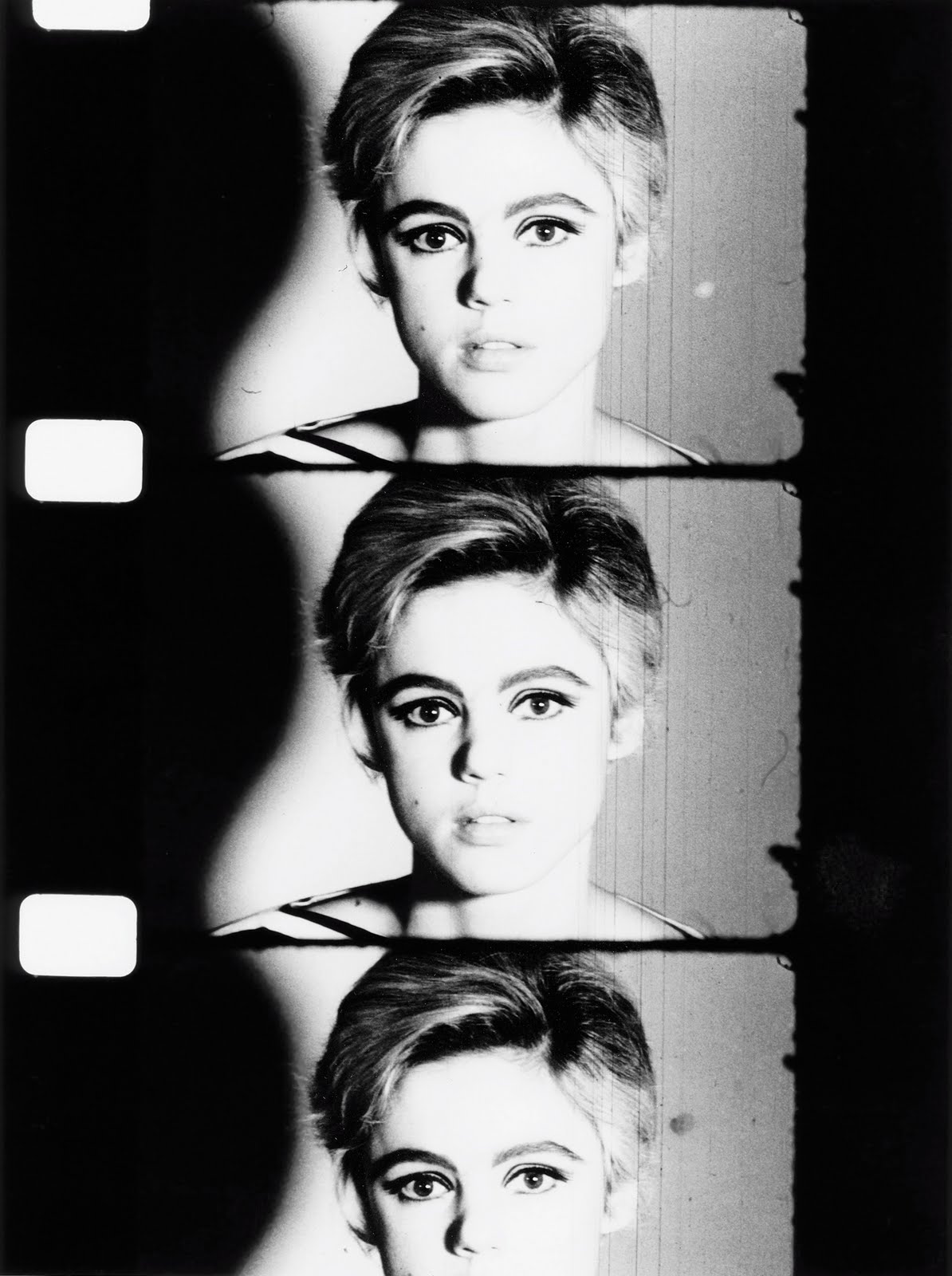
Edie Sedgwick, a famous subject of one of Warhol's
screen tests and one of the artist's "superstar" creations
Warhol’s process of course was all about interrogating the means through which the camera helped construct representations of celebrity. Screen tests had been used (and continue to this day) as a method through which directors tested the suitability of actors for particular projects in the process of casting their movies. As a tool through which to judge, it is also a tool to help determine the “marketability” of performers for major studio productions (you can check out these screen tests of famous actors to see this process played out). Most of Warhol's screen tests consisted of placing his subjects in front of a 16mm Bolex camera without any direction (he often left the room) and shooting two and a half minutes of silent black and white footage that was wholly determined by the 100-foot rolls of film used for the session. Through this set up, the artificial conventions of the director’s instructions were removed freeing up his subjects to be relived of the pressure to “perform” for the camera. As film historian Tony Rayns argues in his discussion of the tests, “The resulting films drastically reduced the roles of director and viewer alike. The director’s function was limited to choosing the subject, setting up the shot, turning the camera on and off and deciding whether or not to exhibit the result. And the viewer, for the first time in the history of the commercial exploitation of persistence-of-vision, was relieved of the obligation—perhaps even a large part of the desire—to pay attention to the screen."
For Warhol, the mechanisms of the camera lay at the heart of the proposition—the ability of film to capture something “special” that the naked eye could not make out. In a famous passage from The Philosophy of Andy Warhol, he ponders how the mechanisms of perception shift when an audience is confronted with a photographically based representation: “Beauties in photographs are different from beauties in person. It must be hard to be a model, because you’d want to be like the photograph of you, and you can’t ever look that way. And so you start to copy the photograph. Photographs usually bring in another half-dimension. Movies bring in another whole dimension. That screen magnetism is something secret – if you could only figure out what it is and how to make it, you’d have a really good product to sell. But you can’t even tell if someone has it until you actually see them up there on the screen. You have to give screen tests to find out.”
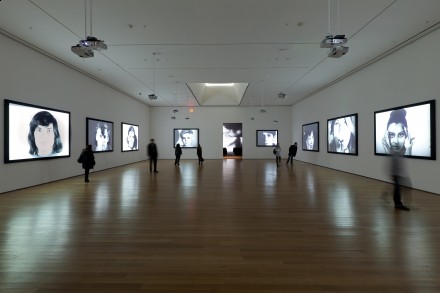
Seeing Warhol's Screen Tests in a museum setting is very different than viewing
the DIY Screen Tests on the MoMA website or in their original setting at Warhol's Factory.
(Image courtesy of ArtObserved)
In today’s media and celebrity obsessed culture, the opportunity to stage screen tests has grown exponentially with the birth of social media formats like YouTube. Every day it seems as if we are introduced to someone who has been plucked from obscurity to experience the 15 minutes of fame Warhol promised each of us. Indeed, as I looked through a number of the (now 646) screen tests on MoMA’s website, I realized just how far from the original proposition and purpose of Warhol’s screen tests this project had come. Within the new media context, the elements of speed, boredom, and distraction allow audiences to click through the tests in a completely reconfigured way, transforming the experience of duration, banality, and timeless presence of Warhol’s original screen tests. Much like the MoMA project accompanying Marina Abramovic’s The Artist is Present, we are left wondering just how indifferent people are to the camera recording them. In either case, I think Warhol would have been pleased with the evolving conversation about photographic seeing and the perception of celebrity in today's technologically mediated world. As Warhol famously asked, "Isn't life a series of images that change as they repeat themselves?"
See below trailer for 13 Most Beautiful... Songs for Andy Warhol's Screen Tests, a DVD release featuring 13 of Warhol's classic silent film portraits. People in the trailer in order of appearance: Paul America, Edie Sedgwick, Richard Rheem, Ingrid Superstar, Lou Reed, Jane Holzer, Billy Name, Mary Woronov, Freddy Herko, Ann Buchanan, Susan Bottomly, Nico, Dennis Hopper.
All of the proceeds from the following prints go directly to the rebuilding and rescue efforts currently underway in Japan (click on individual images for complete details). To donate and help support relief efforts directly, visit the Red Cross or Salvation Army websites.