Another incredible week of world events impacted by the Twitterverse-- one need only glance at the thousands of tweets streaming from the #tsunami and #earthquake and #Japan and #Tokyo hashtags for a sense of what is happening on the ground in Japan. All of this following the devastating earthquake and tsunami events in the country this past Friday. The sheer number of images and videos circulating on the Internet and other media are also contributing to an unprecedented visual document of what is happening there-- the event will no doubt be studied for years to come by visual culture theorists in this regard. But for now, we are once again watching and waiting as critical historical events unfold. Closer to home (where life seems thankfully far more banal) this morning's tweet from Douglas Coupland really said it all: "Daylight Savings. F*ck"
Situationist - iPhone App game where you have to interact with strangers
Twitter & Facebook have declined to sign onto Global Network Initiative to protect global free speech
Now Available - World Art's first issue is now available with #free online access throughout 2011!
As research paper writing season intensifies, I thought it would be useful to re-post a number of helpful links from my blog for those students working on encroaching deadlines. Keep in mind that your best resource remains the actual bricks and mortar library on campus and the many librarians on-site ready and prepared to help you with your research. Make sure you do not make the mistake of simply researching from your home computer alone. Accessing books and other useful materials at the library always leads to unexpected finds and avenues of research you may not have expected (see videos below). These following steps for completing your paper may also prove helpful:
Step One: Figure out how much time you have to complete your assignment and check out this link on "How to Finish a Paper On Time"
Step Seven: Use a consistent citing system like MLA and be sure you have the correct formatting for your citations by utilizing an on-line citation generator
Step Eight: Try scheduling your research and writing over a longer stretch of time and avoid the dreaded "all-nighter" by using an on-line "Time Management Tool"
Step Nine: While writing and finishing up your paper, be sure to consider the typical and avoidable mistakes made by students when working on research papers. Here are the "Top 10 Mistakes" Part One and Part Two.
Good Luck!
Here are some more helpful and reinforcing messages about the QUALITY versus QUANTITY of research that you do:
Both art events take place within weeks of each other
annually in New York City
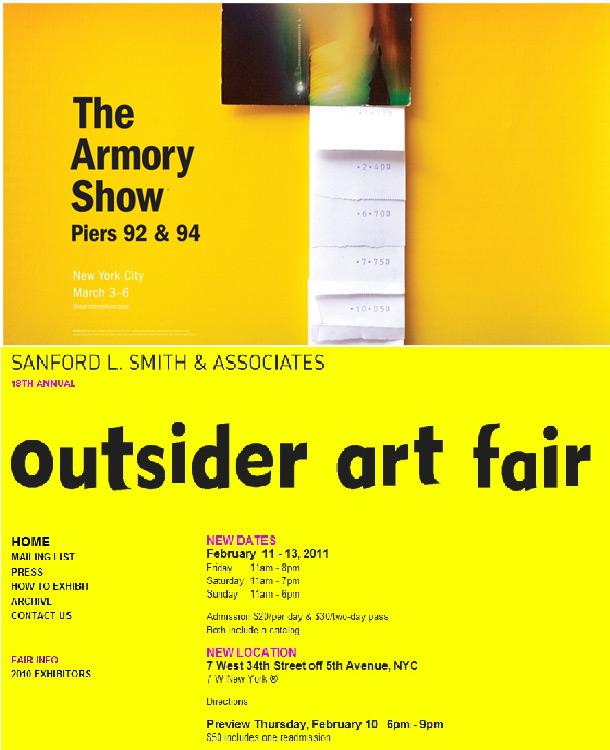
Over this past weekend, artists, critics, galleries, collectors, and curators from around the world descended on New York to take part in America’s preeminent art fair, The Armory Show. Advertised as the leading fair devoted to the most important art of the 20th and 21st century, the event has become an annual fixture predicting many of the trends and interests of the art market and its network of dealers. Split into two main exhibitions (the Armory Show Modern and the Armory Show Contemporary) and a series of satellite shows around other parts of the city, the fair is open to the public and allows individuals a chance to peruse and purchase artworks ranging in value from hundreds to millions of dollars. In this sense, there is often a palpable love/hate relationship between contemporary artists and the fair since the primary interest of many attendees relates to the commercial aspects of the international institution. Paddy Johnson, art writer and founder of the popular Art Fag City blog, produced a wonderful summary of the event that captures the spirit of this tension-- she includes a Trendwatch report that includes an Armory Show Bingo Card featuring the common motifs of this year’s fair (apparently lots of neon, cubes, and the colour yellow).
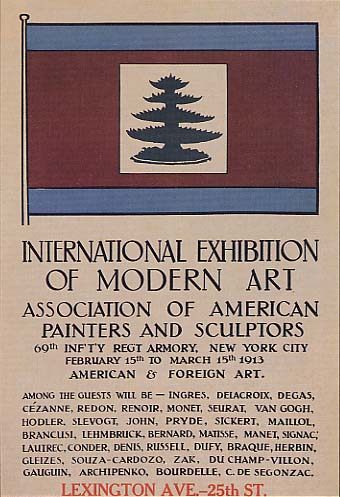
The original poster for the first Armory Show in 1913.
A virtual tour of the first show can be found here
The spectacle and many conversations created around an art fair is of course part of the draw. The original Armory Show of 1913, from which today’s fair takes inspiration, was a pivotal moment in the history of American art when the public was first introduced to the art of modernism on a grand scale. With the many radical works exhibited, famously including Marcel Duchamp’s Nude Descending a Staircase(1912), the goal was to challenge audiences accustomed to more figurative or realist approaches to painting and allow a new generation of artists articulate a modern vision in keeping with new European art movements such as Cubism, Fauvism, and Expressionism. Then, like today, the question of what constitutes “acceptable” and “good” art was largely decided within the complex network of artists, critics, curators, dealers, and galleries that held stakes in the outcome of how particular art was perceived. And then, like today, the issue of artistic transgression and pushing art beyond acceptable limits was also up for debate.
Still, what separates the original spirit of the Armory Show from its contemporary counter-part is its mainstream appeal. As a result, other kinds of art fairs have emerged in recent years to challenge the huge influence and residual impact of the Armory Show on the world of contemporary art. Of these, the Outsider Art Fair (now in its 19th year) takes place in New York several weeks ahead of the Armory Show, creating a welcome contrast and new source of inspiration for many contemporary artists. Outsider art was a term originally coined to categorize a range of self-taught and “naïve” artists operating outside the institutionalized world of art schools and gallery systems. Today, the term has also come to connote a range of art practices that do not fit comfortably within the contemporary art parameters determined by an art fair like the Armory. Indeed, comparing the events (see the videos below) it is interesting to note the different kind of vitality and community engendered with the exhibition. As one New York Times art critic noted while covering the Outsider Art Fair, “For those of us caught up in the art world, it offers a corrective, or at least a temporary window into another world.”
You can compare these two video overviews of the recent 2011 Armory Show (Vernissage TV) and Outsider Art Fair (James Kalm Report):
March is traditionally the craziest month in my academic schedule, and this year proves no different. It seems that every weekend is filled with a new opening, student event, or must-see exhibition. Even so, it is wonderful to see the vitality of springtime take hold and the hard work of students take shape. I have been so impressed with the range of creativity coming out my classes and seminars—this truly is my favourite time of the term. Secretly however, I am already looking forward to the summertime—final bookings for our trip to Europe had much of my past few weekends preoccupied—and it has certainly paid to get all of arrangements scheduled early.
In terms of the Twitterverse, this past week proved that Twitter is as prone to the whims of celebrity as it is to the aims of protesters. Charlie Sheen somehow managed to attract just under two million followers after joining Twitter early in the week—this has to be some kind of a record and I am sure will keep the cultural studies people talking. And while his tweets are somewhat entertaining (in a sad and train-wreck kind of way), here are some of my (Sheen-free) favourites from the past week:
Van Gogh paintings as pie charts
"Sound Sculpture" A collection of essays by artists surveying the directions of sound sculpture. (1975)
Has Banksy Finally Been Photographed? - Moviefone UK
The architect's life: Frank Lloyd Wright's 10-point manifesto for his apprentices ("Fertility of Imagination")
Internet Sleuths Prove Qaddafi's Son Plagiarized His PhD Thesis
The recurring "exam nightmare.
The Bermuda Triangle of Productivity...is this what your typical day looks like?
The new 2009 edition of the book with an aptly chosen
picture of the Louvre Pyramid on the cover
Art History is arguably one of the most disciplined of all the academic disciplines. This is an idea that was introduced to me very early in my graduate training and one that reflects the self-conscious nature and high stakes involved with how histories of art have evolved and become institutionalized within academia. To be sure, it is difficult to ignore the great degree of order and progression built into the “story” of art that unfolds within a typical undergraduate art history program. Students are still routinely faced with survey courses that attempt to seamlessly connect decades of historical development through engagements with significant art movements and, by extension, a limited range of art producers. And even while there are survey textbooks that have attempted to disrupt the progressive and modernist approach to the history of art and its many consequences (see my discussion on the Art Since 1900 series), art historians are often left with the job of intervening in their own teaching of art’s history to bring awareness to its highly constructed nature and the many embedded discourses within the written histories of art that can be sidelined.
I kind of miss the 1998 edition with a
section of Hans Holbein's Renaissance painting The Ambassadors (1553) on the cover
As the next installment of my Essential Readings series, Donald Preziosi’s The Art of Art History attempts to bridge many of these concerns with an anthology of key texts that positions art history as firmly part of a broader intellectual historiography. Beginning from the premise that art history has been written and rewritten since classical antiquity, Preziosi contextualizes the anthology with an important discussion about how the foundation of modern art history was part of a larger project to reposition and establish a particular understanding of art’s function in the late eighteenth century. Critically, Preziosi opens the anthology’s introduction “Art History: Making the Visible Legible” with a key assertion: “Art history is one of a network of interrelated institutions and professions whose overall function has been to fabricate a historical past that could be placed under systematic observation for use in the present.” Preziosi (an important and influential art historian in his own right) establishes and broadens this thesis through the 35+ key texts assembled for the book which read like an unfolding examination of the mechanisms of art history’s various networks and the kinds of themes and subjects that have most captivated and interested the discipline as a whole. Authors range from Immanuel Kant, Alois Riegl, and Michel Foucault to Mieke Bal, Rosalind Krauss, and Jacques Derrida.
I was first introduced to this text as part of a third year undergraduate methods and art theory seminar-- and yes, it is challenging. The thematically based chapters and readings could easily constitute their own separate courses. Still, I find myself returning to the book again and again as both a reference tool and as a point of departure to other key texts cited in the anthology’s extensive notes. The first edition of this anthology appeared in 1998 and I still recommend checking it out for its comprehensive scope and cornerstone texts, but you can also purchase the most recent 2009 edition which has updated themes and includes an entirely new section on Globalization and a new concluding essay by Preziosi. While challenging-- the history of any history tends to be--I still believe the book essential to anyone interested in probing how art’s history has been (and continues to be) shaped.