
• Fall 2025
  • Blog
  • Resources
  • Field School
  • Students
  • Feedly
  • About
Menu

Avant-Guardian Musings

  • Fall 2025
  • Blog
  • Resources
  • Field School
  • Students
  • Feedly
  • About
large monogram_2018-02-01_22-31-07.v1 (1).png
“Art is an outlet toward regions which are not ruled by time and space”
— Marcel Duchamp

Avant-Guardian Musings is a curated space of ideas and information, resources, reviews and readings for undergraduate and graduate students studying modern and contemporary art history and visual art theory, film and photography studies, and the expanding field of visual culture and screen studies. For students currently enrolled in my courses or the field school, the blog and associated social media links also serve as a place of reflection and an extension of the ideas and visual material raised in lecture and seminar discussion.

Blog RSS

Screenshot 2018-02-05 20.56.45.png
Blog
KPU FINE ARTS PARIS + VENICE BIENNALE FIELD SCHOOL (MAY/JUNE 2026)
about a month ago
"No Fun City" Vancouver: Exploring Emotions of Detachment in Palermo, Sicily at AISU
about 2 months ago
Making Sense of Art in the Age of Machine Learning—A Suggested Reading List
about 3 months ago
From the Archives | How (And Why) To Take Excellent Lecture Notes
about a year ago
Weekly Musings + Round Up... And A Few More Things
about 2 years ago

Screenshot 2018-02-05 20.56.51.png
The CEO of our household reflecting on his year 🐈✨🎄
.
.
.
#caturday #banksycat #endofyear #holidayseason
The CEO of our household reflecting on his year 🐈✨🎄 . . . #caturday #banksycat #endofyear #holidayseason
Frank Gehry’s passing today at 96 years old marks the remembrance of a daring, risk-taking artistic visionary. Gehry’s aesthetics, process, and design philosophy have always resonated deeply with me as an art historian invested in the stu
Frank Gehry’s passing today at 96 years old marks the remembrance of a daring, risk-taking artistic visionary. Gehry’s aesthetics, process, and design philosophy have always resonated deeply with me as an art historian invested in the study of spatial disruption and urban space. One of my most prized possessions is a Gehry designed torque ring that I purchased in New York back in 2006 and wore religiously in the years I was completing my Ph.D. as a kind of talisman. My love of silver is Gehry inspired too 🩶 Over the years I have been fortunate to visit, teach, and share knowledge of his many amazing buildings all over the world, always telling students that architects are among the most powerful people in society. Frank Gehry was arguably one of the most risk-taking and dare I say avant-garde architects and artists of our generation. “It’s not new that architecture can profoundly affect a place, sometimes transform it. Architecture and any art can transform a person, even save someone.” Frank Gehry Photos (my own) from Las Vegas (Ruvo Building), Paris (Louis Vuitton Foundation), Chicago (Jay Pritzker Pavilion), Los Angeles (Walt Disney Concert Hall), and my much loved and worn Gehry torque ring he co-designed in a collection with Tiffany and Co. #frankgehry #architecture #urbanspace #urbanism #arthistory
Proof of life photo 📸 Taken on the last day of classes of the fall semester. I survived… barely 😥 Countdown to Christmas vacation!
.
.
.
#arthistorianlife #endofsemester #ootd #iykyk
Proof of life photo 📸 Taken on the last day of classes of the fall semester. I survived… barely 😥 Countdown to Christmas vacation! . . . #arthistorianlife #endofsemester #ootd #iykyk
Aren’t we all tho? 🤔

#christmasshopping #literaryfiction
Aren’t we all tho? 🤔 #christmasshopping #literaryfiction
“Knitting is the saving of life”— Virginia Woolf 🩶
.
.
.
#knitterofinstagram #knitting #woolandthegang #knittersgonnaknit
“Knitting is the saving of life”— Virginia Woolf 🩶 . . . #knitterofinstagram #knitting #woolandthegang #knittersgonnaknit

Screenshot 2018-02-05 20.57.02.png
  • November 2025 (1)
  • September 2025 (1)
  • August 2025 (1)
  • September 2024 (1)
  • February 2023 (1)
  • January 2023 (3)
  • August 2022 (1)
  • March 2022 (1)
  • February 2022 (3)
  • January 2022 (4)
  • November 2021 (2)
  • October 2021 (3)
  • September 2021 (3)
  • July 2021 (2)
  • June 2021 (1)
  • May 2021 (3)
  • April 2021 (3)
  • March 2021 (3)
  • February 2021 (4)
  • January 2021 (5)
  • December 2020 (3)
  • November 2020 (6)
  • October 2020 (4)
  • September 2020 (1)
  • July 2020 (1)
  • June 2020 (4)
  • May 2020 (9)
  • April 2020 (5)
  • December 2019 (2)
  • November 2019 (5)
  • October 2019 (3)
  • September 2019 (1)
  • July 2019 (6)
  • June 2019 (19)
  • April 2019 (2)
  • March 2019 (5)
  • September 2018 (2)
  • July 2018 (1)
  • June 2018 (4)
  • May 2018 (2)
  • April 2018 (5)
  • March 2018 (5)
  • February 2018 (8)
  • January 2018 (3)
  • December 2017 (4)
  • November 2017 (5)
  • October 2017 (7)
  • September 2017 (3)
  • July 2017 (6)
  • June 2017 (15)
  • April 2017 (2)
  • March 2017 (3)
  • February 2017 (1)
  • January 2017 (2)
  • November 2016 (2)
  • October 2016 (1)
  • September 2016 (3)
  • August 2016 (1)
  • June 2016 (2)
  • May 2016 (3)
  • April 2016 (2)
  • March 2016 (5)
  • February 2016 (7)
  • January 2016 (9)
  • November 2015 (1)
  • October 2015 (2)
  • September 2015 (3)
  • August 2015 (3)
  • July 2015 (1)
  • June 2015 (20)
  • May 2015 (4)
  • March 2015 (2)
  • January 2015 (1)
  • November 2014 (1)
  • October 2014 (2)
  • June 2014 (1)
  • May 2014 (4)
  • April 2014 (6)
  • February 2014 (1)
  • January 2014 (2)
  • November 2013 (1)
  • September 2013 (1)
  • July 2013 (3)
  • June 2013 (10)
  • December 2012 (1)
  • November 2012 (3)
  • October 2012 (6)
  • September 2012 (3)
  • August 2012 (1)
  • July 2012 (1)
  • June 2012 (25)
  • May 2012 (5)
  • April 2012 (4)
  • March 2012 (7)
  • February 2012 (11)
  • January 2012 (6)
  • December 2011 (5)
  • November 2011 (11)
  • October 2011 (11)
  • September 2011 (8)
  • June 2011 (9)
  • May 2011 (15)
  • April 2011 (9)
  • March 2011 (14)
  • February 2011 (17)
  • January 2011 (16)
  • December 2010 (11)
  • November 2010 (18)
  • October 2010 (24)
  • September 2010 (30)

Screenshot 2018-02-05 20.57.07.png

© Dorothy Barenscott, Avant-Guardian Musings, and dorothybarenscott.com, 2010-2023. Unauthorized use and/or duplication of this material without express and written permission from this blog’s author is strictly prohibited. Excerpts and links may be used, provided that full and clear credit is given to Dorothy Barenscott, Avant-Guardian Musings, and dorothybarenscott.com with appropriate and specific direction to the original content.

The best way to study for an art history exam? Flashcards.

The best way to study for an art history exam? Flashcards.

Focus on Tech: Art History Flashcards

February 24, 2014

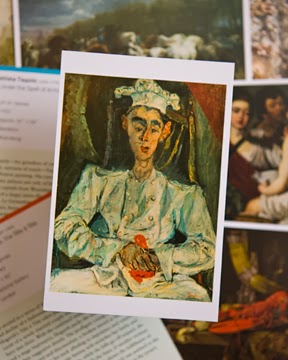
It is closing in on midterms and I am once again urging my students to utilize the time honoured tradition of "old school" techniques for studying. To this end, nothing beats a well crafted deck of flashcards. Remember those? You were probably first introduced to them in kindergarten when learning the alphabet or later in grade school when mastering simple arithmetic and multiplication tables. On the one side, a question or problem or image, and on the other, the solution or description to memorize.

When it comes to art history, students are often intimidated with the vast array of visual images that they are assigned to study for exams. The typical first or second year art history exam involves studying many dozens of art objects and being shown a small selection of these images projected on a screen for a set amount of time with the instructions to identify the artist, title, and date and answer a specific question related to the art work's form, content and/or context. While this may sound daunting, what I remind students of is that art history exams are among the only kind of test that provide the luxury of placing the "answer" as it were right in front of them. In other words, even if you cannot identify all of the art work's constituent elements, there is always the possibility of drawing from what you see, or being reminded by association what the answer to the question could be. This is especially true if you are a visual learner.

Enter the flashcard. At its simplest level, the flashcard is useful to help associate all of the relevant information gathered via lecture, textbook, and outside reference material into one focused place related to any individual art work. In the flashcard sets I used to make in university, I would glue a colour copy of any art work I was studying, while on the back, I would categorize the information I was studying into three categories based on

FORM, CONTENT, and CONTEXT:

1) FORM: All of the details related to the medium, composition, scale, and description of the art work independent of meaning.

2) CONTENT: The subject matter and story or implied meaning of the art work that is derived by simply assessing the work without knowledge of any additional historical information-- the "what you see is what you get" kind of thing related to the themes and ideas represented in the art work.

3) CONTEXT: This is the largest category of information that includes all of the relevant circumstances in which the art work was produced and circulated. To avoid getting overloaded with too many details, here is where I tell students to isolate those aspects of history, theory, and artist details that the professor focuses on in their lecture first, and then add in any additional information provided in the textbook that helps extend those observations afterwards. Remember that most professors will draw midterm questions directly from their own lecture notes, and/or focus on themes and ideas that were being discussed more broadly when the individual art object made its appearance in the lecture. This is why it is always a good idea to take lecture notes that tie big ideas and themes to specific art works under discussion.

Now, you can make these flashcards the old fashioned way using index cards, colour photocopies, scissors, glue and pen, or you can check out some of these techie methods listed below to produce digital flashcards, saving trees and maybe a bit of time (depending on whether you have digital notes and images handy). Either way, the creation of the flashcards is as important as the actual studying you will be doing with them later. Here are some free flashcard applications and software to check out that either I have used or have been used by my students:

  • Flashcard Machine: This is one of the older of the applications, created by a BFA student who wanted to create a simple way to produce flashcards using digital means. It is very simple to use, but does require you to upload images to a database before using.
  • Fauxflash: A simple, quick and easy set up for creating on-line flashcards. This site makes them public, so that you can share your flashcards and/or collaborate with friends, but you can also "hide" them by simply forgoing the addition of a category or easy to search title for your deck.
  • Evernote Peek: For iPad users, this application works with your tablet cover to help create a desk top flashcard that shows you snippets of information that prompt you to figure out the information or image being memorized. This one requires a bit more set up, but it is private and can be more customized for those concerned with design.
  • ProProfs Flashcards: this application is one that many of my students have used and allows users to create and share flashcards as a group over social media, making that art history scene in Social Network come to life in new ways!

The fun part begins after the flashcards are made. Enlist your friends, family, and loved ones (you know, the ones who keep asking you what you are up to in school) and have them test you with the cards. It is a proven fact that the best way to learn about a subject is to teach it to someone else, so it is great to use the flashcards with someone who knows little about your subject area. Their natural curiosity and questions will help draw out important information from you and put you in the position of "expert." You will also likely remember these bits of conversation when the image appears as if magic on the screen during an exam. And even if you cannot recall every detail, chances are you will remember enough information about the art work to provide a decent answer. Good luck studying!

← Meditation on Time: The End of Term Reckoning, A.K.A. The Graduation ExhibitionTen Books To Share On My Current Wish List →
Back to Top
Screenshot 2018-02-05 20.48.17.png

© Dorothy Barenscott, 2010-2025