VIFF Preview| ANPO: Art x War, Desert of Forbidden Art, Thomas Mao

The Vancouver International Film Festival kicks off today! I will continue to preview art related films periodically through the next two weeks.
Let the viewing begin!

Let the viewing begin!

Art history has not always done a good job of considering the site-specific histories of the places and cultures that fall away from the “canon” forming the core of the discipline. In fact, the recent conference I attended in Poland is part of a larger ongoing effort to re-think how the narratives of modernism, the avant-garde, and modern art have privileged a very narrow focus on Western European and North American art production. As Polish art historian Piotr Piotrowski questions in a consideration of the new “critical geography” that is attempting to recast art historical research, “We should wonder to what extent [critical geography], is aimed towards disclosing the centre of power—that is the West, and to what extent it rejects its dictatorship and—like feminist, postcolonial and other deconstructive practices—is based on a pluralistic and non-hierarchical concept of the subject.” While this approach is vital, it is clear that the limited access to remote archival information and visual materials, especially during the Cold War and up until only a few short decades ago, has prevented the kind of cross-cultural and cross-national research that is needed to broaden art history's often narrow scope.
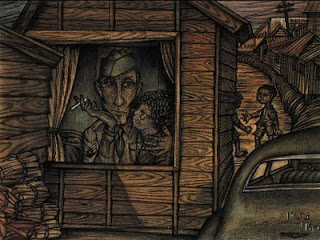
A Japanese protest painting featured in ANPO: Art x War 

A Japanese protest painting featured in ANPO: Art x War 

Three films set to screen at the Vancouver International Film Festival, ANPO: Art x WarThomas Mao, and Desert of Forbidden Art, provide recent examples of how site-specific histories and new concepts of the subject are emerging in the discourse. Linda Hoaglund’s ANPO: Art x Warexplores the tensions that have given shape in Japan over the presence of US operated military bases in the country over the last six decades. Utilizing provocative and often highly conceptual paintings, photographs, and film segments created by Japanese artists protesting the presence (you can learn more by checking the artist biographies on the film’s website), Hoaglund constructs a visual dialogue that works against the traditional narrative expected of a documentary film.

Humour is an important element of Wen's film as seenin the official movie poster

Humour is an important element of Wen's film as seenin the official movie poster

In a similar vein, award winning Chinese novelist and film director Zhu Wen explores the dynamics of culture shock and spatial dissonance in Thomas Mao, a film that follows the unexpected meeting of an American artist backpacker and a Chinese farmer on the Mongolian grassland during the summer of the 2008 Olympics (in Beijing). And while shot in a documentary style, the film navigates the humorous collision of two very different world views with innovative techniques. Reading the Hollywood Reporter’s review for this film, it is clear that Zhu Wen is stepping far out on a limb with both his visual and narrative approach: “Filled with as many laugh-out-loud farcical gags as high brow visual aesthetics, Thomas Mao is a refreshing aperitif for the artsy crowd yet relatively accessible to an open-minded western audience. Within China's current filmmaking trends, it juts out like a lone palm tree in a desert oasis. The majority audience will probably be festival audiences and China's art in-crowd.”

And finally, Desert of Forbidden Art examines the aftermath and stakes involved with recuperating and creating a museum for works of the Russian avant-garde that were criminalized during the period of the Soviet regime. The film focuses on the life of Igor Savitsky, a Russian painter, archaeologist and art collector whose own paintings were banned by the Soviets. But through an act of resistance and desire to create a space for the “forbidden” works of the Russian avant-garde, Savitsky quietly begins collecting thousands of banned art works over several decades (often covertly with state funds) and builds a museum in the remote desert of Uzbekistan. Today, the Nukus Museum houses one of the most important collections of Russian modern art, and in an ironic twist is now the target of Islamic Fundamentalists—all of which gives this film another critical dimension in terms of the complex cultural politics at play.

Thomas Mao will be running at VIFF on Monday, October 4th @ 6:45pm (Pacific Cinematheque) and Tuesday, October 5th @ 12:20pm (Granville 7)

ANPO: Art x War will be running at VIFF on Sunday, October 3rd @ 6:00pm (Granville 7) and Monday, October 4th @ 1:15pm (Pacific Cinematheque) The Desert of Forbidden Art will be running at VIFF on Saturday, October 9th @ 3:20pm (Granville 7), Sunday, October 10th @ 6:00pm, and Thursday, October 14th @ 10:45am (Pacific Cinematheque).

Focus on Tech| How to Digitally Record Lectures (BONUS: Tech-Related Films at VIFF!)

Every semester I am asked by students whether or not they can record my lectures. My standard answer is "Yes, just let me know that you are recording me" and then I ask them not to use the audio files beyond personal study use. What many students do not realize is that lecture recordings and professor's personal lecture notes (including all visual aids such as the PowerPoint presentations I discussed last week) are considered intellectual property and are not to be sold or distributed beyond what is considered the "fair-use" of those items for personal and group study. Many universities also have specific digital recording policies in place that require students to ask permission to make recordings of class lectures-- so be very aware. That being said, I wanted to provide some useful tips and links on how best to record lectures using a variety of technical options. Keep in mind that the recordings should ideally supplement your active listening and note-taking in lecture, and not act as a replacement for attending lectures.

LAPTOP:  if you are in a smaller classroom environment or able to sit close to the professor, the use of a laptop computer is a viable option for recording lectures. You can run an external USB microphone  directly into most laptops that enable the sound quality and clarity to improve substantially over a straight recording using the basic laptop microphone. Here is a very basic how-to guide to get started.

iPOD TOUCH, NANO & BLACKBERRY: With a small thumbtack microphone and Griffin Technology's  iTalk app, you can adapt a fourth generation iPod Nano and/or a second generation iPod Touch into a fairly adaptable recording device. Check this useful tutorial for more specific hints. You can also turn your Blackberry into a recorder with a memory card and the Voice Notes app that comes standard with the phone. See this great tutorial for more help. Once configured, you then simply ask the professor if you can place the device up by the lecture podium and create a very clear recording.

DIGITAL RECORDER: If you plan to make many recordings over your educational career, you might look into investing in a dedicated digital voice recorder. There are many on the market, but I did run across a recent forum discussion on the options available to students that you might find quite useful. 


VIFF Preview| The Woodmans and Waste Land

Francesca Woodman, Untitled (1978)
The story of art and family is always rich and compelling, as is the relationship between artists and the spaces they creatively inhabit. Each of these themes serves as backdrop for two fascinating films set to screen at the Vancouver International Film Festival in the coming two weeks: C. Scott Willis’s The Woodmans and Lucy Walker’s Waste Land.

The Woodmans, which took top documentary award at the most recent Tribeca Film Festival, centers around the internal dynamics and family relationships of famed photographer Francesca Woodman, a talented and enigmatic photographer whose haunting photographs and experimental films of nudes taken over nine short years (before her tragic suicide in 1981 at 22 years of age) have continued to captivate artists and art theorists interested in the permeable border between the photographer’s eye and the internal state of their chosen subjects. As art critic Elizabeth Janus describes in a FlashArt article about Woodman, “like other women artists of her generation, (Woodman) must have been aware of newly emerging film theories, particularly Laura Mulvey’s ground-breaking essay Visual Pleasure and Narrative Cinema (published in Screen in 1975) and its discussion of psychoanalysis and the social formations of the self through cinematic representations of women. These developments, as well as William Eggleston’s breaking through the color barrier in art photography, lead to a boom during the early 1980s that made photography the medium par excellence for artists interested in challenging the established criteria imposed on photography as art by modernist and pictorialist traditions.” The film, much like Woodman’s photographs, suggests an intimate encounter with the family of artists Woodman grew up with—her father George is a painter and her mother Betty is a ceramicist, both of whom have exhibited and shown works at high profile galleries in the U.S., and her brother Charles is an artist and art professor—and the undercurrent of competition and coming to terms with a family of creative individuals working to express their own vision operates at the core of this documentary film.

Vik Muniz, Socrates (1978)
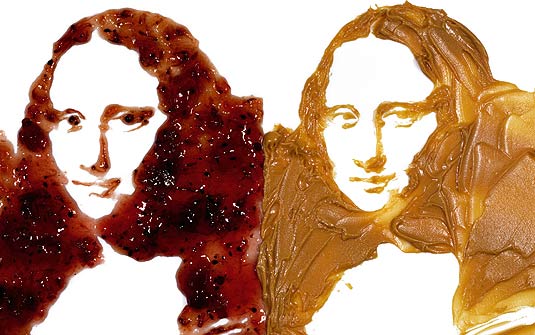
Waste Land, in a somewhat similar vein, is a documentary film that also tackles the personal relationships developed between contemporary Brazilian artist Vik Muniz and the garbage pickers that he befriends in Rio de Janeiro for collaborative art projects using the waste of the city. This collaboration goes back to 1998 and Muniz’s “Aftermath” project when the artist first began inviting street children to find pictures they identified with in art history books and then asked them to pose in the position of the principal figure for portrait photographs. Muniz would then collect street sweepings left over from the famous carnival in Rio de Janeiro and scatter them onto a light box, skilfully dusting and vacuuming part of the material away to leave a convincing replica of the original photograph (see image above). These portraits, together with Muniz’s other detailed works (he has made detailed replicas of Leonardo da Vinci's Mona Lisa out of jelly and peanut butter and worked in sugar, wire, thread, and Bosco Chocolate Syrup, to produce recreations of other canonical images in the history of art) point to the relationship between the superficial surface of images and their complex histories. Therefore, while the film features Muniz’s attempts to bring attention to the pressing social, political, and ecological conditions that have created the problems of Brazil (the film won the World Audience Award at the most recent Sundance Film Festival), his strong belief in the conceptual aspects of making art from trash and other unexpected materials features as a prominent undercurrent of the documentary as a whole.

The Woodmans will be running at VIFF on Thursday, September 30th @ 9:00pm (Vanccity), Saturday, October 9th @ 12:20pm (Granville 7), and Sunday, October 10th @ 6:00pm (Granville 7)

Waste Land will be running at VIFF Friday, October 1st @ 6:20pm (Granville 7) and Saturday, October 2nd @ 11:40am (Granville 7)

Trailers for both The Woodmans and Waste Land


James Franco| When art imitates life, imitating art, imitating life, imitating art......

As the latest issue of Esquire notes, "The Guy is Everywhere"
I get dizzy when I try to make sense of James Franco. I recall back in April when a colleague circulated an Artnet link about Franco being chosen to represent the United States in the 2011 Venice Biennale. Of course he wasn't-- it turned out to be a great and very effective April Fool's joke-- but it left the lingering question about who this actor was and why the art world was paying so much attention to him. Fast forward to this past summer, and I am left asking week after week, who is this guy and why is he always on my arts-related Twitter feeds? As the latest Esquire cover correctly points out, Franco is everywhere. But why?

In many ways, Franco is a walking, breathing contradiction. Recognized as a Hollywood actor by most people, Franco came to international attention playing a superhero in the Spiderman franchise and has since appeared in mainstream films ranging from Tristan and Isolde (2006), Pineapple Express (2008), Milk (2008), and a host of 2010 summer films including the Oprah approved Eat, Pray, Love (2010). At the same time, Franco has successfully positioned himself as a "thinking" actor and performer, taking on more "serious" acting roles in small, independent projects while simultaneously attending Columbia University's and Brooklyn College's M.F.A. programs and New York University's Tisch School of the Arts graduate film program in 2009/10 (recall Lady Gaga's connection). He is now apparently beginning a Ph.D. program in English and Film Studies at Yale, and some minor controversy is already being reported about the university denying his request to teach undergraduate classes as a TA (can you imagine?). An important aspect of Franco's interests therefore include the integration of performative and conceptual art theories which are routine aspects of MFA and Ph.D. art/film history training, but often come off as bizarre to many outside the art school context.

Franco playing "Franco" the multimedia artist on ABC's
General Hospital (courtesy ABC)
Take for example his recent role on the daytime soap General Hospital (already weird), where he plays the reoccurring role of the fictional "Franco" a multimedia artist like himself (weirder), who holds art exhibitions of works that the actor Franco makes, which are then promoted in real life galleries (confused yet?). Still, the recent trend of celebrities as artists does successfully initiate dialogue about the significance of contemporary art movements to a much broader public (see the new Click and Poll topic on my blog's home page concerning Joaquin Phoenix as another case in point), and so when the Wall Street Journal publishes Franco's thoughts on performance art, another audience is initiated into the world of art ideas. Instead of being cynical about it, I am trying to remain intrigued and wonder if this is a sign that the mainstream culture as a whole is undergoing part of a radical shift where the mechanisms of celebrity culture will be subverted and exposed more effectively. In other words, Franco's either convincingly mediating the often polarized worlds of high art and popular culture, or he is duping all of us. I bothered to blog about him, so I guess the joke might also be on me (but I would let him be my TA-- no one would skip class).

**The range of Franco material on YouTube reflects the contradictions I have tried to conjure in my post. See for example this experimental film by Carter, Erased James Franco, where Franco plays both himself "re-enacting" every television and film performance from his career-- he calls it his favourite performance-- and this most recent clip of Franco playing Allen Ginsberg (very well I might add) in the soon to be released biopic Howl. At the other extreme, see this spoof of Franco's Gucci commercial outtakes. But the clip I have chosen dovetails nicely with my post on Marina Abramovic from last week (ironically enough, it will be appearing in the upcoming Abramovic movie I discussed). Here is the oddly humorous video of Franco visiting Abramovic's "The Artist is Present" exhibition at MoMA-- I am calling this "The Celebrity-as-Artist meets the Artist-as-Celebrity." I hope you enjoy the bizarre juxtaposition as much as I did.

Weekly Twitter Round Up| Click and Muse


Twitter has become my minor obsession the past several months. So much terrific information and great context to help expand many of the news events and sound bites we encounter during the week. Instead of re-tweeting it all, I will continue sharing the favourites I gather over the week each Sunday. For added convenience, you can click on the Twitter icon profile next to each tweet to check out the feed for each entry.

As for the first "Click and Muse" poll conducted over the past several weeks, the results to the question of whether Murakami's artworks are "high art" or "commodity fetish" are in:  26% say high art and 74% say fetish. I will start introducing the poll weekly and announce the results each Sunday. Check out the new poll (now moved up higher on the blog's home page) concerning the recent admissions of actor Joaquin Phoenix. Simply click on the image, consider and muse over the question posed, and vote!

Et tu, Facebook? John Lopez, Harvard '03, reviews The Social Network


Ever since serious art was invented some sort of subsidy has been required to protect it from the market


"We have art in order not to die of the truth." (great daily Nietzsche quotes)


Michael Douglas reprises oily Gordon Gekko in a timely but overloaded sequel.


40th anniversary celebrations begin for radical publishing house Verso Books with the unveiling of a new website: www.versobooks.com


See How Twitter Has Changed People's Lives


The Art of New York Fashion Week