Focus on Research| How to Create Effective Lecture Notes

Biggest note-taking mistake in lecture? Trying to write down everything
the professor is saying. Learn to discern what is important to write down.
An evolving skill for most undergraduate students is the ability to take good notes in lecture class. This is another of those tasks, along with preparing for seminar/tutorial discussion, learning to make use of PowerPoints, and scheduling to complete assignments on time that is usually left to students to figure out for themselves. Looking back on my own notes taken from university lectures, I can see this progression in action, moving from the attempt to write everything down in my first year in pages upon pages of notes (big mistake) to arriving at a system of highlighting key terms and creating quality notes while building the confidence to listen more and write less in class (far more effective and less stressful). All of this was gained from trial and error, and so I have attempted over the years to come up with a variety of pointers to help students with note-taking, many of which are usefully summarized in an online handout I recently discovered (and can be downloaded) from Dartmouth College.  The most useful part of this handout is found in a section titled “Note Making” that I have reproduced for you here:
  1. Don't write down everything that you read or hear.  Be alert and attentive to the main points.  Concentrate on the "meat" of the subject and forget the trimmings.
  2. Notes should consist of key words or very short sentences.  If a speaker gets sidetracked it is often possible to go back and add further information.
  3. Take accurate notes.  You should usually use your own words, but try not to change the meaning.  If you quote directly from an author, quote correctly.
  4. Think a minute about your material before you start making notes.  Don't take notes just to be taking notes!  Take notes that will be of real value to you when you look over them at a later date.
  5. Have a uniform system of punctuation and abbreviation that will make sense to you.  Use a skeleton outline and show importance by indenting.  Leave lots of white space for later additions.
  6. Omit descriptions and full explanations.  Keep your notes short and to the point.  Condense your material so you can grasp it rapidly.
  7. Don't worry about missing a point.
  8. Don't keep notes on oddly shaped pieces of paper.  Keep notes in order and in one place.
  9. Shortly after making your notes, go back and rework (not redo) your notes by adding extra points and spelling out unclear items.  Remember, we forget rapidly.  Budget time for this vital step just as you do for the class itself.
  10. Review your notes regularly.  This is the only way to achieve lasting memory.
If you think of it from the professor’s perspective, the lecture is normally devised to introduce and develop core ideas and themes with supporting context, terminology, and theory—importantly, these are normally the very same ideas and themes you will be tested on during exams. For art historians, the addition of visual imagery and core discussion encapsulated around individual works of art creates another layer of context. In my case, I devise most of my 2 hour lectures around no more than 4-6 main arguments/ideas and core supporting images/video. Your job as a student is really to look for the logical flow of the lecture’s argument (i.e. what is the "story"of the lecture) and isolate those limited number of points that are potentially examinable and/or most significant to the lecture at hand. 

You can increase the effectiveness of your note-taking
ten-fold by simply dividing up the space of your notes
Another solid note-taking tool that I would recommend with this task is the highly effective but very straightforward Cornell note taking method—a system devised to help you practice identifying the most important parts of a lecture. If you look at the diagram of the system itself, it helps divide up a sheet of paper into three sections: 1) the NOTE TAKING column where you jot down the main ideas and questions raised in the lecture; 2) the CUE column where you periodically stop and summarize core concepts and terminology; and 3) the SUMMARIES section at the bottom of the page where you will return after the lecture to reflect and add additional ideas (from the textbook and/or other readings and sources) and gained while reading through the notes. This process is usefully summarized in another Dartmouth hand-out found here as a word document download. Whichever method you end up using, just remember that note-taking is highly individual all about the relationships you are building with the ideas being presented in class—take some time to make sure yours are more functional and productive than dysfunctional and stressful.

A simple and straightforward YouTube clip summarizing the Cornell Notes method. You will note in this example that the method also works great for taking notes on textbook and other types of readings:

Weekly Twitter Round Up


As many of us spent the weekend watching the important events of Egypt unfold, the Twitterverse played an incredibly vital role circulating information about what is actually transpiring on the ground. With the Internet effectively shut down by the Egyptian government, Twitter has stepped up support to ensure that the free flow of information be made a priority for those who have used the social networking service to post updates, pictures, and important minute to minute updates of what is happening on the ground (see the final Twitter link on this post for a timeline of what has been happening). Besides collecting some favourites for the week, I have been also following the reports and tweets concerning the vandalism that occurred in Cairo's Egyptian museum and have pasted a YouTube clip below from AlJazeera that shows footage and a report from the past several days concerning the event. The eyes of the world are watching....sending peace vibes to all.

Art History Study Abroad Programs and Scholarships | GoAbroad.com: GoAbroad.com's comprehensive directory of Art


Photos from the set of "Mad Men" by James Minchin III


Fascinating question. Can video games make us better people?


Mark Zuckerberg's Facebook page was hacked. What does this say about Facebook's security?


CBS 60 minutes Assange overtime video


Sundance 2011: A Complete Guide To All The Films - This is indieWIRE's frequently updated guide to the festival's films


EVERYTHING you need to know about #Egypt: timeline, who's who, quotes from the ground + more 


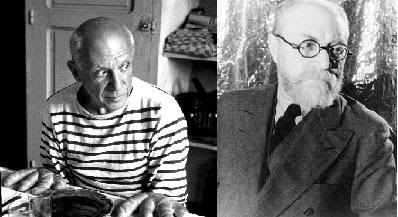
Quick Compare| Henri Matisse and Pablo Picasso on "Process"

Pablo Picasso and Henri Matisse, one of the twentieth century's
greatest artistic rivalry.
In a lecture this week discussing the rise of modernism in the early twentieth century, I discussed how the history of this period has been carefully constructed around the notion of artistic rivalries and the competition to see who can more successfully “evolve” and push for a revolution of form in the establishing narrative of modern art. Perhaps no bigger rivalry exists in this regard than the one forged between Henri Matisse and Pablo Picasso. For Matisse, the struggle to move away from a traditional painting method lead him to the experimental realm and an attack on Western traditions of painting at both the level of iconography and form. We see this worked out in his epic and radically perturbing painting Joy of Life (1906). For Picasso, the motivation was very similar, but his experiments lead him towards more of an attack on the stability of signs and the radical questioning of the rules of representation all together. The final result can be seen in his monstrous manifesto painting, and the painting perhaps best associated with modern art, Les Demoiselles d’Avignon (1907).

And even while these two paintings, created only a year apart, signal two landmark works in the history of modern art, they also represent a contrast in approach, stakes, and sensibility in the engagement with modernism. One of my favourite discussions of this rivalry and its many points of contrast can be found in the archives of Slate.com in an article by Jacob Weisberg who breaks down the differences between Matisse and Picasso along the one philosopher Friedrich Nietzsche established in The Birth of Tragedy between Apollonian and Dionysian Art. As Weisberg argues, 
“The Apollonian comes from the Greek god Apollo, the god of light, who was associated with rationality and its subspecialties law, medicine, and philosophy. The Dionysian comes from Dionysius, the god of wine and fertility, who was worshipped with drunken orgies in the woods at which nonparticipants were ripped to pieces. The Apollonian spirit is one of measure, reason, and control; the Dionysian is one of abandon, irrationality, and ecstatic release. The clash between the two principles was what produced Greek tragedy, according to Nietzsche. That Matisse is essentially an Apollonian artist and Picasso a Dionysian is evident even from the backhanded compliments they paid each other. Matisse called Picasso "capricious and unpredictable." Picasso described Matisse's paintings as "beautiful and elegant."
Weisberg goes on to produce a tongue in cheek list that I have pasted below to affirm these differences as an essential competitive struggle still being waged in contemporary culture. Where do you fit into this rivalry? Are you more of a Matisse or a Picasso?
Matisse's Joy of Life (1906) vs. Picasso's Les Demoiselles d'Avignon (1907)

Matisse
Picasso
Jane Austen
Charlotte Brontë
Eliot
Yeats
Freud
Jung
Superman
Batman
Left brain
Right brain
New York City
Los Angeles
Pope
Swift
Puccini
Verdi
Johns
Rauschenberg
Bush
Reagan
Ego
Id
Stravinsky
Schoenberg
Windows
Macintosh
Hillary
Bill
Wordsworth
Shelley
David Remnick
Tina Brown
England
France
Madison
Jefferson
Mort Zuckerman
Donald Trump
Hetero
Homo
Army
Navy
Heaven
Hell
Shaw
Wilde
White wine
Red wine
Aristotle
Plato
Slate
Salon
Bonds
Stocks
Leviticus
Genesis
Felix
Oscar
North Korea
South Korea
Classical
Romantic
Cocaine
Heroin
Mies
Le Corbusier
The Clash
The Sex Pistols
Irving Kristol
Norman Podhoretz
Protestantism
Catholicism
Kant
Rousseau
Mozart
Haydn
Empire State Building
Chrysler Building
Magritte
Dalí
Mickey Mouse
Donald Duck


To further this conversation, I have selected two clips of Matisse and Picasso in action-- it is always great to look back to these archival films to see the two "heavies" of modern art in action.


Weekly Twitter Round Up


A quiet and uneventful weekend (thank goodness for that!)-- finally settling in and getting into the groove of the new term with plans coming together for some travel in the spring and summer for research and leisure (the best combo!). On the local front, there are many terrific art offerings here in Vancouver with the PuSh Festival getting into full swing. As for the Twitterverse, I don't know what was in the air this week, but the tweets seemed just a bit zanier than normal and the art news was especially entertaining (as you will see with my favourite tweets of the week). Grab a cup of coffee, click on the links and enjoy.

When Truffaut met Godard


Kafka's favorite exercise was the most popular one of the early 1900s, and works today. Here's how to do it. WATCH


Ottawa gallery to rent out space for porn shoots 


The rising popularity of street art at auction 


Student pays college tuition in $1 bills


Drunken frat party presented as artwork by London artist Ed Fornieles


It's Jeff Koons' birthday? Don't send him a floral puppy or a balloon flower as a gift. He might sue you.