The Andy Monument (2011)by Rob Pruitt
(my photo, as are all subsequent images)
Rushing around New York City the last day of my trip, I was determined to find the new monument dedicated to Andy Warhol that I had read about a few days before leaving Vancouver. Created by artist Rob Pruitt and unveiled at the end of March, the 10 foot tall silver statue is placed in front of the last version of Warhol's famed Factory studio in Union Square operating in the 1970's and 80's (the original Factory operated on East 47th Street from 1962-1967). For those of you who have lived in or visited New York, you know how busy this part of the city can get (especially on weekends) and how vast the square actually is, so it was very difficult to find among the crowds on the weekend. I gave up and returned Monday morning to look for it and nearly gave up again until I finally saw the top of Andy’s silver head peeking out at the end of a very long corridor of food vendors set up at a farmers market near 17th and Broadway.
There he stood, Bloomingdale’s shopping bag in hand, a Polaroid camera around his neck, hanging out in a relaxed stance without much interest from local passers-by. That was of course until I started photographing him. And then, just as Warhol would have predicted himself, the buzz of celebrity and recognition hit the crowd. “It’s Andy” a man whispered to a child holding his hand, “he made really cool art.”
Doing some research, it turns out this was the same spot Warhol used to stand handing out free copies of Interview magazine and was also very close to the place he was shot in 1968 by Valerie Solanas. Pruitt began making the statue last October and completed it, according to an interview he did with New York Post, through a combination of hand sculpting and digital scanning of both a live model and photos of Warhol. As Pruitt explains, “Warhol would tell friends, ‘Death is like going to Bloomingdale's because it's heavenly.’” For now the monument is on temporary display until October, but Pruitt hopes to see the monument find a permanent home in the same part of New York that helped shape Warhol’s career. For more information about the artist Rob Pruitt (written by James Franco no less), see this link.
Just arriving back from a day of museum going in NYC—Guggenheim this morning and the Met this afternoon with plans for MoMA tomorrow. Yes, I am beyond exhausted, but I have a camera full of images and plans to blog over the coming week about what I have seen and experienced. My plans for doing all of this while here proved ambitious and nearly impossible—time seems to pass at warp speed in this city, and each day of my trip has been absolutely full as a result.
As for the Twitterverse, it has been buzzing all week with the arrest and detainment of Chinese artist Ai Weiwei. Calls for his release have been circulating all week and gaining steam as word of the Chinese government’s crack down on artists, intellectuals, and academics continues. If you are interested in signing the petition to call for Ai Weiwei’s release, see this link.
The trailer for Lars Von Trier's Melancholia is both very promising and very terrifying!
For those of you who can't seem to embrace new technology but don't want to be left behind...
You don’t sit there at 25, unpublished, and respond to Susan Sontag’s editorial suggestions like a little snot."
Art and inflation
Most Anticipated Books of Spring 2011
Learning From Las Vegas: Readers Respond to Our Takedown of Sin City's Art Scene:
Message from the founder of Wikipedia: RT @jimmy_wales Dear China, the entire world is watching how you treat Ai Weiwei..
The mosaic memorial at Strawberry Fields as seen today in NYC (my photo)
Each time I visit New York City, I make a point of visiting Strawberry Fields, the memorial in Central Park dedicated to John Lennon’s life and legacy. As a child, I grew up in a house filled with Lennon’s music and still recall vividly arriving home from school the day he was tragically murdered-- my parents’ sorrow joining the thousands of New Yorkers I saw on the television who spontaneously gathered in Central Park to hold a candle light memorial in response to the unimaginable event. To this day, whenever I hear any song from John and Yoko’s Double Fantasy album—the music my parents played for months following Lennon’s death—I am taken back to that time.
The outpouring of grief eventually lead to the plans for Strawberry Fields, a 2.5 acre landscaped section of the park just outside the Dakota, Lennon’s home and site of the fatal shooting. The focal point of the memorial is a circular mosaic set in the ground with the word IMAGINE placed at is centre. Made by Portuguese craftsman in Lisbon and modelled on an original mosaic design from Pompeii, the memorial was officially inaugurated on what would have been John Lennon’s 45th birthday on October 9, 1985.
As a public space of ritual, John Lennon's memorial also operates
as a site of continually changing artistic expression (my photo)
But more than just serving as a site of pilgrimage for Lennon’s fans, the mosaic has also evolved into a form of public art, becoming a place and space of expression for both known and unknown contributors who admire the ideas of peace Lennon wrote, talked, and sang about. When we arrived today, fresh flowers, leaves and, yes, strawberries decorated the entire mosaic. Other visits, only the centre portion has been treated with flowers, or strawberries alone lining the mosaic creating a peace sign (simply Googling "Strawberry Field Memorial" gives you a sense of the creativity). Listening to one of the “keepers” of the memorial today—a fan who devotes a good deal of his time to maintain the art work and educating those who visit the mosaic about Lennon’s life—the mosaic is in constant transformation and is found decorated in a range of materials from the more typical flowers and strawberries, to pine cones, other natural materials from the park, and even pennies. This is very much part of the draw to Strawberry Fields, seeing the ritual of artistic expression unfold daily in the same park that Lennon loved so much and in full view of the Dakota where Yoko still maintains their home.
If you ever find yourself in New York, make sure to visit.
Here is a wonderful clip from the PBS American Masters documentary LENNONYC showing John Lennon and Yoko Ono strolling through Central Park. A longer trailer that examines Lennon’s connections to New York can also be found here.
April is here... finally! Days and nights are still filled with end of year events, but there is a palpable feeling of completion and lots of well earned praise for the amazing work achieved by the many students I am fortunate to work with. I also really enjoyed the many good April Fool's Day gags surfacing on Twitter this week. My favourite has to be a tweet link I innocently opened to a new Google application-- Gmail Motion-- that *almost* convinced me until the demo guy appeared on the screen (hilarious!).
I am also off to New York City mid-week and have a jam packed itinerary planned (both work and pleasure). In addition to the requisite museum and gallery going (and yes, the new Warhol Monument at Union Sqaure-- see Jerry Saltz's tweet below), I have also spent a good part of this afternoon scouring discussion boards on Chowhound, Yelp, and New York Magazine locating the city's best eats. Last year, we were delighted to discover some of NYC's best cannoli's, donuts, coal oven pizza, and hamburgers. This year is all about the food vendors, and we are eager to check out this list. There is no better place to eat since you invariably burn the extra calories walking!
I will also be looking to blog while away, so stay tuned for my out-of-town posts later in the week and over next weekend. For now, enjoy some of my favourite tweets from the past week:
A $4.1 million FAKE?
"I was locked in a gym locker for 5 consecutive days." A 27-minute Chris Burden documentary
“Give us your rich, your glamorous, your drag queens, & drug addicts.”
Jerry Saltz on The Andy Monument.
China has embarked on the most intense crackdown on free expression in years
James Franco's Twitter Shut Down by The Man
No, I didn't do this. It's and April Fools joke!
Study finds 85% are annoyed by their Facebook friends
An unexpected and refreshing look at the
world of contemporary art from a
sociologist/art historian's perspective
This past week I ended my contemporary art survey class with an examination of the art market and the place of the collector in the circulating discourses concerning "value" and "hype" in the art world. As I blogged about just this past week, the record breaking prices paid at auction for modern and contemporary art appears to have picked up steam once again. This despite Ben Lewis's predictions two years ago of the declining market value for these works in his documentary The Great Contemporary Art Bubble (see trailer below). That is not to say Lewis was entirely wrong in his claims that the bubble for contemporary art would burst following the recent global economic downturn-- declines have been seen in many parts of the market-- but the general consensus is that the world of art collecting is a strange and enigmatic one with its own rules and insider experts.
Around the time I saw Lewis's documentary at the Vancouver Film Festival two years ago, I was introduced to a fascinating, unique, and very entertaining book titled Seven Days in the Art World via a wonderful teaching assistant Erin (now instructor of visual design and a terrific artist in her own right) who gifted me a copy following one of my lectures where we had been talking about art markets. Written by sociologist/art historian Sarah Thornton (an intriguing hybrid), the book is structured into seven chapters that explore and offer critical insights into seven interrelated facets of the art world seen through The Auction, The Crit, The Fair, The Prize, The Magazine, The Studio Visit, and The Biennale.
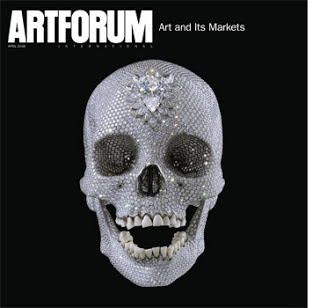
Thornton explores the influence of Artforum
and considers the impact of art "superstars" like Damien Hirst (his diamond skull pictured) in the book.
Reading the book is not unlike eavesdropping on "real" conversations and gaining access to the kinds of full disclosure not necessarily made in the open about the terms of art reception, criticism, production, and circulation. For the book, Thornton interviewed over 250 art insiders from a varitety of fields and spent five years gathering the information for the final book (she discusses this in an interview below). And while some critics have asked whether Thornton has produced enough of a viewpoint with her "fly on the wall" narratives, I find the book both refreshing and insightful for those wanting to understand more closely the deeply connected and often eccentric subcultures of the contemporary art world. I do know that since reading the book many people in my field have admitted to both owning it and especially enjoying the chapters where Thronton explores the sometimes mysterious dynamics of the art crit (she reports on this from the California Institute of Arts) and the often intimidating annual art history College Art Association Conference.
In the end, I listed this book on my essential reading list because it offers a nice counterpart to the more academic and theory derived texts I have already reviewed. Thornton even manages to profile art historian Thomas Crow in an unexpected and enjoyable way-- showing the human dimension of an eminent academic who has had such profound influence in the field. Overall a great read, and especially for the end of term!