 |
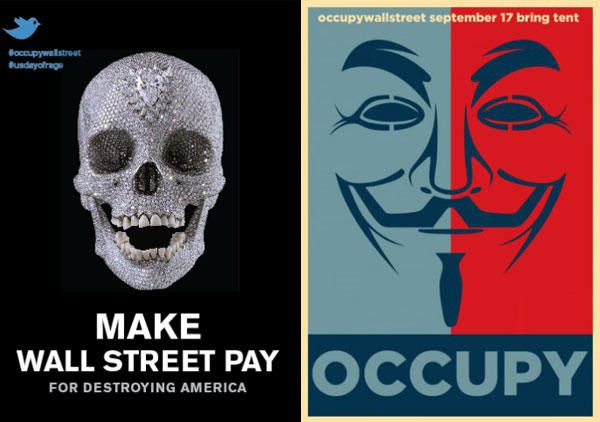
While Damien Hirst's For the Love of God diamond encrusted skull has come to signify
the worst of corporate greed in the Occupy movement, graffiti artist Shepard Fairey's reconfigured
"Obey" campaign signals the potential for artistic intervention. |
A few weeks ago, I
began paying closer attention to the art production associated with the growing
Occupy Wall Street movement. At that time,
a call for participation was
circulated from the protest organizers and a great deal of interest and buzz
has since been generated online about how, why, and through which media forms
artists can engage with furthering debate and conversations about the core
ideas fuelling the movement.
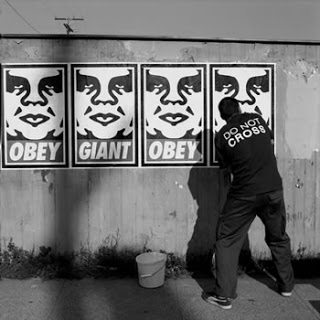 |
Fairey's original "Obey" signs sparked a much
larger conversation about public dissent when they first
began appearing in urban spaces in the early to mid 2000's. |
Observing what has emerged in the form of
art projects, what strikes me as most interesting is how much the street and
graffiti art community have responded and come to support the aims of the
various Occupy protests in large cities around the world. At the outset of the
protests in September, street artist
Shepard Fairey’s "Obey" images—a
project that originally juxtaposed political propaganda and corporate visual
vocabulary and textual references—have become closely associated with the rich visual
campaign launched by the Occupy Wall Street organizers. Not surprisingly, the
use of highly mobile, quickly reproducible, and often clandestine media forms
like the poster (digital and paper format) have close connections to previous
protest movements (
most notably Paris 1968), but also with the aims and
practices of many street and graffiti artists. Also intriguing is how references to elite and top-end contemporary art practices are deliberately
aligned with corporate greed and connections to the business world. I am
curious what
Damien Hirst makes of his diamond skull becoming the literal poster
child of Wall Street evil.
For their part, street artists seem to be
taking this moment as an opportunity to align their interests with the
protesters. Take for example
Banksy who reportedly dropped off a new sculptural
work to the Occupy London protest organizers—a satirical play on the instantly recognizable
Monopoly game board. As London’s
ArtLystdescribes, “The work is a 3 dimensional depiction of a Monopoly Board with Mr
Money Bags portrayed as a down and out panhandler. There are large scale models
of playing pieces, including a sports car (to represent bankers) and a red
plastic house with a Tox tag sprayed onto it. This is a reference to not only
the jailed London Graffiti artist but also to the toxic mortgages that kick
started the current recession. “ Interestingly enough, the article goes on
to mention that the work has already been valued at over £400,000, but it is
not entirely clear whether the work will be auctioned off at some point to
support the London protesters.
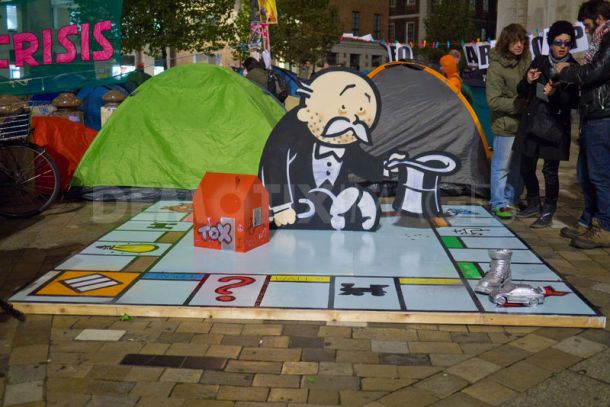 |
Banksy's Monopoly sculpture features Mr. Money Bags as a homeless beggar
(image courtesy: Demotix) |
At a more grass roots level, I was quite
impressed with the clever response by Occupy Oakland to the recent crackdown and
then reinvigoration of their protest. They took the fences that had been used
to partition out those camping at their site and turned them into an
impressive sculptural installation. And across the globe in South Korea, a performance artist
has formed “One-Man Demonstrations.com” (not an actual web site) attempting to
fight against the protest fatigue that many fear will end the Occupy movement sooner than later. For his
part, the artist Lim Ok-Sang engages people on the street in a playful and
entertaining way, trying to point to the absurdity of the global economic situation.
As
he explains, "It is another extension of artistic expression. We are
trying to create a combination of demonstrations and performances and of course
to use the power of the web as much as we can."
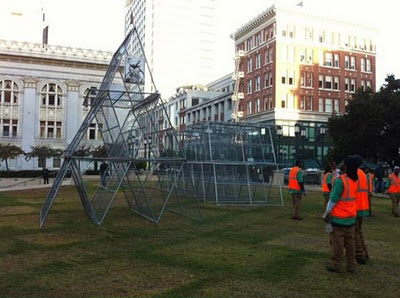 |
| Oakland fences used to create a sculptural work (image courtesy: ARTINFO) |
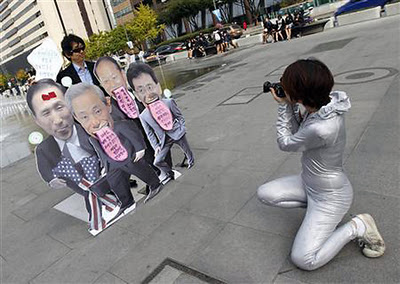 |
Lim Ok-Sang helps counter protest fatigue through his street-level performances
(image courtesy: Reuters) |
But not all street and performance contributions
have been seen as completely aligned to the interests of the Occupy movement. Take
for example the graphic artist turned urban street provocateur
K-Guy, who also
lent his support to the London folks by carpet-bombing the area near the protest
site with a work that reads: “Greed: You Can Bank On It.” While certainly
eye-catching and sure to create conversation, the contribution raises some
questions as K-Guy prepares to open an upcoming solo show at the London West
Bank Gallery.
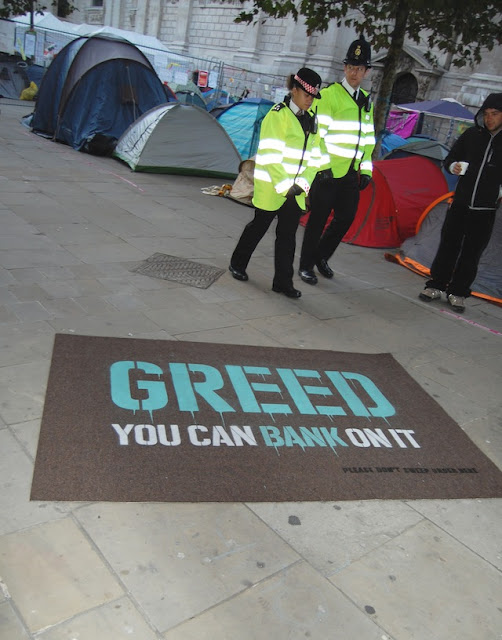 |
K-Guy's carpet bombing at the Occupy London protests
(image courtesy: Vandalog) |
As street art blogger
Vandalog aptly points out, there seems to
be something unsettling with his timing: “He has made what is (likely) a very
temporary piece, put it right next to a legitimate protest about putting people
over profits, and then used photographs of the protest and his artwork in order
to immediately turn around and try to sell something.” I am also left
speculating whether the clearly highlighted word “Bank” is sending some kind of
a message to Banksy. Maybe it is just a coincidence, but the rivalry between
street artists at a time when valuations for graffiti art works are going
through the roof leaves me wondering. Whatever the case, it seems that street
artists have forged the closest connection with the Occupy protesters thus far.

 Some of my favourites from around YouTube land this week including: a walk on the High Line park in NYC and a peek inside Gerhard Richter's new retrospective exhibition at the Tate, to David Hockney's iPad art, Alison Knowles discussion of fluxus, and a video examining what bare essentials an artist needs to live and work in a major city. Enjoy!