 |
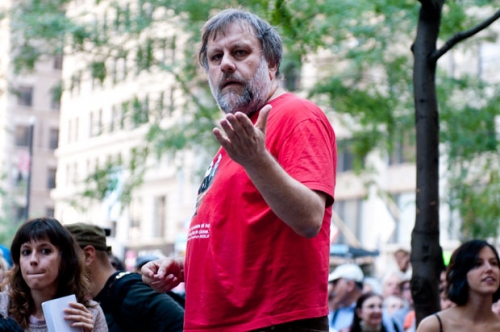
| The philosopher Salvoj Zizek at Occupy Wall Street this past week (image courtesy: roarmag.org) |
I spent much of today reading, reflecting, listening, and taking time to think about what the recent events of the Occupy Wall Street movement is signalling in the global collective. To date, there have been dozens of protests planned here in North America, and this weekend many more are
planned around the world. Because so many of the ideas I discuss with students on a day to day basis revolve around notions of power and the construction of knowledge, I was especially interested to see if I could find something spoken by a figure from within academia and more specifically, from within a critical theory framework, to help spark some meaningful reflection. I was not disappointed.
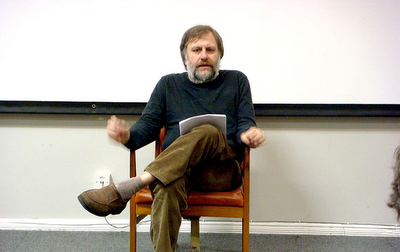 |
| Zizek in the classroom (image courtesy: Village Voice) |
This past week Slavoj Zizek, arguably one
of the world's most respected and dynamic philosophers, visited the OccupyWall Street protests in NYC and delivered a stirring and truly inspiring
address to the crowd. As a Slovenian national and specialist in Hegelian,
Marxist, and Lacanian theory, Zizek is most interested in ideas concerning
subject formation and theorizing about how individuals come to identify within
the context of the shifting world around them. Who better to comment on what is
transpiring at this very moment? I have reprinted the original text from his
speech here, taken from Verso Books website. And whether you agree or disagree
with the aims of the movement, Zizek's arguments-- about why this moment is pivotal in our human history and what the stakes are if we ignore such a deeply abstracted power structure as the one we face globally today-- are worthy of
our collective attention and consideration:
"Don't fall in love with yourselves, with
the nice time we are having here. Carnivals come cheap—the true test of their
worth is what remains the day after, how our normal daily life will be changed.
Fall in love with hard and patient work—we are the beginning, not the end. Our
basic message is: the taboo is broken, we do not live in the best possible
world, we are allowed and obliged even to think about alternatives. There is a
long road ahead, and soon we will have to address the truly difficult questions—questions
not about what we do not want, but about what we DO want. What social
organization can replace the existing capitalism? What type of new leaders we
need? The XXth century alternatives obviously did not work.
So do not blame people and their attitudes:
the problem is not corruption or greed, the problem is the system that pushes
you to be corrupt. The solution is not “Main street, not Wall street,” but to
change the system where main street cannot function without Wall street. Beware
not only of enemies, but also of false friends who pretend to support us, but
are already working hard to dilute our protest. In the same way we get coffee
without caffeine, beer without alcohol, ice-cream without fat, they will try to
make us into a harmless moral protest. But the reason we are here is that we
had enough of the world where to recycle your Coke cans, to give a couple of
dollars for charity, or to buy Starbucks cappuccino where 1% goes for the Third
World troubles is enough to make us feel good. After outsourcing work and
torture, after the marriage agencies started to outsource even our dating, we
see that for a long time we were allowing our political engagements also to be
outsourced—we want them back.
They will tell us we are un-American. But
when conservative fundamentalists tell you that America is a Christian nation,
remember what Christianity is: the Holy Spirit, the free egalitarian community
of believers united by love. We here are the Holy Spirit, while on Wall Street
they are pagans worshipping false idols.
They will tell us we are violent, that our
very language is violent: occupation, and so on. Yes we are violent, but only
in the sense in which Mahathma Gandhi was violent. We are violent because we
want to put a stop on the way things go—but what is this purely symbolic
violence compared to the violence needed to sustain the smooth functioning of
the global capitalist system?
We were called losers—but are the true
losers not there on the Wall Street, and were they not bailed out by hundreds
of billions of your money? You are called socialists—but in the US, there
already is socialism for the rich. They will tell you that you don't respect
private property—but the Wall Street speculations that led to the crash of 2008
erased more hard-earned private property than if we were to be destroying it
here night and day—just think of thousands of homes foreclosed...
We are not Communists, if Communism means
the system which deservedly collapsed in 1990—and remember that Communists who
are still in power run today the most ruthless capitalism (in China). The
success of Chinese Communist-run capitalism is an ominous sign that the
marriage between capitalism and democracy is approaching a divorce. The only
sense in which we are Communists is that we care for the commons—the commons of
nature, of knowledge—which are threatened by the system.
They will tell you that you are dreaming,
but the true dreamers are those who think that things can go on indefinitely
they way they are, just with some cosmetic changes. We are not dreamers, we are
the awakening from a dream which is turning into a nightmare. We are not
destroying anything, we are merely witness how the system is gradually
destroying itself. We all know the classic scene from cartoons: the cat reaches
a precipice, but it goes on walking, ignoring the fact that there is no ground
under its feet; it starts to fall only when it looks down and notices the
abyss. What we are doing is just reminding those in power to look down...
So is the change really possible? Today,
the possible and the impossible are distributed in a strange way. In the
domains of personal freedoms and scientific technology, the impossible is
becoming increasingly possible (or so we are told): “nothing is impossible,” we
can enjoy sex in all its perverse versions; entire archives of music, films,
and TV series are available for downloading; space travel is available to
everyone (with the money...); we can enhance our physical and psychic abilities
through interventions into the genome, right up to the techno-gnostic dream of
achieving immortality by transforming our identity into a software program.
On
the other hand, in the domain of social and economic relations, we are
bombarded all the time by a You cannot ... engage in collective political acts
(which necessarily end in totalitarian terror), or cling to the old Welfare
State (it makes you non-competitive and leads to economic crisis), or isolate
yourself from the global market, and so on. When austerity measures are
imposed, we are repeatedly told that this is simply what has to be done. Maybe,
the time has come to turn around these coordinates of what is possible and what
is impossible; maybe, we cannot become immortal, but we can have more
solidarity and healthcare?
In mid-April 2011, the media reported that
Chinese government has prohibited showing on TV and in theatres films which
deal with time travel and alternate history, with the argument that such
stories introduce frivolity into serious historical matters—even the fictional
escape into alternate reality is considered too dangerous. We in the liberal
West do not need such an explicit prohibition: ideology exerts enough material
power to prevent alternate history narratives being taken with a minimum of
seriousness. It is easy for us to imagine the end of the world—see numerous
apocalyptic films -, but not end of capitalism.
In an old joke from the defunct German
Democratic Republic, a German worker gets a job in Siberia; aware of how all
mail will be read by censors, he tells his friends: “Let's establish a code: if
a letter you will get from me is written in ordinary blue ink, it is true; if
it is written in red ink, it is false.” After a month, his friends get the
first letter written in blue ink: “Everything is wonderful here: stores are
full, food is abundant, apartments are large and properly heated, movie
theatres show films from the West, there are many beautiful girls ready for an
affair—the only thing unavailable is red ink.” And is this not our situation
till now? We have all the freedoms one wants—the only thing missing is the red
ink: we feel free because we lack the very language to articulate our
unfreedom. What this lack of red ink means is that, today, all the main terms
we use to designate the present conflict—'war on terror,' "democracy and
freedom,' 'human rights,' etc—are FALSE terms, mystifying our perception of the
situation instead of allowing us to think it. You, here, you are giving to all
of us red ink."
Further Reading: