Are motion picture Instagrams better than still ones? I highly doubt it.
Media specificity lies at the core of my research focus.
I have long been interested in thinking about how audiences and publics, both
past and present, make meaning of the same represented persons/objects/things
from diverse representational modes. Bringing critical awareness to these means of representation is deeply embedded within traditions of
modern and contemporary art. Artists, ranging from Manet and the
Impressionists, to Magritte and the Surrealists, through to conceptual artists
such as Joseph Kosuth, have made it part of their practice to bring insight to both the illusion and multiple media modes of our visual landscape.
Manet, Magritte, and Kosuth push audiences to think about the means of representation
and media forms as sets of shifting signs. Modern and contemporary art teaches us for example that a painting
is not a mimetic copy of reality, any more than a photograph or a convinving line of text.
Asking students to think critically about the means of
representation is also part of the art historian’s job. Here, the basics of
formal analysis kick into play. For example, what are the benefits and
drawbacks of producing a representation of the same thing as a painting, a drawing, a sculpture,
or a work of film or performance art? What is at stake in the conversations
they will generate? What meanings will be made with each media mode? What
is gained and what is lost? When Instagram announced its introduction to video captures
this past week, I immediately began to wonder what false assumptions were being
made about the move from still to moving pictures. Clearly, from watching the
promotional video, there is an idea in place that the moving image is the
natural evolution from the still Instagram picture. But is this really the case?
In the past several months, I have been thinking a great deal about these sorts of new media assumptions, and especially the move from silent to sound filmmaking and the many difficulties and limitations that were placed on experimental filmmakers of the late 1920’s who simply did not buy into the idea that sound was somehow “better” than silent film. To be sure, the entire history of film was transformed in a few short years when studio executives in Hollywood endorsed and promoted sound film (and narrative based movies) as the obvious evolution in filmmaking and then later colour filmmaking to replace black and white movies. What was lost with those transitions was how the means of filmic representation shifted and recast the way artists engaged with and/or abandoned film as a medium of choice. This is now part of a largely forgotten or misrepresented history we are just coming to grips with.
Claims for new media evolution and superiority have been made as far back as the early 20th century.
Here is an ad from 1918 in the trade journal Moving Picture World making the argument for a new film format.
Looking to the immediate and largely negative reaction to the Instagram announcement by both average users and critics alike, I am reminded of archival documents I have recently looked at from the early 1930’s where the public laments all of the important aspects of silent film that would be lost in its transition to sound. More importantly, the underlying charge of that time was how “artistic” decisions had been made at the expense of commercial interests. This sentiment echoes many of the reactions about Instagram’s move (recently acquired by Facebook) and the mini commercial spots that are surely coming to Instagram within short order. Interestingly, most critics unanimously agree that moving to video signals a backward move for Instagram and not a natural evolution for the new media form. As New York Times writer Jenna Wortham argues in her article on the topic, media specificity has all but been disregarded with the transition to moving images:
Instagram is a yearbook of our most memorable moments, not because they’re the moments worth remembering, but because they’re the moments worth projecting and sharing… Video, at least the amateurish footage I shot, is the antithesis of that fantasy. And as much as I think we’re getting more comfortable being ourselves online, there’s still a difference between the self you’re willing to share publicly and the self you’re willing to share when only a handful of people are watching.
So will video kill the Instagram star? Probably not, but I can't help but wonder as new media forms continue to shift and claim “evolution” how long it will take for critiques like these to recede into forgotten history.
This week's Flipboard cover is an Instagram pic I took while stopped in traffic on the 405 HIghway in Los Angeles (without GPS in my car and a map in the trunk!)
Has it already been a whole week? I have just returned home after several exhilarating days in Los Angeles on a research trip to both the UCLA Film and Television Archive and the Margaret Herrick Library at The Academy of Motion Picture Arts and Sciences. As part of my project I was looking at archival documents, posters, scripts, and yes films!, from the period of the late 1920's and early 1930's related to avant-garde filmmaker Paul Fejos. It was fantastic getting to look at materials from this era, and all of the librarians and archivists I encountered were incredibly helpful and very patient with my questions and queries. I even tried to get into the spirit of the visit by staying at a hotel that used to be an apartment house for silent cinema starts-- it is a great little hotel in Beverly Hills called The Crescent, I highly recommend it. While in Los Angeles, I was able to see some great art exhibitions and later this week I will blog about my visit to the Getty Museum and Research Institute, a must see for any art and architecture lover visiting the area.
Between visits, I was watching my social media feeds and saved several articles, links, and videos into this week's Flipbook. Follow this link to check out the complete magazine (see this link to learn how you can download the Flipboard app to your mobile device), or see a few of the standout articles linked directly below:
This week's Flipboard cover--Warhol meets Lennon-- an encounter captured in the late 1970's.
I am currently blogging from the road (on a short vacation to Las Vegas ahead of a research trip to Los Angeles) and experimenting with mobile Blogger-- wishing you all a wonderful weekend. You can find my weekly pick of social media links, articles, and videos on Avant-Guardian Musings Flipbook Magazine. I will be adding each week's curated selections and starting fresh each month, just like a real magazine subscription. Enjoy!
Punk aesthetics hit every major high-ed retailer in NYC-- including these windows at Bergdorf Goodman. Image: D. Barenscott filtered via Instagram
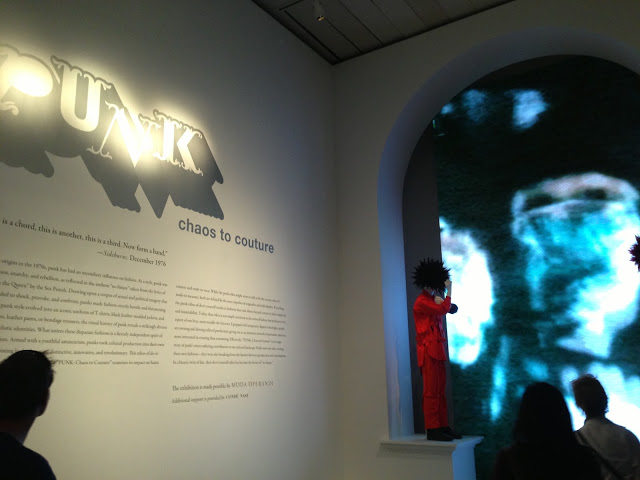
Punk culture and the avant-garde have much in common—they are both difficult to define and everyone has their own idea of what each is. Perhaps that it is why the world of fashion loves the designation of punk or avant-garde couture. With the air of the risqué and subcultural associations, the notion of “punk” comes with the promise of something new, something spectacular, the next big thing everyone will be talking about. A few weeks ago while I was on a research trip to New York, I visited the Metropolitan Museum’s much hyped Punk: Chaos to Couture Exhibition to see just how an art museum would handle the curation of a show dedicated to punk aesthetics. In many ways, it seems like the perfect marriage—an art institution displaying the most out-of-the-box examples of fashion, merging creative experimentation and “fashion as art” discourses. At the same time, removing the clothing from the runway off the model’s bodies and displaying them as ‘art objects’ in a museum forces a new kind of engagement for the public.
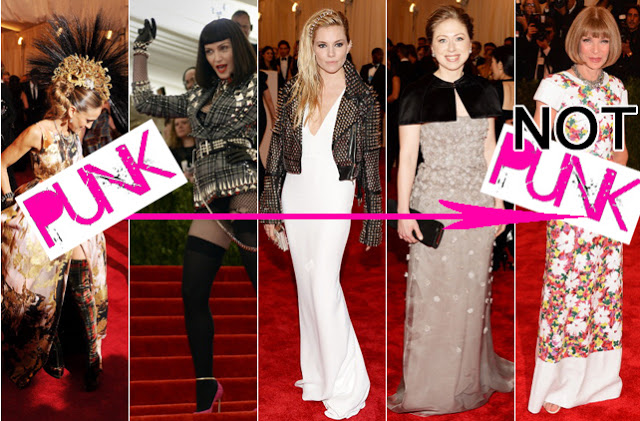
The debates around punk generated by the Met Ball opening were decidedly superficial. Image: Fashionista.com
I have been thinking a great deal about the intersection of fashion and art over the past year (in fact, I blogged about the Alexander McQueen show at the Met two years ago), and I was especially intrigued to see this exhibit running concurrently with the Orsay Impressionism and Fashion Exhibition, which happened to be on display at the Met at the same time on the same floor. Only a few short weeks earlier, the annual Met Gala had opened the Punk Exhibition and caused some interesting discussion about who had managed to nail the punk aesthetic in their red carpet looks. A protest had even formed around the opening in an attempt to draw attention to the subversive roots of the punk movement, with the organizer of “Punk OUT”, Geraldine Visco, questioning both the exhibit and the decidedly “bourgeois” and superficial celebration of punk aesthetics surrounding its opening:
“Our band of “punks” was composed of a ragtag dozen artists and performers from 21 to 58 years of age who’ve been inspired by or involved with punk music, fashion, and the lifestyle. There are no real punks and never have been, since once you call yourself a “punk,” you have become a yuppie in a T-shirt and black leather. Nonetheless, the punk lifestyle and art during the 1970s and 1980s was real and it is still an important influence in art, music, politics, and yes, fashion. We weren’t angry about the show, just disappointed that the Metropolitan Museum has become more and more corporate and less interested in documenting punk and what it has influenced in a serious, well-rounded way — recognizing that the punk aesthetic has always fought against commercialism and corporate culture.”
Much of the radicality and context surrounding the Impressionists' reflection on fashion is lost on today's audiences. Image: D. Barenscott
No doubt the protesters were tapping into one of the persistent tensions within outsider and avant-garde cultures—the specter of assimilation and appropriation by the masses. It was the same issue that plagued the Impressionists when the shock of their new art wore off and people began to appreciate modern painting as something worthy of praise and, yes, purchase. Strolling through the Impressionist Fashion exhibition, very little of the radicality associated with early Impressionism remained. One would have to study the paintings very closely and with a learned eye to pick out the more scandalous elements of paintings that actually poked fun and made commentary on middle class pretensions and aspirations (it was fantastic, for example, to see Courbet’s Young Ladies on the Banks of the Seine (1857) and Manet’s Woman Reading (1879) up close).
For me, probably the only interesting part of the exhibition. Image: D. Barenscott
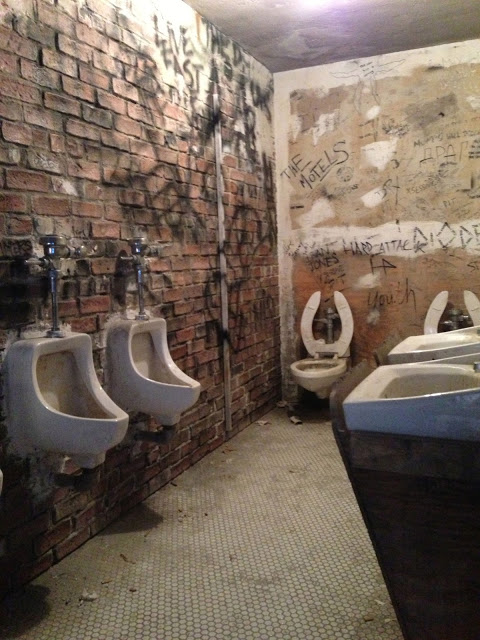
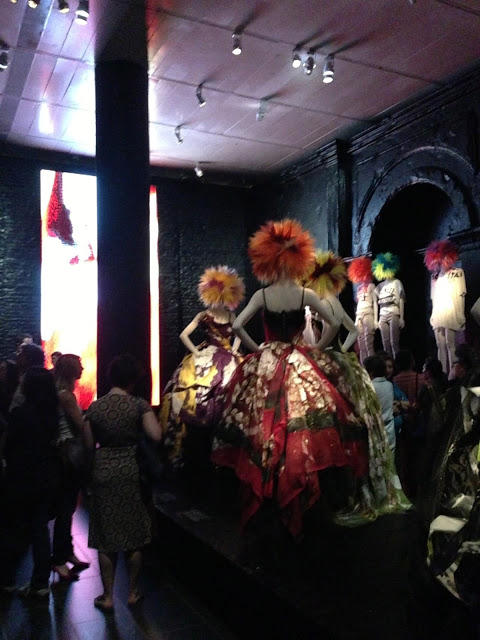
Walking into the Punk Exhibition, I was struck at first by the installation of a recreated punk club bathroom—right down to the urine encrusted and cigarette littered floor. Now this could be interesting I thought. Welcoming audiences into the dark and subterranean world of punk via the nightclub was intriguing—a space of high contrast to the pristine and controlled world of the fashion runway. But once past the entry, the exhibition itself proved quite conventional. Faceless mannequins dressed in couture clothes were presented in groups, in rows, and yes on runways in a very un-punk like way. Even the fake graffiti on the walls seemed too well placed and contrived. And while the punk music blaring from the overhead speakers and strobe lights added some unique atmosphere, the show itself was not especially groundbreaking nor did it require much of the audience in terms of critical reflection. In fact, just as many people were impressed with the “labels” attached to the punk objects (oh look! a Chanel, a Givenchy, a Vivienne Westwood!) as they were with the Impressionist show (oh look! a Monet, a Renoir, a Cassatt!). See the Met's Gallery Views and commentary in the YouTube clip below for more interior views of the exhibition.
Walking down 5th Avenue later that day, I was struck by the number of high-end retailers who had decorated their windows with a punk theme—I chuckled wondering what store clerks in Bergdorf’s would actually do if the punk rocker they had placed in their window came to life and strolled into their establishment.
Another view of a Bergdorf window-- the dude in the window does not fit the conventional demographic. Image: D. Barenscott filtered via Instagram
And while all things punk related seem to be for sale in New York and trending culturally in popular culture (didn’t Daft Punk just drop a new album?), when I arrived home, I was intrigued to read how quietly the arrival of real punk rockers Pussy Riot (to New York City no less) was covered in the mainstream press. As the New York Times reported, they had come to NYC to promote an upcoming HBO documentary concerning their activist cause in Russia:
“Without fanfare, two members of the collective slipped into New York in the last week, to help promote the film and meet, undercover, with supporters. It is their first time in America. At the theater, they munched popcorn as a slew of well-heeled New Yorkers and boldface names — Salman Rushdie, Patti Smith — sauntered by. A few guests wore “Free Pussy Riot” T-shirts, oblivious to the still-at-large members in their midst. There was a party afterward, but for Pussy Riot, this trip was a serious effort to expand their reach without compromising their credibility as artistic revolutionaries.”
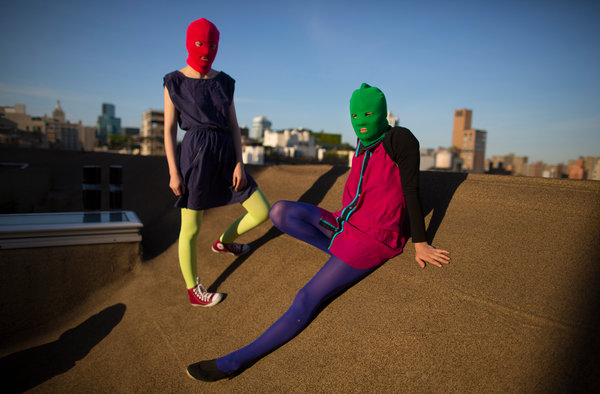
And so, resisting the lure to compromise artistic principles and the DIY ethos attached to punk culture continues on, however quietly. Does this mean that punk culture is still alive and well? Perhaps. Or maybe it is blurred into the cultural landscape in new and unpredictable ways. I must say that the photograph used by the New York Times, for example, to cover the Pussy Riot visit has vague similarities to an editorial spread from a fashion magazine or maybe an Urban Outfitter ad—but I digress. In the end, the conversation around punk culture and its intersection with fashion remains very intriguing despite what the Met show attempted to reveal… or hide.
NYT's cover photo for their story on punk rock group Pussy Riot-- curious who styled this shoot. Image: New York Times
One of the activities I enjoy each morning over coffee is combing through my various social media feeds to find out what information and links colleagues, friends, students, and other users I am following are sharing and circulating. It is always interesting to see what is trending in various fields I am interested in, especially the art and post secondary education worlds, and to track how certain stories are progressing over time. Many of my blog posts are in fact sparked by conversations I see emerging over social media. Several months into starting my blog, I began sharing some of the links I was finding especially worthy of reflection, mostly items I favourited on Twitter (still my favourite source for art and culture related news/info), and shared them on my Weekly Twitter Round Ups.
During the hiatus from my blog, I began researching more useful and time-saving ways to collect all the bits of info I was amassing in various spots on my computer, phone, and tablet into one place. While transitioning to my iPad, I discovered the app that many of you may already know about-- Flipboard.
Flipboard allows users to create personal magazines by collecting, editing, and sharing information they "flip" into their account. Content can be streamed from Twitter, Facebook, YouTube, Instagram, and any number of news feed sources. To date, the application is available on Apple, Android, and select e-reader devices and you can also download a Flipboard bookmarklet to your computer to capture info you may find browsing at your desk.
Voila! I thought-- this would be the perfect way to deliver the Weekly Round-Up in a visually dynamic and interactive way. And so, each week, I will be amassing information into the blog's Flipboard magazine. I am still playing around with how I will organize the issues (be it into a monthly digest or simply a new one each week), but I will change the cover each week to reflect an art-related news story that is on my mind a part of the broader public conversation. To access the magazine, you can download the mobile app for iPhone, iPad, Android, Kindle Fire or Nook devices and search for "Dorothy Barenscott" in the catalogue or get the download link sent to your email . Unfortunately there is no way to view the magazine on a computer yet (I hear rumours of a Google Chrome extension-- I will keep you posted!), so I will work to link a few items each week directly in the blog post. Inside this first magazine, you will find 18 items-- this will be an evolving format, but for now I have included sources from a variety of social media formats and types (images, video, articles, e-books etc..). So grab a cup of coffee, sit back and flip through the collection of links in this week's round-up. I look forward to assembling new items each week and sharing them with you.
For the front of my inaugural weekly Flipboard round-up, I chose artist Ai Weiwei's somewhat controversial cover art for the latest edition of Time Magazine. Ai's graphic work-- using the Chinese art of paper cutting-- was chosen to grace the cover of the iconic American weekly news magazine to accompany reporter Hannah Beech's lead story "How China Views the World." With the twenty-fourth anniversary of the Tiananmen Square protests occurring this past week (see historic video clip below), along with the two-day California Summit between American and Chinese leaders also happening this weekend, the move was a very bold one for the publication. With continued protests in both Turkey and Syria raging, and questions of human rights abuses at the forefront of many activists minds, it also seems a very opportune time to bring Ai Weiwei's art and message to such a wide reading audience.