• Fall 2025
  • Blog
  • Resources
  • Field School
  • Students
  • Feedly
  • About
Menu

Avant-Guardian Musings

  • Fall 2025
  • Blog
  • Resources
  • Field School
  • Students
  • Feedly
  • About
large monogram_2018-02-01_22-31-07.v1 (1).png
“Art is an outlet toward regions which are not ruled by time and space”
— Marcel Duchamp

Avant-Guardian Musings is a curated space of ideas and information, resources, reviews and readings for undergraduate and graduate students studying modern and contemporary art history and visual art theory, film and photography studies, and the expanding field of visual culture and screen studies. For students currently enrolled in my courses or the field school, the blog and associated social media links also serve as a place of reflection and an extension of the ideas and visual material raised in lecture and seminar discussion.

Blog RSS

Screenshot 2018-02-05 20.56.45.png
Blog
KPU FINE ARTS PARIS + VENICE BIENNALE FIELD SCHOOL (MAY/JUNE 2026)
about 3 months ago
"No Fun City" Vancouver: Exploring Emotions of Detachment in Palermo, Sicily at AISU
about 4 months ago
Making Sense of Art in the Age of Machine Learning—A Suggested Reading List
about 5 months ago
From the Archives | How (And Why) To Take Excellent Lecture Notes
about a year ago
Weekly Musings + Round Up... And A Few More Things
about 2 years ago

Screenshot 2018-02-05 20.56.51.png
As we start the week in a storm of activity, new beginnings, and global uncertainty, I am grounded in my word for 2026– INTENTIONAL 🩶— “done with purpose, willingness, deliberation, and consciousness.” I see this word represe
As we start the week in a storm of activity, new beginnings, and global uncertainty, I am grounded in my word for 2026– INTENTIONAL 🩶— “done with purpose, willingness, deliberation, and consciousness.” I see this word represented in the symbol of the heart, and for this reason and many others both personal and professional, I will be bringing this much needed energy to my year. The power of a yearly word is transformative. I started in 2019 and my words have guided and carried me through some important moments and life decisions. If you haven’t already, give it a try, but remember to choose very wisely ☺️ “Radiate” 2025 ✨ “Maintain” 2024 💪🏻 “Refine“ 2023 🙌🏻 “Acta non verba” 2022 🤐 “Audacious” 2021 💃🏼 “Fearless” 2020 😛 “Unapologetic” 2019 💅🏻 #happynewyear #wordoftheyear #intentional #monicavinader @monicavinader
Polar bear ride! 🐻‍❄️🏍️💨🏍️ First motorcycle outing of 2026 in the books. A balmy 4C 🥶We love you Vancouver— good to be home 💙😊Wishing everyone a very Happy New Year! 🥳 
.
.
.
#happynewyear #vancouver #motorcycle #motorcyclesofinstag
Polar bear ride! 🐻‍❄️🏍️💨🏍️ First motorcycle outing of 2026 in the books. A balmy 4C 🥶We love you Vancouver— good to be home 💙😊Wishing everyone a very Happy New Year! 🥳 . . . #happynewyear #vancouver #motorcycle #motorcyclesofinstagram #motocouple #husqvarna #vitpilen401 #svartpilen401 #motogirl #motogirls
2025... where did it go?! 😂 Like a ray of light, I was very much guided by my chosen word of the year “radiate”— to shine and send out beams of energy— and this allowed for a great deal of adventure, new experiences, ideas an
2025... where did it go?! 😂 Like a ray of light, I was very much guided by my chosen word of the year “radiate”— to shine and send out beams of energy— and this allowed for a great deal of adventure, new experiences, ideas and people and opportunities to flow back into my life. Above all else, I found myself very much on the move all year! Travel took me from New York to Lausanne, Paris to Seoul, and Palermo to Maui, while my motorcycling stayed more on the road and less on the track as Brian and I balanced our time, energy, and commitments. But as always, we found every spare moment to prioritize this shared passion and we hope to find a way back to the track in 2026. Professionally, the year was... A LOT... and highlighted by many new research partnerships, conferences, workshops, writing projects, some failed plans and sharp detours, but also the planting of new seeds for future ventures. In the classroom, AI brought many new challenges and opportunities to rethink the purpose of my teaching and courses, but overall I was inspired and at times surprised by what my students were able to accomplish with the new assessment models I put into place. All of this technological change remains very much a work in progress for academics, and I prefer to remain optimistic that the artists I work with will find a way to maintain their voice and vision in it all. The historian in me knows this to be true. Personally, I connected more to my heart and intuition in 2025, listening to that inner voice to guide many key decisions. Brian and I also kept up a decent health and fitness regime that had us energized and aiming for consistency to match our midlife pace. Use it or lose it is a reality in your 50s!!! Sending wishes of peace and love and a very Happy New Year to all! May your 2026 be filled with fun, awe, purpose, and good health and much happiness. Remember to be good to yourself so you can be good to others. I’m still working carefully on my 2026 word… but whatever it is, I know it will be the right one ❤️ . . . #happynewyear #yearinreview2025 #wordoftheyear #motorcyclelife #arthistorianlife
Resting, dreaming, and plotting the year ahead 💙✨😘
.
.
.
#maui #hawaii #vacationmode #newyear #planning
Resting, dreaming, and plotting the year ahead 💙✨😘 . . . #maui #hawaii #vacationmode #newyear #planning
Riding and chasing sunsets across Maui ✨💙🌺🌴🧡
.
.
.
#maui #hawaii #motorcycle #motorcyclesofinstagram #motogirl #vacationmode #sunsets
Riding and chasing sunsets across Maui ✨💙🌺🌴🧡 . . . #maui #hawaii #motorcycle #motorcyclesofinstagram #motogirl #vacationmode #sunsets

Screenshot 2018-02-05 20.57.02.png
  • November 2025 (1)
  • September 2025 (1)
  • August 2025 (1)
  • September 2024 (1)
  • February 2023 (1)
  • January 2023 (3)
  • August 2022 (1)
  • March 2022 (1)
  • February 2022 (3)
  • January 2022 (4)
  • November 2021 (2)
  • October 2021 (3)
  • September 2021 (3)
  • July 2021 (2)
  • June 2021 (1)
  • May 2021 (3)
  • April 2021 (3)
  • March 2021 (3)
  • February 2021 (4)
  • January 2021 (5)
  • December 2020 (3)
  • November 2020 (6)
  • October 2020 (4)
  • September 2020 (1)
  • July 2020 (1)
  • June 2020 (4)
  • May 2020 (9)
  • April 2020 (5)
  • December 2019 (2)
  • November 2019 (5)
  • October 2019 (3)
  • September 2019 (1)
  • July 2019 (6)
  • June 2019 (19)
  • April 2019 (2)
  • March 2019 (5)
  • September 2018 (2)
  • July 2018 (1)
  • June 2018 (4)
  • May 2018 (2)
  • April 2018 (5)
  • March 2018 (5)
  • February 2018 (8)
  • January 2018 (3)
  • December 2017 (4)
  • November 2017 (5)
  • October 2017 (7)
  • September 2017 (3)
  • July 2017 (6)
  • June 2017 (15)
  • April 2017 (2)
  • March 2017 (3)
  • February 2017 (1)
  • January 2017 (2)
  • November 2016 (2)
  • October 2016 (1)
  • September 2016 (3)
  • August 2016 (1)
  • June 2016 (2)
  • May 2016 (3)
  • April 2016 (2)
  • March 2016 (5)
  • February 2016 (7)
  • January 2016 (9)
  • November 2015 (1)
  • October 2015 (2)
  • September 2015 (3)
  • August 2015 (3)
  • July 2015 (1)
  • June 2015 (20)
  • May 2015 (4)
  • March 2015 (2)
  • January 2015 (1)
  • November 2014 (1)
  • October 2014 (2)
  • June 2014 (1)
  • May 2014 (4)
  • April 2014 (6)
  • February 2014 (1)
  • January 2014 (2)
  • November 2013 (1)
  • September 2013 (1)
  • July 2013 (3)
  • June 2013 (10)
  • December 2012 (1)
  • November 2012 (3)
  • October 2012 (6)
  • September 2012 (3)
  • August 2012 (1)
  • July 2012 (1)
  • June 2012 (25)
  • May 2012 (5)
  • April 2012 (4)
  • March 2012 (7)
  • February 2012 (11)
  • January 2012 (6)
  • December 2011 (5)
  • November 2011 (11)
  • October 2011 (11)
  • September 2011 (8)
  • June 2011 (9)
  • May 2011 (15)
  • April 2011 (9)
  • March 2011 (14)
  • February 2011 (17)
  • January 2011 (16)
  • December 2010 (11)
  • November 2010 (18)
  • October 2010 (24)
  • September 2010 (30)

Screenshot 2018-02-05 20.57.07.png

© Dorothy Barenscott, Avant-Guardian Musings, and dorothybarenscott.com, 2010-2023. Unauthorized use and/or duplication of this material without express and written permission from this blog’s author is strictly prohibited. Excerpts and links may be used, provided that full and clear credit is given to Dorothy Barenscott, Avant-Guardian Musings, and dorothybarenscott.com with appropriate and specific direction to the original content.

In the Japanese pavilion, Chiharu Shiota's installation "The Key in the Hand" stuck to Okwui Enwezor's curatorial vision. It was both immersive and spatially complex (and yes beautiful!).

In the Japanese pavilion, Chiharu Shiota's installation "The Key in the Hand" stuck to Okwui Enwezor's curatorial vision. It was both immersive and spatially complex (and yes beautiful!).

Location | Venice, Italy: Reflections From the Field Part 2

June 29, 2015

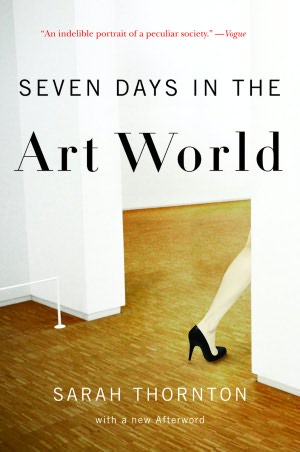
Sarah Thornton's book was one of the books that was assigned for reading in the pre-departure classes. Her final chapter on the Venice Biennale is eye-opening and highly recommended. 

Sarah Thornton's book was one of the books that was assigned for reading in the pre-departure classes. Her final chapter on the Venice Biennale is eye-opening and highly recommended. 

To understand the Venice Biennale, it is important to consider both its very long and often politically animated history, but also the way the event has become spatially charged, creating literal insiders and outsiders to the main venues in Venice. The Biennale has also been subject in recent years to increasing scrutiny for the exhibition’s influence on the world’s very hot contemporary art market. These were themes that we explored in the pre-departure field school classes as part of the larger understanding of the connections between New York—as the center of the art world—and the role of art fairs, biennales, and global exhibitions in determining how audiences come to “value” art.  (Two resources that were especially helpful for students to begin this exploration and I recommend here are: 1) the final chapter on the Venice Biennale in Sarah Thornton’s Seven Days in the Art World; and 2) the Vice produced documentary on the Venice Biennale from 2013, pasted below).

For the 2015 Venice Biennale, the appointment of Okwui Enwezor as curator signaled an important and potentially critical turn for the 120-year old institution. Enwezor, a figure known in the art world as both an ardent critic of the art market and an art theorist steeped in research concerning global modernism and formations of postcolonial modernity, proved to be a bold choice for an event that many have criticized in recent years for being overly commercial and launching global art trends that eventually trickle down to the auction houses.  At the core of Enwezor’s curatorial vision for the 2015 event was the desire to interrogate both the pleasure of viewing and fetishization of the object so key to many individual’s understanding, appreciation, and valuation of art. His theme, “All the World’s Futures” is devoted in Enwezor’s own words to “a fresh appraisal of the relationship of art and artists to the current state of things.” One part of this appraisal is tackling head on the often taboo relationship between art and money. To this end, the central and featured art performance at the Biennale this year is Capital: A Live Reading which entails a daily live reading of the complete four volumes of Karl Marx’s Das Kapital. Of the project, Enwezor says in an interview with The Guardian: “I wanted to do something that has contemporary relevance and speaks to the situation we are in. And so I thought of Das Kapital, a book that nobody has read and yet everyone hates or quotes from.” 

The compact catalogue for the 2015 Venice Biennale with this year's theme "All the World's Futures" logo on the cover.

The compact catalogue for the 2015 Venice Biennale with this year's theme "All the World's Futures" logo on the cover.

Now for those who recall Enwezor’s position as the first non-European art director of the equally prestigious Documenta 11 art exhibition a decade and a half earlier (from 1998-2002), the curatorial vision of the 2015 Venice Biennale follows closely in both approach and execution—an ideas-driven, decentered exhibition, interested in opening up conversations about “shadow histories” that redress past exclusions from the most important art event in the world. To be sure, many critics have been struck by how entire pavilions in the 2015 Biennale are empty of “art objects” and have been made into environments or overtaken by elaborate installations and platforms for performance—art forms that traditionally resist easy commodification and consumption.  For some critics, this is refreshing and potentially transgressive—see for example the review by New York Times art critic Roberta Smith, while for others it is a “joyless” failure—see for example the review by artnet’s Benjamin Genoccchio .

When visiting the Biennale, this curatorial vision was immediately apparent in the minimal, stripped down, and emptied pavilions. I found the experience to be incredibly powerful and thought that the spaces were somehow less burdened and more focused in both vision and message without all the accumulation of things. Having in past visits to the Biennale been overwhelmed with both the information and number of art objects placed in each space, this approach was incredibly radical. This was especially the case at the Giardini venue where nearly every national pavilion presented viewers with open space, sensory immersion, and interactivity. This served to activate art as an "in process” experience versus art as an experience of passive consumption.


 0 
 0 
 1 
 20 
 114 
 Kwantlen Polytechnic University 
 1 
 1 
 133 
 14.0 


 Normal 
 0 


 false 
 false 
 false 
 
 EN-US 
 JA 
 X-NONE

Hungary’s Sustainable Identities installation by Szilard Cseke invites audiences to explores multiple and dislocated identities.

 Another look at Hungary's pavilion

Another look at Hungary's pavilion


 0 
 0 
 1 
 27 
 159 
 Kwantlen Polytechnic University 
 1 
 1 
 185 
 14.0 


 Normal 
 0 


 false 
 false 
 false 
 
 EN-US 
 JA 
 X-NONE

Germany’s Fabrik and their creation of a kind of gaming platform that audience’s get to passively consume as “activists” is both a statement and critique of today’s political landscape.


 0 
 0 
 1 
 18 
 109 
 Kwantlen Polytechnic University 
 1 
 1 
 126 
 14.0 


 Normal 
 0 


 false 
 false 
 false 
 
 EN-US 
 JA 
 X-NONE

Japan’s Chiharu Shiota’s The Key in the Hand uses the key as a launching off point to explore public and private memory.

 USA’s rich Joan Jonas retrospective has audiences come face to face with the fragility of nature.

USA’s rich Joan Jonas retrospective has audiences come face to face with the fragility of nature.


 0 
 0 
 1 
 31 
 180 
 Kwantlen Polytechnic University 
 1 
 1 
 210 
 14.0 


 Normal 
 0 


 false 
 false 
 false 
 
 EN-US 
 JA 
 X-NONE

Switzerland’s unique and full sensory Our Product is a project that artist Pamela Rosenkranz created to approximate the skin colour and smell of the average European (it was smelly!), and to transform the pavilion into a living body. 


 0 
 0 
 1 
 22 
 129 
 Kwantlen Polytechnic University 
 1 
 1 
 150 
 14.0 


 Normal 
 0 


 false 
 false 
 false 
 
 EN-US 
 JA 
 X-NONE

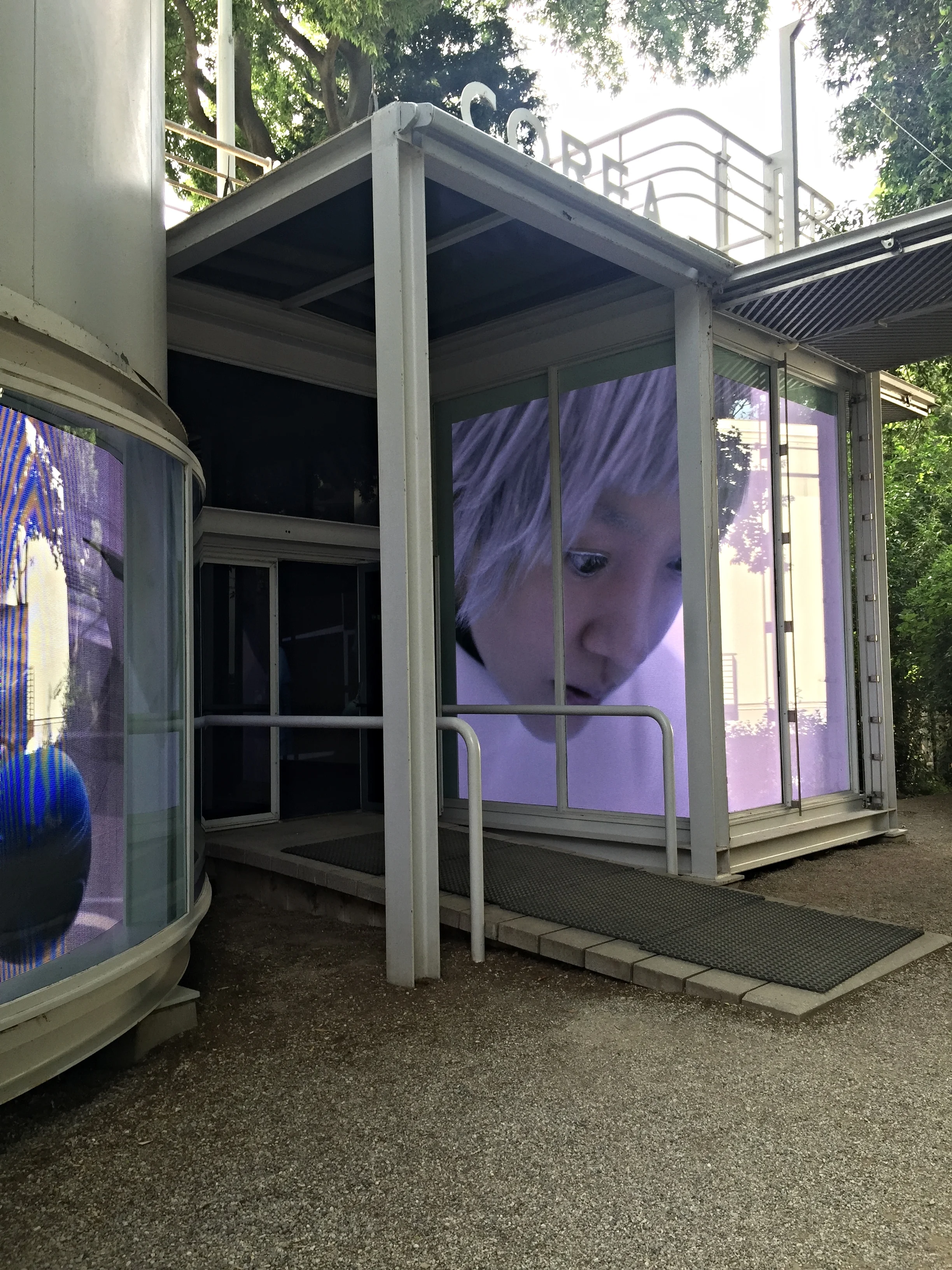
Korea’s artist dup Moon Kyungwon and Jeon Joonho’s digital installation explores new and supernatural visions of the artist’s future role in society.

 Norway's pavilion

Norway's pavilion

 France's pavilion

France's pavilion

 Austria's pavilion

Austria's pavilion

IMG_6789.jpg
   
  
 0 
 0 
 1 
 20 
 114 
 Kwantlen Polytechnic University 
 1 
 1 
 133 
 14.0 


 Normal 
 0 


 false 
 false 
 false 
 
 EN-US 
 JA 
 X-NONE 


 Another look at Hungary's pavilion    
  
 0 
 0 
 1 
 27 
 159 
 Kwantlen Polytechnic University 
 1 
 1 
 185 
 14.0 


 Normal 
 0 


 false 
 false 
 false 
 
 EN-US 
 JA 
 X-NONE 


 0 
 0 
 1 
 18 
 109 
 Kwantlen Polytechnic University 
 1 
 1 
 126 
 14.0 


 Normal 
 0 


 false 
 false 
 false 
 
 EN-US 
 JA 
 X-NONE 


 USA’s rich Joan Jonas retrospective has audiences come face to face with the fragility of nature.     
  
 0 
 0 
 1 
 31 
 180 
 Kwantlen Polytechnic University 
 1 
 1 
 210 
 14.0 


 Normal 
 0 


 false 
 false 
 false 
 
 EN-US 
 JA 
 X-NONE 


 0 
 0 
 1 
 22 
 129 
 Kwantlen Polytechnic University 
 1 
 1 
 150 
 14.0 


 Normal 
 0 


 false 
 false 
 false 
 
 EN-US 
 JA 
 X-NONE 


 Norway's pavilion  France's pavilion  Austria's pavilion IMG_6789.jpg

Some highlights (assembled in the photo gallery of pictures I took at the Biennale) include Japan’s Chiharu Shiota’s The Key in the Hand, which uses the lost key as a launching off point to explore public and private memory; Korea’s artist dup Moon Kyungwon and Jeon Joonho’s digital installation to explore new and supernatural visions of the artist’s future role in society; Germany’s Fabrik  and their creation of a kind of gaming platform that audiences get to passively (but with full awareness) consume as “activists” in both a statement and critique of today’s political landscape; Hungary’s Sustainable Identities installation by Szilard Cseke which invites audiences to explore multiple and dislocated identities; the USA’s rich Joan Jonas retrospective that has audiences come face to face with the fragility of nature; and Switzerland’s unique and full sensory Our Product, a project that artist Pamela Rosenkranz created to approximate the skin colour and smell of the average European to transform the pavilion into a living body. Other notable pavilions operating in this vein include the Austria, Serbia, Israel, France and Norway exhibitions. One after the other, these places engaged audiences with radically new and different spatial propositions.  All in all, a successful approach in my estimation. And while many will likely still ask "where is the art" when visiting this year's Biennale, others will walk away broadening their definition of what art can consist of while expanding the possibilities for the artist's role in contemporary society. 


Inside the Serbian pavilion, the installation United Dead Nations by Ivan Grubanov explores the idea of "nation" by looking at the flags and banners of nations that no longer exist such as Yugoslavia, Czechoslovakia, and the Austro-Hu…

Inside the Serbian pavilion, the installation United Dead Nations by Ivan Grubanov explores the idea of "nation" by looking at the flags and banners of nations that no longer exist such as Yugoslavia, Czechoslovakia, and the Austro-Hungarian Empire. The colours all appear to merge and suggest an unexpected kind of unity.

Comment
Arriving on our first full day in Venice to the Biennale!

Arriving on our first full day in Venice to the Biennale!

Location | Venice, Italy: Reflections From the Field Part 1

June 25, 2015
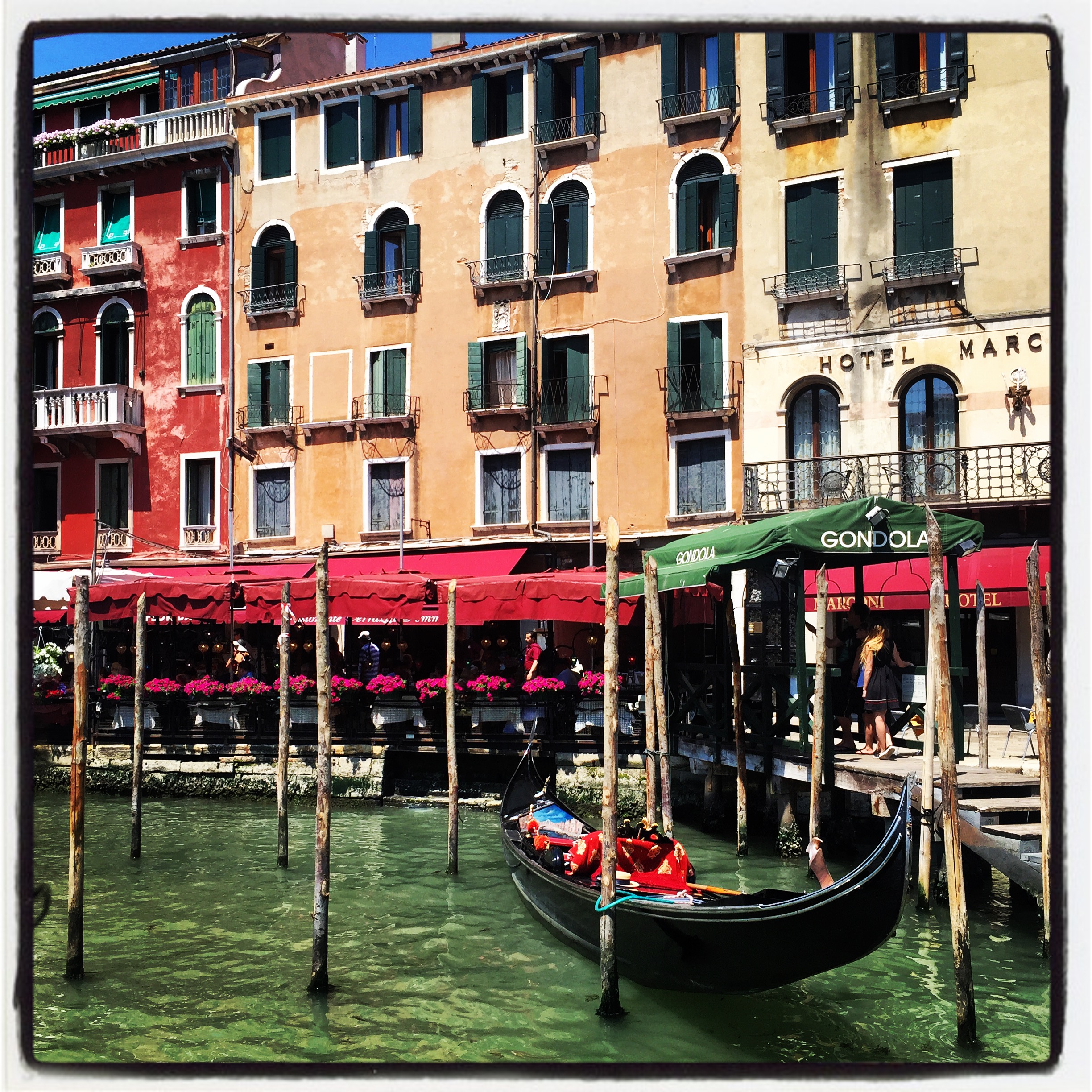
I captured this image from our vaporetto on the day of our arrival to Venice.

I captured this image from our vaporetto on the day of our arrival to Venice.

Now that you have met the field school participants through their individual blog posts, I will reflect on some of the time we spent on the Venice leg of our journey after the initial two weeks in New York. The original intention of this field school was to duplicate the structure of the Paris/Documenta 2012 trip, where we had first spent two weeks in Paris (studying assigned artists and the themes of urban transformation, modernity, and the rise of modern art in the French capital) followed by a visit to one of the most significant contemporary art exhibitions in the world-- Documenta-- held every five years in Kassel, Germany. 

Combining a trip with two very distinct art centers and art histories allows students to study both the similarities/overlaps in the themes of art production and circulation in the two locales, along with considering how a global art scene is created through information exchange, curatorial influence, and the search for a greater vision for the role and influence of today’s art world.  The Biennale—the world’s most influential art exhibition held every two years in Venice—was the focus of our visit to Italy. As part of the pre-trip courses at KPU, each of the students had been assigned a national pavilion (loosely related in some way to their assigned New York artist and art movement) to study and tour while on the ground in Venice.

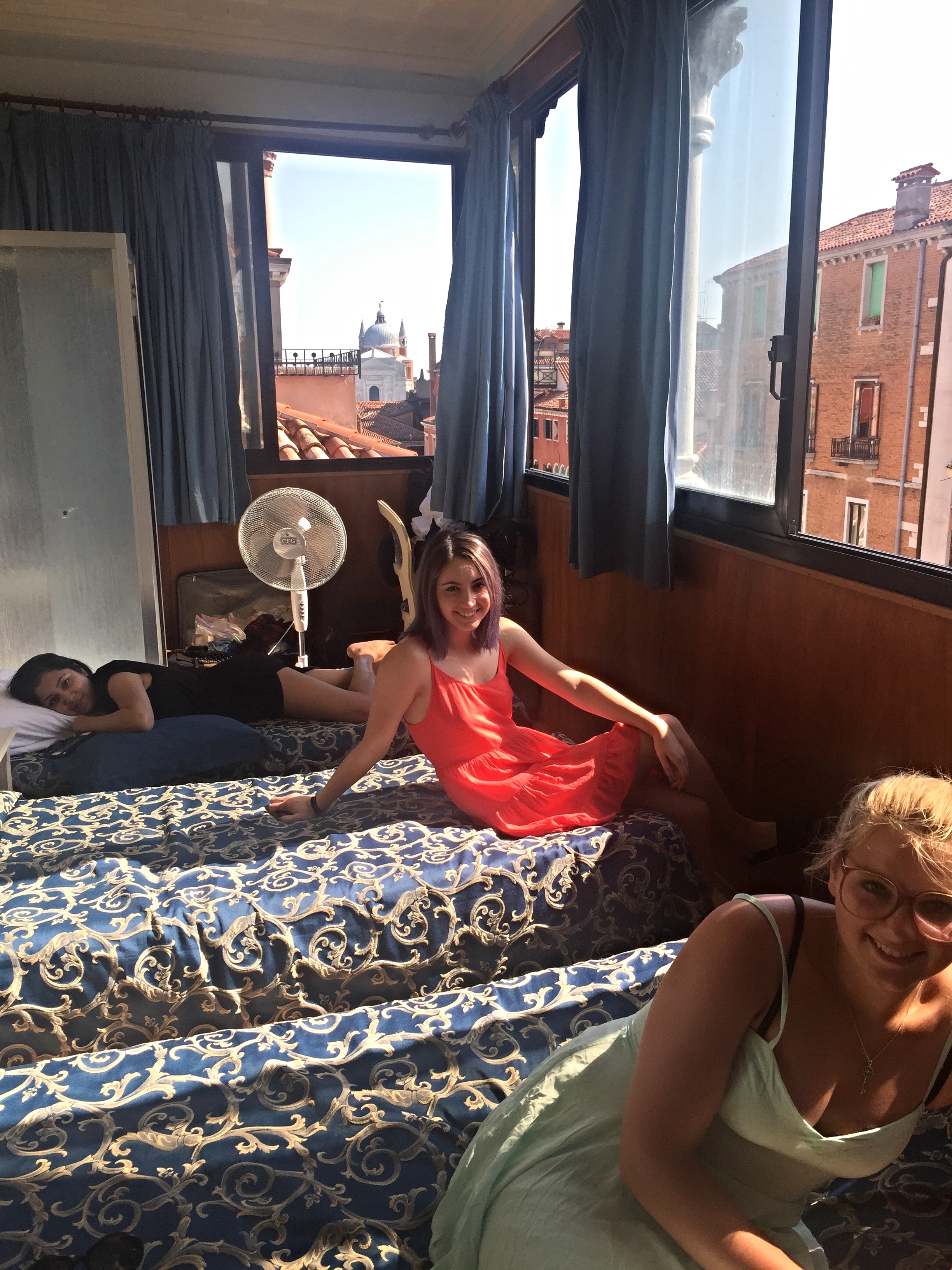
The view from our hotel from Jessica, Michelle, and Olivia's room.

The view from our hotel from Jessica, Michelle, and Olivia's room.

Jessica, Michelle, and Olivia settle into their new temporary home at our Venetian hotel.

Jessica, Michelle, and Olivia settle into their new temporary home at our Venetian hotel.

Arriving in Venice from New York was certainly a bit of culture shock for many of the students on the trip. For beginners, we were welcomed with a heat wave and the daunting task of getting to our Venetian hotel from the airport via a bus and then a vaporetto (water taxi) and finally a walk though the labyrinth of small medieval streets to arrive at our final destination. Air conditioning is both a luxury and a rare find in Venetian hotels, and so our group was forced to acclimatize quickly (with the help of fans, we eventually found some comfort). Once settled, we were then able to get our bearings and plot out our visit to the Biennale over the remaining week.

The Giardini is laid out with thirty national pavilions. Each student had been assigned one national pavilion and accompanying artist to study and then visit while in Venice. Note Canada's location at the south-east corner of the gardens, wedged bet…

The Giardini is laid out with thirty national pavilions. Each student had been assigned one national pavilion and accompanying artist to study and then visit while in Venice. Note Canada's location at the south-east corner of the gardens, wedged between Great Britain and Germany.

Our first task was to tackle the Giardini—the historic and traditional exhibition venue of the Venice Biennale. First laid out by Napoleon Bonaparte during the French occupation of the Republic of Venice in 1807, the garden was to become an open public and cultural space for the enjoyment of locals.  After Napoleon departed and the unification of Italy’s larger cities took place in the mid to late 19th century, Venice used the Giardini as a space of national exhibition, attempting to forge a modern identity for the ancient city. Importantly, these early exhibitions were concerned strictly with art, and so the founding of the International Exhibition of Art in 1895 (eventually to become what we know today as the Venice Biennale) was the world's first modern, open, and international art exhibition, inviting tourists to come and see the best of the world’s contemporary art. The garden today contains thirty permanent national pavilions, while the remaining nations represented at the Biennale are housed at the second venue of the Biennale—the Aresenale, a complex of former armories and ship yards near the Giardini—or in temporary spaces, leased to countries and artist groups seeking access to Biennale audiences, scattered throughout the city. The peculiar tension between old and new art  worlds is therefore played out throughout Venice for the duration of the Biennale, as the temporary contemporary art exhibitions of the event compete with the medieval and Renaissance art that has shaped and created a particular vision of the city throughout history.  Read more about the history of the Venice Biennale here.

The list of national pavilions and other sites of interest at the 2015 Giardini venue at the Venice Biennale.

The list of national pavilions and other sites of interest at the 2015 Giardini venue at the Venice Biennale.

Visiting all of the Biennale is an almost impossible task, but we were determined to give students ample time and space to explore the exhibition at their own pace and with their own particular interests in mind. Outside their own assigned pavilions, we asked students to see the main pavilions at the Giardini and Arsenale, and explore the off-site venues at their leisure, keeping in mind this year’s Biennale theme—"All the World’s Futures" (more on that in the next blog post). But one pavilion we all wanted to visit together was the Canadian pavilion, located in a somewhat isolated spot between the looming Great Britain and Germany pavilions (as in all things, location is a sign of status at the Giardini).

Having visited the Biennale in past years (and blogged most recently on the 2011 Biennale when the chosen artist to represent Canada was Vancouver artist Steven Shearer) I was especially interested to see how the pavilion had been transformed. A great deal of buzz had already been generated back home with the selection of Quebec City’s artist-collective BGL (made up of artists Jasmin Bilodeau, Sébastien Giguère and Nicolas Laverdière) and their Canadassimo concept for the space. On the National Gallery of Canada’s official website for the Canadian pavilion, the following statement by guest curator Marie Fraser helps describe the idea:

 “Canadassimo offers a strange path through the Canada Pavilion, which has been completely transformed. Beneath the scaffolding that partially obscures the building’s façade – creating the impression that the exhibition is still under construction – is the entrance to adépanneur, one of the small neighbourhood convenience stores found across Quebec that sell tinned goods and other household essentials. Beyond this typically chaotic and shabby shop is a loft-like living space: though far more organized, this area is evidently the preserve of a recycling enthusiast. Next comes what BGL has dubbed “the studio,” a place crowded with countless objects of all kinds, including stacks of tin cans covered with dribbles of paint. Having made their way through this bizarre living/working domain, spectators can relax for a while on a terrace that offers a marvellous view over the Giardini.”

IMG_6745.JPG
IMG_6747.jpg
IMG_6748.jpg
IMG_6750.jpg
IMG_6751.jpg
IMG_6745.JPG IMG_6747.jpg IMG_6748.jpg IMG_6750.jpg IMG_6751.jpg

We arrived at the pavilion and were immediately struck with how very “under construction” the place felt. Entering the pavilion, many of us however felt immediately at home when we explored the Canadian convenience store installation with all of the recognizeable Canadian name brands we had grown up with. From the small town convenience store through into the spaces of the makeshift studio, we were met with hundreds of cans of paint and the interior spaces of a living workshop. It is almost impossible to take in the space in its entirety, but it certainly represented some sense of the creative process that is often lost on audiences when visiting an art exhibition. Upstairs to the tree-house, we were delighted to find both a great view of the Giardini, but also the feel of the nature and environment many of us associate with home (wilderness and technology-- very Canadian indeed!).  Invited to drop coins into a large gaming contraption built at the apex of the pavilion, we were a bit disappointed that they did not accept Canadian pennies (“they jam the system” one attendant told us without a hint of irony), but we still had a moment of play and got to experience some of the whimsy that is at the heart of BGL’s installation. Afterwards we all went in groups or individually to begin our exploration. More reflections on the curatorial vision of the Biennale, and other adventures of the field school in the next post!

Experiencing BGL's Canadian pavilion at the 2015 Venice Biennale. Dropping coins are Jess, Olivia, and Eric.

BGL's official video for the 2015 Canadian Pavilion at the Venice Biennale.

To see more photos and impressions of New York and Venice through the eyes of the field school participants, click on this link to check out our Instagram feed #kpunycvenice

Comment
Meet Cody-- here he is scoping out the New York skyline from atop the Empire State Building.

Meet Cody-- here he is scoping out the New York skyline from atop the Empire State Building.

Location | New York: Meet Field School Blogger Cody Lecoy

June 20, 2015

Tell us a little bit about yourself—your background, major program of study, reasons for taking this trip, and anything else interesting you want to share (maybe something people might not know about you).

I am writing this on our last day in Brooklyn.  Today we pack up and leave for Venice, I would like to share with you some of my experiences from the last two weeks here in New York. But first, a little about myself.  My name is Cody Lecoy, and I am enrolled in the Bachelor of Fine Arts program at KPU.  I have found to have a real passion for painting and over the last few years I have developed a studio practice outside of school.  Currently I have been living in an artist residency space, Skwachays, located in the Downtown East Side of Vancouver.  There is access to a shared studio space as well as an art gallery to showcase work.  These two factors and also the centralized location in the downtown core have made for a real enriching experience.  What continues to be surprise me while being engaged in the creative fields is the importance of networking and also the somewhat coincidental circumstances I find when navigating the art world.  Since I have been living Downtown I feel the frequency of these networking opportunities has increased and I feel that is because of greater accessibility to various markets, opening, festivals, performances, film screenings, panel discussions and many other events that happen in the city.  Also the process of actively seeking out these places, I feel, also works in ways to connect one with place and community. To be in this state of immersion is why I choose to participate in this New York/ Venice field school.  

What has met or exceeded your expectations or surprised you about New York so far?

Cody enjoying Coney Island!

Cody enjoying Coney Island!

Since arriving here in New York, I would have to say the neighbourhood of Brooklyn, in which we've been staying has been the biggest surprise for me.  It has been surprising because my first impression was that it was mostly just an industrial space with more of a character of passing activity, with people coming and going, and not having a centralized atmosphere.  Also I believe my notions of art had a large part to do with this reading.  The walls of Brooklyn are covered in street art and I love it.  I feel that because I see street art I never thought that would equate to fine artists also sharing the space.  In our last days here there was the Bushwick Open studios event, which I felt was a perfect illustration of the streets coming alive and the walls of the neighbourhood becoming animated and enhancing the experience.  The density of artists living in studio space here really surprised me.  As I mentioned before, that connection to community and place is really important as an artist for support, and in the days of the Open Studios those values were evident and visually expressed.  I was also impressed to witness how the art community really came together and embraced creating a strong street culture.  There was a strong grassroots and “do it yourself” feel on the streets during the event.  Restaurants were extending their spaces out into the streets.  There were a lot of performances from bands, theatre troupes, and many street vendors.  One could see that it was a sought after destination.  Another aspect I enjoyed were these U-haul storage trucks transformed into portable gallery spaces.  

Give us some insight into your assigned artwork from the Museum of Modern Art. Who is the artist? When was this work made? What is the content of this work? In what context and as part of what art movement was it made?

Cody was assigned Robert Rauschenberg's The Bed (1955) from the MoMA collection.

Cody was assigned Robert Rauschenberg's The Bed (1955) from the MoMA collection.

The Bed (1955) by Robert Rauschenberg is a radical departure from traditional art representation.  The work is described as a “combine” piece, for it combines the mediums of sculpture and painting.  Rauschenberg’s art can be described as neo-Dada.  Dada has been described as an anti-art movement that seeks to question the role of art and expand and redefine the notions of what art is.  In this piece I see Rauschenberg questioning the purist ideal of Abstract Expressionist painting.  Abstract Expressionist painting is said to be “of the body”.  This means the body can be seen or felt as present within the art.  Also the process of making the art is emphasized as giving meaning to the work, and the work itself provides the viewer with an experience of pure ideas and a new experience.  Rauschenberg looked to question Abstract Expressionism both literally and figuratively.  Bed is literally of the body, for there is evidence of bodily secretions such as blood and semen within the work.  Although I looked very closely and I believe the archival quality of these materials isn't as permanent as the oil paint that is found on the bed.  By naming the work Bed, Rauschenberg frames the work within the mysterious domain of the dream world; a world of pure subjective experience that everyone experiences regularly.  

How did you approach the creative task of responding to this assigned work in studio? What were your challenges as an artist to be in dialogue with the artwork and artist? Would you do anything differently now that you have seen the work in person?

Cody (always in motion!) next to his response piece to the assigned Rauschenberg, exhibited at the "Talking Back" show at KPU prior to departure to New York and Venice. 

Cody (always in motion!) next to his response piece to the assigned Rauschenberg, exhibited at the "Talking Back" show at KPU prior to departure to New York and Venice. 

In response to Bed, I chose to also employ the bed frame to frame the work in the domain of dreams and the subconscious mind.  I am interested in illustrating the process of thoughts becoming conscious.  Drawing influence upon reading the work of Carl Jung, I was fascinated from an account of him describing belief systems in the mind being expressed as actual physical structures.  In this train of thought it is my hope to visually express the rise and fall of thoughts and how over time these thoughts work to form beliefs that inform social structures.  I would say in speaking of the conceptual underpinnings of the work, my hardest challenge for this art was allowing the materials to have a greater role in communicating the actual content of the work.  I mainly have a painting background, although I do enjoy the expressive qualities of paint, more often the content of my work has to do with how the imagery I make relates to broader concepts.  I was most struck as to how the actual quilting pattern of the art piece was really a strong compositional element.  I believe Rauschenberg chose this piece of quilt because of how the geometric colouring had reference to minimalist and geometric art that is relatable to the modern art movement.  I would have liked to employ this play of materials.  The challenge I set for myself was to have two-dimensional images and extend outwards and allow them to become more sculptural.  I see the quilting pattern as a solid foundation from which to work on. I see also that it also sort of imposes its own limits on how to make stronger statements with less compositional elements.  Less is more.  

After seeing your assigned art work in person (and any other related art from the same artist or art movement associated with the assigned work), what struck you most, and/or how did the artwork’s form, content, and context shift for you when seeing it?

As one of his studio assignments while in New York, Cody sketches The Bed while at MoMA and photographs a side by side shot, later to be uploaded to the class's Instagram feed.

As one of his studio assignments while in New York, Cody sketches The Bed while at MoMA and photographs a side by side shot, later to be uploaded to the class's Instagram feed.

When seeing Rauschenberg’s work in person, I really enjoyed not only the museum context but also the work it was surrounded by.  In particular his other combine work,  The Canyon,  as well as Jasper John’s work.  In person I could notice on a visceral level how the tension between how the suspended work from a wall and the protrusion into space really gave weight to the work.  In seeing The Bed I found that I was surprised to find it felt a bit smaller than I imagined.  Seeing it in person I felt like Rauschenberg presented it in a light that is unexpected for a bed.  Beds are a place of rest and comfort.  This bed is quite small, the sheets are pulled taut to the corners and contained, the paint hardens into globs sharp and jagged edges.  The bed also mimics the bed frame giving it a very stiff like appearance. 

Today’s activity was a free day spent in the neighbourhood of Brooklyn. What were your impressions of this part of New York after learning about it first in the pre-departure classes? What will you take away of the experiences of this day?  What are the most memorable moments for you?

Kenneth, Olivia, Jess, Cody, and Larry pose proudly in front of their completed street art mural in Brooklyn. From what we hear, it is still there!

Kenneth, Olivia, Jess, Cody, and Larry pose proudly in front of their completed street art mural in Brooklyn. From what we hear, it is still there!

In conclusion to my stay at New York, a group of us were very fortunate to stumble across an opportunity to paint a mural here in the Bushwick neighbourhood.  After being immersed in street art and amazed at the sheer amount of covered wall spaces, we all jumped in at the opportunity to try it out for ourselves.  This experience also went to confirm my beliefs that the Bushwick neighbourhood is a thriving artistic hub of creative energy.  This experience also seemed serendipitous to me in a way.  It had been a goal of mine to expand the borders of the canvas onto outdoor wall space and to create work with the immediacy of being in the public sphere.  Also, for many of us we have been looking at art at The Museum of Modern Art, The Whitney Museum, The Guggenheim, The Metropolitan Museum and many galleries, so I feel like we all were ready to express our collective inspiration.  The wall that we were able to spray paint was attached to a paint supply store.  Their mandate was simple: buy some paint and the wall is yours.  After we found this place in the evening, we went back to the hostel and started up a sketch brainstorm session.  With a direction in mind we went out the next morning and got to work.  I had a picture that in order to do a mural it would take much networking, permits, planning, and experience.  Thank you Brooklyn for changing my outlook on that.  Also a big thanks to Kenneth, Olivia, Jess, Larry, Merry for taking the documenting pictures and everyone stopping in for the input and support. 

To see more photos and impressions of New York and Venice as the field school continues, check out our Instagram feed #kpunycvenice

A closer look at the finished street art mural-- a wonderful opportunity and labour of love for Cody and the other participating students.

A closer look at the finished street art mural-- a wonderful opportunity and labour of love for Cody and the other participating students.


Comment
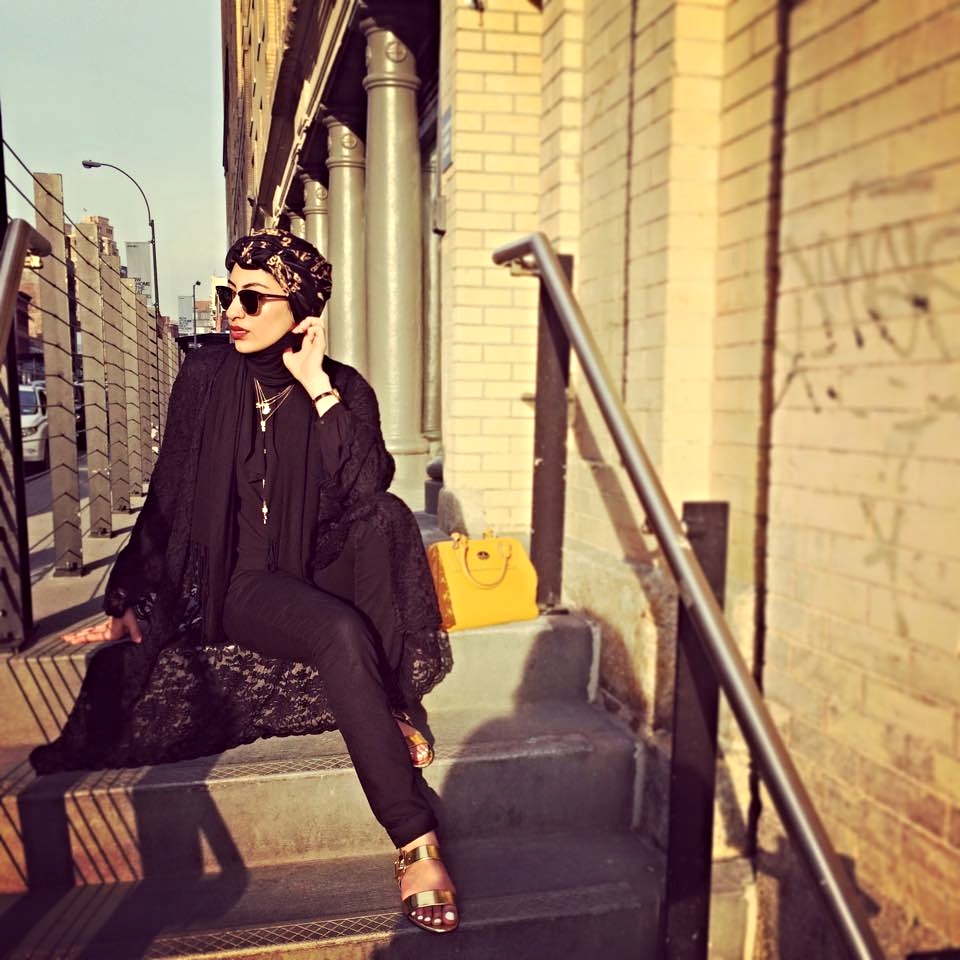
Meet Durrah-- sitting and enjoying a moment to herself in the New York afternoon light. 

Meet Durrah-- sitting and enjoying a moment to herself in the New York afternoon light. 

Location | New York: Meet Field School Blogger Durrah Alsaif

June 19, 2015

Tell us a little bit about yourself—your background, major program of study, reasons for taking this trip, and anything else interesting you want to share (maybe something people might not know about you).

Hello! I am Durrah Alsaif. I was a business student previously, but I am now in my 3rd year for my Bachelors of Fine Arts. My artwork is mainly focused on photography, digital media, and silkscreen. Coming from the Middle East, I have always been fascinated with different cultures, languages, and art, which is my main theme in my artwork. Joining this trip was one big opportunity to be with people who have the same artistic mind and to share the art adventure of a lifetime, as well as connecting with people from different backgrounds. Although I travel quite frequently to many places around the world with family and friends, it is different than traveling with a group of art students because being with like-minded people focuses on my potential career goal, which is being an artist. Also, I thought that coming to this trip would help expand my knowledge of contemporary art and my way of making art.

Durrah (on the far left), with Roxanne, Cody, and Cathrina at Coney Island.

Durrah (on the far left), with Roxanne, Cody, and Cathrina at Coney Island.

What has met or exceeded your expectations or surprised you about New York so far?

As I am writing this on my last night in New York, I would say that it has been wonderful. Although I visited New York City twice in the winter a couple of years ago, this time felt like I have not visited this place before. Everything felt amazingly different: the weather, the neighborhood, the people, and the street art. I am fortunate enough to be in this field school where we got to see New York’s art scene from an artistic eye. What surprised me is the amount of street art in the city; it is literally everywhere! The thing that I liked most was the graffiti around Brooklyn (especially the neighborhood of our hostel) and seeing all the young artists and their work around the area was really delightful and encouraging. Seeing more areas of the city makes me love it more; it is a mixture of everything: art, culture, languages, backgrounds, boroughs and neighborhoods.

Give us some insight into your assigned artwork from the Museum of Modern Art. Who is the artist? When was this work made? What is the content of this work? In what context and as part of what art movement was it made?

Durrah was assigned Rachel Whiteread's not so easy to locate Water Tower (1998) at MoMA.

Durrah was assigned Rachel Whiteread's not so easy to locate Water Tower (1998) at MoMA.

My assigned artwork at the Museum of Modern Art was Water Tower (1998) by Rachel Whiteread. The work is a public sculpture installed on the roof of the Museum of Modern Art, which resembles many of the water towers around New York City except for the fact that it is an actual piece of art. The artist is more focused on the form, lines and the negative space around the artwork. Water Tower is meant to be a jewel to the sky and to accentuate it. Water Tower’s translucent texture makes it glows like a crystal in a clear sky and makes it almost invisible at night.  

After seeing your assigned art work in person (and any other related art from the same artist or art movement associated with the assigned work), what struck you most, and/or how did the artwork’s form, content, and context shift for you when seeing it?

Finding my assigned artwork at MoMA was quite amusing. When I was trying to look for it, I did not see it outside in the garden, so I asked some staff members, and they did not know where it was either. I knew from my research that it is displayed on the roof of MoMA, but I could not picture that it would be so very unnoticeable. After searching for Water Tower couple of times, I found it! It was installed on the rooftop of the sculpture garden, but it was so hidden that even the security guard at the garden did not know that it was part of the museum. Seeing it in real life was totally different experience than seeing it virtually. The first thing I noticed is that it was smaller than the pictures, as we cannot see it closely. Also, putting a sculpture on the rooftop of a building is interesting because it changes its context completely. I was lucky enough to see the sculpture glow in the sky because of the clear weather on that day.

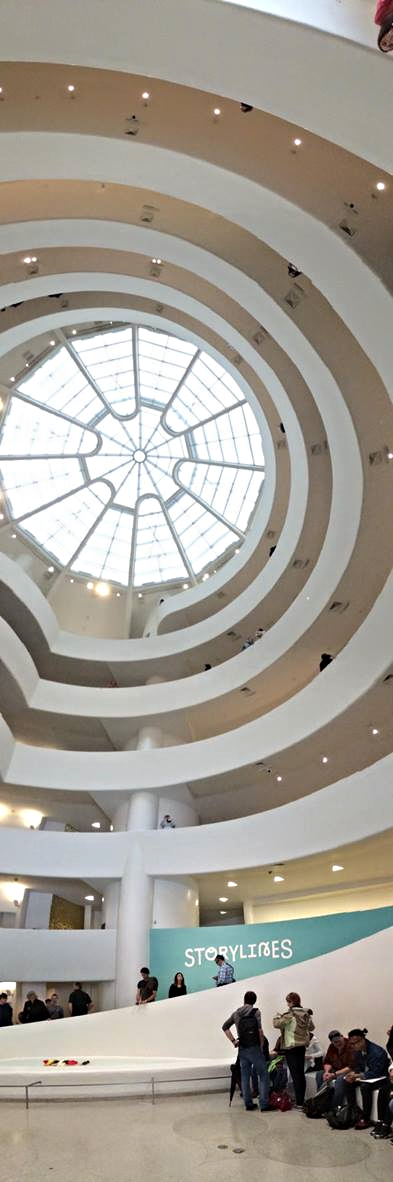
A wonderful shot captured by Durrah of the inside of the iconic Guggenheim Museum.

A wonderful shot captured by Durrah of the inside of the iconic Guggenheim Museum.

Today’s activity was at the Guggenheim Museum in the Upper East Side neighborhood. What were your impressions of this part of New York after learning about it first in the pre-departure classes? What will you take away of the experiences of this day?  What are the most memorable moments for you?

On a rainy Friday morning, we were supposed to meet at the Guggenheim Museum at 10:00am. However, the trains were temporarily held, so we had to go to another subway station to take another train and managed to arrive at 11:00am. When I arrived at the museum, I was struck by the interior architecture of the museum, as it is beautifully structured in a spiral shape that makes the viewers move in a neat order from one artwork to another effortlessly. Also, each artist had his or her own section in the exhibition without interfering with other artworks. The exhibition that was on view was called “Storylines,” which is a collaboration of artists from different countries to tell their stories about politics, religion, sexuality and identity through different kinds of media in a contemporary way. In my opinion, the artworks in the show were too personal for me to understand or relate. Also, I felt that it was too contemporary in the way that they are shown. In my point of view, some of the artworks were kitsch. What I thought about the exhibition is that most of the artworks do not relate well to each other.

Later after the Guggenheim Museum visit, we decided to go for lunch at Shake Shack. I was hesitant at the beginning because it was my first time trying it (and I am glad I did!). It was so delicious that I decided to go back for dinner, but this time I waited in the line for 45 minutes (yes, it was that good!). On the same day, Pauline and I did some shopping before we left New York for Venice. When we arrived at the hostel later at night, we heard some loud noises coming from upstairs until we realized that there is a mini party happening in the Fashion Girls’ room. We went straight there as well as some other students in our group and spent a fun night with lots of laughter! 

To see more photos and impressions of New York and Venice as the field school continues, check out our Instagram feed #kpunycvenice

Durrah and Pauline capture a selfie in New York's Times Square.

Durrah and Pauline capture a selfie in New York's Times Square.

Comment
Meet Andi as she parts Felix Gonzalez-Torres' golden curtains (Untitled (Golden) at the Guggenheim Museum.

Meet Andi as she parts Felix Gonzalez-Torres' golden curtains (Untitled (Golden) at the Guggenheim Museum.

Location | New York: Meet Field School Blogger Andi Icaza

June 18, 2015

Tell us a little bit about yourself—your background, major program of study, reasons for taking this trip, and anything else interesting you want to share (maybe something people might not know about you).

Around every corner in New York... Andi captures an unexpected moment and juxtaposition. A street vendor talking on his cellphone inside a phone booth. 

Around every corner in New York... Andi captures an unexpected moment and juxtaposition. A street vendor talking on his cellphone inside a phone booth. 

Hi. I go by Andi (although my passport says something else), and I’m a Vancouver/Managua-based photographer and visual artist currently pursuing a BFA in Visual Arts at Simon Fraser University. Having taken Dorothy’s 19th and early 20th Century Art History course at SFU, I was sure that doing a Field School about the hubs of contemporary Western art would be an extremely informative and exciting opportunity for learning and travelling. Plus, a studio course to go with it seemed the best way to keep doing hands-on work when travelling. All in all, it was my desire to experience first hand a part of the “World of Art” that I’m at odds with; I am a firm believer that one must know what one seeks to criticize and potentially subvert.

What has met or exceeded your expectations or surprised you about New York so far?

I thought the Statue of Liberty would be bigger. Grand Central Station met my expectations. Specifics aside, I was pleasantly surprised by the vibrancy of the city—it truly never sleeps. New York’s enormous density resonates with its multiculturalism; it is a place where those who want to be heard are the ones raising their voices (and you bet they have to be loud to counteract the bustling sounds of the city). There seems to be a constant tension between standing out and fitting in that keeps creative minds working and Metro musicians playing. Alas, the levels of pollution and dirtiness did exceed my expectations—you’d think they would’ve figured out a better system for its disposal at this point. Nevertheless, people are kinder than what they are pictured to be and I definitely got more smiles than insults.

Andi and Pauline enjoying Salvadorean food on the streets of Bushwick in Brooklyn.

Andi and Pauline enjoying Salvadorean food on the streets of Bushwick in Brooklyn.

Give us some insight into your assigned artwork from the Museum of Modern Art. Who is the artist? When was this work made? What is the content of this work? In what context and as part of what art movement was it made?

Andi was assigned Jenny Holzer's You Should Limit the Number of Times... (1980-82) from MoMA's collection

Andi was assigned Jenny Holzer's You Should Limit the Number of Times... (1980-82) from MoMA's collection

Jenny Holzer is a living artist that has been active since the late 1970s and most prominently throughout the 80s and early 90s. She’s the text-based artist per excellence of a generation in New York City concerned with the search and exposal of meaning while balancing the tension between the private and public. Her text-based work includes works on LED, bronze, t-shirts, projections, fortune cookies, souvenirs, billboards and the Internet. She was the first woman to represent the USA in the Venice Biennale in 1990. I was assigned to respond to her Living Series (1980-82), YOU SHOULD LIMIT THE NUMBER OF TIMES… specifically. This work was made as American youth were growing uneasy with the conservative direction the late 1970s was bringing into the new decade. An 8”x10” bronze plaque that blends in with the urban landscape, the artwork touches upon matters of the daily defiance of human nature, diverting from a mainly explicit political content and turning inwards.  Working with the idea of language as a vehicle for everyday meaning, the Living Series are connected to the new wave of Conceptual Art of the 1980s.

How did you approach the creative task of responding to this assigned work in studio? What were your challenges as an artist to be in dialogue with the artwork and artist? Would you do anything differently now that you have seen the work in person?

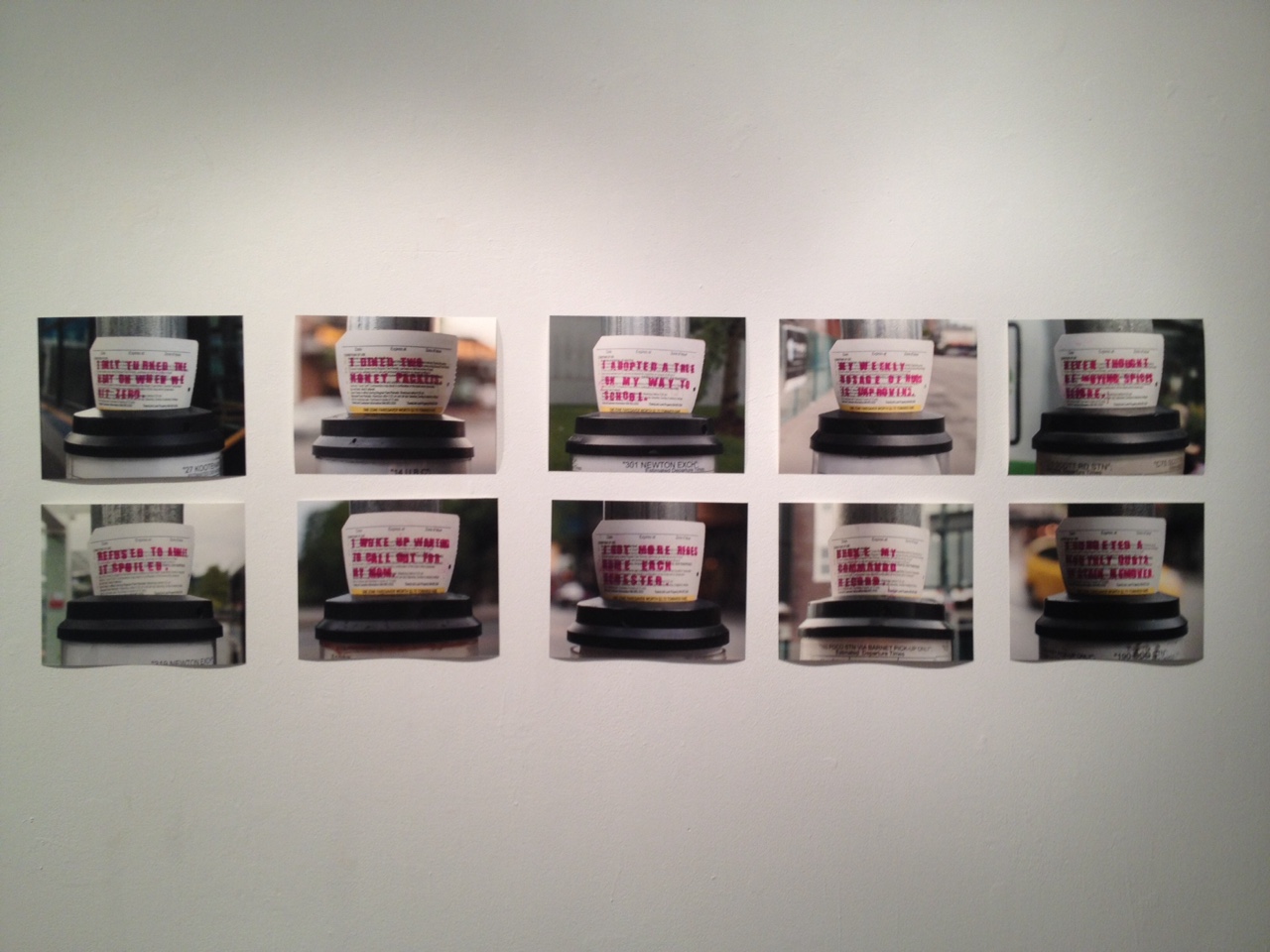
To respond to this work, I focused on Holzer’s use of language and her approach to installation in unexpected but totally commonplace spaces. I created an exchange of intimacy through stamping phrases (in pink) of transition from a girl into a woman, a young adult into an adult, a momma’s girl into a tenant onto un-used transit tickets. The idea was to interrupt someone’s day momentarily with an anonymous gift that nevertheless carried some form of human weight. Surely the biggest challenge was trying to say something that Holzer hadn’t already said in some form, while remaining truthful to what I was sharing with the lucky passerby. In retrospect, I could have been cleaner with the actual stamping, as Holzer’s work has a manufactured quality to it that might have benefited my piece.

An installation shot of Andi's response piece to Holzer-- exhibited at KPU as part of the "Talking Back" exhibition prior to departure for New York and Venice.

An installation shot of Andi's response piece to Holzer-- exhibited at KPU as part of the "Talking Back" exhibition prior to departure for New York and Venice.

After seeing your assigned artwork in person (and any other related art from the same artist or art movement associated with the assigned work), what struck you most, and/or how did the artwork’s form, content, and context shift for you when seeing it?

The plaque is installed with uttermost perfection. On the second floor of the MoMA, it exists without a label, without an explanation, without a spotlight. Placed around the corner from the elevators, there’s no piece in front of it, and most people walking in front of it dismissed it immediately or thought it was just another informative plaque and so dismissed it thereafter; you could say it’s hidden in plain sight. Holzer’s cleverness hasn’t ceased to amaze me. As for other conceptual works previous to her time in the Western art, I was mostly disappointed; the level of abstraction the concepts being addressed rendered many of the works inaccessible to those outside the art world. The power of the ideas were there alright, but an idea that can’t be shared with those who most need it in the world is as good as an inside joke. Luckily, the newer generations are paying attention to conceptual artists with a more encompassing engagement to the world, as in many of the works shown in MoMA’s “Scenes for a New Heritage” exhibition, the Guggenheim’s “Storylines” exhibition, and in the Brooklyn Art Museum’s “Diverse Works: Director’s Choice” exhibition.

Today’s activity was visiting the Solomon R. Guggenheim and the East Village. What were your impressions of this part of New York after learning about it first in the pre-departure classes? What will you take away of the experiences of this day?  What are the most memorable moments for you?

Street dancers and musicians at Washington Square Park.

Street dancers and musicians at Washington Square Park.

Like most of my co-bloggers, I was amazed by the architecture of the Guggenheim—it certainly is a space worth experiencing, simply viewing images of it don’t do justice to Frank Lloyd Wright’s architectural achievement. However, unlike most of the students, I truly enjoyed their current exhibition “Storylines.” Tracing the narratives concerning contemporary artists’ practices, the building’s spiral created an approachable survey of artworks relevant to today’s world. I actually believe that it branched out from Western art, illustrating the increasingly globalized culture we are living in. But what I’m certain of is that it represented the gender demographics of contemporary art more accurately than other museums in town: half, if not more, of the artists were female.

As for the East Village, it provided me with a lovely day around a part of town that embraces the aging of the inanimate. Old buildings with walls covered in refreshing ivy (not as much green as I need but closer than several other parts of New York). The amount of commercialized sub-culture was not a pleasant surprise but I have been to Camden in London before and the commodification of punk is old news. Nevertheless, I think that if I had to live in NYC, the East Village would be the place for my rusty, musical, plant-filled apartment (granted money wasn’t a concern, of course).

Andi’s blog on her selection of Works from the Field School will be up and running soon. To check it out and follow visit: www.whatcaughtme.tumblr.com

To see more photos and impressions of New York and Venice as the field school continues, check out our Instagram feed #kpunycvenice

Inside the spaces of the Guggenheim Museum.

Inside the spaces of the Guggenheim Museum.

Comment
Newer / Older
Back to Top
Screenshot 2018-02-05 20.48.17.png

© Dorothy Barenscott, 2010-2025