Focus on Tech| Google Chrome: Fast, Stable, Flexible (Did I say it was FAST?)

Frederico Fieni, The Story of Google Chrome (2008)
I love Google Chrome. As web browsers go, it is by far the fastest, most effective, and most flexible of all the ones I have tried (even Firefox), and it boasts the best possible feature of being virtually impossible to crash (I am looking at you Internet Explorer 8 and Safari 5). I switched to Chrome only a few weeks ago after finally being convinced to download it to view the The Wilderness Downtown Project. Clearly, Google understood what they were doing putting together that collaboration because I ended up playing around with the browser after thinking the download to watch the video/film was only going to be temporary. It was like my computer was given a turbo charger and my web browsing speed (even with dozens of open tabs) easily doubled-- oh, and it is very pretty to look at, great minimal design, and the addition of artist designed themes to choose from if you wish (I selected the abstract Casey Reas-- see his fascinating bio).

I have since spent some time researching and playing around with options on the browser and have discovered several great features (including the fantastic integration of Google search right in the web address bar). Many of these are usefully summarized not only in the YouTube video I have added below (which also discusses how the Chrome browser inspired the upcoming Chrome open source operating system for computers) and this one here, but also summed up in a series of "how-to" posts found here and here on one of my favourite tech blogs, ProfHacker.

To download Google Chrome (it is free!), view demonstrations, and browse nifty theme packages, visit the download page.

The Anatomy of a Developing Discourse, Part 2: William Powhida and the Art of Insider-ism

William Powhida, The Game (2010)
"The goal of the game is relatively simple,
get your work in to Met and make history."
Further to the Jerry Saltz and Frieze magazine “talk around art” incident I raised a few posts back, I wanted to extend that discussion and raise the work of William Powhida as one recent example of an artist's attempts to represent and provide critical commentary on the “unspoken” aspects of the contemporary art industry. Living and working in New York as a visual artist (with a specialization in drawing and painting), Powhida’s illustrations focus on exposing the mechanisms of power that influence the world of art criticism, acquisition, production, and circulation. Importantly, what sets Powhida apart from many other artists attempting to do something of the same is his direct engagement with the power of social media and the growing influence of blogging, posting, and tweeting in the circulation of ideas concerning art and the art industry. Much like his drawings suggest and to which they give form, the nature of the discourse is built upon a series of interconnections and pathways of knowledge and influence.

William Powhida,
How the New Museum Committed
Suicide with Banality
(2009)
For example in 2009, Powhida was commissioned by Brooklyn Rail (a monthly journal covering art and politics in New York and around the world) to produce a cover for the publication and submitted a satirical drawing titled “How the New Museum Committed Suicide with Banality” which was based on the title of a blog of the same name offering a critique on the New Museum’s show featuring celebrity (and some suggest overexposed and overplayed) artist Jeff Koons. Powhida’s drawing extended the original blog into a carefully detailed drawing that not only named and connected all of the players involved in the exhibition, but also featured caricatures and ironic commentary on the whole affair. The use of individual "Facebook" like pictures and snappy short text in "Twitter-esque" prose also successfully pushed the conceptual reading of the work. But perhaps most ironic in the end (and something Powhida must come to terms with as an artist) was the purchase of one of Powhida's drawings by the very museum trustee at the center of the controversy. Jerry Saltz not surprisingly described the drawing and whole aftermath as “a great big art world stink bomb” (!).

William Powhida, Pressure (2007)
Powhida’s most recent Brooklyn Rail cover features “The Game”—a drawing that traces the dynamics of power based upon the players career choices moving from an MFA program towards celebrated art career. The summary says it all: "The goal of the game is relatively simple, get your work in to Met and make history. You need to follow a path through the art world from an MFA program towards recognition, representation, and museum exhibitions while picking up some supporters along the way who will help propel you into history. Like the real art world, whether your in or out is largely out of your control.We’ll assume you have some modest talent, but making history requires a lot of luck. The only decisions you have to make along the way are which paths to try to get ahead, whether or not to drink, and how you can best use your supporters influence to advance your career, the rest is either luck or chance, depending on your outlook on life. You can also play the ‘Bitter Version’ by following the suggestions for modifying the game play. Also, feel free to make your own supporters and new INS and OUTS. There’s at least 197 other collectors who matter and shit loads of ins and outs. Good luck.”

This work and other projects can be found on Powhida’s entertaining blog and see this interview with William Powhida conducted by James Kalm (art vlogger)


Further Reading:

Leffingwell, Edward. "William Powhida at Shroeder Romero" Art in America 95.9 (2007): 204.

Lindholm, Erin."The Art of the Crowd." Art in America online, February 16, 2010

VIFF Preview| Hunky Blues: The American Dream

A photographic still of immigrants waiting to be processed,
used in Hunky Blues: The American Dream
For many North Americans, the story of our individual family’s remembered past includes tales of immigration adventure. Passed down through oral storytelling, the occasional photograph from the “old country,” and the suggestive trace of a name found on an archival document, the stories form and re-present memories through the mediation of personal visual and textual documents. At the same time however, these same stories remain in constant dialogue with the visual and textual documentation of the broader cultural context from which they emerge. For Hungarian filmmaker Péter Forgács, this dynamic intersection of personal and cultural/national memory forms the basis for his latest experimental film, Hunky Blues: The American Dream, playing at the Vancouver International Film Festival.

The captain from
Danube Exodus (2002)
Forgács, who is also a media artist and has represented Hungary at the Venice Biennale and exhibited his art works at the Getty and in multiple galleries and museums around Europe, is best known for his work with found amateur home made films recovered mainly from Hungarian families of the 1920’s through 1960’s. Through these efforts, he established the Private Film and Photo Archives in 1983 that houses a collection of over 300 hours of amateur film. Since 1978, Forgács has made more than thirty films, the most internationally recognized to date being The Danube Exodus (2002) which tells the story of Nándor Andrásovits, a riverboat captain who documented his voyages along the Danube as he transported Eastern European Jewish refugees to safety in Palestine in 1939 within the same year as transporting Bessarabian Germans who had fled back to the Reich from the Soviet invasion to resettle land confiscated in occupied Poland in 1940. Compiled from original 8mm footage taken by the captain, Forgács presents these complicated (and seemingly irreconcilable) stories in purposeful and stark juxtaposition.
Péter Forgács, rendering of video portraits in frames for Col Tempo (2009)
courtesy of Art in America

With this found film material, Forgács has thus worked to retrieve competing narratives in an overall understanding of the troubled region of Central Eastern Europe. Born in 1950, only five years after the end of WWII and the beginning of a new communist regime in Hungary, Forgács has spent a good deal of his professional career attempting to understand the complexities of art and history-making in his homeland. Expelled from the Hungarian Academy of Fine Arts for his involvement with an unsanctioned art movement, he began to explore the avant-garde scene rarely discussed in the art schools of the time—finding the work of pioneering modern artists such as Marcel Duchamp and more contemporary filmmakers such as David Lynch to be both inspiring and mind-opening. As a result, Forgács has worked with a conceptual aim in both his art and film making practice to explore and visually represent those places of slippage where the historical and personal record intersect. In his latest film, Forgács once again tackles the complexities of what would appear at its surface to be a straight-forward documentary account of the large wave of Hungarian migration to the United States between 1890-1921. What he creates instead is a visual fusion of early American cinema sources, archival photographs, found amateur film, and personal diaries, in a carefully composed “picture” of the complexities of immigration. The film's world premiere in New York's Museum of Modern Art attests to its visual focus.

As I close this preview, I want to disclose that my personal family history is also linked to a Hungarian past and a harrowing tale of immigration adventure that my parents took to find their way to Canada. It is a part of who I am and has played a critical role in how I understand the production of history and visual representation. Still, I believe that an experimental film like Forgács’s can resonate with a much broader audience than first presumed. As Forgács has explained about his process: "I am using the ordinary language of photography and film to find in banality, the sacred."

Hunky Blues: The American Dream will be playing at VIFF on Wednesday, October 13th @ 7:00pm (Pacific Cinematheque) and Friday, October 15th @ 1:15pm (Vancity)

Here is an example of the "found footage" technique used by Forgács. More examples can be located at his YouTube Channel

Weekly Twitter Round Up| Click and Muse


October is finally upon us and the semester is beginning to feel more like a routine and less than an exercise in keeping one's head above water! The Twitterverse is buzzing with many great visual art and culture related topics and I have gathered my favourites once again this week (FYI, you can follow all the Vancouver Film Festival related tweets by checking out the #VIFF or #VIFF10 hashtags). Make sure to vote for your favourite films at VIFF in the CULTURE POLL on this blog's home page-- I am starting to get some great selections submitted and will share them with you this week and as VIFF moves forward.

Finally, check out this week's CLICK and MUSE poll concerning the ethics of art criticism. Last week's poll asked the question about whether or not Joaquin Phoenix's recent activities have been more performance art or publicity campaign, and a unanimous 81% of you thought it was all performance art!


Culture war violence breaks out at an art gallery in Istanbul, a 2010 European Cultural Capital


Careers: When should a grad student go on the job market? 


Facebook and Skype are beginning a beautiful friendship


Uffizi paintings on web in high resolution


Electronic Arts pulls ability to play as Taliban 


Facts, fiction, Facebook, and appletinis


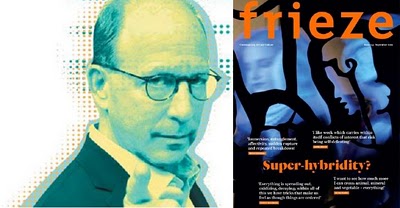
Frieze magazine responds to Saltz's criticism by eagerly confirming cronyism. Sad, pathetic (this is the tweet that inspired my post about Jerry Saltz and this week's CLICK and MUSE POLL)

The Anatomy of a Developing Discourse: Jerry Saltz, Frieze Magazine, and the Ethics of Art Criticism


Jerry Saltz asks Frieze magazine a tough question

This past week in two separate classes, I touched upon the importance of the “talk” or "discourse" around art and how it influences the production and circulation of meaning around art objects. This is perhaps nowhere more evident than in the world of art criticism, where individuals with some measure of influence evaluate and offer critical description, analysis, interpretation (and yes, judgement) about chosen visual art objects. Importantly, it is the notion of ideas being at stake more than just the actual form that art objects take, and the many voices weighing in to react to those ideas drive the discourse in often new and unintended directions.

In recent days, a terrific example of a “developing discourse” emerged with one of North America’s most publicly recognized art critics, Jerry SaltzNew York Magazine’s art critic and guest judge this past summer on Bravo TV’s celebrated Work of Art: The Next Great Artist. Saltz, who has started a new online Q&A column on New York Magazine’s Vulture Network (which addresses questions from the lay public on art-related matters), stirred some controversy with the response to a poster who wanted Saltz to address the problematic issue of whether or not art critics should submit a disclaimer if they are writing about an artist whose work they own or are closely affiliated with. In the post, Saltz made specific reference to a review written in the current issue of Frieze magazine (a leading journal of contemporary art and culture), claiming that the reviewer had very close connections to the curator who put together the art exhibition under review--the curator had been the reviewer’s graduate student, worked with him at MoMA, and was now working for him at an ivy league university.

Within days, my Twitter feed was buzzing with discussion about this allegation, with Tyler Green (editor of Modern Art Notes on ArtInfo.com) calling via Twitter for Frieze to respond. Frieze finally did post a response on Saltz’s column, claiming that the “review” was actually more of a regular column, but that they agreed more should have been disclosed about the personal connection between the reviewer and the curator whose exhibition he was covering. I leave the entire affair for you to ponder (the full text of the question to Saltz, his response, Green’s tweets, and Frieze magazine’s letter to Saltz follow), but it certainly exposes some of the mechanisms concerning the “talk” around art objects in its most recent and cyberspace mediated form.

Dear Jerry,
Here's my question: Should an art critic post a disclaimer if they write about an artist whose work they own?
Best,
Museum Nerd

Read Saltz's response, Green's Tweets, and Frieze's response after the jump


Jerry Saltz's response to original question:

Dear Mr. or Ms. Museum Nerd,

I don’t make rules for other people, but my policy is to not write about artists whose work I own or I know well. When I’ve done so, I try to disclose my association. The last column I wrote for the Village Voice was on Barbara Gladstone’s show by the painter Carroll Dunham. The first lines of that review are: "By now I no longer know if I like Carroll Dunham’s paintings because we’re friends or if we’re friends because I like his paintings. So anything I say about his work is biased — although over the years I have relentlessly ribbed Dunham about how limiting and wrong it might be that he seems to paint the same male character over and over again." I’ve written about my friend, the curator Francesco Bonami, calling one of his shows great and another, organized for French luxury-goods magnate billionaire art collector Francois Pinault, "truly horrendous." But to each his own; I’m with Whitman who wrote, "It is not upon you alone the dark patches fall."

Still, something caught my attention in the current issue of Frieze. Robert Storr gives a rave review to Sarah Lewis’s "Site Santa Fe" show in the September–October issue of the magazine. The review is subtitled: "Site Santa Fe’s Eighth International Biennial is as inspiring as it is original." (Actually, the magazine misspells the name of the city as "Sante Fe.") The first line of Mr. Storr’s review is, "Sometimes someone gets it right." The last lines of Mr. Storr’s review are, "If I were young, how would I want to begin my curatorial life? With an exhibition like this — because there’s never been one like it before."

It's absolutely fine that Mr. Storr loves Ms. Lewis and this show so much (while in the same review lambasting previous "Site" curator Dave Hickey as a "Michel Foucault–quoting ... all-around all-American Tea Party aesthete, Slim Pickens impersonator ... "). Storr neglects to mention, however, that Ms. Lewis was his student at Harvard. Ms. Lewis worked with him at the Museum of Modern Art. Ms. Lewis is now employed with him at Yale University, where she is a PhD student, and listed as a "critic of painting and printmaking" in the School of Art, where Storr is dean and also a professor of painting and printmaking.

The four questions I would ask are:
1. Why would Frieze ask this person to review this show?
2. Why would Frieze publish this without mentioning the writer’s special long-term relationship with the curator?
3. If Frieze was unaware of these facts, why?
4. How did this come to pass?

I’m sure all critics have done some of these things. I am sure that I have written on former students. I’m not sure, however, that all of these unstated overlaps have appeared at the same time in the same review about such a high-profile biennial in such a high-profile magazine by such a high-profile critic/curator/art-school dean/former curator of a "Site Santa Fe Biennial."

Tyler Green's Tweets:

@frieze_magazine Are you saying Saltz's facts are wrong? Send me deets: tgreen (at) artinfo (dot) com.

Frieze magazine responds to Saltz's criticism by eagerly confirming cronyism. Sad, pathetic: http://bit.ly/d80oeP (Scroll a bit.)

Update: Frieze co-editor Jennifer Higgie responds to Saltz's comments on Robert Storr:

Dear Jerry,

I hope this finds you well.
We would like to respond to the allegations of cronyism in your column, which we take very seriously: I can assure you that Frieze is scrupulous about impartiality in regards to reviews. Which gets to the crux of the matter. You ask: "Why would Frieze ask this person to review this show?" There's a simple answer. Rob Storr's piece on Site Santa Fe (which you can read here) isn't a review, in the conventional sense — it's part of his regular column, 'View from the Bridge,' in which he has carte blanche to express his enthusiasms and bug-bears about shows/writers/artists/ideas that are engaging him at this point in time. (Our extensive international review section is to be found at the back of the magazine.) In retrospect, however, we agree it was an oversight not to mention Storr's personal relationship with the curators, although it must be stressed that there is absolutely nothing self-serving in the piece. If Storr has committed a crime, it's simply to be enthusiastic and supportive of the work of upcoming curators he knows professionally and whose work he admires.

With best wishes,
Jennifer Higgie
Co-editor, Frieze magazine
