Weekly Twitter Round Up| Click and Muse (Banksy Tags The Simpsons!)


Happy Thanksgiving! Enjoy the last of your long weekend with a few great tweets from the past week. Thanks as well to those who participated in the "Click and Muse" poll. 76% of you thought art critics should only write about artists/curators that they are not professionally involved with (wow, if that were actually the case, I am not sure who would be working!). Check out this week's poll dovetailing with Jenna's terrific guest blog about graffiti art and the public sphere. Coincidentally, the graffiti and underground artist Banksy mentioned by Jenna was featured last night on The Simpsons when he "tagged" the opening sequence of the show. I have tried to find a stable YouTube link, but 20th Century Fox keeps deleting them for copyright reasons. I hope the embedded link I added stays up for a while so you can check out this unique bit of pop culture history in the making!

Work depicting Jesus in compromising position fuels attendance surge, protests in Loveland, Co.
"The length of the human attention span is about the length of a Beatles song. After that we're off to a new link or a different window."
Mythologizing Facebook: Too soon?: In today’s harried world, our rush to idealize the recent past borders on ridiculous

Memories of John Lennon


PHOTOS: 16 Prettiest Cities In The World!
Website posts ultra-high resolution images of famous paintings, up to a staggering 28 billion pixels each


James Franco's frantic behavior—could be ADD. He plots his next film.


Banksy storyboards the darkest Simpsons opening credits sequence ever 


Guest Blog | Jenna Kirouac: Graffiti as Vandalism-- The War on Love

Guest Blogger Jenna Kirouac is Avant-Guardian Musings Vancouver Arts Correspondent. To see her previous posts, please click here.

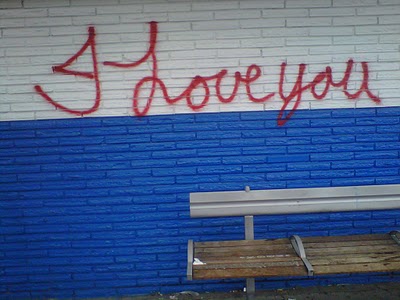
Local Vancouver "I Love You" graffiti (photo by Jenna Kirouac)
Have you noticed the graffiti workings of some young Vandal Romeo professing “I Love You” on the sides of buildings that have been popping up all over downtown Vancouver? I have spotted at least four of them now, although some have been painted over as quickly as the next day.  They are all, no doubt, done by the same hand. All workings bear the same style of sloppy spray paint cursive. I know that I am not the only one who is intrigued and amused by his/her efforts as I recently spotted a spray painted “We Love You” as some other amateur vandal’s response just two blocks down from one of the original tags.

The efforts sparked a few different thoughts:

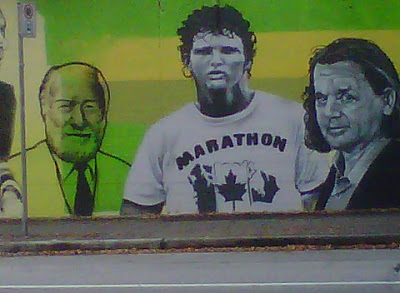
The “I Love You” tags reminded me of the long-standing battle most Canadian municipalities have had with graffiti. The subject is a sensitive one because tax money is spent on funding for public murals that are sometimes horrible (in my opinion) and by the same token, money is put into covering up work that wasn’t commissioned by the city in the name of vandalism--work that is sometimes better than the professional murals. For example, when the Beatty Street mural that had been commissioned by the city in 2007 was covered up for the Olympics, there was a public outcry.  What was wrong with the mural? Nothing. The city painted over it the custom cobalt blue that matched the visually appropriate propaganda for the games. At first, I was a bit ticked off. I liked that mural and I had to look at the blue wall of nothingness everyday when I stepped out my front door. However, I loved the Olympics and quickly forgave the city for their bad behavior when the announcement of a new mural was soon to come.  Well, that time has arrived and the new mural has emerged. What do I think of it? Meh.

Beatty Street Mural (photo by Jenna Kirouac)
There are parts of it that look great and there are other parts that look so amateur. I cannot believe that the city commissioned a mural in such a high traffic area that was executed so poorly! The portrait of Terry Fox looks like he has Down’s Syndrome (sorry). I can only hope the mural is not yet completed (although I think it is) and in that case I will eat my words. Graffiti raises some tough questions that need examining when we think about modern art. Art is inherently subjective and therefore some people will hate what others really love. Far more importantly, there is the question of hate-speech and the stigma that comes with politically fueled semiotics such as a Swastika. So if we could probably all agree that a spray painted Swastika needs to be covered up then where do we stop agreeing? I don’t think we should claim a slippery slope and enforce a zero-tolerance policy. After all, who gets to decide what murals adorn our public spaces? If these shot-callers implemented the recent Beatty Street mural, then perhaps the least they could do is grant the residents of Vancouver a say in what stays and what goes in terms of graffiti.

Canadian cities are not the only places that tend to have a zero-tolerance policy for graffiti, but there are lots of major metropolitan areas that have a different relationship with it than we do. However, regardless of which city you find yourself in, the critical issue is always centered largely on the aesthetic quality of the graffiti in question; especially as some of you would be quick to agree that graffiti work like that of the famous Banksy is worth keeping intact. After all, his work usually carries a powerful political message. Well for those of you who stake that claim, Ok fine. Then what about “I Love You?” Could there be a more powerful and positive message?  Do we paint over it just because it wasn’t written pretty enough or because it wasn’t done by a famous artist? Before you decide, check out these two YouTube videos. One is a trailer for a documentary on the origins of graffiti and the other is a clip from an unofficial documentary on Banksy. How do you like them apples?


Remembering John Lennon as Visual Artist, Filmmaker, and Social Activist

John Lennon, Imagine All the People (c. 1970)

"If art were to redeem man, it could do so only by saving him from the seriousness of life, and restoring him to an unexpected boyishness."
John Lennon (1968)

If John Lennon were alive today, he would have turned 70 years old this weekend and the world of music would no doubt be a different place. But what about the world of art and film? I have long been fascinated by Lennon’s interest and involvement with the world of art (his partnership with Yoko Ono was marked with a deep respect for her avant-garde artistic vision and sensibility) and I often discuss with students Lennon’s drawings and work in experimental film as part of the broader milieu of the alternative and counter-culture movements of the 1960’s to early 70’s. 

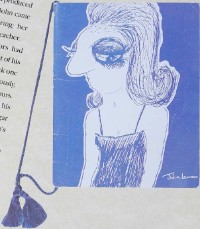
A caricature drawn by John Lennon
while in art school
People sometimes overlook the fact that Lennon had attended art school in Liverpool during a number of the formative years of his early musical career from 1957-1960. It was there and around Liverpool’s most bohemian neighbourhood that he was introduced to the social circle of painters, sculptors, poets and musicians who were experimenting with new ways of representing the shifting world around them. And while Lennon mostly rejected the strict art school curriculum of the Liverpool College of Art, it is significant that he developed his intersecting interests in drawing, visual representation, and music within the context of rebellion and subversion of the status quo. Lennon would go on to use his early drawings to illustrate a number of his albums (i.e. Walls and Bridges) and help inspire elements of the animated 1968 musical film The Yellow Submarine. Four years later in 1972, Lennon would also co-produce and direct with Yoko Ono the experimental film Imagine that features a part surreal and part documentary interpretation of the music from Lennon’s album of the same name. Watching the clip I have embedded below (which features the title song Imagine Lennon is perhaps best known for), it is clear that Lennon’s artistic vision was as important to him as the musical talent for which he will always be best remembered.

For a closer look at more of John Lennon's art works, see johnlennonartwork.com and on Saturday, October 9th, Yoko Ono will relight Imagine Peace Tower in Iceland in his memory. You can join the ceremony by  Tweeting your wishes or visiting IMAGINEPEACETOWER.com where the lighting will take place live at 8pm in Reykjavík and 1pm PST on the West Coast.


Further Reading:

Daniels, Stephen. "Suburban pastoral: Strawberry Fields forever and Sixties memory." Cultural Geographies 13.1 (2006): 28-54.

Inglis, Ian. "The Continuing Story of John Lennon." Critical Studies in Media Communication 22.5 (2005): 451-455.

Kruse II, Robert. "Contemporary Geographies of John Lennon." Critical Studies in Media Communication22.5 (2005): 456-461.

VIFF Preview| Winds of Heaven: Emily Carr, Carvers, and the Spirits of the Forest

Emily Carr, Indian Church (1929)
Living and working in Vancouver as an art historian, it is difficult to avoid conversations, questions, and debates concerning Emily Carr. Few Canadian artists have had more of a longstanding and direct impact on the guiding art historical discourse of this city and province (some argue all of Canada), and her controversial works have inspired fierce debate and critical conversations about both the aesthetic re-presentation of this part of the world and the engagement modern artists have had both formally and contextually with First Nations culture.  In short, she is quite literally an institution in this town, lending her famous name to Emily Carr University of Art and Design and making her presence permanently felt at the Vancouver Art Gallery where her works are always on display and frequently inspire new exhibitions (see "In Dialogue with Carr: Douglas Coupland, Evan Lee, Liz Magor, Marianne Nicolson" as the most recent example).

Perhaps for this reason alone, I was uncertain at first about previewing the new documentary about Emily Carr screening at the Vancouver International Film Festival.  Do we need to continue and contribute to the conversation about Carr? Can audiences look beyond her seductive images of the West Coast and their spiritual undertones to arrive at a more critical response to their impact on picture-making in British Columbia? Can we move the Emily Carr discourse in a new direction? Michael Ostroff’s Winds of Heaven: Emily Carr, Carvers, and the Spirits of the Forest is described as “a filmic journey into the deep brooding mystery and inner beauty of Emily Carr’s paintings—a lyrical, luminescent and entertaining impression of the life of Carr and her connection to the First Nations people of the Northwest Coast.” To my ear, this sounds like more of the same about Carr that needs questioning. But with the addition of commentary by art historian and critic Marcia Crosby (who has done ground-breaking research into the artistic representation of First Nations-- see further reading for Crosby's work and recent critical discussions of Carr at the end of this post), I am hopeful that this film will have moments that cut through the carefully constructed Carr narrative and open up people's eyes to the complexities and tensions of Carr’s legacy to the art of this city, our province, and the country. Taking the family to see the film over Thanksgiving weekend seems like no more appropriate time.

Winds of Heaven will be playing at VIFF on Saturday, October 9th @ 6:30pm; Sunday, October 10th @ 4:00pm; and Wednesday, October 14th @ 1:00pm

A short introduction into the life of Emily Carr from a local perspective


Further Reading:

Crosby, Marcia. "The Construction of the Imaginary Indian" in Vancouver Anthology,. Stan Douglas, ed. (Vancouver: Talonbooks, 1991), 267-291.

Dawn, Leslie. "The Enigma of Emily Carr: A Review Essay" BC Studies 152 (2006): 97-103.

Moray, Gerta. Unsettling Encounters: First Nations Imagery in the Art of Emily Carr. UBC Press, 2007.