Focus on Tech| Assignment Calculator: How to Finish a Paper On Time

A fantastic and useful online tool to calculate the time you need to complete a research assignment without the stress and headache of procrastination

A fantastic and useful online tool to calculate the time you need to complete a research assignment without the stress and headache of procrastination

In my post How to Begin Researching a Topic, Part One, I stressed the need to start early with any assignments you have. Looking back to my own experience, it is amazing how much time I spent procrastinating on research in my first and second years of university. I would find myself with bits of research completed here and there, a half thought out thesis statement, and piles of notes stuffed into books without a clear focus or direction. Finally somewhere in my third or fourth year, through trial and error I figured out the concept of scheduling the steps of research and writing to make what was often a painful process into something I felt I had some control over and would ultimately come to enjoy. Learning and mastering time management is a vital part of the university experience, but is often left to students to figure out for themselves. Fortunately we now have many web-based tools to help calculate and create personal calendars to complete assignments on time and with confidence.

In this example, I entered a deadline of November 30, 2010 (click on image to enlarge). The best of these in my opinion is the University of Minnesota's Assignment Calculator with the tag line, "You can beat the clock!"

In this example, I entered a deadline of November 30, 2010 (click on image to enlarge). The best of these in my opinion is the University of Minnesota's Assignment Calculator with the tag line, "You can beat the clock!"

Simply visit the site, enter the date you are given the assignment, the date the assignment is due, and then select the appropriate subject area of the research (in the screen shot above, I selected "Art and Art History." Press the "Calculate Assignment Schedule" and voila!, you are presented with a clear path and a reasonable timeline to finish the assignment. 

Note that with each step in the process, youare given an approximate date to keep you on track

Note that with each step in the process, youare given an approximate date to keep you on track

For Masters and PhD students, the Dissertation Calculatorprovides some direction over the long haul 

For Masters and PhD students, the Dissertation Calculatorprovides some direction over the long haul 

With each step, you are provided with tasks to complete and linked to useful online tutorials about how to define your topic, how to begin the process of outlining, and when and how to start writing. Over the years, many universities have quietly adapted the Minnesota calculator and added other useful functions. I especially like the UCLA version of the Assignment Calculator since it addresses the concerns of ESL (English as a Second Language) students, brainstorming techniques, links to resources on citation styles and highlights modules on learning the difference between scholarly and popular sources of information. I suggest using both calculators to access and combine the weekly suggestions and tasks. You can also download a version of Assignment Calculator for your desktop and use it when you do not have access to the Internet.

P.S. For masters and doctoral students, I highly recommend the Dissertation Calculator -- it is one of the only online tools that actually walks PhD students through the mystical process!

Remember, start early, and avoid the pitfalls of late nights and even later papers and assignments. Your time is precious, don't waste it procrastinating. How many all-nighters did it take me in my first and second years to figure this out? Too many! Trust me on that one.

Focus on Research| How to Begin Researching a Topic PART ONE

The research essay season is in full swing and I thought it would be useful to begin a series of posts over the next several weeks covering the different steps in seeing an essay topic to the final written paper form. And if if there is only one piece of advice I can give you now, it is to START EARLY! Once you finish reading PART ONE, you can find PART TWO of this post here.

A scholarly book on Dada that you will only find at your university library

A scholarly book on Dada that you will only find at your university library

I want to begin with discussing the process of locating sources first even before identifying a specific topic (the subject of Part Two to be posted later in the week) since it is an area of research that has become increasingly more complicated, but also more dynamic, in the range of possible places to search and consult. Also, a good knowledge of searching sources can trigger ideas for your essay topics. Bottom line for students to understand when looking at sources for academic papers-- information must be critically assessed for its sources and tested for its rigour (i.e. how many people actually read and checked the information before it was published). Your professors will be looking for evidence that you did more than a Wikipedia search and a glance through your textbook to complete your research essays.

Ideally, you should conduct your search in this order:

A peer-reviewewd article from Performing Arts Journal  found using JSTOR database

A peer-reviewewd article from Performing Arts Journal  found using JSTOR database

BOOKS:

Your first line of research should begin with an actual trip to the library and a physical search equipped with a title or two that you located with a quick online library catalogue search. Why, when there is so much available on-line? Two major reasons. First, because scholarly books are among the very best and most rigorously peer-reviewed of all the resources you will consult for your papers and very few of them exist online in complete form. Ask any of your professors how long it takes to get a book published and distributed in the world of academia, and you will understand why academic sources are so highly privileged in the world of research.  Second, once you locate books of interest, you are able to look at related books on the shelf and quickly identify other good resources. This is where chance finds and good common sense prevail in research, and there is no virtual or attempted online equivalent to duplicate this very necessary step of the research process.

This issue of Artforum  contains a review of a Dada-related artist

This issue of Artforum  contains a review of a Dada-related artist

JOURNAL ARTICLES:

After books, scholarly journal articles published in reputable peer-reviewed publications are your next line of research. These articles (mostly available in PDF and HTML full-text format) often represent individual dissertation chapters or long-established projects of academics, thus they are packed with fantastic sources and targeted critical discourse on the given topic. These are the articles that are most available through Academic Index searches through popular online database search engines such as Academic Search Premier, JSTOR, Project Muse, etc. Every academic library has their own system of organizing these databases and instructions and topic guides are often published on the library’s web pages (SFU students look here, KPU students look here). Also check out this "Is this journal scholarly" chart to assess your source.

INDUSTRY JOURNALS:

For research involving the arts, it is often important to consult trade and industry journals (i.e. ArtforumArt News, and Canadian Art) that publish up-to-date art related information, exhibition reviews, and artist interviews. These can often be located in database searches (such as the Art Index) that include these kinds of materials.

NEWSPAPER/MEDIA SOURCES:

important and widely read reviews of exhibitions/films/performances in newspapers and media sources (i.e. New York TimesCBC ArtsGlobe and Mail, and the Guardian) are excellent sources of information and can also be found through appropriate newspaper/media databases.

GOOGLE SCHOLAR/BOOKS:

please see my previous blog entry concerning Google Scholar, and note that a search of Google Books is also a great step once the actual visit to the library has been made. The problem with Google Books lies with its unreliability/narrow scope and the simple fact that many pages of books are removed for copyright purposes. It is a wonderful resource however to check out tables of content and bibliographies, but should never be relied upon as a first stop in the search for scholarly books.

INTERNET SOURCES:

  • Artist websites: if researching an individual artist/performer/filmmaker, see if they have their own website. These are often useful places to find gathered sources on their work, interviews, and links to projects. Do keep in mind however that any biographical information and/or discussion of the artist’s work by the artist must be weighed for its objectivity.
  • Specialty websites and blogs: many good websites and blogs are organized around key topics and themes that may relate to your area of research. Once again, use these sites very carefully and look for links back to scholarly resources. You can also use the Google blog search to target your research.
  • YouTube: videos and excerpts showing artistic works, documentaries, and interviews are increasingly available on YouTube. Look in the video’s description for any information regarding the date and original producer of the video, and keep in mind that many of the videos are edited and arranged outside the original context of the visual material presented.  
  • Twitter: you can do a search for a key term, person, or individual performance/work in Twitter to assess the general conversation around the idea in the present moment (i.e. search "John Lennon" to see the recent discussion around what would have been his 70th birthday). Often, these searches lead you to useful information in the form of links to reputable on-line media sources.
A book of Duchamp's writings foundon Google Books (many pages "missing" though)

A book of Duchamp's writings foundon Google Books (many pages "missing" though)

Scroll to the bottom of any Wikipedia page to look for the Notes, References, Further Readingsand External Links that point you to more scholarly sources

Scroll to the bottom of any Wikipedia page to look for the Notes, References, Further Readingsand External Links that point you to more scholarly sources

TIPS AND HINTS WHILE SEARCHING:

  • Once you have a solid selection of books and journal articles, consult the bibliography of each and you can quickly find other potential sources of information for your topic to research and locate.  Also, if you are able to consult the table of contents of any journal that you find an individual article in, you will often find related articles, especially if the article is part of a thematic group of essays (i.e. a special issue on Andy Warhol or German Expressionism).
  • If you find a book or journal article that is unavailable at your home institution, you can ask for an Interlibrary Loan and have the material located and delivered to your school. Check with your librarian about how to do this, or search for the term “Interlibrary Loan” through your home library website (SFU students look here and Kwantlen students look here).
  •  If you live in a larger city or community, check the library websites of nearby universities/colleges/city libraries/art museums for resources. A trip to another library in town is often worth the extra effort.
  • Visit www.amazon.com and check out books that are related to your topic. Once at the website, you can also preview many of the books’ table of contents and quickly assess whether the book is worth checking out and available at a local library.
  • While Wikipedia should never be cited directly or appear in your bibliography, it can be used to identify good scholarly sources for further research. Simply scroll to the bottom of any Wikipedia entry and look for the Notes, References, Further Reading, and External Links to identify the source of the information given on the page, or to locate a more reliable source of information. 

Weekly Twitter Round Up


With the Vancouver International Film Festival bidding the city farewell and the cooler days of fall finally upon us, the midterm season descends. Here are a few great finds from the Twitterverse this past (short) week. Pause from study/research, take a break, and check out the following:

Map Of Social Networks Reveals Surprising Shifts (Especially You, Twitter)


Dana Claxton’s new interdisciplinary work is a cultural mashup 


From @NYMag to the Art21 Blog: Guest blogger Marissa Perel chats with @jerrysaltz on Work of Art and more


Why I Hate (Academic) Conferences


Why are so many film editors women?


This is for all you Mad Men fans... WOW


New breed of young socialites are now selling art 

The Fight for Legitimacy| Adobe's 24/7 Internet Museum and the Politics of Digital Art

A screen shot of the "disembodied eye" that helps viewers navigate
Adobe's new Museum of Digital Media 
The new Adobe Museum of Digital Media opened its virtual doors last week, raising once again the question of influence and power relationships in the world of digital art. Created by US software giant Adobe Systems, the museum is billed as a “unique virtual space” and the first Internet museum of its kind. On its website, the statement of purpose describes Adobe's aims:

Our mission is to showcase and preserve groundbreaking digital work and expert commentary to illustrate how digital media shapes and impacts today's society. Here, artists and innovators have a unique freedom to create work that wouldn't be possible in a traditional museum. Unlike traditional museums, AMDM is open 365 days a year, 24 hours a day and is accessible everywhere.

The high stakes battle continues
Adobe’s move to create an internet museum is of course not just grounded in altruism.  The Adobe Flash multimedia platform has long existed as the industry standard for delivering video and for adding animation and interactivity to web pages (I have several Flash elements added to this very blog), and artists have long used Adobe’s graphics editing program Photoshop to retouch and manipulate digital images. But for several years now, Adobe has been entrenched in a very public fight with Apple Inc. and CEO Steve Jobs about the efficiency of the Flash platform, especially on Apple mobile products like the iPhone, iPad and iPod.  Jobs posted his “Thoughts on Flash” this past April on the Apple website explaining his position, building a case around the need to move beyond a “PC” world. In response, many industry leaders and experts have suggested Jobs simply doesn’t want to be “held hostage to another company’s proprietary software,” noting that Jobs himself has been accused of attempting to monopolize and control digital media software for several years now. Jobs’ push to have developers and artists create applications in HTML5 (recall The Wilderness Downtown Project I blogged about last month) is also regarded as largely short-sighted since it could take years for the platform to match Flash's capabilities.
Early cinema history sheds interesting
light on the current state of the digital media tech wars.
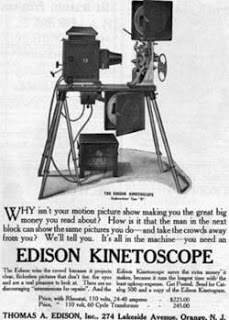
Edison and Apple/Adobe may have something in common.
Interestingly enough, many of these recent debates about new technology are not unlike the tech wars in the history and development of early cinema when powerful moguls, industry executives, and suppliers of movie and film equipment engaged in the high stakes game of establishing industry standards for the art of filmmaking. Much of this activity resulted in the famous anti-trust case of 1915 when a small group of minor film companies in Hollywood took down the Edison Trust (a group of powerful East Coast centered film stock and filmmaking companies). That same group of Hollywood companies would go on to create a huge monopoly of their own from the 1930-50’s and spark another series of anti-trust cases that would lead to the eventual dismantling of the vertically integrated Hollywood studio system. In other words, this business between Apple and Adobe (and Apple and Microsoft for that matter) is really just déjà vu.

All of this now begs the question of how digital media artists will proceed. Back in the day of early filmmaking, the process of experimentation and underground strategizing by creative individuals interested in the artistry of making moving images helped determine what the industry standards would ultimately be. Simply put, the artists and their relationship with the audience lead the charge. Adobe’s move to create the first Internet museum can therefore be understood in a similar light. Even with the air of legitimacy that the notion of a “museum” brings to the world of art and its audiences, Adobe’s move is not unlike the Hollywood moguls who created the Academy of Motion Picture Arts and Sciences to award Oscar awards and generate a kind of legitimacy and institution for an “art” that was not seen as such at the time. The act began with the industry and the establishment of a core legitimacy and then the artists took greater control. Adobe’s move is very similar in my mind and just another example (in case we needed one more) of the intersecting worlds of art and commerce. 

Here is the promo video for the new Adobe Museum:

Ai Weiwei and the Art of Activism: 100 Million Seeds, 100 Million Voices

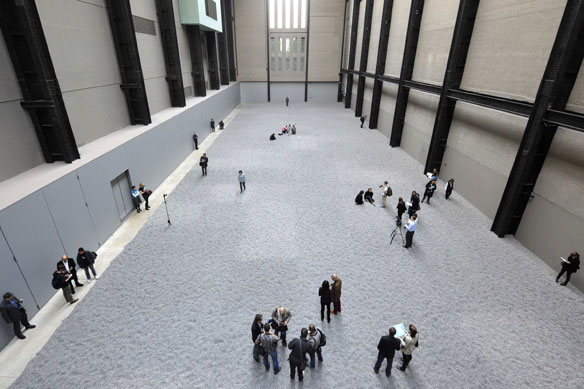
Ai Weiwei filled Tate Modern's Turbine Hall with 100 million porcelain sunflower seeds
which he encourages visitors to experience with all of their senses. Photo: CBC News Arts
This past week the Nobel Peace Prize was awarded to imprisoned Chinese dissident Liu Xiabo, a Chinese intellectual, university professor, writer, and human rights activist who participated in the Tiananmen Square protests of 1989 and helped establish a Human Rights Report of China that he published online and for which he was eventually imprisoned in 2008. During the award ceremony, the Norwegian Nobel Committee praised Liu’s “long and non-violent struggle for fundamental human rights” and said of China that it had an obligation as a growing economic and political power to take more responsibility to protect the fundamental rights of its citizens. China has since denounced the awarding of the Prize to Liu Xiaobo, insisting that the political prisoner is a “criminal who has been sentenced by Chinese judicial departments for violating Chinese law.”  In short, the award is an embarrassment to China, but has successfully placed a massive spotlight on the state of the freedom and the restraints on the exchange of information in China.

Observing these events unfold, I thought it was difficult not to reflect upon how Chinese artists, filmmakers, writers and cultural producers who circulate their art works beyond China to an increasingly global marketplace and audience will react. In the past several years, the Chinese contemporary art market and the number of individual Chinese collectors showing an interest in global art has exploded, opening up dialogue and debate in the country about the kinds of artistic traditions and global influences (many avant-garde, postmodern, conceptual, and/or anti-institutional in nature) that are inspiring a new generation of visual artists and those who follow and are interested in them.  Among them, conceptual artist Ai Weiwei has emerged as a leading figure of Chinese contemporary art and his high profile exhibition at the Tate Modern in London opening during the same week as the awarding of the Noble Prize is either calculated brilliance or the most amazing and ironic coincidence.

Ai Weiwei (artist, curator, architectural designer, activist)
 posing with a handful of seeds
Ai Weiwei was born in Beijing in 1958, the son of a poet exiled during the Cultural Revolution who spent time with his father in labour camps as a child. As a student, Ai enrolled in film school and helped form an avant-garde artist association that was later disbanded when he left for New York in 1983. It was in the United States that he studied at the Parsons School of Design and would apply his interest in Dadaism and Marcel Duchamp’s ready-mades to his practice. Returning to China in the 1990’s when his father fell ill, Ai’s art also began to show signs of reaction and commentary on the brewing social and political tensions within China, creating art works that explore the history and discourse of modernism/modernity and how they have been deployed in his homeland. This direction has proved controversial to say the least. For example, during the preparations for the 2008 Olympic Games in Beijing, Ai famously withdrew support for his design that inspired the final “Bird’s Nest” stadium, claiming that the use of the building to promote China’s forward-looking modernism was nothing short of a “pretend smile.” 
Ai Weiwei was the artistic consultant on the spectacular building
project that became the symbol of the 2008 Olympics in Beijing--
a project from which he later withdrew his support.
As a result of the artist's outspoken commentary and heightened profile in the global art world, Ai's studio has since been put under surveillance and his blogs deleted by Chinese authorities (his website and blogs have subsequently existed on US servers that cannot be viewed in China). His most recent activism concerns the 2008 Sichuan earthquake where the death of school children in badly built schools was partly the result of funds for school building costs being taken by local Chinese officials. In the earthquake’s aftermath, the Chinese government attempted to downplay and cover up the severity of the event both in China and around the world. In response, Ai published the list of students on his blog and organized a one day boycott of the government mandated Green Dam spyware that was to be sold with every personal computer sold in China to prevent full access to the Internet (the initiative has since been postponed due in no small part to the artist’s efforts and the near impossibility of implementing a fully controlled Internet ban). At that time, Ai connected his art practice even more directly with his social concerns stating that: “As an artist, I will never be satisfied if I cannot reach…the nation’s problems. My activism is a part of me. If my art has anything to do with me, then my activism is part of my art.”

What then can we make of the artist’s exhibition and the centerpiece of 100 million porcelain sunflower seeds spread across the Tate’s famed Turbine hall? It is reported that Ai commissioned 1600 artisans specializing in traditional porcelain making in one small Chinese city to produce each individual seed, challenging audiences to think in new ways about the ubiquitous "Made in China" label attached to many consumer goods. As Guardian art critic Adrian Searle suggested in a review Monday, the “undifferentiated field of grey” seems at first somewhat “disappointing.” Upon closer inspection and engagement however, Searle points out how the many layers of meaning speak to the process of silencing and capital expansion that China seems to be currently engaged with:  “Ai Weiweireadymade and Warhol's multiples and turned them into a lesson in Chinese history and western modernisation, and the price individuals in China pay for that. Every unique seed is homogenised into a sifting mass. Most contemporary Chinese art is a product made for western consumption, just as willow-pattern plates or porcelain vases were shipped out in huge quantities for the western market.” An important part of the exhibition thus shifts to the artist’s concern to give voice to the “masses” represented in his work. Visitors are encouraged to record and share their opinions and dialogue with the artist in an open format that is then circulated via the Internet—it is the kind of freedom and circulation of information that reflects the spirit of the new Nobel Peace Prize participant, a work of art that Liu Xiabo would no doubt endorse. 

Check out these two great video clips, the first a Tate short featuring interviews with Ai Weiwei and a documentary showing how the seeds were produced and their symbolic significance to Chinese culture, and the second a glimpse inside the Tate's Turbine hall with the sights and sounds of 100 million seeds.