Mark Zuckerberg and the Art History Connection: A Lesson in Elegant Organization

Mark Zuckerberg, Facebook Founder and CEO 
Last night I sat down to watch 60 Minutes (a time honoured ritual inherited from Mom and Dad) and take in a fascinating interview with Mark Zuckerberg, founder of Facebook (see full clips of the episode below). Like many of you, I was curious to learn more details about the “New Facebook” profile set to launch today—an attempt in Zuckerberg’s words to more effectively “tell the story of who you are” to friends and acqaintances. But more importantly I wanted to find out more about who Mark Zuckerberg was and what he had to say about the broader vision for his social network. Notably, the much more visually intensive version of the new profile settings with an emphasis on incorporating photographs and images to help navigate a person’s connections “at a glance” is connected to Facebook’s goal of facilitating users’ high rate of interest in image uploading and sharing. This was one of the unexpected outcomes of Facebook’s popularity according to Zuckerberg-- the way people want to be seen and see one another through visual means.

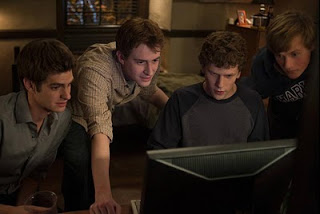
One of many scenes in The Social Network when students
are shown looking to connect online.
Having attended a screening of the recent docudrama movie The Social Network about the founding and rise of Facebook, I was especially struck with the idea of the visual discussed in last night's interview in connection to one significant scene in the movie where Zuckerberg, played so brilliantly by Jesse Eisenberg, effectively passes an art history exam without attending a single class. And although the movie did not fully reveal the process through which he managed to do this (it only hinted at how he used online information), I did research and tracked down a full description of the events from Jeff Jarvis’s fascinating book What Would Google Do? In a section discussing Facebook specifically, the author describes how Zuckerberg’s argument for establishing social networks emerged in connection to the art history exam episode with the concept of “elegant organization”--  a method to help groups of connected people do what they do, but BETTER. Jarvis goes on to describe how Zuckerberg latched onto this idea while trying to figure out how to study for the visually intensive class he had not attended (because of his work and involvement on his Facebook project):

"The final exam was a week away and he was in a panic. It’s one thing to drop out of Harvard to start a gigantic, world-changing company; it’s another to flunk.

Zuckerberg did what comes naturally to a native of the web. He went to the internet and downloaded images of art he knew would be covered in the exam. He put them on a web page and added blank boxes under each. Then he emailed the address of this page to his class-mates, telling them he’d just put up a study guide. Think Tom Sawyer’s fence. The class dutifully came along and filled in the blanks with the essential knowledge about each piece of art, editing each other as they went, collaborating to get it just right. This being Harvard, they did a good job of it.

You can predict the punch line: Zuckerberg aced the exam. But here’s the real kicker: The professor said the class as a whole got better grades than usual. They captured the wisdom of their crowd and helped each other. Zuckerberg had created the means for the class to collaborate. He brought them elegant organization."

What I love about this story is how the art history professor not only applauded the efforts of Zuckerberg (however selfish the original reasons were), but also recognized how the student collaboration had raised the collective grade point average for the exam. In this sense, elegant organization has a critical potential to transform how and through what means we learn and share information. But it can also work in new, unexpected, and unintended way. This is the potential I hope exists with my use of Facebook, especially associated with this blog, and I just love that art history and the mediation of images had a role to play in getting to that important realization.

And so yes, I still remain ambivalent about Facebook and yes, I have an account (I even tried the new profile today and actually kind of like it), but I am hoping that this story helps inspire more critical thought about elegant organization and perhaps inspires students with final exams looming to study in groups-- it really does work-- or better yet, figure out how to do what Zuckerberg did. I dare you!


Weekly Twitter Round Up


Several days spent catching my breath, meeting with friends and family for holiday drinks, and generally getting some much needed sleep after completing my final week of lecturing at SFU-- one more week to go at Kwantlen. Thanks to those students who either wrote me or let me know in person that they found my tips and suggestions for essay writing useful-- sharing and collecting this information is one of the main reasons I started this blog. Speaking of which, I am looking forward to a more regular schedule of blogging as December unfolds and the exam period begins (it will help balance out all the marking that is just around the corner!). In the meantime, check out some picks from around the Twitterverse:

Vancouver sci-fi author William Gibson on why he loves Twitter & thinks Facebook is ‘like a mall'


My conflicted feelings over the culture wars' being reignited by National Portrait Gallery's risky gay-themed show


Marshall McLuhan on the Dick Cavett Show in December 1970 [MP3]


A head of his time: Did George Michael try to buy Hirst skull?


Moderna Museet presents ALLA KUNGENS HÄSTAR, Legacies of the Situationist International


Jerry Saltz on the 11 paintings You Can’t Miss at MoMA’s Historic Abstract Expressionism Show


Smile to the future and it will smile back to you.

Seeing Photographically: The Drawings of Kota Ezawa

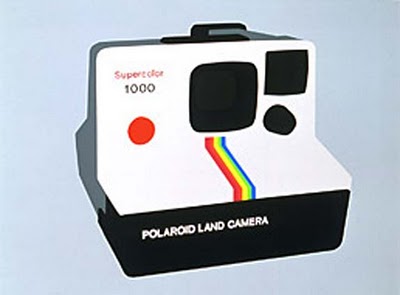
Kota Ezawa, Polaroid Supercolor 1000 (2005)
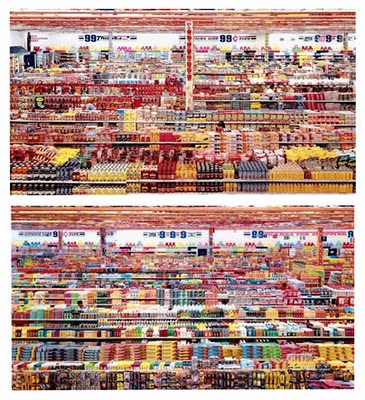
One of the many challenges of teaching a dedicated history of photography course is trying to instill the concept of media specificity and how powerfully the means of representation influences the circulation of meaning for photographic objects. This is especially true when trying to make sense of how artists and art institutions have dealt with photography as art and photographs as art objects from the early twentieth century to the present. Today, photography occupies a very privileged position in the contemporary art world and for collectors there appears to be little distinction between the value of a painted work and one that is photographic. The prices paid at auction for photo works are quite staggering and all of the record setting sales have occurred in the past decade or so beginning with Andy Warhol’s photograph of Robert Mapplethorpe in 1987 and culminating more recently with the highest price paid for a photographic work, Andreas Gursky’s 99 Cent II Diptychon (2 c-prints mounted to acrylic glass), an image showing what appears as a highly superficial and flattened interior photograph of a supermarket that sold for over three million dollars in 2007 (see picture below).

Andreas Gursky's 99 Cent II Dyptychon set the record in 2007
as the most expensive photograph sold at auction. Notice the
superficial nature of both its form and content.
Living in Vancouver, which at times seems like ground zero for so much discussion about all things photoconceptual—the artists Jeff Wall, Roy Arden, Ken Lum, Vikky Alexander, Ian Wallace, Stan Douglas, and Rodney Graham etc… all made their start in the city and have come to constitute the Vancouver School of photography—it is difficult for many students to understand all of the important transitions in the debate concerning photography and medium specificity that lead to the challenging discourse around photography's importance in today's art context. Recently, however, I was introduced to the work of Kota Ezawa, a Japanese-German artist whose art practice is centered on exploring the transfer of media forms (in his case from photography to drawing/animation) as a potent site of investigation. 

I first encountered Ezawa’s images when I viewed his video work that was part of an exhibition called CUE: Artist’s Videos set up on the exterior portico of the Vancouver Art Gallery during the Olympic Games. Researching his practice, I was struck with the way in which Ezawa engaged his interest in the powerful photographic imagery that accompanies the representation of historical events and how the final outcome of transforming images from the photographic to the drawn/animated revealed a process of reception and meaning-making that exposes the flattening out effect that reduces specific moments of history to a series of iconic signs.
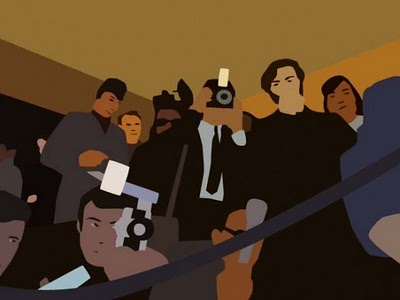
Kota Ezawa, still from Lennon, Sontag, Beuys (2004)

One of the most powerful examples of this emerges in his video work Lennon, Sontag, Beuys (2004) which features animated and audio loops of John Lennon and Yoko Ono's 1969 interview at a bed-in for peace at an Amsterdam hotel, a Susan Sontag lecture in 2001 at Columbia University, and performance artist Joseph Beuys speaking at the New School in New York in 1974. Watching the video, it is striking to consider how the stripping away of photographic details through the drawing/animation process (many of which we either know through memory of seeing the actual footage or through photos of the people in question) results in a kind of sign making system that takes place right in front of your eyes. As Lori Waxman persuasively argues in a review of the work in Parachute, the superficial nature of the drawings only underscores the received superficiality of these events, “The triptych plays simultaneously and cacophonously, reducing three critical players in the recent history of cultural protest to an appealingly repackaged sound bite of flat, adolescent colour blocks. The speakers' physical accessories-Lennon's granny glasses and long beard, Sontag's dark hair and sophisticated scarf, Beuys's fedora-solidified here as geometric elements, render their respective images all the more iconic. Simplified quotations on both a visual and a content level, Lennon Sontag Beuys graphically exaggerates and further elevates the kind of sieve through which we too often prefer to trickle our information and inspiration: South Park, the cartoon show for adults.”

In a recent San Francisco Museum of Modern Art video discussing his practice (see below), Ezawa describes his interest in what he calls “symbolic image content” developed through the process of re-presenting photographic images. Critically, he understands this process as a way of thinking about the power of semiotics--or sign systems--in our contemporary world. And although I do not necessarily agree with Ezawa that drawings hold a richer symbolic image content than photographs (I do not even think we can begin to fully understand the implications), I am very taken with the way in which his practice helps us think about the critical distinction between visual media forms and the role of photography in shifting the ways in which we perceive history and memory.


Further Reading:

Sukonik, Alexandr. "The Productive Limitations of Art Photography." Raritan 23.2 (2003): 129-141.

Szeman, Imre, and Maria Whiteman. "The Big Picture: On the Politics of Contemporary Photography." Third Text 23.5 (2009): 551-556. 

End of Term Evaluations: The Critique

“Everyone in this culture understands the freedom and permission of art’s mandate. To put it simply:  art ain’t rocket science, and beyond a proclivity to respond and permission to do so, there are no prerequisites for looking at it.”


Consider the validity of Hickey's quote while mulling over two of my favourite scenes from Art School Confidential (2006) dedicated to those hard working students who will be enduring the evaluation process over the next several weeks. I only wish John Malkovich would turn up at one of our university crits!


Weekly Twitter Round Up


Let it snow, let it snow, let it snow! Well, for a day or two that is, lol. In other words, the winter wonderland that was Vancouver mid-week has now melted back into the much more familiar puddles of West Coast rain. With the final days of November upon us, the holiday season beckons and with it the promise of rest and assignment free days just around the corner. Grab a cup of mulled cider (or other warm beverage) and check out some links I collected from around the Twitterverse from this past week.

How the Internet will change the future of the top-end of the art market


Texting is the new doodling, say fed-up profs


Jeff Wall: "Comments on Claims Pro & Against Painting" at MUMOK


Smarthistory rethinks the online art history textbook


Throwing shredded Freud texts out of a moving car & retyping "On the Road," two artists write conceptually


When I Grow Up I Want to Be... an Art Historian? 


It really is true; you meet some great people when you sleep overnight on the Black Friday line at Wal-Mart!