Film sequels spell success for investors of Hollywood movies in the 2000's
One of the last lectures of my survey film studies class this term dealt with the predominance of the sequel, serial, and reboot in mainstream filmmaking of the 2000’s. Looking back at my notes, I discussed how many of the biggest, top grossing films of the 2000’s were based on remakes of previous works from comic books (X-Men, Spider Man), TV shows (Sex and the City), TV movies (High School Musical), Broadway plays (Chicago), and even theme park rides (The Pirates of the Caribbean). In 2002 alone, three of the four top-grossing films (domestic) were franchise sequels: The Lord of the Rings: The Two Towers, Star Wars Episode II: Attack of the Clones, and Harry Potter and the Chamber of Secrets.
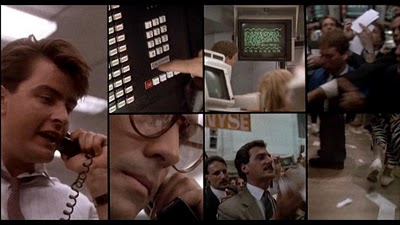
The original Wall Street captured the frenzied and dizzying world of
stock trading at the level of form and content.
What then is lost in a sequel? In my opinion, a whole lot. Case in point is the recent sequel to Wall Street (1987), the original being a critically acclaimed film which tells the morality tale of a young stock broker who finds himself lured into the world of high stakes corporate raiding. Starring Michael Douglas (as the enigmatic Gordon Gekko) and Charlie Sheen (as the young and ambitious Bud Fox), the film won critical acclaim in its day for an unflinching examination of 1980’s excess and corporate greed. The themes of the film were also highly connected to the visual treatment of the story line. For example, in order to create the air of authenticity and intensity the film has become so famous for, director Oliver Stone spent a great deal of effort perfecting the camera work for the film, using the visual field to capture the sense of the “feeding frenzy” and fast pace of the financial world in contrast to the steady and stationary world of middle America. In one wonderful scene of confrontation between Gekko and Fox in New York’s Central Park, the camera work quite literally represents the sense of exchanged punches that leads to the final confrontation between men. In other parts of the film, the camera is completely stationary, as in the scenes with Bud Fox’s hardworking blue collar father (played by Martin Sheen), representing brilliantly the contrast between the illusionary and fleeting world of Wall Street and the more stable, if even nostalgic, scenes of working class America before the coming fall.
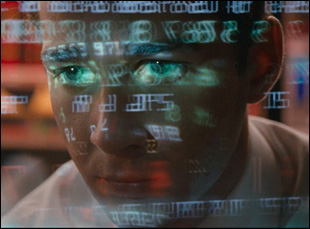
Oliver Stone's camera work in the sequel lacks
the charge of the original Wall Street. Much of it reads
as superficial and decorative rather than conceptual.
Fast forward to the sequel Wall Street: Money Never Sleeps(2010), and all of the nuanced camera work in tandem with the carefully crafted plot gives way to pastiche. Stone’s elegant camera work is replaced by sensory overdrive and the fast and loose utilization of gimmicky and superficial panning shots of NYC. Gone is the critical scope. Gone is the believable plot. Gone is any sense of authentic character development. Bud Fox even makes a ridiculous and unnecessary appearance in one scene (the sequel's plot has nothing to do with him) that reads more as a cameo role for Charlie Sheen, signaling all of the recent scandal surrounding his real life moral dilemmas. There are also one too many product placement scenes of 2000’s excess—ironic for a film attempting to critically expose the mechanisms of consumer marketing and corporate greed that supposedly lead to the recent economic crisis. I could go on and on. Don’t even get me started on the not so subtle appearance of contemporary and expensive works of art in the film. I laughed out loud during one key scene where a corporate titan physically destroys a priceless Goya painting after being exposed for his corporate sins. Yeah right… as if.
Reflecting on all this, it is quite staggering to think that an entire generation of film going audiences might grow up only ever experiencing the remake or adaptation of previous works as indication of movie success. What does this signal for filmmakers and more importantly, what does this signal for the possibility of taking risks and being creative in a film market demanding guaranteed financial returns? It seems that to make a successful (read: high grossing) film today, one has to falsely leverage the value of the original to sell the new crappier version to audiences. Sound familiar? This seems to be the shared modus operandi of Wall Street and Hollywood. Let us hope this crashes as well.
A comparison of the original Wall Street (1987) trailer with its sequel Wall Street: Money Never Sleeps (2010) pretty much speaks for itself.
Something finally had to give and so my blog took a back seat all week as I finished up marking, invigilating exams, attending a ridiculous number of end-of-term meetings, with a few Christmas parties thrown in! Some more loose ends to tie up and marks to enter etc... but I still managed to bookmark some great tweets from the past week, so check them out if you need a break or have the luxury of being finished with the term (congrats!)
And so how do I feel as the term closes? Like this:
Also, awesome new paintings up on the Advent Calendar!
Don't forget: In Smithsonian art censorship mess, anti-gay hate groups are running scared
How Andy Warhol turned a love of money into a $228 million art career
Now more than ever. Download Michel Foucault's 'Fearless Speech' (2001)
Performance artist duo Allora & Calzadilla on their piece currently being shown @MuseumModernArt
The 10 most powerful Tweets of 2010 as determined by Twitter's army of intelligent robots
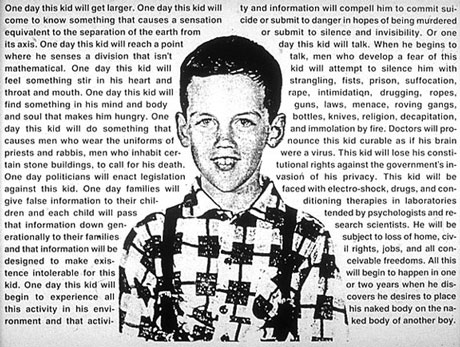
David Wojnarowicz, Untitled (One Day this Kid...) 1990
Getting caught up with the end of term, I have not yet had a chance to weigh in on the brewing and unfolding controversy surrounding the Smithsonian’s National Portrait Gallery and its recent exhibition “Hide/Seek: Difference and Desire in American Portraiture,” which examines the role sexual identity has played in the creation of modern portraiture. One of the exhibition’s works—a four-minute video created as a complex metaphor for AIDS in 1987 by artist David Wojnarowicz (now deceased)—was removed by the Gallery at the beginning of the month when allegations were made by the Catholic League and a number of Republican members of the US government about the anti-Christian nature of the work. The “disturbing” images in question relate to a short eleven second section of the film, titled A Fire in My Belly featuring ants walking across a crucifix (see clip below). Of course many people believe that this particular allegation is just a diversion for the actual target of protest and homophobia related to the fear of direct conversations around the full spectrum of sexuality (and the AIDS crisis) conjured up by the art work and broader exhibition.
Robert Mapplethorpe's controversial photographs were
at the center of an infamous 1989 exhibition at the Corcoran
Gallery of Art in Washington D.C.
Shown here: Derrick Cross and Friends (1982)
Since that time a number of important questions and debates are once again emerging within American art institution circles concerning the public funding for the arts and questions of obscenity and the freedom of expression in the country’s museums. Reminiscent of the 1980's Culture Wars that saw the work of Robert Mapplethorpe come under scrutiny (a topic I have written about), the Twitterverse has been burning up with articles, op-ed links, and calls for protest in the wake of the controversy. Most recently, the Warhol Foundation for the Visual Arts has announced that it will withhold all potential future funding from the Smithsonian unless it reverses its decision and reinstates the video into the exhibition at the National Portrait Gallery, and the San Francisco Museum of Modern Art has decided to host a screening of A Fire in My Belly and a public forum discussion about the work and controversy on January 4, 2011.
Andreas Sterzing, David Wojnarowicz "Silence=Death" 1989
The most comprehensive and compelling coverage of these unfolding events has undoubtedly come from Tyler Green over at ARTINFO, and I recommend checking out his timely series of interviews with both the curators of the present Smithsonian exhibition (Jonathan Katz and David C. Ward) and the Q&A he did with curator Dan Cameron who put together a retrospective of Wojnarowicz’s work in 1999 at the New Museum in New York. I was especially struck with how much Wojnarowicz foresaw the kind of controversy and heated debate that his work would continue to stir in audiences:
MAN (Tyler Green): What was Wojnarowicz’s reaction when these types of things happened to him?
Dan Cameron: I think that David was pretty agonized a lot of the time, to be honest with you. He just didn’t understand why someone who wants to actualize their life, their consciousness, in the broadest and richest possible way, why they’d become targets for people who want to shut that down. There was an essential confusion with him, he’d ask it over and over again: What is the source of homophobia in our society, and why do we not look at homophobia as a disease the same way we understand racism and sexism are bad and negative, and that they harm and even kill people? We’ve never had that national conversation, and David insisted that it be in the forefront of discussion of his work.
When the forces of religious-driven bigotry rose up, when he became the victim, he really suffered. It was really horrible for him to live with this reality. He was surrounded by people at the time who said, ‘It’s a bitter cup, but you’re going to have to take it.’ In that sense, this idea that people are saying that David’s work is hate speech against Christians during the Christian season… it’s fascinating how passionately [the religious right has] used anti-bigotry and anti-hate language and that they have turned the same language and weapons to beat us up with.
I even heard Rep. Cantor go off on the class dimensions, saying it’s only elitist East Coast liberals who believe this stuff is art.! To think of David, who was a Polish-American from a working-class background, and to hear these accusations of elitism, it’s frightening.
MAN (Tyler Green): Did Wojnarowicz expect that this silliness would continue after his death, or did he expect the persecution to pass?
Dan Cameron: I don’t really know. I think he had a pretty pessimistic and borderline fatalistic viewpoint on the need for American society to need to invest in homophobia. He thought it performed a dynamic function in American society, and that unless we look at why fear and hatred of gay people is part of our culture we’ll never get to the bottom of it.
I think that he thought that in the early 1990s that there was no one willing to do the heavy lifting. That’s changed now: You have the Log Cabin Republicans and a broad non-partisan consensus about “Don’t Ask, Don’t Tell.” But I don’t think that the roots of homophobia have been explored. I don’t think we’ve begun to look into the ‘why’ of all this, why people like Boehner and Cantor seem to continually believe that gay-baiting and using this broad, blunt instrument to attack contemporary art through its exposed gay flank, why they think they can get away with it, why they think they can get mileage out of the fear and loathing of gay people.
Of course, maybe they do. The Association of Art Museum Directors basically, in a very, very bland, kind of almost anti-confrontational statement in which the sexual identity of David was non-issue, didn’t really stand up.
MAN (Tyler Green): I’ve been struggling with whether this kind of dust-up is ‘good’ for the artist’s legacy in that it brings attention to his work or ‘bad’ because it reduces him to cartoonish public flare-ups. Have you thought of that this past week and if so have you come to any conclusions?
Dan Cameron: A friend of mine here in New Orleans reported to me a very heated elevator conversation he overheard wherein a couple of right-wingers were speaking with great approval of the censorship and how dare they call this art and so on. Of course, this person didn’t intervene.
I think when people talk about contemporary art I think it’s always good for contemporary art. I would even say that when bigoted people talk about this, it’s good for contemporary art because in exposing their bigotry or narrow-mindedness, it’s good for other people and that’s really important.
I think more important than these suit-and-ties who are having a knee-jerk reaction are young people, who have an intrinsic resistance to censorship. They want to know why it’s being done and they want to get to the bottom of it. I bet there are thousands or millions of young people hearing about this and looking at David Wojnarowicz’s work for the first time. The museums who are presenting David Wojnarowicz’s work in response to this controversy will only add to the appreciation and understanding of his work. It’s just unfortunate that it has to happen in this way.
As for the Smithsonian, they have issued a Q&A of their own on the museum’s website outlining their position on why they removed the work. It will be interesting to see how these events continue to unfold and circulate discourse about both the art/artist and the real underlying issues in question.
David Wojnarowicz, A Fire in My Belly (1987) *warning: some images may be disturbing*
Yes, classes are over! But..... now the marking and exams begin. One step at a time....one day at a time. The nasty flu bug finally caught up with me as well and I have been under the weather all week. Even so, I am grateful for the fantastic and creative group of students I have come to know this term-- many of your papers and projects are looking very very good so far and the marking has been less painful than in the past (I cannot tell you what a joy it is to read essays that have been edited and proof-read). Need a reason to procrastinate from studying for a bit? Here are some picks from around the Twitterverse this week:
A bunch of rare 60s & 70s conceptual art artists' books, downloadable as PDFs.
'Liu Xiaobo must be freed' - Nobel prize committee
Thru a chain of unexplainable circumstances I went to get something from the fridge & instead got lost watching frolicking otters on Youtube
Students: What TV show should you watch instead of studying for finals?
Peter Schjeldahl's 2010 art roundup in The New Yorker
Hee hee... Modern art = I could do that + Yeah, but you didn't
Yoko Ono: What I’ve learned about John Lennon, 30 years on (Esquire)
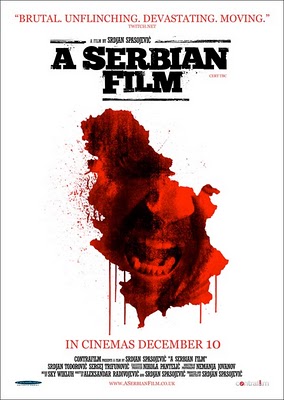
What happens when someone tells you that they have seen a film so transgressive, so unspeakable, and so awful, that you must never ever see it? The answer is probably quite obvious that your morbid curiosity gets the best of you and you check it out anyway. Isn’t that our human nature after all? And isn’t that what many filmmakers trade on, especially those engaged in the growing genre of “pseudo-snuff” and “gore-nography” horror movies (think the Saw and Hostel film franchises) where the imperative seems to be to push the bar of explicit and shocking material to continually arouse and stimulate viewers. This was the dilemma and ensuing debate raised a few weeks ago in my Film Studies class when a student first asked me if I had seen A Serbian Film.
I had in fact heard about it— not so much about the content of the film itself, but more so about its context, as a Serbian film project which had worked in opposition and reaction to the contemporary state of Central and Eastern European filmmaking. All I really knew was that the film was touring the indie circuit and had been printed in Hungary after Germans had refused to touch it. Interestingly enough, the film had also hit my radar when I was researching material related to Marina Abramovic (a Serbian and controversial artist in her own right) and ran across forums where people were trying to make meaningful connections and raise debate about what potential remained to create a subversive form of art to raise consciousness about the troubled state of Europe, especially in the regions so scarred by the aftermath of Soviet occupation.
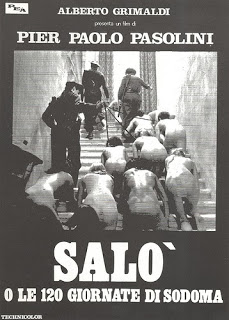
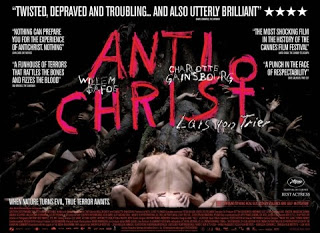
Going home and Googling the film, I read over the Wikipedia entry for the detailed and highly explicit and disturbing plot summary (something I had also been warned about, and so I am warning you as well) and quickly realized that this was one of those films that would generate the controversy of Pasolini’s Salo (1975) or more recently Von Trier’s Antichrist (2009). At its simplest level, the film’s plot is highly conceptual and concerns an aging porn star who agrees to participate in an "art film" in order to make a clean break from the pornography business, only to discover that he has been drafted into making the most unspeakable and horrific film of his entire career.
Lars von Trier's Antichrist has been the focus of
recent debate concerning the growing trend of torture-porn in film
Reading up on the film director Srdjan Spasojevic, it is clear that the political subtext of the film is aimed squarely at the current state of affairs in Serbia (it is quite literally "A Serbian Film") and speaks to the problematic nature of fully re-presenting the terror and trauma of inter-generational memory in the country. In this sense, the film’s exploration of the most dehumanizing and unspeakable acts of transgression and perversion is meant to give some shape and embodied expression to those feelings. As Spasojevic explains in a recent interview for Bloody Disgusting: "We’ve been living in Serbia our whole lives and we’ve experienced the last 20 years, which have been tumultuous. They were really depressing and frightening. It’s the political stuff and everything else that comes to the forefront, but it’s also our own experiences with everything that’s happened and the emotions that start to develop from living in an environment where anything can happen at any time. It’s like something that has been concentrating for a long time and it’s been storing up for a long time.” As a horror movie that deliberately engages with only the illusion of violence and torture, A Serbian Film seems to provoke questions about the process and limits of the desensitized viewer while simultaneously inflicting a form of trauma and terror on its audience.
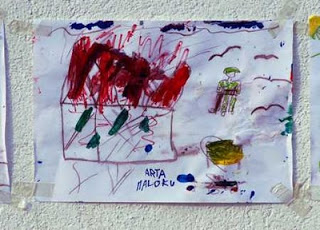
Children are often encouraged to draw unspeakable acts of war
(such as this Serbian child's drawing of the Kosovo War)
as part of an art therapy to deal with traumatic memories.
The response, especially from Serbian audiences (the student who brought this film to my attention among them) has been especially divided. Many fear that a film like this will only continue to perpetuate stereotypes of violence and war-mongering that has marred the global perception of Serbia, while others welcome the chance to directly confront the national shame and fear that has gripped the country since the dissolution of Yugoslavia and the Kosovo War of the late 1990’s. It is with this latter opinion that the question of irony and reading the film’s gesture as “art” falls under some scrutiny. Unlike Abramovic, who had also explored the horrors of a Serbian past in film, this movie is not billed as an “art film” and is unlikely to be shown in any gallery setting. For this reason alone, I question how and to what end a film like this will be viewed and discussed in the future, especially beyond the indie film circuit.
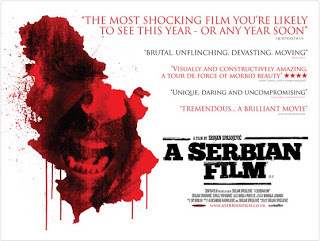
The shock value of A Serbian Film appears to be its main selling feature,
not the underlying political subtext
I debated all week whether or not to blog about this film, to give it any more attention or “legs” as it were—I wasn’t even sure up until my last film studies lecture if I would reveal the title of the film to students, a movie that could so disturb and essentially terrorize the original student who had brought it to my attention. In the end, I decided that the debate raised around this kind of filmmaking and what it signals for our contemporary moment and the state of the filmmaking industry, the question of its status as “art”, and the visual worlds filmmakers build and situate their audiences within, were all compelling enough reasons to speak its name. Researching reviews of the film over the past week, I have been impressed with the high level of thoughtful reflection and reaction to A Serbian Movie—especially the review and comments posted on Pajiba.com and those I ran across on one San Francisco bloggers reaction to the film. No doubt there is a micro-thin line to be drawn here between art and pornography. As for me, I know I will not see this film—for many personal and philosophical reasons—and I hope that you consider carefully before you make your decision. I am very much of the mind that it is impossible to “un-see” visual images of horror and sexual violence, however simulated, after being exposed to them. There are some worlds perhaps better left to literature and non-visual representation.
Interview with the producer and director of A Serbian Film, April 2010 at the SXSW Film Festival in Austin, Texas: