Essential Reading| Chicago Guide to Your Academic Career

THE book that explained the mysteries of
grad school to me. My most recommended book
for students considering the challenge
of life and work beyond the BA.
So you want to go to grad school? If so, you can begin by consulting one of the very best books on the often mysterious and baffling world of postgraduate education. I have chosen The Chicago Guide to Your Academic Career as the next title for my Essential Reading post series because it is a book that I have recommended perhaps more than any other since completing the journey through MA and PhD training. And even while it is not specifically related to the world of art history, it is a book that offers a very honest and frank insight into what it takes to pursue education beyond the Bachelor’s degree while addressing the many aspects of the pursuit that are often sidelined or left ignored by graduate schools. This includes topics such as the basic distinctions between undergraduate and graduate studies, the real length of time and amount of money it takes to complete a PhD, the high degree of competition and realities of the current job market, what life is like as a new professor, and the many sacrifices and bonuses to personal and other career options students encounter when they make the choice to go on with university studies.

In my case, I first spotted this book in a university book store after being accepted to an MA program. I already knew that I wanted to pursue a postgraduate degree and possibly work in academia, but I was still uncertain about the intricacies of the process. Having spoken with a range of professors on the topic (something I routinely encourage any student considering grad school), I was left with an impression that what determined one’s success with postgraduate education was having a very realistic outlook and a game plan to complete the task.

The Chicago Guide is written very much with that kind of pragmatic approach and is constructed as a series of conversations between three professors from very different backgrounds and institutional settings: John A. Goldsmith, Professor of Linguistics at the University of Chicago; John Komlos, Professor of Economics at the University of Munich; and Penny Schine Gold, Professor of History at Knox College.  With chapters including “Deciding on an Academic Career,” “Entering Graduate School,” “The Mentor,” “Landing an Academic Job,” and “Family, Gender and the Personal Side of Academic Life,” the book is a useful tool to help navigate not only the grad school experience, but also the daunting and seldom addressed challenges of transitioning out of postgraduate studies back into the “real” world of work. Even though written in 2001, the book still reads in a very “of the moment” kind of way, especially with respect to the strategies and tips for preparing oneself for the difficult job market. If there is anything dated at all about the book, it comes with the statistics concerning the time and money it takes to complete postgraduate work and find a job—unfortunately more is required of both and the roads to success are not as simple or as straightforward as described ten years ago.

One of the best features I have taken away and urged students to use from the book is the list of questions Penny Gold asks students to pose to experts they already know or admire (here is a direct copy of the list from Chapter 2 of the book which can be found reproduced here):

  • To professors who know your work well: Do you think graduate school, in this particular field, would be a good choice, given my level and kinds of talents? Do you think I would have a contribution to make?
  • To professors in your field who have completed graduate school within the last five years or so: What are the current issues in the field? Where do you see the field going? What is graduate school like these days?
  • To these and any other professors whom you admire or whom you might aspire to be like: Are you glad you became a professor? What are the best things about life in academia? What are the most difficult or troubling things?
  • To graduates of your own college or university who are now in graduate school in a field close to yours or who have recently obtained jobs (your undergraduate teachers, the Career/Placement Center, and/or the alumni office should be able to give you names and addresses): How have you found the graduate school experience? Did you find that you were well prepared for the program you entered? Is there any advice you wish you'd had before entering graduate school?

For some comic relief about grad school, check out PhD Comics
Bottom line, if you are contemplating staying in school beyond an undergraduate degree, it is worth the investment to purchase a book like this. After some years in grad school, I even took the time to write a letter thanking the authors for producing it, expressing my gratitude for finding an uncensored and realistic account of the process. You can find a chapter and more info about the book here, and the text is now available as a digital download.  For more information about the grad school experience, I also highly recommend checking out the Chronicle of Higher Education Advice column and the fantastic resources of Phinished. For fun, you can also follow the hilarious weekly cartoons published by Piled Higher and Deeper (with an example from the site featured above). Good luck and let me know how it all works out! 
Google's Art Project and the Perennial Crisis of Objecthood

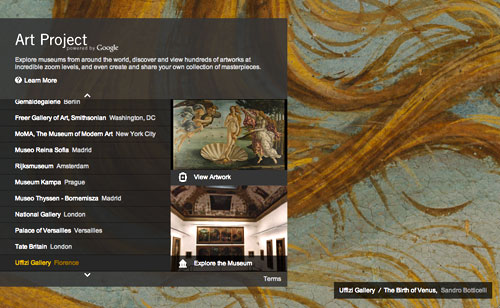
A screen shot of Google's new foray into the world of art museums
As soon as I first heard of Google’s plans to do for art museums what it had done for the navigation of city streets with Google Earth, I couldn’t help but wonder how this newest digitization project would push the conversation started so many decades ago with Walter Benjamin’s landmark essay “The Work of Art in the Age of Mechanical Reproduction.” In this key text, written in 1936 by one of the most influential cultural critics and philosophers of the Frankfurt School, a pivotal argument is made about how the modern age of technology facilitates in removing the “aura” of original art works through the process of mechanized reproduction. In other words, Benjamin persuasively argues how the reproduceable image of an original art work (such as a postcard of the Mona Lisa for example) results in a loss of authority for the singular work of art itself, leading to further questioning of the artist genius model upon which notions of “authenticity” and “authority” are imbued in traditional understandings of the art object. In this sense, there is an apparent freedom or democratization of the art work gained in the process. Even so, Benjamin goes on to warn that the contemplation of these new modes of technologically mediated images (such as those seen in photography and film, or today on our computer screens) signals another kind of dynamic caught up in a distracted and uncritical state of viewing fuelled by the speed and technological processes of contemporary image circulation.

Walter Benjamin's 1936 essay predicted many of the
concerns we face with technologically
mediated imagery today.
His concern, shared by many who work in critical media studies, relates to what happens over time when mechanically reproduced images change the very structure of perception itself. Are we able to gain a critical distance to understand the difference and stakes involved between identifying the “real” world of objects and their many many “doubles”? What is at stake in this process, and how does it effect how we perceive ourselves and the objects around us?

Not surprisingly, the launch of GoogleArtProject has not necessarily been met with the kind of immediate praise that one might expect of art historians. This past week, I began to pay closer attention to the discussion on art history discussion boards, blogs, and reviews to gauge the immediate response. On the one hand, it is undeniable that many art historians (particularly those working in North America) teach almost exclusively with digital reproductions of original works in the form of PowerPoint presentations or with the older variation of this idea, the colour slide. In this sense, the added gain of being able to zoom in and show the brush work of an Impressionist painting at the level of detail one would expect if in the presence of the actual object cannot be entirely ignored. As several art historians noted, this feature is an added bonus to punctuate arguments about the degree to which artists were attempting to efface or bring attention to their brush work and what that signals for the moment. On the other hand, concerns were raised that the obsessive level of detail achieved by GoogleArtProject will return some degree of overdetermined focus on the art object's form. Ironically enough, this brings us back to a strange reappearance of the "aura" in precisely the way Benjamin originally talked about, fostering a fetishization of the original and placing an emphasis back on the formal qualities of objects. What results is a kind of art appreciation and connoisseurship of the art object at the expense of the contextual and social/political underpinnings that so many art historians privilege as a key component of their pedagogical approach to art history.

While seeing Van Gogh's paintings up close is fascinating,
it can be argued that this carries a critical value only when it is
contextualized. Without that, we risk privileging a kind
 of obsession with form at the expense of engaged reflection
It will be fascinating to see how the project unfolds and what kinds of debates are sparked from within my discipline, but for now the GoogleArtProject exists as a kind of cabinet of curiosities that has been assembled without any clear program or curatorial vision. As Roberta Smith, the art critic for the New York Times concluded Sunday in her review of the project echoing Benjamin,


"In many ways this new Google venture is simply the latest phase of simulation that began with the invention of photography, which is when artworks first acquired second lives as images and in a sense, started going viral. These earlier iterations — while never more than the next best thing — have been providing pleasure for more than a century through art books, as postcards, posters and art-history-lecture slides. For all that time they have been the next best thing to being there. Now the next best thing has become better, even if it will never be more than next best."
For now, I think it is also significant that the majority of the images in the database are paintings from the most popular of the host institutions' collections, and also the most pleasurable to look at. In many ways, this only serves to perpetuate the discourse and frameworks of certain historically constructed art history “isms”, key favoured artists, and mainly Western European artistic developments. It is no doubt a concern then for many art historians that the main function of the initiative appears to foster a kind of online art appreciation devoid of any critical reflection. If nothing else, it will certainly help us remind students of why we make them read critical texts and histories alongside the study of pictures.

You can check out the tour of GoogleArtProject in this YouTube clip below:

Weekly Twitter Round Up


Being an observer of the Twitterverse this week, I do not think anyone can overstate the unprecedented role that online social networking played in the revolutionary events unfolding in Egypt. In the coming days, I will dedicate a special post to reflect on some of the commentary about Twitter and Facebook's impact on the uprisings, but for now I can direct you to a wonderful link that was tweeted to me of influential and key Egyptian bloggers to follow on Twitter. Bottom line, if you didn't take Twitter that seriously before, you might reconsider your position and test the waters with an account. There is a fascinating world of information to discover. As cyberpunk novelist William Gibson has famously declared, "Facebook feels like a mall. Twitter feels like the street." I tend to agree with this assessment. In the meantime, there were still many wonderful  arts and culture related tweets to save in my favourites-- here are my picks for the week:


100s of UC Press books avail as public html. Includes Barthes, film studies & more. Some great stuff here


Mad Men says little of substance about the world it depicts. What explains its appeal? Daniel Mendelsohn has a theory


A brief history of hip hop, as told through a cappella beatbox


Happy Chinese New Year twitter muster! Hans Hoffmann's Hare


Museums on "high alert" for trafficking of stolen works in Egypt & Alice Walton deems @FolkArtMuseum too weird to save


Well, that's it. The internet has run out of free space


WikiLeaks' Julian Assange inspires street artists  

Does Philosophy Still Matter? A Timely Question Addressed by The New School

James Miller's new book profiles twelve philosophers
whose solid ideas about truth and human conduct
did not always translate so smoothly to social
and political engagements. See NYT Review here 
With the dramatic turn of events unfolding in the Middle East over the past weeks, the question of philosophical ideas rooted in academic discourse and informing critical theory—notions of reason, democracy, liberty, freedom, and human rights—have taken on a new kind of immediacy for many of my students. It is not dissimilar to what I recall as a student in 1989 when the Berlin Wall was falling and I found myself coming to grips with how ideas I was learning about in the classroom translated to what I was seeing unfolding as street level activism. Then like now, I, along with many other individuals working within the academic context, have grappled with what role public intellectuals and philosophers can play within the contemporary and postmodern context in which we live. In many ways my blog has become part of an exploration into this very quandary, but I have also entered into the world of social networking as a way to “think aloud” many of these same questions.

The New School in NYC was founded with avant-garde
principles of teaching and dissemination of ideas
Last week, The New School in New York City raised an idea that I think many of us working closely with critical theory and philosophy in our own work at times ask of ourselves: does philosophy still matter? The New School, founded in 1919 on the heels of the First World War as a school of modern and later avant-garde approaches to teaching and circulation of ideas, has played a key role in uniting leftist American thought with the European philosophical tradition, while fostering the critical theory of the Frankfurt School.  Famous students of The New School read like a who’s who of the cultural fabric of American life, and at many times in its history the institution has come under political attack for its outspoken faculty and student activities. That being said, the question of philosophy and its utility in our present moment forms the backdrop for a fascinating panel discussion that took place there this past week only a day after the Egyptian uprising began. The panel itself is inspired by the publication of a provocative new book by James Miller, professor of political science and chair of the Committee on Liberal Studies at The New School for Social Research titled Examined Lives, From Socrates to Nietzschand includes the following distinguished group of diverse and multi-faceted participants:  

What struck me most after watching the panel (video embedded below) is how frankly and openly the discussion engages with the public perception of academia, and the crisis of disconnection that many believe is now part and parcel of our new technologically mediated world. Still, there is something of an urgency presented in the conversations between these individuals (as citizens and academics) which I take very seriously-- a need to "slow down" as Critchley argues so passionately, and a way to carve out as West argues "a critical space of reflection" to counter the sense of escalation and rapidly moving world events over which many of us feel so powerless.

The New School regularly uploads lectures and panel discussions on its dedicated YouTube Chanel-- a wonderful public resource that is in keeping with the New School's founding mandate.

Some Thoughts on the Egyptian Uprising and the Attack on Art Institutions

A picture posted January 31st by blogger and Syrian journalist Danny Ramadan on Hyperallergic
**update** the Egyptian Museum as of 6:12 pm Cairo time appears to be on fire as reported on CultureGrrl's blog
**update** conflicting reports as of 12:12am Cairo time that the fires appear to be contained

Yesterday, I spent a great deal of lecture and seminar time discussing the Egyptian uprising with students and faculty. The images of massive surging crowds, standoffs between pro and anti-Mubarak supporters, and the spectre of violence and uncertainty have permeated the unfolding and escalating events. As I write this post on Wednesday morning (6pm Cairo time), tear gas and Molotov cocktails are now being used by the pro-government forces to attempt to disperse the crowds—the situation is beyond tense and very concerning.

For days now, these events have largely unfolded in Tahrir Square ("Liberty" in Arabic) only meters from the Egyptian Museum, and the conflicting reports about the looting and vandalism of the country’s cultural institutions have become a focal point of concern. Yesterday, I posted a YouTube clip reporting on the situation and the blogosphere has provided timely and on-the-ground reports about the status of many of the museums and libraries of Cairo (see examples here and here). Over the weekend, the National Geographic Society published a letter on its website from the Bibliotheca Alexandrina (the controversial Egyptian library and cultural centre in Alexandria) shedding some light on the nature of the tense and often confusing confrontations taking place on the ground:
To our friends around the world: The Events in Egypt
30 Jan 2011 
The world has witnessed an unprecedented popular action in the streets of Egypt. Led by Egypt’s youth, with their justified demands for more freedom, more democracy, lower prices for necessities and more employment opportunities. These youths demanded immediate and far-reaching changes. This was met by violent conflicts with the police, who were routed. The army was called in and was welcomed by the demonstrators, but initially their presence was more symbolic than active. Events deteriorated as lawless bands of thugs, and maybe agents provocateurs, appeared and looting began. The young people organized themselves into groups that directed traffic, protected neighborhoods and guarded public buildings of value such as the Egyptian Museum and the Library of Alexandria. They are collaborating with the army. This makeshift arrangement is in place until full public order returns. 
The library is safe thanks to Egypt’s youth, whether they be the staff of the Library or the representatives of the demonstrators, who are joining us in guarding the building from potential vandals and looters. I am there daily within the bounds of the curfew hours. However, the Library will be closed to the public for the next few days until the curfew is lifted and events unfold towards an end to the lawlessness and a move towards the resolution of the political issues that triggered the demonstrations. 
Ismail Serageldin
Librarian of Alexandria
Director of the Bibliotheca Alexandrina

Photographs of the destruction of French cultural symbols
circulated as part of the unfolding events of the 1871 Paris Commune
The question of why Egypt's museums have come under attack, by whom, and for what reasons, was part of many of the conversations I had yesterday. Having just introduced the Dada movement to one of my survey classes—a movement which emerged as both anti-war and anti-art during the unprecedented violence of World War I—many parallels were discussed between that moment in the early twentieth century and the one emerging in Egypt today, concentrating most specifically about the way “art” can become a focus of harsh and sustained criticism and attack, seen as both a tool of the state and a way to separate people through its appropriation, institutionalization, and end use. Looking back on the history of revolutionary action, the attack on museums and institutions of art and culture has figured prominently as part of the street level action. Importantly, many of these isolated events gained even more power through the modern era via the circulation of powerful photographic images loaded with symbolic associations. As early as the Paris Commune of 1871 and as recently as the infamous scene of the pulling down of the Saddam Hussein statue during the 2003 invasion of Iraq, the technologically mediated images of toppled statues and looted museums have entered historical records as representations of resistance to what the art and monuments under attack represent and for whom they speak. 

An Egyptian soldier protecting the Egyptian Museum, image courtesy
of Associated Press/ Amr Nabil
In the case of Egypt, the attack on museums is tied up with the complicated associations that the art of Egypt has to the maintenance of a history of Western Civilization—a history largely located in the ancient past and clearly distant from the contemporary concerns of today’s Egyptians (the majority of whom are under the age of 30). As one of my students queried, “who cares about art and the protection of “precious” artifacts when the majority of people are living in poverty and without basic human rights?” On the other hand, as another student pointed out, the maintenance of Egypt’s lucrative tourism market “can not be ignored as part of its economic future.” There is also the very practical question of the high value and status of many Egyptian objects, fetching untold sums of money in the underground market for stolen art, and as another student suggested “provides quick and easy money for those who care nothing about art.” To whom do these objects belong, and for whom are they continuing to be exhibited and protected? As the fluid situation of Egypt unfolds, the question of art and culture with all of its loaded symbolic and material associations will no doubt continue to resurface.  But for now, the future of Egypt is being decided (quite literally) outside of the museum.