Quick Compare| Artistic License, Lady Gaga vs. Rihanna

While I was watching this past Sunday’s Grammy awards and marvelling at the stamina of Mick Jagger and his tribute performance to Solomon Burke, and the surprise appearance of Bob Dylan providing a growly rendition of “Maggie’s Farm,” not to mention the many wonderful performances by the younger generation bringing renewed attention to the artists that came before them—i.e. John Mayer, Norah Jones, and Keith Urban’s version of “Jolene” to honour Dolly Parton was incredible— I was reminded again how much the music industry operates within the context of artistic license.

Lady Gaga and Madonna made an appearance together in 2009
on NBC's Saturday Night Live, only fueling the persistent comparisons
Take for example the much awaited appearance of Lady Gaga and her new single “Born This Way.” Aside from the now expected provocative costumes and conceptually based performance of the song itself, I was immediately struck along with many others of my *ahem* generation, that the general vibe of the lyrics and melody was almost identical to Madonna’s now classic 80’s hit “Express Yourself.” Within days, the mash-ups appearing on YouTube drove home these undeniable comparisons (see clip below for an example). 

Lady Gaga was quick to respond to allegations of artistic copyright by announcing that Madonna had provided her blessing for “Born This Way.” In fact, during the award ceremony itself, Gaga made a point of acknowledging her admiration for the powerful superstars of the 1980’s in one of her acceptance speeches, declaring that she had written her latest song imagining Whitney Houston as the lead vocalist:  "I wanted to thank Whitney because when I wrote 'Born This Way,' I imagined she was singing it because I wasn't secure enough in myself to imagine I was a superstar. So Whitney, I imagined you were singing 'Born This Way' when I wrote it." In this sense, much of Lady Gaga’s fame has been calculated to draw on specific references to the artists and movements that she admires the most. Her admission of this approach is also strategic in that she is able to operate much closer to the workings of a visual and performance artist who respectfully pays homage to the “masters” of the past. It is a very thin line, but she has managed not to cross it so far.

The comparisons between the visual stylings of  David LaChappelle's iconic photographs
and Rihanna's video and  are pretty undeniable. Image courtesy of  Meets Obsession
Perhaps not the same could be said of Rihanna, another pop musician who recently debuted a new single “S&M” with an accompanying video (see below) that has likewise been accused of appropriating a well known artist’s style. In this case, Rihanna has denied allegations that her new video copies the now iconic visual style of artist, photographer, and director David LaChappelle. A simple glance however at the comparative screen shots of the video and the photographer’s work tells us a different story. LaChappelle, who was reportedly discovered by pop artist Andy Warhol and invited to work for Interview Magazine in the 1980's, is known for his very strong and recognizable photographic style relying on the use of humour, surrealism, and celebrity. After the Twitterverse blew up with talk of the uncanny comparisons and Rihanna’s denials, LaChappelle filed suit against Rihanna claiming, as reported by the New York Times, a “willful, wanton and deliberate” infringement of his copyright protections.  One wonders if the suit would have been filed had Rihanna simply admitted the similarities. Was the difference more blatant because she took visual artistic license versus a musical one? It is a very compelling question to raise and one that likely comes down to the perceived respect that has (or has not) been offered to the artists that have come before. 


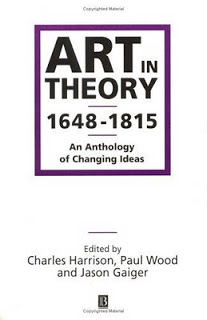
Essential Reading| Art In Theory


One of the best anthologies available to
students of art history and theory.
Click on image above to access Google Books version
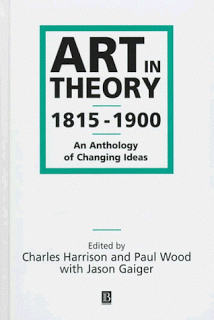
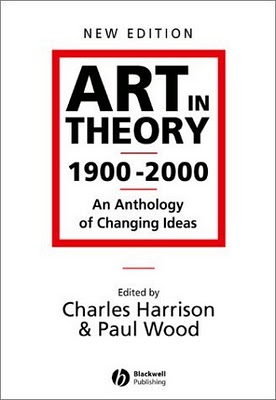
Seeing as it is reading break for many university students all or much of this week, I wanted to add another set of titles to my Essential Reading series which constitute a kind of “greatest hits” of art theory discourse. As I mentioned in passing in a post last week about Google Art Project, the critical conversations around art production, reception, and dissemination are far removed from the apparatus of spectatorship invited by the coffee-table book approach to art exhibition that Google (and many other on-line art galleries and museums) employ. Engaging with the ideas and theories surrounding art in any given period is one key antidote to a strictly formal approach to art, and the "Art in Theory" book series provides us with the perfect place to start. Published by Wiley-Blackwell, the set of critical anthologies cover the historical period of 1648-2000 in three large volumes: Art in Theory 1648-1815; Art in Theory 1815-1900; and my personal favourite Art in Theory 1900-2000

Click on image above to access
Google Books version
Each book is divided into thematic chapters with an opening introductory essay by one of the anthologies' editors (Charles Harrison, Paul Wood, or Jason Gaiger) and an accompanying series of key primary texts written within the time frame under investigation. With themes ranging across the three volumes such as “Establishing the Place of Art”; “The Profession of Art”; “Demands of the Present”; “Aesthetics and Historical Awareness”; “Freedom, Responsibility and Power”; “Institutions and Objections” there is a deliberate approach to contextualize the writings of key artists, philosophers, writers, and historians many of whom students have likely heard of but never read in the original. In this way, reading the likes of Poussin, Rembrandt, Locke, Diderot, Delacroix, Marx, Baudelaire, Courbet, Zola, Duchamp, Greenberg, etc.. (to name but a few) in their own words is part of the importance of these volumes. 

Click on image above to access
Amazon "Look Inside" version
In a networked culture where so much of what is offered up academically  comes at us “second-hand”, it is vital to build the practice of going back to the original texts of those we are studying to look for the specific nuances, rhetoric, style, and complete version of ideas under consideration. In my case, I used all three of these anthologies as an undergraduate and graduate student, and today routinely include readings from the volumes in the classes and seminars I instruct. As with many of the other titles I have featured in this series, these volumes have a special space in my home and office library. Lucky for us, Google Books has done a very nice job of reproducing key parts of two of the three volumes. Click on the images of the books to link directly to Art in Theory 1648-1815 and Art in Theory 1900-2000. The middle volume, Art in Theory 1815-1900, is somehow missing from online access, but I have included a link to the Amazon page where you can search the “Look Inside” feature to get a sense of its contents. Happy Reading Break!    

Weekly Twitter Round Up

One of many images of Egyptian protest signs citing Twitter
that went viral this past week (original source unknown)
I literally just walked in the door from an unexpected and surprise early Valentine getaway and was able to catch the amazing 60 Minutes interview with Wael Ghonim, the young Google executive and Egyptian protester who helped spark the Egyptian revolution we all witnessed last week with the aid of social networking. I wanted to wait and see what he had to say himself about the importance of Twitter and Facebook to the actions of the past week before commenting in a lengthier blog post (there is some debate as to its full weight and significance), but I am now convinced after hearing him speak so specifically about the unfolding events that social networking played a much more important role than many of us even truly realized. (to see the full interview, click here). I plan to gather my thoughts and write a lengthier reflection later this week.

Ironically enough, CNN's Anderson Cooper was not the one conducting the interview on 60 Minutes, even as Ghonim has praised him all week for keeping the Egyptian events in the news the past several weeks, but he did conduct an equally fascinating and candid interview with Lady Gaga ahead of the Grammy's on the same show! She is the number one followed individual on Twitter, so I thought it only worthy of mention here on the weekly round up (to see the full interview, click here). Off to watch some of the Grammy's now and catch up on my email!

Carpetbagger: Banksy Shenanigans Not Welcome at Oscars: If the street artist Banksy wins an Oscar, he will not


The Last Roll of Kodachrome—Frame By Frame! 


'I absolutely forbade all public photographs of myself.' Fascinating short film of Derrida in discussion


A whack of historical documents & manifestos of Dada, Surrealisms & Futurisms (1912-1928)


Architecture for the ears


Here are some books and magazines I recommend. Please share your favorite books in the comments here


Mon dieu! Slap fight in Paris over Frank Gehry art museum design 

Guest Blog | Jenna Kirouac: The Diffusion of High-Low Art Forms

Granville Street Photo-cubed -- a signature work of Vancouver-based artist Cameraman
(Photo from artist's website
Guest Blogger Jenna Kirouac is Avant-Guardian Musings Vancouver Arts Correspondent. To see her previous posts, please click here.

Byron Dauncey, aka Cameraman, is a well known artist here in Vancouver, garnering attention for his conceptual photography called cubic re-photography, where fragments of images are redistributed and constructed to create new meaning in spaces as in the image Granville Street Photo-cubed featured above. Cameraman has worked with a number of local artists, including Andrew Owen, with whom he collaborated on a recent street art event called "Throwup Throwdown."

Dauncey's "oultes" pop up around Vancouver
in unexpected and intriguing ways (Photo: Jenna Kirouac)
Cameraman’s ability to manipulate images that evoke new perceptions is something that he does with a modest and subtle sophistication that is matched by few. Much of street art is merited on its ability to disrupt the space it has inhabited in a way that draws the most amount of attention to the image as a kind of spectacle. Because of this, the vast majority of street art is shock-based as it competes to capture the public’s attention. This is what separates Cameraman’s work, however, as many of his installations have a subtlety to them while still being able to solicit a great degree of attention, as in the classic electrical outlet motif that he is well known for placing in unexpected and repeated places around the city.  This is not an easy accomplishment and is what really makes his work so alluring. The end result is smart and provocative, but not brash and tasteless.  Shock-value doesn’t need to be in his regular bag of tricks.

That being said, the growing scale of popularity and exposure (largely via social networking and media) that street art has steadily been gaining over the past ten years has now plateaued somewhat, culminating as something more mainstream than purely transgressive. After the release of street artists Banksy’s Exit Through the Gift Shop (now nominated for an Academy Award for Best Documentary Feature) the direction that artists like Cameraman will move has yet to be determined. However, the departure from street based work as a predominant form of expression for artists like Cameraman is definitely something to be anticipated. Cameraman’s involvement in the Vancouver Art Gallery’s 12 Manifestos of the City, along with many other local cultural producers is something that marks a specific place in time. It acknowledges the work of a few individuals that have consistently contributed to our public spaces at a time when artists like Cameraman may or may not return to the same forms of cultural production that have made them well known.  

 "12 Manifestos For The City" begins today at the Vancouver Art Gallery (Saturday, February 12) and will feature FREE Admission for one day only to coincide with the 2010 Olympic Anniversary Festivities in Downtown Vancouver.  Check it out!

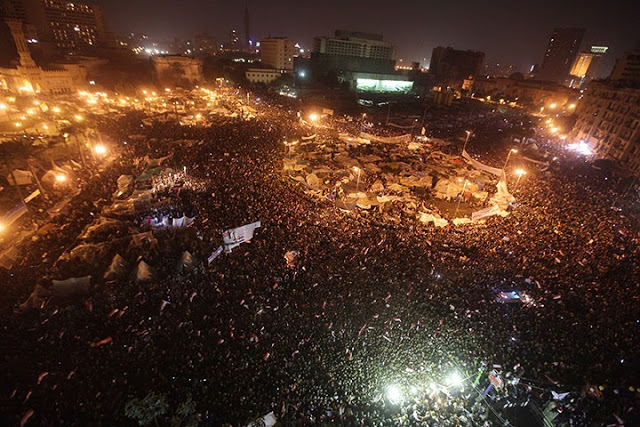
The Power of Peaceful Protest: Witnessing A Moment in History

Protesters celebrating in Egypt at Tahrir Square after President Mubarak steps down
image courtesy of The Guardian
"A 'No' uttered from the deepest conviction is better than a 'Yes' merely uttered to please, or worse, to avoid trouble." 
-- Mahatma Gandhi


"The real political task in a society such as ours is to criticize the workings of institutions that appear to be both neutral and independent, to criticize and attack them in such a manner that the political violence that has always exercised itself obscurely through them will be unmasked, so that one can fight against them."
-- Michel Foucault