Academy Award Preview | Documentary Feature Films 2010


As with the foreign language film nominees for the Academy Awards that I previewed yesterday, the selections for Best Documentary Film reflect the excellence of filmmaking outside the limited scope of mainstream Hollywood features. Documentary films, especially over the past decade, have also continued to probe highly controversial and often political subject matter, pushing the possibilities for wider social action. I was especially thrilled to see Waste Land nominated in this category, a film that was among my top picks from the Vancouver International Film Festival and a film that I highlighted and reviewed for its close connections to contemporary artist Vik Muniz. When director Lucy Walker appeared in Vancouver during VIFF to promote the film, I was especially captivated with her discussion of how much Waste Land had shifted the public perception within Brazil of homelessness, class divisions, and the very real concerns about the country’s giant landfills in the short time since it had been screened. I continue to believe that documentary films are to our generation what large scale history paintings were to many nineteenth century audiences—representations to help bring into discourse the most pressing social and political concerns of the moment.


WASTE LAND: The film documents two years of work of Brazilian contemporary modern artist Vik Muniz in creating art with the cooperation of garbage pickers working at Jardim Gramacho, one of the world's largest landfills, serving the metropolis of Rio de Janeiro in Brazil. Official Website | New York Times Review


EXIT THROUGH THE GIFT SHOP: A film directed by Banksy, Exit Through the Gift Shop tells the story of Thierry Guetta, a French immigrant in Los Angeles, and his obsession with street art. Official Website | Guardian Review


GASLAND: The film focuses on communities in the United States impacted by natural gas drilling and, specifically, a stimulation method known as hydraulic fracturing. Official Website | Globe and Mail Review


INSIDE JOB: the subject of Inside Job is the global financial crisis of 2008. It features research and extensive interviews with financial insiders, politicians, journalists, and academics. Official Website | New York Times Review


RESTREPO: The film follows the deployment of the 2nd Platoon of Battle Company on a fifteen month deployment in the Korengal Valley of northeast Afghanistan. It chronicles the lives of the men from their deployment to the time of their return back home. Official Website | New York Times Review


Academy Awards Preview | Foreign Language Films 2010


With all of the hype surrounding Sunday night’s Academy Awards—James Franco and Banksy already providing me two reasons to tune in—I am glad to see that the nominated Foreign Language Films reflect the excellent range of filmmaking from the past year. Having seen two of these films at the Vancouver International Film Festival already, I thought it would be worth the time to reassemble the list here with links to trailers and critical reviews for those of you wanting to check out and preview five of the most celebrated foreign films of 2010. Of course, this list only reflects a narrow range of international films selected by the American Academy of Motion Picture Arts and Sciences (for a more comprehensive list of foreign film selections, see the Cannes Film Festival website), but for many people watching Sunday, these movies will provide a gateway to the diverse world of filmmaking beyond Hollywood. I will preview the Documentary Feature nominees tomorrow.


BIUTIFUL (Mexico):  Biutiful is the story of Uxbal, a cancer-ridden single father who struggles to reconcile fatherhood, love, spirituality, crime, guilt and mortality amidst the dangerous underworld of modern Barcelona -- all before his time is up. Official Website| Guardian Review


DOGTOOTH (Greece):  A married couple and their three young adult children, a son and two daughters, live at the outskirts of a city in a large compound with a garden and a swimming pool. A tall fence surrounds the property and the children have never been on the other side of it, for their parents have kept them unaware of the outside world. Official Website | New York Times Review


IN A BETTER WORLD (Denmark):  Anton is a doctor who commutes between his home in an idyllic town in Denmark, and his work at an African refugee camp. In these two very different worlds, he and his family are faced with conflicts that lead them to difficult choices between revenge and forgiveness. Official Website | Variety Review


INCENDIES (Canada):  Adapted from Wajdi Mouawad's play, "Scorched", Incendies follows two young adults' voyage to the core of deep-rooted hatred, never-ending wars and enduring love. Official Website | Globe and Mail Review 


OUTSIDE THE LAW (Algeria):  Taking place between 1945 and 1962, Outside the Law focuses on the lives of three Algerian brothers in France, set to the backdrop of the Algerian independence movement and the Algerian War. Official Website | New York Times Review


And the Oscar Goes To...... Banksy?

Street art attributed to Banksy began popping up in Los Angeles this week
signed by Mr. Brainwash-- the tagging name of Thierry Guetta in the film Exit Through the Gift Shop
(image courtesy of Doro Design)
One of the most entertaining moments of the Oscar Awards ceremony Sunday might occur if the enigmatic street artist Banksy wins the best documentary feature film category for Exit Through the Gift Shop. Speculation has been running high for days about whether or not Banksy (who is nominated as the film's director) would attend the Oscars after officials refused him permission to attend in disguise. As the Academy's executive director stated, "The fun but disquieting scenario is that if the film wins and five guys in monkey masks come to the stage all saying, 'I'm Banksy,' who the hell do we give it to?" To add confusion to the matter, many in the press have now been openly speculating and reporting that the main character of Banksy's documentary, Thierry Guetta, is the "real" Banksy. This claim however seems both unlikely and not in keeping with Banksy's history, as blogger Alissa Walker at Fast Company argued in a great piece about Banksy last year.

With the award ceremony fast approaching, graffiti works attributed to Banksy, but signed by Guetta's tag name "Mr. Brainwash" have been appearing around Los Angeles. In Guetta's first extended interview with the LA Times published today, he maintains that the "movie is 100% real" and goes on to credit Banksy with helping to tell his story, claiming that "Banksy captured me becoming an artist... In the end, I became his biggest work of art."

We will now have to wait until Sunday to see how Banksy may have to pull off his biggest prank of all-- collecting an Academy Award without revealing his true identity. As he told the Guardian after receiving word of the nomination, "I don't agree with the concept of award ceremonies, but I'm prepared to make an exception for the ones I'm nominated for," adding: "The last time there was a naked man covered in gold paint in my house, it was me."

The following graffiti images, credited to Banksy, appeared around Los Angeles this week (images courtesy of NBC Photoblog)


Trailer for Banksy's Oscar Nominated Documentary:

Weekly Twitter Round Up


Ah mid-term...... it is slowly creeping upon us, and for many students exams are just around the corner. Even so, the hint of spring and the promise of longer days beckon. Two beautiful afternoons outside in the sunshine did a world of good-- Vancouverites seemed to fill up all the patios as if on cue and the first of the cyclists and rollerbladers were out on the seawall. For those of you starting your research essays for end of term assignments, make sure to refer to the list of resources on this blog to help you out with your plan of attack. Time will fly from this point forward, but for now you can take pause and check out a few of my weekly favourites from around the Twitterverse. 


Protest disrupts Sotheby’s auction as activists unfurled banner reading “Orgy of the Rich’’ 


Caravaggio's police record is more shocking than any modern bad boy rock star's. 


The push to make English the official language of academe in Europe causes problems for both students + professors


An anonymous Tehrani talks about the marches


Lady Gaga gaga about Winnipeg girl


Al Pacino to play Henri Matisse


Hi everybody, here I am on Twitter! This is my FIRST tweet... 

Social Networks and the New Art of Revolution: What Next?

Protester or Hipster (are the two mutually exclusive?)-- this is a question that
the newly created Tahrir Hipsters website seems to pose.
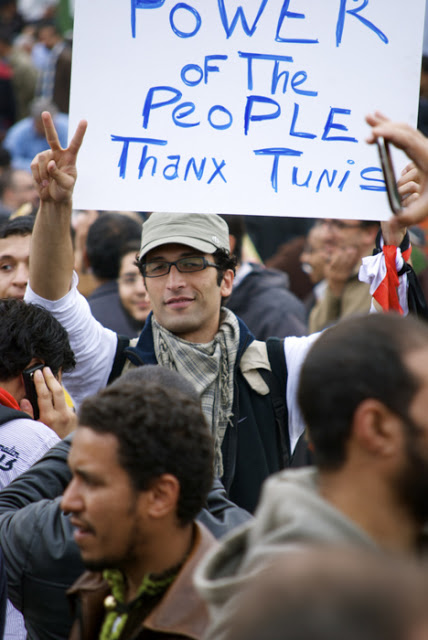
More than a week after the toppling of the Mubarak regime in Egypt and it seems that the role of social networking has taken center stage in conversations about protest movements in a way that nobody had really predicted. Like many of you, I too became caught up and engrossed with the rapidly changing events, doing my part to help circulate information via Twitter, Facebook, and YouTube to keep the events on the ground prominently within the news of the day. Activists, many young students themselves, also did an amazing job reaching out to the mainstream press to help keep the information fresh and relevant. Last week, the young Google executive Wael Ghonim gave several interviews thanking the social networking sites, especially Facebook and Mark Zuckerberg, for aiding the liberation of Egypt for its massive youth population.
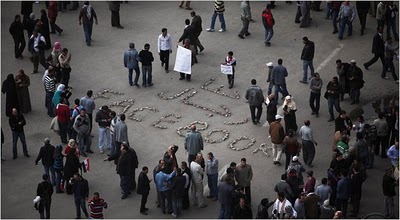
One of many images showing crowds in Tahrir Square thanking social
networking sites for spreading news of the protests
(image courtesy of New York Times)
A key dynamic of this shared information came through the posting of images and videos of what was actually taking place at Tahrir Square, especially once the violence subsided and everyday people came to join the massive and growing demonstration against the Egyptian government. Incredibly, the will to protest was quickly joined to the will to make art. As many of the images suggest, the role of  artists and the freedom of expression through creativity was yet another right being exercised by the people as part of the free flow of information. As one Egyptian poet and playwright explained, "An Egyptian person can reach into his pocket and buy someone food or pastries; that's something normal, but for the Egyptian people to go and buy papers and markers and bring it to us, that shows that the Egyptian people understand the importance of the artists in the revolution."
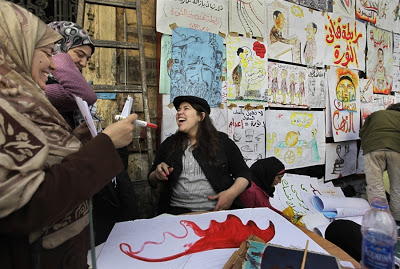
Hundreds of images and videos of artists and their work have circulated
since demonstrations started in Egypt (image courtesy of NBC Photoblog)
Interestingly enough, Facebook has remained very quiet and made few public comments about its undeniable role in the latest wave of revolutionary uprisings in the Middle East. As Ethan Zuckerman, a senior researcher at the Berkman Center for Internet and Society at Harvard told the New York Times on Monday, “It might be tougher for Facebook than anyone else. Facebook has been ambivalent about the use of their platform by activists.” Still, Facebook along with Google, Twitter, and YouTube actively assisted protesters in both the Tunisia and Egyptian revolutions by helping to fend off viral attacks on its systems by government hackers and even setting up alternative routing of information when the official networking sites were compromised. In this way, it is clear that the mandate of these companies is to remain open and accessible and allow the free flow of information exchange at all costs.

Still, one of the difficulties of making sense of the will to protest through the aid of social networks has been the undeniable cynicism, growing ironic commentary, and fear of the dwindling interest that has already emerged as the transitions in Egypt remain uncertain and very fluid. As an "event", the Egyptian revolution appears to have met its expiry date with many Western audiences.  CNN’s Anderson Cooper was even apologizing a few days ago to his audience (albeit somewhat sarcastically) for continuing to bring news of spreading protests and government violence against citizens of Bahrain and Libya. And with news of the tragic beating and sexual assault of ABC news correspondent Lara Logan on the very day of Mubarak’s resignation, the conversations have also turned focus away from discussions of democracy to the many  difficult and unresolved tensions that exist between Western observers of the Middle East and the actual inhabitants of the region. Overall, it appears that the persistent fear on all sides seems to concern who is leading the charge of change and for how long.
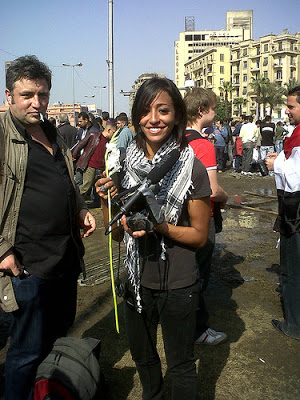
Another image from Tahrir Hipsters which features
a "fashionable" protester wielding a camera
Perhaps the newly created Tahrir Hipsters website illustrates and provides the best ironic statement on this confusion over the role of social networking. With the tagline “Celebrating Revolution in Style,” the website went viral this week with a minimal format picturing what looks like non-resident Egyptians who appear to join the revolution as a kind of fashion statement. With stylized photographs of attractive protesters typing tweets into their iPhones and Blackberrys, one could be forgiven for thinking they were looking at images from the Sartorialist. And perhaps there is a kind of ugly truth to what is being suggested here. The underlying fact is that most of the social networking mechanisms that helped bring about changes in Egypt are intrinsically linked to business interests calculated upon attracting the same young and tech-savvy consumers featured on the Hipster website. But like it or not, the notion of  “pure” and “authentic” grassroots protest movements outside these links is almost impossible to conceive of today. It remains to be seen how far, how wide, and for whose benefit the protest movements first sparked in Tunisia and then in Egypt will spread, but whatever the final outcome, it will continue to involve the unpredictable and uncharted pathways facilitated by the Internet.