Weekly Twitter Round-Up


Happy new semester and welcome back to my humble weekly Twitter round-up. Fresh from summer vacation and having navigated the always jam-packed first week of classes, I have also resumed more regular activity on Twitter after over a month of self-imposed limited access. My ambitious plans to blog while in Europe were partially thwarted by irregular access to the Internet, but in the end, it turned out to be a welcome relief to recharge and draw back from both the blogosphere and the Twitterverse. Everyone needs a tech break, right? Back and refreshed, I look forward to continuing my musings on this first anniversary of my original blog start-up date.

 Today of course is the tenth anniversary of the attacks on the World Trade Centre in New York and the Twitterverse has naturally been fully abuzz with links, personal reflection, and feeds from the many commemoration and ceremonies taking place today around the world. It is interesting to think how differently the events would have been experienced and remembered with the advent of social media, and at times it is hard to believe that it was ten whole years since the incident took place. Like many of you, I spent some time remembering the events of that day in my own life. I was entering the final year of my Masters degree program at UBC and was excited to attend a much anticipated graduate seminar in the history and theory of photography with Dr. John O’Brian. I had woken up early the morning of September 11th to go out for a walk on Kitsilano beach, and I was first made aware of the attacks when I began listening to the morning radio on my portable player. Once I realized what was happening, I ran back home just in time to turn on the TV and see the second plane hit the WTC. Later that day, several of us students gathered for our seminar with John and talked about the events. As the semester unfolded, I processed my thoughts in a seminar paper I wrote concerning the thousands of photographic images that circulated after the event. That paper turned into my first journal publication with Postmodern Culture Journal and still brings me back to that time ten years ago whenever I read it. 

Now as we begin another term, I have included a few tweets that deal with 9/11, along with a few other of my favourites from around the Twitterverse. Here’s to new beginnings and a successful academic term.

The computer that predicts the future 


Adam Harrison Levy: On the controversial 9/11 image known as ”The Falling Man”


"Brands take over the artist" Interview with Street Artist JR


How do we prepare kids for jobs we can't imagine yet? Teach imagination 


Teaching 9/11: A Decade Later, What Do Textbooks Say?


"Dinner with Henry Miller", a 30 min. documentary meal with the 87 year-old writer in 1987


Google results as Zagat entries 

Welcome Back! Top 10 New Term Checklist


Yes, it is already that time once again. Welcome back! A new semester, a new set of classes, and a new set of goals and expectations. But do you have a plan for how to navigate the messy first few weeks of class? Like many of you, I literally walked off a plane from summer vacation Monday night and headed onto campus by Tuesday afternoon. No doubt that the energy of the first week will help many of us make it through the jet lag and uneasy transition to sitting in the classroom, but this checklist should also help organize those pesky new term details. Good luck and remember to soak up the remains of summer while they last!

1. Check your classroom listings: this is imperative to do, especially if you attend a large university or have classes that take place on more than one campus (yes, I always have students at the beginning of each term who make this mistake). It never hurts either to take a dry run finding your listed classrooms ahead of time and even scoping out the most advantageous seats and plug-ins for laptops. It sure beats the frustration and rushing around on the first day of class to make sure you find the place you are supposed to be. Online campus maps are also terrific for pre-planning, so Google your university’s name and map to begin the process.

2. Read over syllabi carefully: A syllabus is like a contract and establishes the mutual expectations for a class between student and professor. One of the first things you want to check immediately are the dates for any midterms and finals. These dates are written in stone, and if you cannot make them because of other plans (and no, a trip to Hawaii or a friend's wedding are not legitimate reasons to miss an exam), consider dropping the class.  Remember, deadlines are your responsibility. Also, make sure to check your syllabus before emailing your professor with a question about the course. I cannot tell you how many questions I get each term that are clearly answered by the syllabus. Consider keeping a copy with you whenever you attend the class.

3. Get your books (eventually): Ask any senior undergraduate or graduate student about purchasing books, and they will no doubt tell you what nobody ever reveals to you in your first year-- wait to buy your books. Yes, I said wait. And although some of you might find it really tough to resist the urge to line up with hundreds of other students and spend hours to buy books during the first week of class (something that always amuses me), you will have the luxury of shopping in relative peace and quiet and perhaps save some money if you do. First, it often helps to wait until after you go to your first class and find out if you need all of the books listed at the bookstore (many times, you don’t). Another option is to wait and check the titles and prices of the books at the online university bookstore and see if you can find them for better prices elsewhere. I have seen students make ridiculous savings buying textbooks on AmazonChapters or Abebooks.

4. Check on-line course material: Almost all courses these days have an online component through tools like WebCT or Moodle where professors post links, images, class material and provide discussion boards etc... Make sure to check either on your syllabus or through a quick preview of your personal university homepage to see if your course also has an online component. Most institutions have a personalized portal which links you directly to any online connection to a class. Make sure to check the online material frequently and take note of any additional information related to assignments and/or exams that are often posted there.

5. Note important dates and deadlines: Along with the syllabus, it is important to bookmark or make a copy of your university’s dates and deadlines so that you are clear when add/drop dates, holidays, tuition deadlines, registration deadlines, graduation deadlines, final exams, etc.. etc.. occur. I usually just cut and paste these deadlines directly into my day planner or check them periodically to make certain I do not show up to teach a class during reading week J

6. Double check your registration: The saddest thing is when a student finds an “F” on their transcript at the end of the term because they erroneously remained registered for a class that they “meant” to drop. Be warned, not all universities will listen to your tale of woe, so do yourself a favour and double/triple/quadruple check your registration before the final add/drop deadline to make sure you are not registered for classes other than those you are actually planning to attend.

7. Purchase school supplies: I admit that this is my favourite thing to do each term. And yes, I was that geek in grade school who was happy in August when the school supplies showed up in the stores! Remember too that you can charge a killing if you are that one student with a mini stapler on the day assignments are due in class.

8. Look into taping your lectures: I encourage students who find it difficult to keep up with note-taking or enjoy having another listen to ideas raised in classroom lectures and discussions to consider taping lectures. Some things to keep in mind—first, make sure to check and see if it is OK with your professor before taping the first time (you need their permission); and second, see if your professor is already having the service done by another source. Some universities provide a lecture taping service and playback for large lecture courses. You can also check my blog post on this topic for tips and different approaches to the task.

9. Make a transportation plan: You might be surprised how easily and affordably you can create a carpool or learn about better ways to get yourself to classes by talking to fellow students and/or checking with your university’s website for resources (many schools help arrange car pooling). Also check your transit provider's website for routing plans-- many of them give alternative (and shorter!) suggestions getting from Point A to B.

10. Pay your tuition: Don’t forget—it is crazy how many students do.

On Summer Vacation....See you in August!

Summer afternoon - summer afternoon; to me those have always been
the two most beautiful words in the English language.
-- Henry James

Ah summer... it is calling to me. 
I will be taking a much needed break from blogging over the next several weeks to complete personal research and writing projects and plan for the following academic year. For students who are interested in more information about the new courses I will be teaching in the fall, please click here. Please feel free as well to continue posting and sharing links on my blog's Facebook page and/or connect with me on Twitter. I will check and contribute to both regularly. I know many of you will also be traveling to some great art cities over the summer, so I invite you to let us all live vicariously through you and upload pictures of any fabulous places you visit to the Facebook page. It is always a treat to see first hand accounts of places and art works we have studied in class. In turn, I will do the same and resume blogging in August when I make my way over to Europe for the month.
Wishing you all a wonderful summer!

Roy Lichtenstein, Girl with Ball (1961)
(courtesy MOMA)

Weekly Twitter Round Up


What a dramatic week for my fair city…..a roller coaster of feelings since this past Wednesday…. of sadness, of frustration, of outrage, but also of  civic pride in the way everyday Vancouverites are seeking to come together and leave a different impression, visual and otherwise, of the way Vancouver will be seen and understood in the weeks to come. What was most heartening is that social media was able to play such a significant role in helping to expose and identify those responsible for a night of idiocy and violence against the city. There are many lessons to be taken from the events that unfolded this past week, not least of which concern unpacking and making sense of the intense focus on circulating images and representations of what took place. My hope is that people will continue to observe it all with a critical eye and with an open mind to the dialogue that is sure to follow concerning it all. Peace Vancouver. Here are some of my favourite tweets from the past week:

Marina Abramovic To Open Community Art Space


Basel - Nearly 300 galleries from 5 continents at this year's #ArtBasel. Preview the art on show


Fascinating. "The Most Famous Canadian Photographer You've Never Heard Of"


Help Fund James Franco’s Museum of Non-Visible Art


There's really no need for academics to look frumpy. So why do they try so hard?


Dare to Edit! – The Politics of Wikipedia 


Pictures of the Cleanup Effort. @myvancouver #thisismyvancouver

Aftermath Vancouver: Picturing the Dimensions of a Riot

I took this photograph of one of the many message-covered boards now temporarily
replacing broken windows following the riot in Vancouver on June 15th. 
It wasn’t supposed to end like this. That is what most of us were thinking in Vancouver on Wednesday night when our hockey team lost to the Boston Bruins in a crushing 4-0 loss. Weeks of joyous anticipation and happy energy, the likes of which had not been experienced by locals since the Winter Olympics street celebrations in 2010, came to an unexpected end. Swept up in the euphoria of it all, most of the city was prepared to thank their team for a great season and move on. But that is not what the world got to see. Instead, what transpired after the game was a sad and shameful display of a small group of people-- many of whom were out to capture and represent their antics through the power of social media.  In less than 24 hours, the world came to see a very different Vancouver than the one advertised in glossy brochures and high livability indices.

A participant or by-stander of the riot? The lines are blurry.
Capturing the event on camera seemed to be the priority.
What was most disturbing to me as I watched the live coverage on television of a city appearing to descend into madness was the majority of individuals who stood by in zombie-like rows, capturing the spectacle on cell-phones and cameras, unwilling to scramble from the violence lest they lose their chance to digitally capture the scene. Most of what was being imaged was taking place only blocks from where I live, and so it was haunting—and no, the irony is not lost on me—that I too was experiencing the “live event” through the technological mediation of the screen. As the night wore on and more of the still and moving images were uploaded to Facebook, Tumblr, Twitter and YouTube, there was a clear sense that all of us were participating in a quickly unfolding social media event, the likes of which were nowhere comparable to the last time Vancouver experienced a riot when the Canucks lost a Game Seven hockey game in 1994.

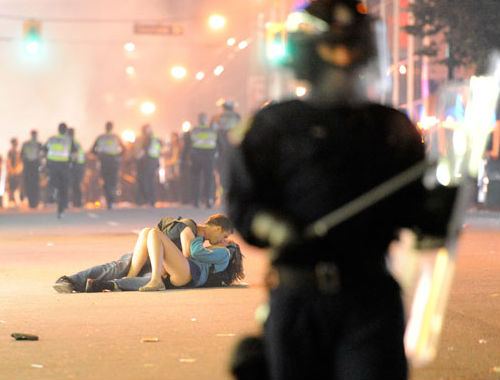
So what was different this time? Beyond the obvious sheer ubiquity of the available pictures thanks to social media, what struck me was the aesthetic quality and approach of the many photographs pouring onto these sites. Some of them were of the predictable snap-shot variety—the “hey look at me, I was at a riot” motif that you would expect of a cell phone picture. And some of them were clearly of a documentary nature, trying to capture the faces of rioters getting away with goods etc. to be identified by police for later prosecution. But many more were disturbingly and even exceedingly stylized, far more so than what was circulated after the 1994 riots. Capturing that dreaded National Geographic photojournalist quality that renders scenes of violence in a seductive and even beautiful light, the avalanche of mostly amateur photos taken with high quality photo equipment (many photo-shopped to heighten effects) radically altered the dimensions of the riot. Not surprisingly, these were the images that also captured the media’s attention and circulated around the world, perhaps none more problematic than the strangely cinematic and perplexing quality of the photograph of an amorous couple in the street as the city burns down around them (see below). It looks like something out of a bad apocalyptic Hollywood movie, the kind, incidentally, where Vancouver is routinely utilized by filmmakers as a backdrop for a fictional and unknowable place.

The Vancouver riots of 2011 will likely be distilled to this one "iconic" image
taken by local photographer Richard Lam. He claims it is not staged, but the image remains strangely cinematic.
Waking up yesterday morning, I wandered out to see the destruction for myself. I arrived on the scene by mid-morning and was heartened to see hundreds of people, brooms and garbage bags in hand, cleaning up the streets. Once again, photographers numbered among them, and within several hours a new type of photograph was being uploaded to social media sites. The images capture yet another dimension to the riot, but one that is perhaps less spectacular or alluringly apocalyptic. Yes, it is true that these pictures may be contributing to another kind of lie as well—the city is not always this clean and not all of our residents are so friendly or sartorial, trust me. But sadly, the community effort to counteract the effects of the riot is an event that many around the world will never see. I am therefore using my platform to circulate access and some measure of visibility to these images.

Anonymous Vancouverite pictured by Andy Fang cleaning up the streets
the day after the Vancouver riot


At the same time, I ask the question of how aestheticizing or even attempting to make a spectacle of the semiotics of violence seen the night of the riot removes or excuses photographers from the crowd's actions. Don’t get me wrong, I am all about questioning the squeaky clean image of my city. I am born and raised here, and I know many of its secrets and unflattering aspects. But there is something exceedingly manipulated and overtly false about so many of the riot pictures I have seen. This is an idea to ponder for all of the amateur and professional photojournalists out there in Vancouver. What did your stylized images do to contribute to any meaningful or critical conversation about the night of the 15th? Which “truths” were you interested in representing and what “lies” did your pictures perpetuate?