Location| Venice Biennale: Photos and Reflections (Part 3: Germany, France, and Great Britain)


Venice by night.... a unique atmospheric experience
(photo: D. Barenscott)
Having looked closer to home with my reflections on the Canadian and US pavilions at the Venice Biennale in Part One and Part Two of this post, I will now turn to some thoughts on three exhibitions that reflect more current trends in immersive installation, new media, and the intersection of filmic and visual arts in contemporary art. Perhaps not surprisingly, the German, French, and Great Britain pavilions best reflected these approaches and with the most drama.

Venice Biennale 2011(photo D: Barenscott)

German Pavilion, the sign says it all
(photo: D. Barenscott)
First, it was nearly impossible to ignore the publicity surrounding the German selection for this year’s Venice Biennale. The late artist and filmmaker Christof Schlingensief had agreed to participate just nine months before passing away of terminal cancer, and so the pavilion organizers were faced with the challenge of how to present the artist’s controversial work without his guidance. In the end, a large scale replica of Schlingensief’s boyhood church created the spatial container for a tribute to his creative projects joining film, experimental theatre, and mixed media. We spotted the pavilion almost immediately—it is tough to ignore a building with the words EGOMANIA emblazoned on it—and entered into what was both a terrifying and strangely kitschy and surreal space. The church-like setting had been transformed into a temple of “Kino,” complete with alter and benches to sit and contemplate the birage of motion pictures on three screens above the viewers’ heads. 

As a controversial filmmaker within his native Germany, Schlingensief’s difficult films-- such as A Hundred Years of Adolph Hitler (1989) and The German Chainsaw Massacre (1990)-- deal with the unspoken and repressed elements of the nation’s violent past. The pavilion was awarded the top prize at the Biennalethis year, yet I could not help thinking that all of the violent spectacle shown there only worked to reinforce negative stereotypes visitors might already hold about Germany. There was also something very creepy and unsettling about how people were interacting with the show—many were giggling and seeming to enjoy the “forbidden” quality of what was being represented. Perhaps this was Schlingensief’s understanding of human nature at work—seeking to expose and confront us with our hidden impulses.    


A peek inside cannot the church to Kino
(photos: D. Barenscott)
Moving to the French pavilion, the theme of motion pictures and immersive environments was approached from a different direction by the mixed media artist Christian Boltanski. The multi-room exhibition "Chance" featured one of the most intriguing spaces for visitors to explore. Floor to ceiling scaffolding and a maze-like setting invited people to walk through the show and the addition of moving images of babies faces (quite literally on tracks above our heads), and a great deal of mechanical noise (unusual in an “art space” that is often a quiet space of contemplation) added to the high sensory experience. Every minute or so, the noise and the track would stop, focusing on one single image of a baby’s face. Titled The Wheel of Fortune, the quality of random selection in this project reflected the other rooms where Boltanski featured statistics of people who would be born and would die that day (Last News from Humans) and an interactive piece that allowed people to form a new human through pressing a button and assembling a face from random fragments of pre-existing photographs (Be New).


(photos D: Barenscott)
Finally, our visit to the Great Britain pavilion rounded out the last of these most experiential exhibitions. Mike Nelson’s much talked about atmospheric installations, which immerse the viewer in an unfolding narrative that is built through a sequence of carefully reconstructed spatial structures, are like a grown-up versions of those amusement park rides that move people through reconstructed haunted houses. The final project does not disappoint and a real sense of adventure and play takes hold as we enter the pavilion. First, we are told to watch our heads at all times and be careful not to trip or fall over all of the materials on the floor and overhead. Second, we are placed inside what appears to be a real space, with harsh lighting, poorly ventilated and dusty rooms, together with rusty cans, implements, dirty mattresses, rugs etc. strewn about the dingy floors. 


Inside the spaces of the Great Britain pavilion-- a contemporary art version of a haunted house
(photos: D. Barenscott)
One of the guides tells us that it is meant to be replica of a Turkish workhouse, yet its bleak atmosphere and bizarre additions (like the room pictured above that is used as a photo development lab) was one that likely triggers connections to any number of sweatshop or illegal spaces of temporary refuge for migrants and other marginalized and "outlaw" elements.  As we were also told, Nelson attempted to reconstruct an earlier installation from another Biennale held in Istanbul in 2003. That is, the whole project is as much a conceptual one of trying to recreate an installation using a different space and geographic location as it is about the very embodied experience the final project provides its audience. No doubt it left me with a very disorienting sense of where I was, and that is perhaps the journey that we were meant to take with all three of the pavilions I have outlined here.

Location| Venice Biennale 2011: Photos and Reflections (Part Two: United States)


Ah Venice..... (photo: D. Barenscott)
Part One of my reflections on the Venice Biennale began with Canada this week, and now my attention turns to the United States--no surprise there, and perhaps a bit too expected, but as you will see, the pavilion was impossible to ignore. With rumours of James Franco representing the United States circulating around the exhibition all year, I can readily admit a spectacular quality was already attached to the US show well ahead of my visit. And quite literally within a few days of arriving in the city, we had heard rumours again that the previously cancelled and then postponed Franco installation (off-site and not at the official pavilion) was going to go ahead in a matter of days. Now for any of you who have visited Venice, you know the labyrinth of small islands and thousands of snaking streets and campos pose a challenge to the most seasoned traveler. And so in the end, we were quite honestly disappointed not to be able to find the Franco project, but what we found at the Giardini in the American building was still quite something to behold.

Venice Biennale 2011 (photo: D. Barenscott)
Approaching the pavilion, we were already puzzled with the presence of a massive military tank near the entrance. I had made efforts to avoid reading too much about what I would see there, so I did not connect the tank to the US pavilion, assuming that it was part of something  that the Israelis were showing in the adjacent exhibition (my bad, I know). Moving closer, we caught sight of a very athletic woman running on what appeared to be a treadmill on top of the massive vehicle, causing the wheel mechanism below to move. I immediately smiled at the irony of this very typically North American leisure pastime, treadmill running (something I actually enjoy myself), connected to what many would perceive as an unrelated reference to the military industrial complex. But as we entered the US exhibition and got to know the work of Jennifer Allora and Guillermo Calzadilla—a collaborative artist duo who live and work in the American territory of Puerto Rico— it became apparent that their unexpected juxtapositions were part of a broader project to bring themes of commerce, entertainment, competition, and nationalism into a productive tension.

Unexpected juxtapostions abound in Allora and Calzadilla's exhibition Gloria at the US Pavilion.
Featured here is Track and Field (2011) (photo: D. Barenscott).
Upon entry, visitors are immediately met with another odd sight—a human size neo-classically rendered statue lying inside a sun-tanning bed. With the provocative title Armed Freedom Lying on a Sunbed, the statue’s visual vocabulary and location inside the entrance way’s architectural dome (referencing the US Capital dome and rotunda) signals its idealized representation. But in a clever twist, the artists render this national symbol of an ideal nation in connection to the idealized and individuated notions of beauty associated with the pursuit of youth in American culture.

Allora and Calzadilla, Armed Freedom Lying on a Sunbed (2011)
(photo: D. Barenscott)
The pursuit of beauty and perfection in the national social body is also represented in Allora and Calzadilla’s Body of Flight installation and performance. Recreating in sculpted form Delta and American airlines’ business class seats, the artists partnered with American Olympic gymnasts to create an intentionally “contaminated” gymnastic routine that the athletes would perform with and around the seats. When we arrived at the pavilion, we were fortunate to get a front seat for the rigorous fifteen minute gymnastic routine performed right inside the gallery space in front of our eyes. I still cannot believe the physical endurance demonstrated by the gymnast, and found myself understanding how the artists were exploring ideas associating modernity, innovation, and design, with embodied notions of flexibility and performance.


All images are part of the artists' Body in Flight (2011) project. I was unable to find out the name
of the US gymnast, but she was absolutely amazing! (photo: D. Barenscott)
Finally, the piece that left us most amused was the massive sculptural object, Algorithm, which was located in its own room. Well over twenty feet tall, the object appears to be some kind of a monster organ from one side, but as soon as you move around it, one immediately recognizes its function as an ATM machine. We had already been warned upon entry that all of the art works were “fully functional,” so I understood that I would be putting my own bank card at risk if I actually placed it inside the machine. Pulling out an SFU copy card with a magnetic strip, I placed it inside the machine and was prompted to push a few buttons. Almost immediately, the large sculpture began to project a very loud series of sounds and spit my card back out at me.

Allora and Calzadilla, Algorithm (2011)
As we spoke with a pavilion representative, we learned that the artists had collaborated with a composer to create a variety of atonal and structured musical compositions to correspond unpredictably to the way users engaged with the machine. I watched as several visitors approached and used the machine, thinking about how such a mechanized part of our lives becomes so completely defamiliarized through the unexpected connection to a musical algorithm. The music had a very trance like quality, as if we were enjoying the sounds in a church, and I think that association with the detached and very mystical workings of international commerce was the very point that the artists wanted to make.  Loved it and all that Allora and Calzadilla brought to the table for the US offering at Venice. If only they could have talked James Franco into making an appearance running on the tank—now that would have been very very cool to unpack and discuss.

Location| Venice Biennale 2011: Photos and Reflections (Part 1, Canada)


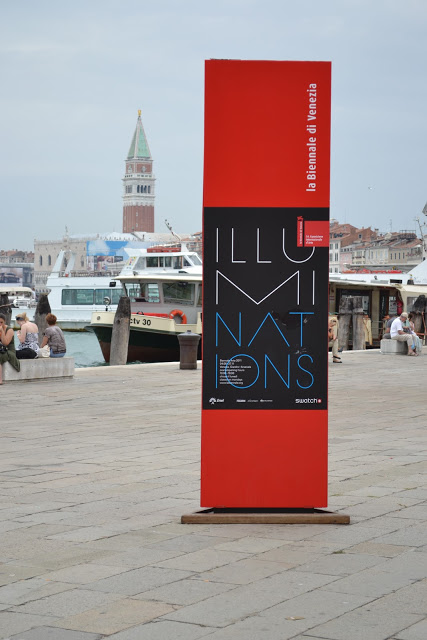
The Venice Biennale is one of the most anticipated contemporary art exhibitions
in the art world, held in one of the most unique and somewhat unlikely settings on the planet
(photo: D. Barenscott)

Over the summer, I embarked upon a pretty ambitious month-long trip to Europe that took me from Budapest to Paris, from Venice to Dubrovnik, and touring around the Mediterranean as far as Turkey. Taking a much needed break from the rigours of teaching and other administrative tasks over the past academic year, I wanted to take some time to focus on important facets of my research and also work in as many key exhibitions and museum visits as I could. At the beginning of the year, I had blogged about important exhibitions to watch in 2011, and I am happy to report that I did my best to see as much great modern and contemporary art as I could in Europe, even while continuing to be sucked into a Gothic or Medieval church or two along the way! 

Of my contemporary art encounters, the Venice Biennale was perhaps among my favourite. This might seem an obvious choice to many, but I had grown somewhat ambivalent about what I would see on display after many years of lukewarm reviews and questions about the relevance of a nationality based exhibition in an increasingly global art world context.  

The main and original site of the pavilions are situated in a large city park on
the Western most edges of Venice (photo: D. Barenscott)
After downloading and sorting through my hundreds of photographs (yes, it paid to bring along a good digital camera on this trip!), I decided that I would share and reflect on a number of the pavilions I visited over a series of blog posts over the next week or so.

I wanted to begin with Canada—not just because I happen to be Canadian, or because our artist representative Steven Shearer happens to be from Vancouver (although these are valid enough reasons, right?)—but because the pavilion stood in very stark contrast to the direction other country’s took in their artistic and thematic choices.

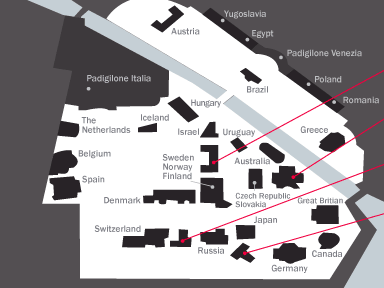
Note Canada's awkward position on the map in relation to other nations.
To begin with, the Canadian pavilion traditionally occupies an odd and very small and difficult space in the overall design of the broader Biennale grounds at the Venice Giardini (gardens). Lodged between and behind the much more prominent England and Germany pavilions, Canada is relegated to the very edge of the exhibition grounds and perceptually seems to get lost, reflecting our often perceived global position as a distant and small player in larger global affairs. Steven Shearer’s works, as I introduced in a post last June, already seemed a somewhat unlikely choice for placement in the pavilion since his works gave shape to a much more personal and less overtly political or broader social approach as with past choices that drew visitors to the pavilion (i.e. other Vancouver based artists such as Rebecca Belmore, Rodney Graham, or Ken Lum). But after seeing and experiencing the exhibition for myself, it makes sense to me why he took on the challenge of both the space and place of the pavilion.

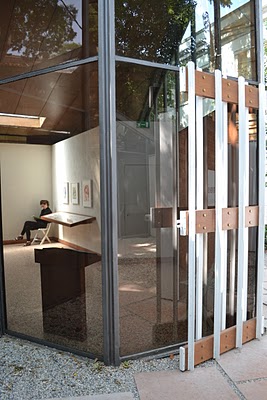
The inside entrance to the Canadian pavilion at the 2011 Venice Biennale
(photo: D. Barenscott)
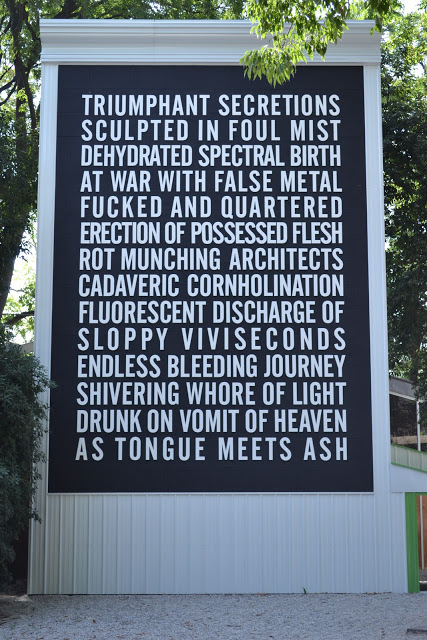
Shearer's large scale mural of one of his "heavy metal poems" did
manage to catch audience attention, but the interior of the exhibition space was
in sharp contrast to the spectacle of the sign outside
(photo: D. Barenscott) 
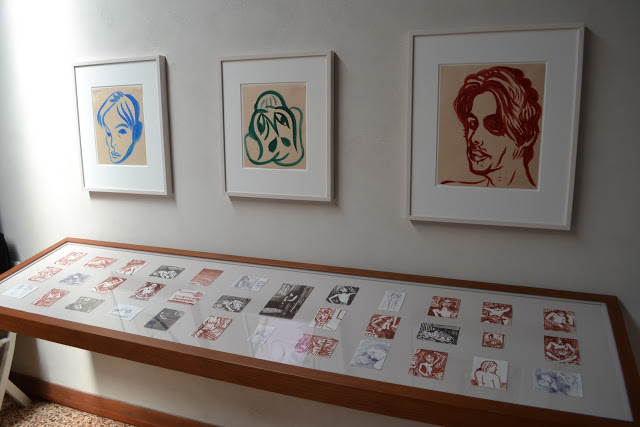
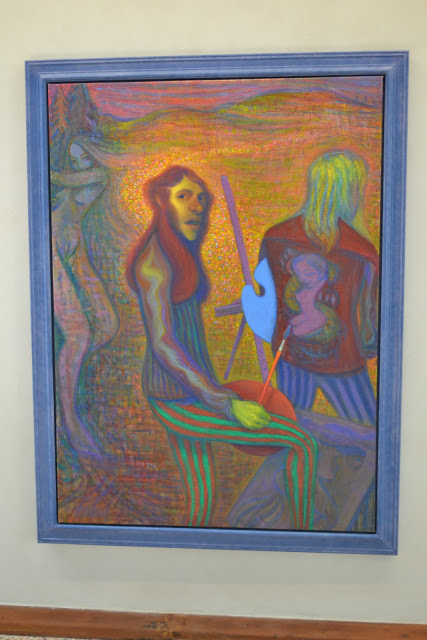
Shearer’s art practice, which is mostly made up of drawings, paintings, sketches, and murals, channelled a kind of quiet and contemplative retreat from the more brash, spectacular, and sometimes overtly in-your-face new media, performance, and installation focused projects seen in a majority of the other national pavilions. The only hint of that came with his large and provocative mural (see image above) that actually worked to grab visitor's initial attention to the Canadian space. Once inside, however, I kept thinking as I walked through the space and watched other’s engage with Shearer’s works, how much more attention was being paid to these works and to a practice that some would now think of as far more traditional in orientation.

(photo: D. Barenscott)
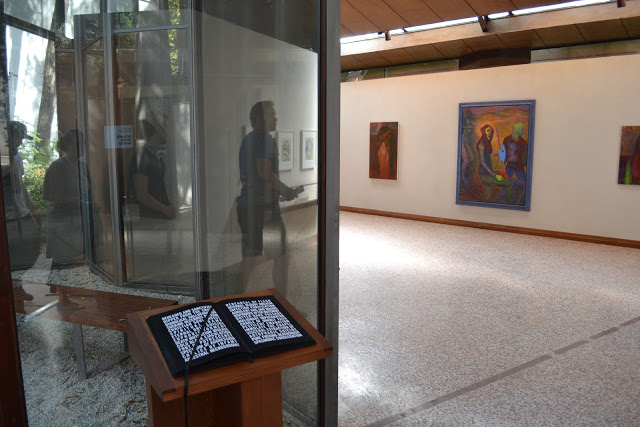
A quiet retreat from the noise of the Venice Biennale
(photo: D. Barenscott)
Canada, of course, is well known and often closely connected to its pioneering role in new media, video, and digital arts technologies, and so it was a bold move to go with a body of work that asked for a renewed attention and interest to less technologically centered art-making practices. As Shearer explains in an interview this past summer with the National Post, the “Canadian” identity is one that he also views as shifting, indeterminent, yet worthy of consideration. 

Q:  How does it feel to be representing Canada in Venice?

A I don't feel like I'm representing a nation. To make something about being a Canadian person... I don't know how you do that other than just do what I've done, be an artist based in Canada. And at many points, I never even thought I'd be an artist. I had social anxiety and for a long time wanted nothing more than to be left alone in my parents' basement making drawings and playing guitar. The fact that those kinds of activities are what pushed me out into the world... that's about as big of a transition as I can handle.

Q: So what are you doing in Venice?

A I wanted to respond to the Canada Pavilion's space, and also to some anxiety that exists about its small scale and lack of prominence. So I decided to create a false front for it and put one of my poem murals on it. This way, at least from one point of view, the Canada Pavilion appears to be as big as the German or British ones. I also liked putting this large thing out in front to point out how intimate the Canada Pavilion is. It's not a great pavilion for big, dominant works. It was made to show paintings, drawings and small sculptures. So inside, I decided to do that. Overall, I was interested in celebrating the space rather than trying to negate it.


I for one was very glad to see Canada represented in this way, and hope that the curatorial decisions made for this year's Venice Biennale signal a new direction for representing Canadian contemporary art to the rest of the world.

Weekly Twitter Round-Up


Fall is definitely in the air, and the flexibility and long days of summer freedom are certainly fading fast. I spent much of my weekend working on projects, proposals, and conference papers for this academic term, along with all of the other mundane organizational tasks that so many of you are also dealing with as the new year takes shape. In many ways, the cooler weather helps ease this transition and I have already been enjoying getting into a routine and also having a chance to meet and get to know many of the new students enrolled in my lectures and seminars. The Twitterverse has also been brisk with activity, and I am glad to see so many new arts and visual culture based and academic players starting to show up and take advantage of what this dynamic social networking platform has to offer. Got to run-- Sunday pot roast is almost done in the oven!-- but grab a cup of coffee and enjoy a few of my favourite tweets from this past week:

Uncreative Writing, Unoriginal Genius, and the New Literary Plagiarism


The Guggenheim Connection: Fame, Riches and a Masquerade: As painted by the authorities


Views: #Highered isn't dying, but radical change is on the way


Untangling the web: how the internet will grow through rites of passage  


Damien Hirst diamond skull is perfect emblem for "Make Wall Street Pay" activism campaign


Florida art dealer accused of faking Monets, Pollocks, Rothkos


The future influences the present just as much as the past.#Nietzsche

Art School, Confidentially Speaking


While many are familiar with the movie inspired by the same name, Art School Confidential
was originally produced as a comic book poking fun at the art school experience. 

As the season of art exhibition openings and festivals gets under way along with a new academic year, I wanted to share a catalogue essay I had the privilege of writing for the faculty art show of the Department of Fine Arts at Kwantlen Polytechnic University. Opening this Friday, September 16th at the Cloverdale studio from 6-9pm, “Art School Confidential: Then and Now” features an intriguing set of themes related to the art school experience, but also presents them in a powerful framework that juxtaposes fantastic art projects from the participants' past (when they too were in art school) with art works from present-day practices. 

Having read over the summer the complete version of Steven Henry Madoff’s important edited book of essays and interviews contributing to conversations about the future of art school, Art School (Propositions for the 21rst Century), I began my observations through the lens of those debates.  As both an instructive and highly conceptual show, the final exhibition raises many critical questions about what the art school experience can offer to both its students and the broader public. 

 *note* Where possible, I have included direct links to personal websites and/or CVs all of the artists featured in my essay—the individual art works can be viewed at the Cloverdale show and will also have an afterlife as a virtual exhibition (link to be posted when available). 


ART SCHOOL, CONFIDENTIALLY SPEAKING
Dorothy Barenscott

“No school is a school without an idea.”
Steven Henry Madoff, Art School (Propositions for the 21st Century)

What is it about art school, and the art school experience in particular, that signals such mystery, fascination, and fear? Perhaps it has something to do with the enigma of the artist’s role in our modern world—the power possessed to extract, focus, and represent the best and worst of who we are— or maybe it has more to do with the wider question of what a liberal arts education delivers in an increasingly utilitarian and results-oriented university environment.  However we approach the question, the spectre of art school conjures notions of alchemy, a touch of danger, and the profound capacity for transformation.    

In the past, art education based on the European model was forged in the tradition of the atelier or “workshop” method where apprentices were taught a valuable skill set from a principle master. Starting as early as the Greek era and gaining force and recognition in the late medieval period, the focus of art making was based upon a system of empiricism and the handing down of abilities to reproduce observed phenomena. Mimesis ruled the curriculum, as did the ability to follow a strict set of rules for art-making.

Over time, art schools have evolved to facilitate a much more subjective endeavour, foregrounding individual creative interpretation and discovery, together with a more issues based approach to the making of art objects that takes into account the long history and theory of art. Along with this shift, the focus towards group evaluation and negotiated feedback via the studio crit now predominate. For some students, this signals a difficult challenge. This is perhaps best characterized in the film from which this exhibition takes its title, Art School Confidential (2006), where the protagonist must adapt his own vision about what it means to be an artist to those of his instructors, his fellow students, and the world around him. In a favourite line from the movie, Professor Sandiford, an acerbic art school instructor played so brilliantly by John Malkovich, exposes the fatal error made by many an aspiring artist:  “Now, everyone don't be so hard on Jerome. He is attempting to achieve the impossible. He is trying to sing in his own voice using someone else's vocal cords.” In this sense, the process of falling apart or going to pieces and then coming back together again appears to typify the experience of many art school students.

A special chapter was even recently devoted to the mysteries of the art school “crit” in Sarah Thornton’s wildly popular ethnography Seven Days in the Art World (2008), exploring the many subcultures constituting today’s contemporary art scene. Therein, her interview with famed CalArts studio instructor and artist John Baldessari reveals something elemental about the ritual of group critique utilized by almost all North American art schools.  “Art comes out of failure…you have to try things out” he explains, adding “You can’t sit around, terrified of being incorrect, saying, ‘I won’t do anything until I do a masterpiece.’ Students need to see that art is made by human beings just like them.” 

In this exhibition, we bear witness to objects created precisely within this context of vulnerability, transformation, and the very human process of experimentation. These are faculty and department associate and support projects, past and present, which constitute the ambitious and multiple roads to success forged in art school and beyond.  The interrelated themes of the exhibition, much like a student’s rear view at the end of their art school years, are set within the conceptual frame of “Then” and “Now” orienting viewers through the gallery space.

The passage of time is marked out in a number of provocative ways. At its most literal, we see the material and unintended marks of deterioration in Maria Anna Parolin’s "Carega" Chair—the consequence of an art student’s rookie mistake of not framing and storing art work properly—but also in her more recent project Consumed Series, which deals with the juxtaposition of littered manmade and organic objects. At its most symbolic, the theme of time is played out in theory-based transitions within long established practices—Frank Fan’s early ceramic works give way to an exploration of the semiotics of pot making in Times River, while the spirit of collaboration and human desire to shape the natural world unites Scott McBride’s special interest in new media art with Kent Anderson’s bold experiments in sculpture in Suspended Wall.  
The interrogation of identity so key to the art school experience is likewise a principle theme of the show. We see approaches moving from the more distinctly personal and individuated, as in Robert Gelineau’s early Untitled double portraits set alongside his more recent explorations into the transgression of socially constructed boundaries in How Do I Look?, together with Paulo Majano’s interrogation of “uncanny” figurations in Valley Woman, Man and Kira Wu’s poignant and intimate image capture of her mother in Woman with the Bracelet.  Sibeal Foyle’s timely My Sister in Benghazi series bridges the personal with the historical, reflecting on comparative experiences of violence and the view of war at a distance. This emphasis on identity and the contours of history—critical to an understanding of how we construct our collective experience—is also present in other components of the exhibition, played out in Eryne Donahue’s study of memory preservation in Family History, Merrell Gerber’s recollection of dark moments in human activity with Faggots, and Nicole Brabant’s reflections on human/animal correlation in Hive Study.

As an exhibition seeking to instruct as much as it seeks to question, the themes linking Art School Confidential also reveal traces of knowledge gained through years of sustained art practice. Nancy Duff’s The Artist’s Studio: A Real Allegory (after Courbet) confronts emerging artists with the weight of art history and the cult of artistic “genius”, while Excerpts from the Artist Taxonomy Series recognizes the present-day conditions of artists’ many artificial worlds. Traces of this wisdom and dialogue also emerge in the installation of Alison MacTaggart’s interactive Promising Objects examining notions of invention and problem-solving set alongside the visible struggle to mediate traditional painting within a post-industrial context in Elizabeth Barnes’ Proliferation of Possible Plausibilities.  We are still reminded, however, of the instructive dimension of art objects through David Lloyd’s Candle Lanterns, initially conceived as class demonstration pieces for beginner’s projects.  Other works reveal the consistency of exploring core themes over the span of a career. This is seen in Ana Black’s investigations into the conflict between viewer and performer and the model of experience in Teen Beauty and Audition Series, together with Terry Sawatzky’s kinetic experimentations culminating in the mash-up between past and present 3D and 2D forms in the Albatross Series.

What then is the place of the art school today and what role does art education play in the shifting and rapidly changing world that we inhabit?  We find clues in the exhibition through Kent Anderson’s ironic wall sculpture Bright New Idea, reminding and even warning us of grand claims to ingenuity. Still, Scott McBride’s whimsical Sketch for a Video advises students of the value associated with play, humour, and “fun”—hinting at key components to success and longevity in an arts career. But more than ever before, these are critical questions to ask as we all seek creative and out-of-the -box solutions to an accumulation of unanticipated and pressing global challenges. At the same time, artists themselves face a confluence of institutional change, including the increasing pressure to professionalize early, the growing influence of contemporary art market trends, and the revolution in new media and information technology (together with their many new theories)—which all threaten to transform the terms of current art making practices.

Most recently, these issues were probed by poet and writer Ann Lauterbach in a poignant essay “The Thing Seen: Reimagining Arts Education for Now” in Steven Henry Madoff’s Art School: Propositions for the 21st Century (2009). At the conclusion of her treatise, Lauterbach asserts the urgency and importance of art education to the vision and fabric of democratic social space: “How do we inform the public that art is not a luxury, not mere entertainment, that artists are not spoiled children of an indulgent culture? Perhaps most important, how do we slow down our responses so that our opinions are aligned to judgements that are informed by what we know? How do we convince the public that neither complexity nor difficulty in art—in thinking about and responding to art—is a formula for estrangement but an invitation to imagine solutions to seemingly intractable problems and predicaments in contemporary life?”

For Lauterbach, as indeed for the multifaceted participants in this exhibition, the answer lies not just in the creation of critical and provocative art objects, but also in the facilitation of open and free-flowing conversations in the studio and classroom that generate new ways of seeing and challenging what students encounter in their world. “To teach persons to make art,” writes Lauterbach “is to teach them to resist the commodification of their wills and desires, to use flexibility and ingenuity in the face of adversarial forces, to build a capacity for the attention and response to which is not like them or belongs to them.” That is the real secret, the mysterious alchemy and transformational power of the art school experience represented by this exhibition. It is a secret that continues to play an equal role in art school’s great power and in its perceived and sometimes necessary danger.