Weekly Twitter Round-Up (Back at Long Last!)

My inbox these past few weeks has been FULL!
Meet my assistant, budding art historian and my new kitten Banksy (yes, he is quite a bad-ass)
Perhaps it is because the summer weather is still with us, or more likely the avalanche of responsibilities, appointments, meetings and events accompanying the beginning of term, that I have delayed blogging as long as I have this term. For whatever the reasons, this past few weeks has been especially busy and full of unexpected time drains. Finally, with the weekend drawing to a close and some much needed rest, patio sunshine, and down-time accumulated, I am happy to share some favourite tweets from this past several weeks. Normally, I attempt to share items from just the past seven days, but I have reached back a bit with a few of these selections as I get back into a more regular routine of checking Twitter. Much of the buzz on my feed the past week has dealt with a range of news from the Toronto Film Festival, the last days of Documenta, and New York Fashion Week, to the renewal of the Occupy Movement, ongoing American election news, and of course all the buzz surrounding the iPhone 5 launch (a long time RIM fan, I finally decided this weekend to pull the plug on my Blackberry and try out the new iPhone and iPad and test the Apple waters-- it is a bittersweet decision, but I have grown tired waiting for the launch of BB10). I trust the next week will bring a bit more calm-- grab a cup of coffee and enjoy these links:


What the era of phone photography means for the evolution of visual culture and how it all began: http://j.mp/zHi4IS 


great piece on the depthlessness of "innovation" rhetoric funny how we look for edgy ideas from the centers of society


Video: 'Silver Linings Playbook' named Toronto film fest fave  #TIFF12


Is Bansky's javelin the most iconic image of these Olympics?


Marcel Duchamp "The Creative Act" (1957), read by the author, 7 mins. 17 secs [MP3 link]: 


= conceptualism in the wild: actors read Yelp reviews


nice infographic about social media: software studies initiative


New Semester Checklist: Are You Prepared?


Welcome back! A new semester, a new set of classes, and a new set of goals and expectations. But do you have a plan for how to navigate the messy first few weeks of class? Many of the tips featured below are not new, but I wanted to pass them along once again because I know it will save at least a few of you some headaches. No doubt that the energy of the first week will help many of us make it through the uneasy transition to sitting in the classroom, but this checklist should also help organize those pesky new term details. In addition to my featured checklist, be sure to check out some other new semester survival tips I found both amusing and quite relevant at HackCollege, including a list of Five School Supplies You Don’t Need, 11 College Tips From a Senior, and 4 Freshman Tips You Probably Have Not Heard About. Good luck and remember to soak up the remains of summer while they last!

1. Check your classroom listings: this is imperative to do, especially if you attend a large university or have classes that take place on more than one campus (yes, I always have students at the beginning of each term who make this mistake). It never hurts either to take a dry run finding your listed classrooms ahead of time and even scoping out the most advantageous seats and plug-ins for laptops. It sure beats the frustration and rushing around on the first day of class to make sure you find the place you are supposed to be. Online campus maps are also terrific for pre-planning, so Google your university’s name and map to begin the process.

2. Read over syllabi carefully: A syllabus is like a contract and establishes the mutual expectations for a class between student and professor. One of the first things you want to check immediately is the dates for any midterms and finals. These dates are written in stone, and if you cannot make them because of other plans (and no, a trip to Hawaii or a friend's wedding are not legitimate reasons to miss an exam), consider dropping the class.  Remember, deadlines are your responsibility. Also, make sure to check your syllabus before emailing your professor with a question about the course. I cannot tell you how many questions I get each term that are clearly answered by the syllabus. Consider keeping a copy with you or downloaded on your laptop or phone whenever you attend the class.

3. Get your books (eventually): Ask any senior undergraduate or graduate student about purchasing books, and they will no doubt tell you what nobody ever reveals to you in your first year-- wait to buy your books. Yes, I said wait. And although some of you might find it really tough to resist the urge to line up with hundreds of other students and spend hours to buy books during the first week of class (something that always amuses me), you will have the luxury of shopping in relative peace and quiet and perhaps save some money if you do. First, it often helps to wait until after you go to your first class and find out if you need all of the books listed at the bookstore (many times, you don’t). Another option is to wait and check the titles and prices of the books at the online university bookstore and see if you can find them for better prices elsewhere. I have seen students make ridiculous savings buying textbooks on AmazonChapters or Abebooks.

4. Check on-line course material: Almost all courses these days have an online component through tools like WebCT or Moodle where professors post links, images, class material and provide discussion boards etc... Make sure to check either on your syllabus or through a quick preview of your personal university homepage to see if your course also has an online component. Most institutions have a personalized portal which links you directly to any online connection to a class. Make sure to check the online material frequently and take note of any additional information related to assignments and/or exams that are often posted there.

5. Note important dates and deadlines: Along with the syllabus, it is important to bookmark or make a copy of your university’s dates and deadlines so that you are clear when add/drop dates, holidays, tuition deadlines, registration deadlines, graduation deadlines, final exams, etc.. etc.. occur. I usually just cut and paste these deadlines directly into my day planner or check them periodically to make certain I do not show up to teach a class during reading week J

6. Double check your registration: The saddest thing is when a student finds an “F” on their transcript at the end of the term because they erroneously remained registered for a class that they “meant” to drop. Be warned, not all universities will listen to your tale of woe, so do yourself a favour and double/triple/quadruple check your registration before the final add/drop deadline to make sure you are not registered for classes other than those you are actually planning to attend.

7. Purchase school supplies: I admit that this is my favourite thing to do each term. And yes, I was that geek in grade school who was happy in August when the school supplies showed up in the stores! Remember too that you can charge a killing if you are that one student with a mini stapler on the day assignments are due in class.

8. Look into taping your lectures: I encourage students who find it difficult to keep up with note-taking or enjoy having another listen to ideas raised in classroom lectures and discussions to consider taping lectures. Some things to keep in mind—first, make sure to check and see if it is OK with your professor before taping the first time (you need their permission); and second, see if your professor is already having the service done by another source. Some universities provide a lecture taping service and playback for large lecture courses. You can also check my blog post on this topic for tips and different approaches to the task.

9. Make a transportation plan: You might be surprised how easily and affordably you can create a carpool or learn about better ways to get yourself to classes by talking to fellow students and/or checking with your university’s website for resources (many schools help arrange car pooling). Also check your transit provider's website for routing plans-- many of them give alternative (and shorter!) suggestions getting from Point A to B.

10. Pay your tuition: Don’t forget—it is crazy how many students do.

New Term, New Beginnings, New Opportunities...

The late August mantra of students the world over.
Ah yes, the new term is almost upon us. Even the weather seems to be signalling the transition to fall. And secretly I know many of you are actually quite excited about the prospects of a fresh new year. I know, I know... many more of you will not really be in the head space of a new term until after the Labour Day long weekend, but I thought I would reemerge from my own self-imposed blogging hiatus to begin the transition into the reality of the 2012-2013 academic year. Over the next week, I will begin  a series of posts that will catch up with some of what I was up to this summer, along with some topics students have requested I write about ahead of the new term. I am also happy to start up the weekly Twitter round-up again that so many of you seem to enjoy-- I had more than a few emails asking what had happened to them (and from people I know actually dislike Twitter!). While I wait along with you for school to begin, here is a quick snapshot of some of the posts I am working on for the coming weeks:

  • An overview of the best of Documenta and many highlights from the Paris Field School's visit to Kassel (we could have stayed another week!)
  • An academic survival kit for the first few weeks of class-- you will certainly be needing one with all of the information being thrown your way in a new term of classes.
  • A post related to the anxiety inducing topic: "So Your Thinking About Grad School?" and a no-holds barred response that I often give to those who ask me my advice on the matter.
  • A post highlighting some of the cultural events, festivals, exhibitions coming our way this fall.
  • Catching up with some of the controversies that erupted in the art world over the summer.
  • Information about the new field school planned through Kwantlen Polytechnic University for New York and the Venice Biennale in Summer 2013 (start planning early!)  
  • An overview and tour of the revamped blog and where to find the stuff you are looking for if you are either registered in one of my classes and/or looking for past resources.

Location | Paris: Meet Field School Faculty Member Dorothy Barenscott

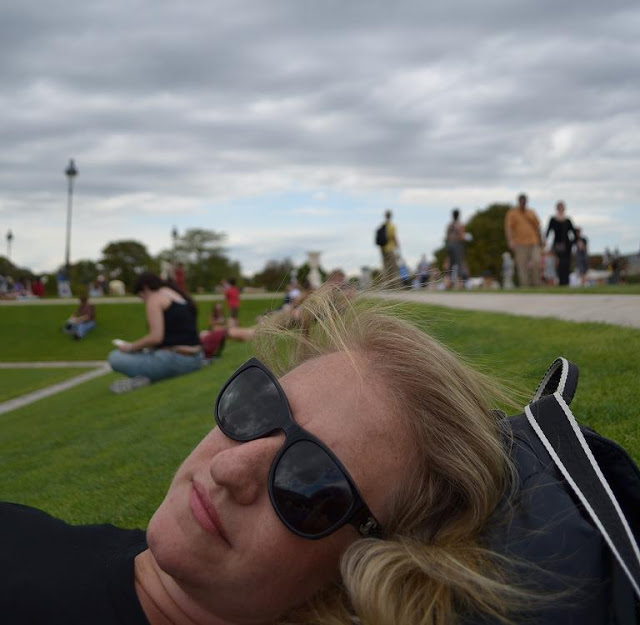
Meet Dorothy! Resting and daydreaming at the Tuileries Garden in Paris
(photo courtesy: self-portrait by Dorothy Barenscott)

Tell us a little about yourself—your teaching areas and interests and/or your background and how you became connected to the Paris field school?

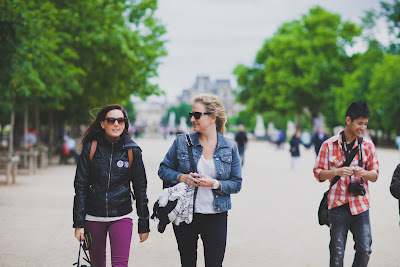
Walking and talking with students every day was a higlight of the trip for me.
Here I am chatting with Courtney-- Kenny to the right
(photo courtesy: Kyubo Yun)
Bonjour! My name is Dorothy and I work as an art historian and researcher in the field of modern and contemporary art history with interests in film/photography history and theory, urban studies, avant-garde movements, and the expanding field of new media studies. In a nutshell, I enjoy thinking and teaching about how techniques and technologies of seeing and art-making impact the way in which individuals and groups produce meaning about themselves and others. I am also very interested in helping students and artists understand and make sense of the dynamic visual worlds they inhabit and bring critical awareness to the history of art as a constructed body of knowledge—one in which they can intersect and leave their own mark. My blog (and the field school blog) have become extensions of these interests and attempt to reach beyond the classroom into non-traditional circuits of information exchange. I am also a lifelong traveler and organizing the Paris Field School was the realization of a long-standing dream I have had to travel with a group of students to one of the most influential art centers in the world and experience both the art and architecture of the city first-hand. The side trip to Documenta was icing on the cake and allowed students to immerse themselves in something that is truly special and one-of-a-kind in the world of contemporary art exhibition.

What was unique or memorable about experiencing Paris with a group of students already interested in and/or practicing art making?

I cannot tell you how happy I am that this moment was captured! It literally made my whole experience in Paris.
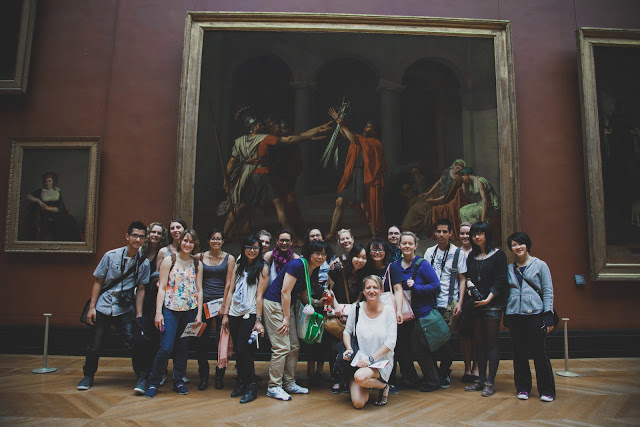
Our group standing in front of Jacques Louis David's Oath of the Horatii (1784)
(photo courtesy: Kyubo Yun)
Watching students experience works of art they have studied in the classroom is among the most rewarding parts of my job. There is something profoundly unique about watching the individual faces of students light up when they come face to face with an art object recognized from a textbook or especially memorable art history or studio class. It is in fact one of the reasons I became an art historian! Many of the students on the trip were also visiting Europe for the first time, so Nancy and I felt a real sense of responsibility to help them get the most from the trip. I have shared the story on my blog of being a grade 12 student dazzled by my Western Civ teacher’s passionate tales of summer travel abroad, and it has remained a cornerstone of my professional goals to engage students more directly in the study and understanding of art through travel of this kind. There was one very special moment on this trip, when we were all gathered in the Louvre and standing in front of Gericualt’s Raft of the Medusa, that I literally felt overcome with joy. I am so glad this moment and others that day were also photo-documented thanks to Kyubo! Seeing a powerful painting like that come to life through the eyes of students is a beautiful thing and I know that it is an experience none of us there that day will soon forget.

How did you see students connecting what they were learning about the art and history of Paris during the time of the Impressionists with their writing and studio projects?

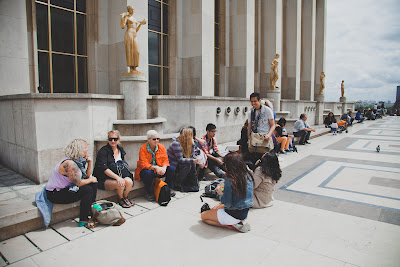
Nancy and I sit and chat with students outside the Architectural Museum
(photo courtesy: Kyubo Yun)
The connections started early in the pre-trip classes at Kwantlen where students were assigned an individual artist and artwork to research and negotiate in both their art history and studio based assignments. The final projects were remarkably strong and well-conceived taken the compressed time frame of the three weeks of summer classes before departure to Paris, but there was the additional excitement and enthusiasm of knowing that the work that was being completed ahead of the trip would only serve to enrich the time spent in Europe. Once in Paris, the students were assigned daily questions that pushed them to probe and revisit ideas and theories they had learned about in their studies and experimented with in their studio projects, but this time with the embodied experience of walking, breathing, and living in the urban context they had been studying ahead of the trip itself. I am very proud of what the students were able to bring to their writings, studio projects, and journals. I know many of them will continue to work in a creative and critical way with the ideas gained through the field school for many years to come.

Which of the activities during the trip stand out to you? Any special highlights or memorable moments for you?

Every day brought unanticipated highlights! Who would have known that the Paris Metro would have been such a source of excitement and focus for so many of us? We had as much fun getting to the many different activities of each day as the activities themselves. Shopping daily and selecting from all the amazing food choices at local markets for meals, sitting outside sketching in many of Paris’s most beautiful parks, and learning about everyone’s unique talents and abilities over the course of our travels are among the day-to-day highlights of the trip for me. Nancy’s ingenious idea to create the moveable feast and start a tradition of nightly Salons was also instrumental to the real bonding and creative excitement that was fostered over the course of our field school. Other stand out moments for me include the much anticipated visit to the Orsay Museum to finally see the assigned Impressionist paintings; the Gerhard Richter retrospective at the Pompidou!; the wonderful group dinner in the Latin Quarter where we ran into the “flashmob” White Dinner Party on the way home; meeting up with past students Andrea and Jen at different points in the trip, the journey from Paris to Kassel (imagine moving 25 people with too much luggage through cobble stone streets, two metro stops, and two train stations!); the Kassel beer gardens; and of course, every moment of Documenta!    

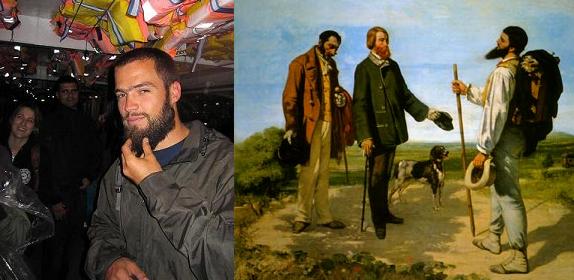
Another fun moment-- meeting a Courbet lookalike on our biking excursion!
Those who know this painting will get a big laugh.
(photo courtesy: Dorothy Barenscott)
We really feel that this is just the beginning of a signature element of Kwantlen Polytechnic University’s B.F.A. Degree and we now have plans in the works for another 6 credit (3 studio credits and 3 art history credits) New York and Venice Biennale Field School in Summer 2013! (I visited Venice last year and blogged about the exhibition here). Of course, an undertaking like this does not happen without a great deal of planning and support. I am especially grateful to my co-field school leader Nancy Duff (Department Head for the Fine Arts Department) for supporting the early idea of this field school and enthusiastically agreeing to plan and execute the first trip. I also want to thank Nancy and her partner Corrie for being such patient, adventurous, and fun travel companions—for anyone that travels a great deal, you know how important these qualities are! Important acknowledgements and thanks also go to Sandra Schinnerl and Andrea Reynolds in the International Office—without all of their logistical support and experience, the field school would not have been realized. Thanks also to the student fundraising efforts spearheaded by Stephanie MacKay—you leave a fantastic legacy for future field school students to follow! Overall, I feel privileged for so many reasons to have traveled with this specific group on our department’s inaugural field school adventure. Each and every student on this trip contributed to the success that it turned out to be, and I am proud that this blog project will allow these memories to live on and inspire future participants.

Experiencing Documenta-- priceless and hard to describe. This picture says it all!
Here I am with students (and past students who joined us in Kassel): Tina, Jen, Andrea, Mitra, Tessa, and me
(photo courtesy: Kyubo Yun)

Location | Paris: Meet Field School Faculty Member Nancy Duff


Meet Nancy! Working away on the Documenta itinerary while enjoying a few drinks in Kassel, Germany
(photo courtesy: Kyubo Yun)
Tell us a little about yourself—your teaching areas and interests and/or your background and how you became connected to the Paris field school?

I have wide ranging art interests and expertise, and my teaching reflects this.  I teach all levels of Drawing, Painting and 3rd and 4th year Open Studio, together with 2nd and 3rd year Cultural Theory and a variety of other 3rd year studio seminars, including Subversive Art, Public Art – and coming to a classroom near you soon:  tada – The Graphic Novel: Sequential Storytelling with Critical Content.  Currently serving as Chair of the Fine Arts Department at Kwantlen Polytechnic University, my goal is to contribute to making our BFA program rigorous, unique, and highly desirable – with an excellent national and international reputation.

What was unique or memorable about experiencing Paris with a group of students already interested in and/or practicing art making?

Nancy poses at the moveable feast for Kyubo in a contemporary
update to the barmaid in Manet's infamous A Bar at the Folies-Bergere (1882)
(photo courtesy: Kyubo Yun)
Experiencing anything in a group is like seeing through insect eyes that have multiple facets.  Watching students respond to art that they have only seen in reproductions, watching them experience a new cultural environment, and helping them operationalize a disciplined approach to reflecting on these experiences visually and in writing has been most enjoyable.  I, too, had a unique experience seeing the world through their eyes, especially as we sat together drawing. A very memorable experience was the moveable feast, for which we had divided the students into 3 groups, given them money to buy food for appetizers, main course and desserts. Seeing how they worked together to shop, prepare, present and host the meal and coming as guests with wine pairings, was loads of fun.  Bed runners had been converted to table décor, cots had been turned into sofas; the food presentation was highly aesthetic and also delicious!


How did you see students connecting what they were learning about the art and history of Paris during the time of the Impressionists with their writing and studio projects?

In the instructional half of the course that was based at Kwantlen, the students produced very interesting and well-conceived and executed projects in relation to aspects of Art Historical Modernity that they were learning about.  They installed two exhibitions in the Kwantlen Art Gallery and the Arbutus Gallery, both of which garnered much positive response from the Kwantlen community. For the Field School half of the course, without studios or facilities, the students were asked daily to respond in writing and visually to specific questions based on our itinerary.  Of course, these sketchbooks were very experimental forms, and much more reactive than analytical, reflecting the being-in-the-moment of the experience.

Nancy planned and organized  two exhibitions at Kwantlen Polytechnic University of student art work
based on the combined themes of the two field school courses prior to our departure to Paris
(photo courtesy: Dorothy Barenscott)
Which of the activities during the trip stand out to you? Any special highlights or memorable moments for you?

On our first day in Paris, Dorothy and the students colluded in a crazy surprise:  my sister, Jane, and her partner Maria, were at the pyramid entrance to the Louvre, when I had been expecting to meet with an administrator.  Jane had secretly celebrated her 50th birthday in Paris, and on this, their last day, we invited them back to the moveable feast where they got to meet the students they hear about all the time. I was very lucky to have my partner, Corrie, join us in our 2nd week abroad.  A former emergency room nurse and nurse educator, her expertise always brings a sense of relief to any unanticipated health concerns.  Having completed the readings for the Art History course, she really enjoyed seeing Paris through the lens of this particular history, and she was also very impressed by the student work, as an invited guest to the critiques.  In Paris, we spent a couple of lovely afternoons on our own: one in the Place des Vosges, and another in the Marais where, on a sunny outdoor terrace, we ate actual French onion soup! The drawing salons, being on the Paris Metro with the students joking around – getting to know them a bit better – was quite delightful.  I really appreciated seeing them spontaneously help one another.  We had a fabulous group, and despite a few inevitable dramas, the group became close, cohering as its own entity.  These kinds of experiences change us, in how we look at the world, at art, at each other.  Hopefully they make us more open, curious, analytical, friendly and compassionate.
Nancy, Corrie, and Dorothy stopping traffic along the Champs-Elysees with the Arc de Triomphe
in the background. (photo courtesy: kind stranger using Dorothy's camera)
On the strength of a personal connection (thank you Annetta Kapon at Otis in LA!) we made contact with a highly respected art school on the outskirts of Paris – Ecole Nationale Superieured’Art Paris-Cergy  (the school from which Orlan recently retired!!)-- with whom we hope to develop opportunities for student exchange.  They invited us to a student exhibition of work based on a similar concept to what our students had been doing in the course:  a conversation with specific works from a particular art historical collection.  I think our students were very interested to see the work of their contemporaries, and they subsequently made themselves at home, participating happily in some performative projects – perhaps even contributing to the success of the event.I feel very fortunate to have been able to help develop this paired offering at Kwantlen, and for it to have been so successful.  This was largely because of the students, who I admire and respect.  Also, I owe a great deal of gratitude to Dorothy Barenscott, who did so much research for our itinerary, and was a great traveling colleague (whose husband Brian was unfortunately unable to join us).  Our friends Andrea Reynolds and Sandra Schinnerl in the International Office were a great help in organizing our accommodation and travel, and we had the pleasure of spending some time in class and in Paris with Andrea, who now has a much better idea of what it is we do. 

Nancy's much anticipated "salons" were well attended by students looking to sketch, chat, and reflect on their
activities at the end of the day. Nancy and others sketch Shannon as she performs a butoh dance
(photo courtesy: Dorothy Barenscott)
With the success of this 6 credit, 3rd year Studio/Art History offering, we hope to develop an annual Field School that will become a signature flagship of the BFA degree.  Next year: NYC and Venice – here we come!  For 2014, perhaps Chicago and Berlin …