Writing and Not Writing About the Art Market: The Fallout

Screen grab of the article that started the conversation...


A few weeks ago while surfing my Twitter feed, I noticed a tweet from documentary filmmaker Ben Lewis, producer of The Great Contemporary Art Bubble, citing a "bombshell" announcement that Sarah Thornton was no longer reporting on the art world. He quoted her statement that summed up quite simply: "the art market is too corrupt to report on and I quit." I was immediately intrigued and being a huge fan of Thornton's writing I followed Lewis's link to an article Thornton published in the October edition of Tar Magazine titled "Top 10 reasons Not to write about the art market."I have summarized her points in a list here below:

1. It gives too much exposure to artists who attain high prices.
2. It enables manipulators to publicize the artists whose prices they spike at auction.
3. It never seems to lead to regulation.
4. The most interesting stories are libelous.
5. Oligarchs and dictators are not cool.
6. Writing about the art market is painfully repetitive.
7. People send you unbelievably stupid press releases.
8. It implies that money is the most important thing about art.
9. It amplifies the influence of the art market
10. The pay is appalling.

Sarah Thornton became well known for her study of the
institutions making up the art world in her wonderfully written
Seven Days in the Art World (2008)
Image courtesy: Canadian Art
Bravo I thought. Finally someone speaking the truth that so many of us struggle to make sense of when approaching the baffling world of today's art market. Indeed, Thornton goes a long ways towards explaining through her ten points just why it is that the bubble Lewis described so well in his film has not burst (in fact, it just keeps getting bigger). Following since the discussion and comments about her abrupt departure, it is clear that the lack of real political mass in the wake of Occupy and many of the protest movements witnessed over the previous year is partly fueling this position. To be honest, I really can't blame her for the decision to stop reporting on the market, and especially after reading and thinking about Martha Schwendener's follow-up article on "The State of Political Art"-- an article I blogged about last year when pondering these issues through a series of Philosopher Cafe's I was hosting on the topic of artist activism. Schwendener's depressing conclusion after studying a number of exhibitions mounted in the year since the protests is that contemporary art, however political or subversive its intent, relentlessly suffers the fate of institutionalization and the money problems that come with it.

Moreover, Schwendener's observations only reinforce Thornton's ten points:

"What all of these shows do, however, is return protest and activism to the white cube and institutions funded, as Occupy Museums points out, by the very people the art work theoretically rails against. "Stop using my art to wash your money," one participant said at Momenta. But this happens all the time…Like other fields, art has a serious money and institution problem that reached a breaking point under neoliberalism. What past art movements taught us is that changing the medium or the definition of an artist doesn't help."

Christie's auction of a Renoir painting in October-- it wasn't even over and
the price was already well over $4 million.
Image courtesy: UK Telegraph
Not surprisingly, the response from art market insiders has been both dismissive and condescending. Case in point is billionaire art collector and art critic for the New York Observer, Adam Lindemann, who posted an article "Writing About Not Writing About the Art Market"  offering a point-by-point rebuttal of Thornton's original article. Having very little to add to the critical discussion, the article ironically enough proves all of Thornton's points by offering an example of the kind of writing and approach to art and its institutions that does little to question anything other than the status quo. For a billionaire collector, who is also an art critic, this should not be so surprising (this is the same man, after all, who infuriated his neighbours by planting a giant phallic Franz West sculpture on his property). But if this is the best kind of reporting we now have on the art market, it is hard not to be discouraged.

As a final note, I absolutely love this 2011 interview with Thornton posted below. Here, much like in her recent article, she offers up candid, honest, and valuable assessments concerning the art world in straight-forward and concise language. In particular, Thornton convincingly argues that too much time is taken up talking about whether people "like" particular kinds of art versus understanding the way art is deployed as a potent form of cultural capital (Ah yes-- this really *is* the task of any good art historian afterall). She also describes how and why she decided to combine her skills in sociology and art history to arrive at her eye-opening accounts of the mechanisms, interests, and power mongering within the contemporary art world-- a fascinating topic in and of itself.  But in the end, and despite any misgivings she now has about the subject she has spent so much time invested in, Thornton does share one pearl of wisdom that I think is worth repeating here:  "A successful artist is one who doesn't feel bitter." Words to live by, in my humble opinion, whatever your profession.


Further Reading:

Horowitz, Noah. Art of the Deal: Contemporary Art in a Global Financial Market. Princeton University Press (2011).

Thompson, Don. The $12 Million Stuffed Shark: The Curious Economics of Contemporary Art. Palgrave Macmillan (2010).

Thornton, Sarah. Seven Days in the Art World. W.W. Norton and Company (2009).

Quick Compare | Cindy Sherman, Martha Rosler, and Vogue Magazine

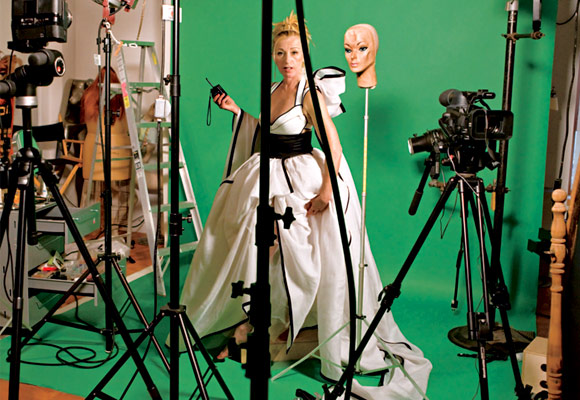
Cindy Sherman, Self-Portrait for French Vogue (2007)
Image courtesy: Artobserved 
A few weeks back in my art theory course, we were reading excerpts from Lea Vergine's 1974 groundbreaking book The Body as Language and discussing how female performance art has transitioned, changed, and sometimes stayed the same in connection to the shifting discourse around feminism and beauty. Interestingly, while researching material for this class, I ended up juxtaposing Martha Rosler's 1982 video art performance Martha Rosler Reads Vogue with Cindy Sherman's editorial work in French Vogue in 2007, where she assumed the persona of the "fashionista" that Rosler had offered critical commentary about 25 years earlier. After reflecting on the class discussion, it is quite amazing how well these two works stand in tension with one another. In Rosler's performance, that familiar deadpan voice (the one many of us recall from Semiotics of the Kitchen) poses the relentless question "What is Vogue?" while offering a close reading, and unpacking the cultural language offered, on page after page of an actual edition of the popular and iconic fashion magazine.


Here, Rosler anticipates the emerging post-feminist position that has been unwilling to fully interrogate (or at least come to some reasonable terms with) the resilient and seductive world of commodities targeting female consumers. One need only point to any episode of the popular "Real Housewives" franchise to see this phenomenon in action. Indeed, it is hard not to notice Rosler's fingers caressing each page of the magazine as she works through her monologue. This of course is at the core of the performance's powerful statement. With Sherman, we see Rosler's radical critique morph into a situational and fully postmodern intervention that dramatically positions the artist on the actual pages of Vogue. It is important to know that Sherman was invited and encouraged to produce her own performative fashion shoot using the very commodity items and media forms that had been a source of Rosler's critique. In the end, Sherman's difficult to categorize pictures (one wonders if the irony of the images is lost on Vogue readers-- Sherman does not really comment on this issue in her interview and discussion of the editorial below) further highlights the problematic and contradictory forces that inform present-day feminist politics.


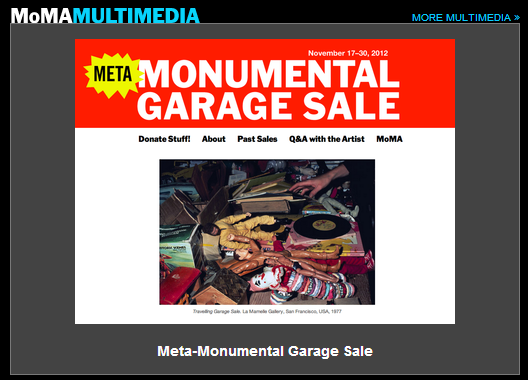
Interestingly enough, and to add to the complexity surrounding these related performances, Rosler's video was recently screened as part of MoMA's contribution to the "Fashion Night Out" event that happens annually during New York Fashion Week. In November Rosler will have her much anticipated first solo exhibition at MoMA and is planning a large-scale version of an American style garage sale where she will display and sell second-hand goods to visitors. Rosler is also soliciting donations and, as the ad for the video screening promises without a hint of irony, "contributors will receive a 20% discount at the MoMA store!" I have no doubt that Rosler knows exactly what she is doing-- stay tuned.


Screen grab from Martha Rosler's upcoming solo exhibition at MoMA-- a live garage sale is planned.
Image courtesy: MoMA 
Further Reading:


Brunsdon, Charlotte.  “Feminism,Postfeminism, Martha, Martha, and Nigella”  Cinema Journal , Vol. 44, No. 2 (Winter, 2005), pp. 110-116.

Sprague-Jones, J. and Sprague, J. “The Standpoint ofArt/Criticism: Cindy Sherman as Feminist Artist?” Sociological Inquiry, 81: 2011, 404–430. 

New Courses for Spring 2013: Topics in Modern/Postmodern Architecture and Avant-Garde Film

As registration for Spring 2013 academic courses begins soon, I wanted to provide more information about new courses I will begin teaching in January. Please see detailed descriptions below including a new special topics class in the History of Architecture (1700-present), and the History of Avant-Garde Film. If you have any specific questions that are not answered here or in the links I provide you to the registration for the courses, you can contact me directly. I look forward to another rich and engaging semester with both new and familiar faces.

Kwantlen Polytechnic University (Mondays 4:00-6:50pm, Room Fir 3414)
Norman Foster, Reichstag interior, Berlin (1993)

This course traces the history of architecture from the period of the late Baroque in the eighteenth century through to the postmodern architectural styles associated with the contemporary present, approaching architecture as a unique medium with its own visual vocabulary and spatial codes. The various formal languages, designs, and theories that have shaped the history of architecture will be explored through the close examination of select buildings and spatial environments set within specific cultural, social, political and economic contexts of their planning and construction. The broader purpose of this course is to provide students with the ability to critically evaluate and recognize how the history and theory of architecture, especially as it evolved through periods of emerging nationalism, industrialization, urbanization, and modernism within the framework of a broader global visual culture and art history, continue to impact our collective spatial, visual, intellectual and cultural environments today.

All of the buildings under examination (which will introduce and cover aspects of architecture, spatial planning, and styles associated with the Baroque, Neo-Classical, Gothic Revival, Arts and Crafts, and Art Nouveau movements in Europe and North America, together with radical breaks seen in the turn to globalizing Modern and Post-Modern architecture in the practices of Le Corbusier, Walter Gropius, Frank Lloyd Wright, Robert Venturi, Peter Eisenman, Frank Gehry and others) will be related to their original contexts, but also raise questions about the range of functions that architecture might fulfill within different societies. While the primary focus of the course will be on Western architecture and culture, the architecture of the Middle East, Asia, the Americas and Africa will also be explored through targeted readings and lectures. The course will therefore not just be about following a chronological and progressive trajectory of “great buildings” and “great architects” but will instead address broad issues related to political power, gender, sexuality, race, and the formation of individual and group identities. In this way, the ideas raised in this course will also draw attention to the dynamics and ongoing debates concerning what it means to make a building and design a space in any cultural context.

Kwantlen Polytechnic University (Tuesdays 4:00-6:50pm, Room Fir 3414)
Andy Warhol, Screen Test (Edie Sedgwick) (1964)
The avant-garde movements of the late nineteenth and twentieth centuries have been determining forces in shaping collective ideas about artistic practice and culture, social history, and subversive intent.  Not surprisingly, the technology of motion pictures has provided avant-garde practitioners with a dynamic new medium to explore a range of themes and philosophies, linking filmic experimentation with important ideas emerging in the modern and contemporary art of the past century.

Beginning with an examination of film’s critical role in the development of modern art and the history of the avant-garde, this course will draw from existing issues and debates concerning art history and the expanding field of visual culture linked through a number of filmic subgenres (such as abstraction, collage, Dadaism, appropriation, surrealism, structuralism, duration, parody, camp, autobiography and expanded cinema). In this way, the course also offers a critical examination of selected films in connection to key theoretical and historical turning points in art history and critical theory and will roughly follow the history and theory of visual arts as it moves from the emergence of the modern period in Europe through the demise of modernism following WWII and into the areas of post-modern intervention leading to our contemporary present. Artists and filmmakers under examination include, but are not limited to, Germaine Dulac, Marcel Duchamp, Sergei Eisenstein, Jean Cocteau, Hans Richter, Man Ray, Jean-Luc Godard, Stan Brakhage, Akira Kurosawa, Shirley Clarke, Robert Smithson, Chantal Akerman, Andy Warhol, Yoko Ono, David Lynch, Doug Aitken, Stan Douglas, Doug Aiken, Matthew Barney, Pipilotti Rist, Kenneth Anger and Matthew Barney. 

Weekly Twitter|YouTube Round Up

Ai Weiwei goes Gangnam style to the delight of audiences worldwide
(see tweet and YouTube video below)
Another week done and we find ourselves over the midterm hump and ready to dive into the meaty part of the fall semester. I have been doing a lot of marking and evaluating this weekend along with enjoying the best of the Halloween season (i.e. scary movies and treats). Take a quick break and enjoy some of my picks from around the Twitterverse. As a new feature, I've also decided to add some of my favourites from around YouTube land into the weekly mix-- now that there are so many more art-related videos popping up on my subscription feeds, I want to pass along some worthy picks to compliment the Twitter links. Enjoy and have a safe and Happy Halloween this week! 


Garage (Art) Sale: Martha Rosler to fill the @MuseumModernArt with 12,000 donated objects to sell for charity

New film technology may be the death of Vancouver theatres


Art exhibit in Seattle replaced all work by male artists with work solely by female artists for new exhibition 

100 ideas that changed art 


I would just like to point out that @metmuseum has put hundreds of PDFs of out of print art books online. #gratis

UbuWeb has just added over 150 films

Ai Weiwei goes 'Gangnam Style' in video tribute to Psy


Focus on Research | How to Write A Lot.... (or Enough to Meet Deadlines)

All good writing begins as a draft. Start creating more of them with some useful tips.
Writing, like almost any other activity that is worth doing well, takes practice over time. That is as cold a reality for the first year university student as it is for the seasoned graduate or professor.  Here are ten tips and bits of advice that can help ward off procrastination and get you on the path to writing lots and writing well.

P.S. Not surprisingly, most of these tips can be applied to making lots of any other kind of creative output (art, music, dance, film) etc... 

1. Write a little bit every day: This is my most often repeated advice regarding writing. Think of it this way. If you are working out, does it make sense to go to the gym 2-3 times a week for an hour or once a week for 6-9 hours? Which approach is manageable and realistic, and which approach guarantees burnout and failure?  Too many people look at their calendars and try to set aside multiple hours and even entire days to produce writing, especially on a deadline. This is a recipe for procrastination and failure since it sets up tremendous pressure and an unrealistic expectation that you will be able to write vast amounts of words consistently over that shortened time frame.  Instead, set aside a reasonable and achievable amount of time several times per week to get your written assignments started and/or completed. Remember, good writing takes practice and works on day-to-day momentum.  It is simply not a weekend warrior kind of sport.

2. Set a timer: Following up on the previous tip, get yourself a simple egg timer and/or download an app for your smart phone or computer to set a limit on your writing for the day (I use this old school app for the computer). Returning to my workout analogy, setting a limited time to write produces the expectation that you will in fact begin writing (the biggest hurdle to writing itself) and that the activity will have a firm endpoint. When I write blog posts, for example, I schedule a certain set amount of time to produce my text. If I don’t, I probably won’t actually get to writing, or I could be sitting and writing for far too long and unnecessarily over-editing and overthinking the process. Case in point, the failure to establish a time to write my blog posts resulted in far fewer posts this past month. Once I set the time in my schedule--voila!--posts begin to appear as if by magic. For more focused days that I schedule writing, I write in 40 minute sessions and for no more than 2-3 sessions a day max. This was true even when I was working on my dissertation. You see, the secret to understanding this tip is to know that a bolt of inspiration will seldom spur you into writing on a regular basis and for a protracted period of time. Bolts of inspiration do come (see Tip #9 to be prepared for this), but if you actually want to complete a writing goal or assignment, you have to plan time for and not overdo it.

3. Don’t edit…yet: This bit of advice is important if you are writing for a larger assignment or project and want to be able to have something good to work with. Students especially seem to believe that they have to create perfectly edited sentences or well thought out ideas when they sit down to write. The reality is that a good piece of writing comes out of rough drafts of writing, which requires the ability to get ideas down on paper quickly and without too much overthinking. Bottom line, start writing and start writing without the expectation that it will pour out of you in perfectly constructed sentences and paragraphs. You can then dedicate every second or third writing session to editing what you have produced (or split your writing session into two parts: part one, write without editing; and part two, edit what you have written).  

4. Disable the Internet…no, seriously: In our present culture of perpetual distraction, this is a critical tip that many people instinctively know but seldom put into good practice. You must disable your Internet to get any decent (and non-plagiarized) writing done. If you need to have some wonderful article to refer to, download it and have it on your desktop. Need some reference to a great website or image? Take a screen shot and do your best to paraphrase what it is you are referring to. There are countless ways that disabling the Internet leads you to better writing, but the simplest one is that you will remain writing and not be tempted to engage in web-surfing, email or social media with the access cut off. There are many great applications out there to shut down your Internet access when you get down to some serious writing, but I think the easiest one is to simply TURN IT OFF.

5. Create carrots and a few sticks: Like all of you, I enjoy the pleasures of life and cannot imagine balancing my writing without a reward system. For example, I try to schedule my writing session ahead of some pleasurable downtime activity, like going out for a walk, watching a great TV show, catching up with friends on social media, or any other task I am looking forward to. When writing in more intense sessions (more than once a day), I make sure to create breaks between writing to relax my mind and recharge my mental battery through some form of play.  On the other hand, you may also have to build in a few “sticks” to stay on task. If I am facing an especially strong bout of procrastination, I will simply not allow myself to check email/social media/my phone until I complete the session. I have even gone as far as telling myself that I cannot go out or take a shower/put on makeup until I am done my writing session. That is very strong motivation, no?

6. Park your ideas on a downhill slope: This is a bit of advice I picked up from a professor mentor some years ago. The idea here is that you have a much better shot at getting into the momentum of your next writing session if you leave off your last session with either a partially completed sentence/idea that you can pick back up when you open up your document, or if you give yourself some bullet points or notes on where to get going next in your assignment. Once again, this is simple physics in action—an object in motion tends to stay in motion, while the energy required to get a stalled object moving is much more daunting. Help your future self out and park your writing on a downhill slope at the end of each session.

7. Establish soft deadlines to make firm ones possible: This is another of those tips calculated to avoid the dreaded specter of procrastination that will inevitably hit if you see days of non-stop writing in your future to make a looming deadline. Simply break down your writing task to manageable chunks. For research papers and bigger projects, you can use a calculator like this one, or you can make your own system of getting parts of the whole completed over a reasonable amount of time. Students often balk at the idea of completing a paper over 4-6 weeks, but this is really the secret to becoming an effective student (especially if that student plans to succeed at the upper undergraduate level and beyond). I also schedule in the writing of outlines and other bits of descriptive writing (like describing images, preparing bibliographies and footnotes) into this system so that my writing moves between different types and different levels of difficulty over the life of the project.

8. Create an elevator pitch for your project: This was an idea I developed over the course of my graduate student days when people would inevitably ask me what my dissertation was about. The “elevator pitch” is an idea that actually comes out of the world of screenwriters who often get less than 1-3 minutes to sell an idea to a producer in passing (usually on an elevator during a brief encounter—it seems to happen a lot in the movies). The basis of the elevator pitch is that it reduces to understandable and plain language what it is that you are actually writing about and arguing in your written projects. The best way to know what you are writing about is to speak it aloud, and preferably to someone who knows nothing about your topic. This guarantees the level of clarity and plain language you will be seeking in defining and writing the thesis/main idea/main argument of your project. Another tip is to record yourself when you are describing what you are writing about to someone else. Silly as it seems, I started doing this when I stopped myself during many conversations with the thought, “So THAT is what I am arguing—wait, I have to WRITE THIS DOWN.”

9. Carry a journal and prepare for ideas to “hit” you: This is a tip that I often share with students who are attending especially engaging lectures and classes with many “big ideas” and theories as part of the curriculum. But also, you have to have to think of how many times you have been riding a bus, driving home, watching a TV show, or simply talking to a friend or catching something on-line when you make some major connection to your work. Bottom line, we are self-absorbed beings and when you are actively working on a written project, it seems everything is related to your topic. This is truly when inspiration can hit and you must be prepared by carrying a little notebook and pen with you wherever you go. Bring it to class, tuck it in your purse or backpack, have it beside you when you casually Internet browse and even when you sleep. You just never know when a good idea is going to hit you!

10. Establish a writing group: This is a final tip that can go a long way to helping reinforce and establish the first nine tips outlined above. Make it a point to work with like-minded students, friends, or colleagues to achieve your mutual writing goals. Sometimes the simple idea that someone else is working on a writing goal and will hold you accountable the next time you meet is enough to motivate you into action. I have worked with both real life and online writing groups to get my writing done, and I have also acted as the “coach” to friends who have enlisted me to hold them accountable and check in with them. The benefits of working in groups are many, but the best part is that you get to share and receive feedback on your writing while learning from others about their techniques and approach. You also get to feel a lot less isolated in the task of writing, which can be one of the loneliest activities that we do. 

Newton's first law of motion is critical to writing success.

Further Reading:

Belcher, Wendy Laura. Writing Your Journal Article in 12 Weeks. Sage Publications, 2009.

Bolker, Joan. Writing Your Dissertation in 15 Minutes A Day. Owl Books, 1998

Silvia, Paul J. How To Write A Lot. American Psychological Association, 2007.