New Semester Advice: Take Care of Your Future Self

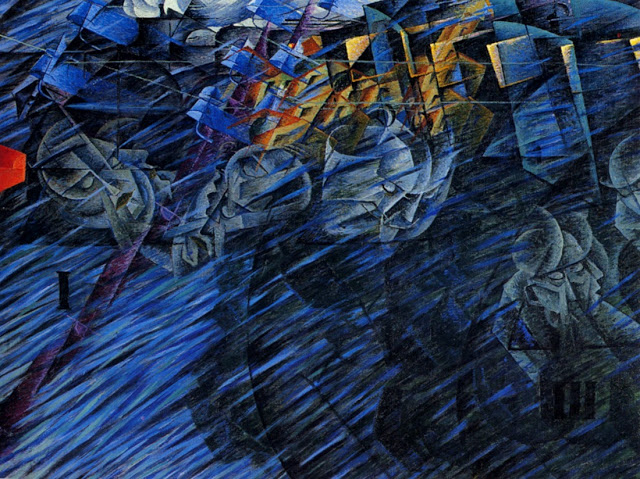
Umberto Boccioni, States of Mind ("Those Who Go") 1911.
The Futurists understood both the transformative and occasionally cruel aspects of time. 
Another fall, another semester, another chance for a fresh start. One week into the new academic term and this is the time of year I honestly love best, and mostly it has to do with the opportunity, that I share with students, to challenge myself to establish a brand new routine for work, study, and play for the 12-14 weeks ahead. It also means wiping the slate clean of what was left unaccomplished over the summer and learning from what did and did not work the same time last year. 

In the last two years around this time, I have mostly blogged about the kinds of tasks that students should make sure they have scheduled—the New Semester Checklist post is still worth checking out, especially if this is your first year at university. But as I’ve started the process of introducing new syllabi to incoming classes, I have found myself repeating an idea that I have grown to embrace and expand into different areas of my life: do something today that your future self will thank you for.

It all started with my writing. I had discussed some time back the notion of parking ideas on a downhill slope to maintain momentum for when you return to an incomplete project. Over time, I realized that there were many other areas of my day-to-day life that could benefit from the idea of helping out the future me. Simple things like how I sort email, plan meals, and arrange my workouts or downtime have all benefited from this approach.

So in the spirit of renewal, here are some random things you could begin to do over this semester to take care of your future (academic) self. I hope they help inspire you to think of some of your own self-care tactics. You'll thank me later as well.

  • Get a big calendar (analog or digital) and write all of your assignment deadlines and exam dates in it. You will immediately get a visual understanding of how best to manage your time and energy for the semester ahead.
  • At the end of each class or at the end of each week, take 5-10 minutes for each set of notes you have taken to generate a quick list of bullet points that summarize the main ideas you remember from class. When it comes time to study for midterm or final exams, you will be grateful to have a ready-made overview of the main ideas covered for each of your courses.
  • Check that your pens have ink and that your pencils have lead each week. Alternatively, charge any device you want to use for taking notes in class. Power outlets are a rare commodity in most classrooms.
  • Every time you find a great book or article for a paper you are working on, type up a bibliographic citation and save it in a file for future retrieval (even if you are not sure if you will use it). Think of how much time you will save not typing up those citations in proper MLA or Chicago style or fussing with bibliographic software the night before a deadline. 
  • One of my favourite bits of advice is to break up your writing/outlining/reading over several days for no more than 1-1.5 hours at a time, i.e. plan ahead with a calendar like this one. Give yourself the luxury of time to marinate and develop ideas. Your future self will be cursing you out if you try to accomplish all of your projects in 8-12 hour marathons in the final week of a deadline.
  • If you are given a choice when to present a paper or group project, pick early in the semester and avoid signing up for dates within a week of a midterm, final, or research paper deadline.
  • If you use an email account other than your university email more regularly, take a few minutes to set up and forward all of your email to one place. I cannot tell you how many student awards and/or important information was missed because students forgot to keep tabs of all of their email accounts.
  • When your car’s gas gauge is down to a quarter tank, get some gas. If you take transit, make sure you have your pass somewhere handy to find each day. Being late and stressed out for class is detrimental to your mental health and your grades-- trust me.
  • Stock your backpack with little bags of nuts or other protein rich snacks and a bottle of water—they will sustain you in those moments when you can’t get to the cafeteria or the vending machine is out of order. 
  • Bring one of those mini staplers to each class… seriously. You will make a lot of friends on days when written assignments are due. 

Weekly Round Up

Weekly Round-Up: Happy Canada Day!


Wishing everyone a wonderful Canada Day long weekend and a happy upcoming Fourth of July to our neighbours in south of the border. I am getting ready to teach a shortened summer session of ARTH 341: 20th Century Art & Culture, The Postmodern beginning tomorrow up at UBC over the next six weeks, so I am taking this time out to relax and enjoy the sunshine and long weekend offerings. You can follow this link to check out the latest additions to my blog's online magazine of collected links, videos, and images or see a few of the standout articles linked directly below:

Flashback Friday: Learning From Las Vegas (1972)

Driving down Las Vegas Boulevard in 1968-- the seeds of modern day Vegas were already planted.
Image from Learning From Las Vegas (1972)
In the autumn of 1968, architects Robert Venturi and Denise Scott Brown decided to take a group of Yale students on an infamous field trip-- one that would lead them to Las Vegas. Equipped with cameras, both in hand and strapped to the hood of a rented Ford, the group studied and photographed every hotel, motel, sign, and gas station along the infamous Las Vegas strip. Their findings, assembled, archived, and analyzed in the landmark text four years later Learning From Las Vegas (1972) not only helped launch the Postmodern Architecture movement, but also brought a level of serious critical inquiry into the popular, spectactular and strange spatial landscape of Sin City.

It was Venturi and Scott Brown I was thinking of on my recent visit to Vegas. I have always had a fascination with the place, going back to family trips as a kid when we would roll through Vegas in my Dad's Volkswagen van en route to visiting relatives in Arizona. Playing carnival games at the Circus Circus hotel while my parents played slot machines, I fondly recall escaping for a short time into a fantasy world of windowless rooms, bright neon lit streets, 24 hour access, and all you can eat buffets. But while Vegas remains a place of play, it is rarely taken seriously as a cultural destination. It wasn't until I studied Learning From Las Vegas in an architecture seminar in grad school that I began to see the Vegas of my childhood memories in a completely new way. How incredible, I thought, it would be to create a field school in one of the most dynamic architectural environments of the planet. Indeed, what we see in Vegas is undoubtedly the synthesis of the "both/and" hallmark of contemporary postmodernism, a place to study where popular and high culture intersect and transform.

Below, I am sharing a fascinating 1984 interview with Robert Venturi and Denise Scott Brown where they encourage audiences to see architecture as a kind of cultural symbolism and to aknowledge the complexity, contradiction, and ambiguity of the urban spaces they inhabit. Next time you find yourself in Las Vegas, remember to look and experience with new eyes.


The semiotics of postmodern architecture can be traced back to the early study of Las Vegas.
Image from Learning From Las Vegas (1972)
Las Vegas 2013-- a cacophony of visual and spatial stimuli
Image from my recent visit to Vegas.
Vegas remains a place of temporal fantasy, a new spectacle around every corner,
such as this pop-up wedding chapel.
Instagram image from my recent visit to Vegas.
Hotelier Steve Wynn paid $34 million at auction for Jeff Koons Tulips (2004),
It is now on public display in the lobby of the Wynn Hotel,  a fitting and symbolic
tribute to convergence of popular and high culture in Las Vegas.
Instagram image from my recent visit to Vegas.
Further Reading:

Culver, Lawrence. "Sin City or Suburban Crucible? Searching For Meanings in the New Las Vegas." Journal of Urban History 35(7): 1052-1058 (2009).

Hess, Alan and Robert Venturi. Viva Las Vegas: After Hours Architecture. Chronicle Books, 1993.

Venturi, Robert et al. Learning From Las Vegas: The Forgotten Symbolism of Architectural Form. MIT Press, 1977.