Focus on Tech| Organize Your Ideas with Evernote

Take notes via text, photo, audio, file upload with Evernote-- sync and save on all of your devices.
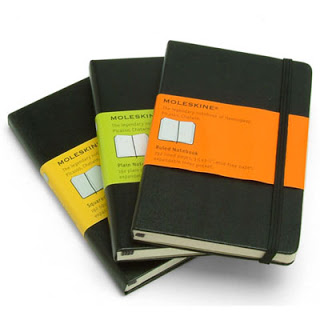
While I love Moleskine journals, I have too many of them
strewn about my desk, bags, and workspace to make them productive.
At some point over the last semester, the inevitable finally happened—I gave up my dependence on paper. I think it had a lot to do with my recent travels and realizing that all of those little pieces of paper on which I had been jotting down notes, not to mention the collection of Moleskine journals I had strewn about my desk, car, and at the bottom of my various bags, were not effective in reminding me or prioritizing all of the information and ideas I tend to collect and organize. Add to that the million times I photographed, bookmarked, or emailed something, or took some random idea down on my desktop sticky tabs and wanted to find a way to integrate that into my idea or to-do pile. 

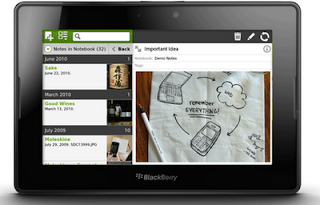
I have Evernote loaded on my Playbook, Blackberry Torch,
laptop and home/work computers. Evernote supports a variety
of platforms including Mac, PC, the iPad, iPhone,
and Android devices too.
Enter Evernote. Evernote is a super basic, but highly effective and powerful note-taking and gathering application that I discovered when I began playing around with my recently acquired Blackberry Playbook tablet (which by the way I adore!). It is an application that came highly recommended on a number of tablet forums, and to my surprise and delight I soon discovered the elegant simplicity of how it works. Once an account is created, Evernote allows you to gather notes through snapshot photographs, voice recordings, file uploads, or the old-fashioned text note through a cross-platform integration and syncing system that connects your  phone, home and work computers, laptop, and tablet. In other words, any note that you take on your phone, for example, will immediately become accessible on your home computer, laptop, or tablet. Even better, the application collects these files through a cloud system that allows you to access any notes you take via the web, allowing you to look at your notes on any computer with an Internet access at any time (like say on a university library computer). You are also provided with further options to tag, categorize, and search your notes. For example, I have a virtual notebook for academic project ideas, and another one for personal notes such as books I want to read (I now routinely take photo notes when I visit bookstores). See a tutorial on how to get started with Evernote here.

Evernote's web clipper is top notch
There is also a fantastic web clipper application that you can download on your desktop that allows you to save interesting things you find on the web without the hassle of bookmarks or tabbing. Simply click on the clipper icon in your web browser and the clipper takes a screen shot and attaches a link to the page as a note to your account. This allows you to clip and collect materials from the web in a far more intuitive way—no more need to search for that interesting article or idea through a long bookmark list or web history.

There really is an infinite range of possibilities for how you can utilize a tool like this. I noted on their website that Evernote is featuring a student-oriented application called StudyBlue which allows you to transform study materials gathered on Evernote into digital flashcards—a great idea for art history students studying a list of images for exams. You can check out all the additional downloads for the application here. In the end, the best feature of Evernote for me was the ability to access, organize, and categorize all of my notes in one place-- oh, and did I mention it is free?

In the coming months, I will be reviewing some other great time saving applications and techniques I have been incorporating into my digital world—I must say that I have a lot more space on my desk these days!

Weekly Twitter Round Up (and my 1000th Tweet)

Modern Christmas Tree = want! Check out tweet below for more inspired looks.
Another hectic week as we march towards the final classes of the semester. Sadly, my blogging has suffered the past month or so, but something had to give with all of the various events and obligations this time of the year brings. Even so, I was glad that many of you noticed the Paris/Documenta 2012 trip information I posted earlier this week-- I am thrilled to see a number of you signing up already and very excited with all of the potential for critical engagement and hands-on learning a trip like this can offer all the way around. As for Twitter, tonight's tweet of this blog post will mark my 1000th since joining Twitter last year (!). I don't know what can be made of this number, but I do know that my time gathering and sharing info on this social network has flown by! Enjoy a taste of this week's offerings:

In the Arab Spring’s wake, Twitter trolls and Facebook spies


The year-long performance piece we promise will blow your mind


David Cronenberg on "A Dangerous Method," "falling off" body parts, and why you should never say "Cronenbergian"
Steve McQueen: A director skilled in the silent treatment


Francesca Woodman Retrospective


The $25 handheld computer that could transform technology education
Looking for a modern Christmas tree? Look no further

Paris and Documenta Field School 2012: Details and Information

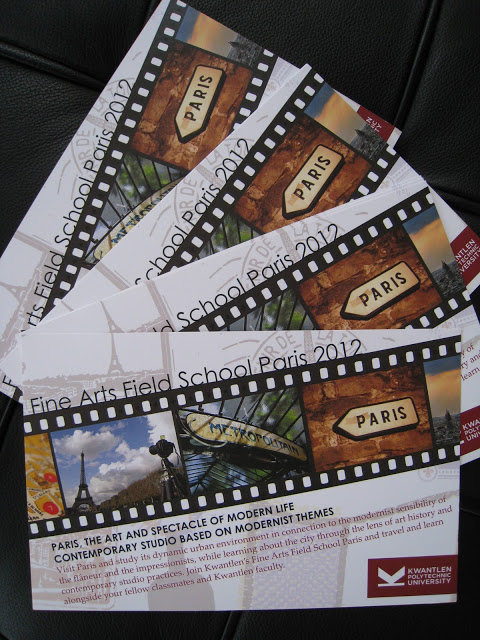
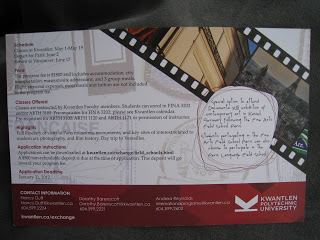
Postcards describing the Kwantlen Fine Arts Field School
to Paris/Documenta are now hot off the presses. 
After a great deal of planning, consulting, and coordination, I am pleased to announce that I will be participating in and helping lead a field school to Paris and Documenta XIII next spring/summer 2012. Some of you have known for a while about this trip and my desire to travel with students and visit the art works, monuments, museums, and urban sites that we discuss and explore in art history classes and seminars. That desire, together with the once-every-five years opportunity to attend Documenta-- arguably one of the most important international contemporary art exhibitions on the planet-- culminated in talks with Kwantlen Polytechnic University's International Programming people to help put together an overseas trip and accompanying courses that students could take advantage of. For this field school, I will be working with artist and Kwantlen Studio Faculty member Nancy Duff, who will be coordinating with me to offer an integrated approach to the art history and studio courses offered on the trip.

Two three-credit upper level art history and fine arts studio
classes are being offered as part of the trip.
The field school itself consists of two courses that students can choose to enrol in (one or both):  my art history class ARTH 3100: Paris, The Art and Spectacle of Modern Life and Nancy Duff's FINA 3202: Contemporaty Studio Based on Modernist Themes. Both classes earn students third year credits towards the BFA degree offered at Kwantlen and/or are potentially transferable to other institutions. The courses will run initially at Kwantlen's main campus from May 1-19th as twice weekly 3 hour courses. During this time, important core material will be covered in both courses to prepare students for the trip and time spent on the ground in Europe.

The Vancouver-based coursework will be followed by a two week break and then the trip to Paris will depart Vancouver for two weeks, leaving June 2nd and returning June 17th. A full itinerary of visits and activities are planned in Paris including trips to the Orsay, Louvre, L'Orangerie, Jeu de Paume, Arc de Triomphe, Montmarte at Night, Versailles, Cinema Museum, Museum of French Monuments, Tuileries Garden, European House of Photography, Eiffel Tower, Opera, the Paris Cemetery and much much more. For those students who decide to stay on and visit Documenta XIII with Nancy and I, there will be a small additional cost for travel and hotel, extending the trip by another 3-5 days.
Details about the trip include a whole host of
visits to local museums and attractions in Paris,
with the optional visit to Documenta XIII.
The program fee is $1800 and includes accommodations in Paris, all city transportation, museum/site admissions, and 3 group meals. Flight, personal expenses, most meals and tuition are not included in the program fee. This allows students a shot at booking their own flight on points or through other special arrangements (leaving open the option to continue travels in Europe) and making individual decisions around the many food options in Paris. There will however be a group flight option that students can book early next year. At this time, the Documenta trip to Kassel, Germany (a short distance by train) is not mandatory and will be part of an optional addition to the trip which we anticipate to come in under $400. We are also accepting limited applications from students who wish to take the trip to Paris without taking the courses.

If you are a student at a university other than Kwantlen Polytechnic and are interested in taking the classes for credit (ideally, we would like to see 6 credits of art history-type courses completed before we consider you for registration), we can assist you in the quick and easy process of temporarily applying for the summer semester. If you are interested in taking the trip and paying the program fee but not taking the classes, we will be accepting a limited number of students to join the group based on their willingness to participate as engaged observers. Students participating in the field school can also choose to participate in the Paris Language Field School that will run classes the same time as our school and be in Paris during the two weeks prior to our arrival. This allows students a chance to be in Paris for a full month, taking French language courses for credit, and then joining our group for the art history and/or studio classes-- a wonderful bonus!
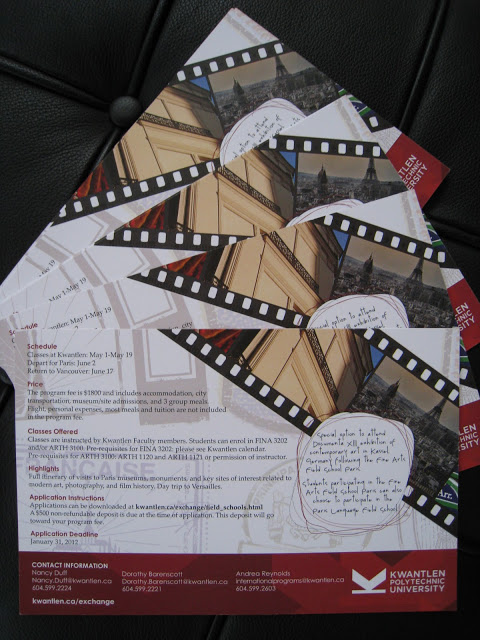
Seating is limited and we will be accepting applications on a first-come, first-served basis
until January 31, 2012.
Application Instructions: very shortly, you will be able to upload an application form at kwantlen.ca/exchange/field_schools.html. I will also continue to update this post with any additional information as it becomes available. For now, please contact me directly if you have any specific questions and/or are interested and know you will be applying to the program so that I can secure your name on our list. **edited to add: see this new Prezi Presentation for even more details

Spaces in the field school are limited and we will be accepting applications on a first-come, first-served basis until January 31, 2012 with a $500 non-refundable deposit (which will go towards your program fee). Student loans can also be applied to this trip as long as you take 9 credits during the summer semester.

We look forward to a dynamic and wonderful trip and would love to have you join us in Europe next year!

Weekly Twitter Round Up


A Duchamp inspired interactive "game"-- see tweet below for more details.

Happy Thanksgiving weekend to all my friends and colleagues south of the border! I am actually enjoying (shock) a football game right now--the Canadian Grey Cup featuring our own B.C. Lions-- a rare moment that I partake in this most American pastime. Enjoy some of my assembled favourites to enjoy during half-time, or while taking a break from those papers. Go Lions Go!

Students cry foul at UC-Davis


A scary new study confirms the motivations behind North Americans' willful ignorance


A dozen Surrealist films by Joseph Cornell, made between 1930 and 1960: 


An unflinching look at Steve Jobs, king of the geeks. Tonight on #passeye


Damian Moppett’s one-man history of art


Today's #TED: Natalie Warne on how youth can make an extraordinary impact: #TEDx


Now that's post-Duchamp!

Status Anxiety: Redefining "Success" and its Many Representations

Originally published in 2004, many of the ideas
contained in the book are more relevant and easy to
identify since the global economic downturn.
Having spent this term discussing and thinking about revolution and art in a dedicated seminar to the topic, it has been important to move beyond the more typically discussed political frameworks of radical change and extend the conversation to the world of social revolution. Of course the two often operate hand in hand-- and perhaps one of the most accessible and interesting philosophers working on the topic today is Alain de Botton. Recently, I assigned portions of his public documentary series Status Anxiety to two of my classes—both of which cover the chronological period associated with the rise of modernism from the late  nineteenth to mid-twentieth centuries. Based on de Botton’s book of the same name, Status Anxiety probes that most modern and equally uncomfortable question of how one’s place in society is ranked and evaluated by others. In turn, the book and documentary series reveals how the historical context for status can be located in the rise of modern secular societies and the alienating effects of global capital expansion. Modern art has an important role to play in de Botton’s argument since it is within the historical avant-garde and bohemian cultures, which helped profoundly shape modernism in the early part of the twentieth century, that we find evidence and representation of the challenge to mainstream conceptions of status, authority, and institutions of power. See the introductory clip to the documentary embedded here below (the whole documentary can be found here):


Alain de Botton is a self-described "public philosopher" and has
written many books probing the question of our everyday lives and concerns.
Interestingly enough, de Botton created this series prior to the current economic crisis, and in this sense his ideas are far more relevant to how many ordinary people are questioning ideas of status today. More recently, de Botton sat down for an in-depth interview to reflect on how his ideas have evolved since he first wrote Status Anxiety, providing targeted commentary concerning the kind of social revolution that many see unfolding around the world today—in expected places like the Middle East, but also in unexpected places like the United States and Canada. His comments are especially intriguing with respect to how people are beginning to redefine how success is measured and represented since the first signs of the crisis.

At the same time, de Botton links some of the problems within today’s frame of mind with what he sees lacking in the contemporary art world, namely an art of tragedy along the lines of the ancient Greeks. De Botton’s argument is that we are less likely to see artists today engaging with themes of inevitable loss and/or unexplained or irrational misfortune since it flies in the face of a deeply held societal belief in the West that everyone has an equal chance at success based on their own merits and hard work. In other words, one of the unspoken assumptions of modern life and status stretching back over 200 years is that our failures are somehow our own fault—period—without consideration for forces well beyond our control (such as the incomprehensible economic structure we currently live in). No doubt de Botton‘s ideas and theories concerning status and success reveal deep stakes in the way social revolutions, and the art that accompanies them, will take shape in the future.  And for many of the students I work with today who worry about their own success in the future, Status Anxiety also offers some measure of comfort and critical reflection.