The week's events have unfolded like some kind of surreal dream. Watching the Twitter feeds of rioting in Greece and the chaotic and violent situation shaping up in Syria intermixed with reactions to the death of Whitney Houston and wishes for a Happy Valentine's Day was quite disorienting. Such is the world of new media news and the unruly paths that stories take to get to audiences. Here are some of my favourite tweets from this past week-- let's hope that heart day spreads some momentary peace to us all.
Why don't we teach kids how to use CTRL+F?
Marshall McLuhan: The World is a Global Village. Predicts
the social web in 1960s. Video:
In case you missed it this week: "The End of Wall
Street As They Knew It"
See the art fair of the future
How Hollywood’s most influential movies were made—from
The Godfather to The Graduate to Cleopatra
Forget flowers and chocolate -- nothing says love more
than a unique work of art
Guy Debord, "Psychogeographic Guide of Paris" (1955). Source: imaginarymuseum.org
The question of the contemporary artist's role in social and political protest movements is a topic that I have been discussing and thinking about a great deal in recent months both inside and outside the classroom. This is of course an area that is already an important component of much of modern and contemporary art history, but the past year's global events have brought the spotlight back to this issue with a new urgency. Most recently, I facilitated an SFU Philosophers Cafe with a group of interested participants drawn from a cross-section of the public where the discussion centered on how artists have faced challenges in recent decades with defining an activist role within new public arenas increasingly defined by digital and social media. And last weekend, more of these questions were addressed when I took part in a Peace Symposium and also helped facilitate a tour of an exhibition of Goya's Disasters of War prints organized by the National Gallery of Canada, and now on display at the Reach Gallery in Abbotsford.
Guy Debord's Society of the Spectacle
remains a key text associated with
the S.I. movement.
An important aspect of these conversations relates to the legacy of artist's participation in previous social and political movements, and it became clear to me at these events and through discussion with people interested in the topic that it might be useful to create mini archival round-ups of key art movements/artists from existing materials on the web to help inform and educate individuals on the topic. Coincidentally enough, Ubu Web (the largest web-based educational resource for all things avant-garde related) began tweeting this past week on links related to the Situationist International-- one of the core art movements involved with the May 1968 student uprisings in Paris. I'd like to think Ubu Web was simply on the same wave-length of so many of us thinking about the state of global affairs and the role of artist activism. It remains both inspiring and critically valuable to learn what we can from these previous movements to relate to our present circumstances. In the coming weeks, I will put together a number of these mini digital archive round-ups to help continue the conversations started at these events, and as a way to keep the spirit of open learning activated beyond the face to face meetings.
Film still from The Tree of Life (2011). Source: Cineffectpodcast
The world of cinema-- its inner workings, contentious history, and visual imperative-- is having quite the moment this year as a subject of filmmaking. Perhaps this is not so surprising considering just how many vital connections exist between the cultures uniting the history of early cinema as a new and emerging technology and the dynamic culture of new media that we inhabit today. These are also the questions fueling much of my own research, so I am always amazed at just how well the cinematic zeitgeist reflects this connection. At its core, film is a visual medium, and the visual turn so instrumental to so much of today's screen culture is finding its way into the conceptual underpinnings of many award-winning films. Looking over the roster of films nominated for a wide cross-section of this past year's awards, three stand out as directly engaged with conversations around the visual drive of cinema: Terence Malick's Tree of Life (2011), Michel Hazanavicius's The Artist (2011), and Martin Scorsese's Hugo(2011).
It is a shame that the first time I saw Tree of Life I was sitting on a plane and experiencing the unique world of Terence Malick's film on an 8" screen. Still, I was thrilled to get the chance to view the film that had won the prestigious Palme d'Or at Cannes in May 2011 (kudos to Lufthansa for featuring foreign and independent films on their personal movie viewing devices!). Coming back on that long flight from Frankfurt to Vancouver, I settled in for what I was told by others would be a film that has no clear narrative but attempts to convey the origins and meaning of life through the memories of the main character. As the film unfolded before me, I was taken with the sheer visual thrust of the opening sequence in the film-- a movie that has virtually no dialogue for 10-20 minute stretches, but somehow succeeded in moving me into an altered state where my own thoughts intermingled with the pictures taking shape before my eyes. I can only imagine how much more visceral that response would have been seeing the film on a gigantic screen, but the film has since stayed with me and I find it difficult to describe to others, simply saying: "Just go see it." Geoffrey O'Brien's brilliant review of the film sums it up best, describing The Tree of Life as a moving representation of memory and experience itself: "As in all that follows, the effect is of seeing a memory
staged, indelible in the realism of its details but edited and compressed over
time, the relevant bits run together and the dross filtered out: the world as
processed by the mind, with finally only the bright bits magnetized by emotion
remaining to flash against darkness."
My experience of The Artist was perhaps less profound, but it did capture so much of what I try to describe to students about the radical transition from silent to sound motion pictures. So often people approach silent cinema, and black and white picture-making, as a kind of retrograde or outmoded form of the medium, but it is exactly the history of that transition which remains so misunderstood and poorly represented in the canon of film history. Instead of a progression and a revolution in filmmaking, sound in particular was met with much resistance, especially among avant-garde and art-focused film directors who asked important questions of what would be lost with the intrusion of dialogue and the subverting of the visual techniques so important to the art and early experimentation of motion pictures. The Artist does an amazing job of raising these questions and providing the audience with a glimpse of the tensions felt and experienced at the time. But even better, Hazanavicius trusts that the contemporary audience can think through these ideas via a black and white silent film-- a radical move in itself, but one that has paid off and captivated audiences from across a broad spectrum of the viewing public (even for those who didn't "get it" that the film was mostly silent). The NYT film review does a good job at examining just how vital the "wordless" film actually is.
And finally, the film Hugo completely caught me off guard. I found myself going to see it after being convinced that this was possibly the best use of 3D as a conceptual tool in filmmaking this year (something that Werner Herzog, for example, executes brilliantly in Cave of Forgotten Dreams), and also after hearing Scorsese's lovely acceptance speech at the Golden Globes, where he saluted the many unknown filmmakers and experimental artists of the early cinema after winning the award for best director. To use the world "magical" may seem a bit cliche, but I walked away from Hugo convinced that Scorsese had recreated the wonder and newness that the first audiences of film probably experienced. Utilizing the immersive 3D technology to its maximum effect, the film brilliantly reveals the illusionary aspects of both the technological and visual elements of early filmmaking through the latest forms of those same technologies. I literally caught myself several times removing and playing with my 3D glasses to try and figure out how the effects were shaping up in front of my eyes. As Richard Brody aptly argues in his review of the film in the New Yorker-- a movie he categorizes as "cybercinema"-- Hugo is a "reminder that realism and artifice aren’t opponents or opposites but
the very systole and diastole of cinematic life."
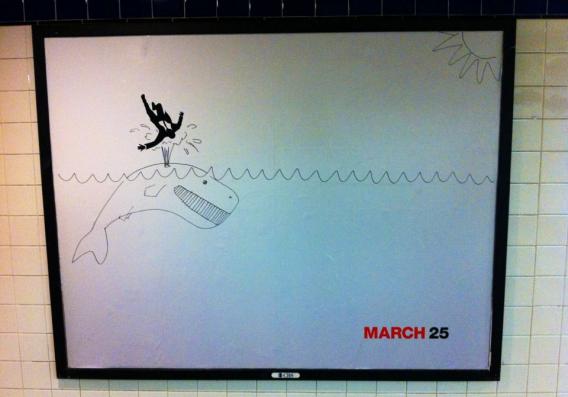
Creative graffiti art incorporating the Mad Men advertisements for Season 5.
Image Courtesy of: Slate
A very busy week! Besides my regular teaching schedule, I finally submitted a grant application that I had spent weeks working on, lead a lively and fantastic discussion at a Philosopher's Cafe on artist activism, and participated in a Peace Symposium as part of a stirring exhibition of Goya's Disasters of War and Los Caprichos prints on show now at the Reach Art Gallery in Abbotsford (until March 25th). I met so many high-energy and inspirational people along the way-- I will say more in the week ahead-- and I am once again renewed with faith in the positivity generated in collective dialogue about art and social action and its many potentials to unite people around the world.
The Twitterverse was also very busy this week buzzing with news of Facebook's immiment IPO and all things Superbowl. And yes, I watched the Superbowl. Surprised? Well you really wouldn't be if you understood my love and admiration for Madonna-- a true artist going all the way back to her NYC roots running with Basquiat, Debbie Harry, and other misfits of the late 1970's and early 1980's underground music and alternative art scene. And her performance, centered around a gladiator inspired spectacle (!) for the masses (!) was both apropos and conceptually brilliant. As the game is now over, I invite you to grab a celebratory beverage and check out some of my favourite tweets from this week:
Hating on the ladies: The sexist social media backlash
against Pinterest
How to Write an Artist's CV in 10 Steps
If David Cronenberg directed Midnight in Paris it might
have been good
Facebook’s IPO gives a stunning and unprecedented amount
of power to Mark Zuckerberg
‘Happenings: New York, 1958-1963’: A look at images from
an exhibition at Pace Gallery
NY Times on Mike Kelley
Who Gives a Tweet? Carnegie Mellon U study includes
"nine lessons for improving tweet content"
And a bonus one this week, because well it made me laugh out loud.
First time watching #Superbowl live
on TV in America. It's very..... American.
Much of my time in lecture is spent describing the mechanisms of how the "genius artist" discourse emerges in histories of art. This is especially the case in survey art history classes and modern art courses where I attempt to find that difficult balance between introducing students to what is essentially the canon of art history, while simultaneously exposing the many stakes and interests involved in how that knowledge came to be constructed. When it comes to the true heavies in the "artist genius" category (think Michelangelo, Rembrandt, Van Gogh and Matisse), Jackson Pollock is among the most challenging artists to position and discuss. Perhaps it is because the abstract expressionist movement he is associated with is already difficult enough for most audiences to contextualize and understand-- one need only point to the Voice of Fire controversy over the National Gallery of Canada's purchase of a Barnett Newman painting in 1989 as evidence, also the subject of a book length treatment. It might also be the cult of celebrity built up around a man who was positioned as kind of loner James Dean figure, an artist who died too young and was largely misunderstood, but also an individual who catapulted New York to the center of conversations around modern art during his lifetime. In this sense, Pollock's pivotal position in American modern art history, and in New York art institutions such as MoMA and the Met, sets up a legacy that is not often questioned-- at least not within the broader public.
Pollock was often pictured alone in the many pictures that circulated
of him during the 1950's. This was critical to the persona of Pollock as
an "artist genius"-- a man who would create a new American style of art.
In recent weeks, a new series of talks caught my eye on my YouTube subscriptions. I have been following the New School's Channel for some time and have already blogged about their various public access programs in the past. In January, they initiated a two-part series looking at the urban milieu of New York's Greenwich Village and its influence on two key artists: Jackson Pollock and Andy Warhol. Within histories of modern art's development in America, Greenwich Village is often relegated to a kind of hazy backdrop against which Pollock and Warhol operated in their rise to greatness. And because today the Village is commonly associated with notions of trendy decadence and associations with the worst of New York's gentrification, many audiences simply miss the more radical connections that this part of New York had to the development of modern and avant-garde art movements in the early to mid twentieth centuries. This disconnect is only reinforced in the popular history of Pollock's legacy. When Jackson Pollock became branded as the poster boy for the new style of American painting in the 1950's, critics and historians were careful to efface his connection to a wide range of artists (both whom he worked with and learned from) deemed too socialist and left-leaning to taint Pollock's legacy. Instead, Pollock was presented to the public as a lone cowboy figure from the mid-West, a figure who emerged with a new vision and method of making art, an artist who had not come under the influence of the radical bohemian elements represented by Greenwich Village.
Greenwich Village was the center of a vibrant bohemian
culture associated to the rise of modern art in New York
Image courtesy: Greenwich Village Digital Archive
As such, what I find especially interesting about the New School's approach in this public lecture series is that the focus of interest shifts away from a strictly individuated history of the artist producer and foregrounds instead the mechanisms through which the creation of the "artist genius" phenomena emerges from within marginal groups who struggle with the move from being virtually unknown to becoming embraced and even celebrated by the wider public. In the case of Andy Warhol, an artist who understood and exploited these mechanisms to his advantage, the story forms a wonderful parallel to that of Pollock.
I have embedded here the public lecture from first part of the series titled "Jackson Pollock's Downtown Years" from January 26th and will in the coming days embed the second of the series "Andy Warhol's Greenwich Village" (**update** now uploaded). The talks are co-sponsored by the Greenwich Village Society for Historic Preservation and The New School for Public Engagement and include the full Q&A at the conclusion of the presentation. I hope you enjoy the material presented on Pollock as much as I did.