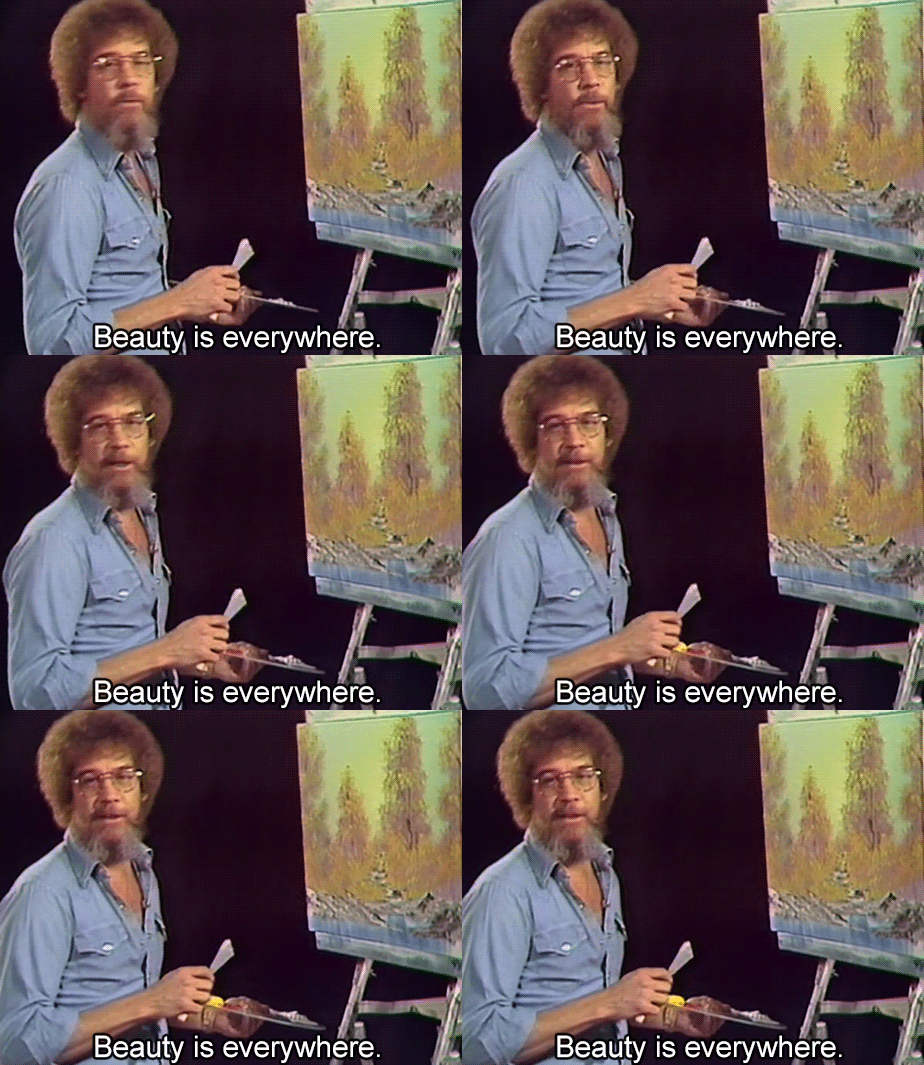
SFMOMA tweeted this "happy little reminder" over the holiday long weekend
brought to us by art legend Bob Ross. He makes all of us smile no?
Loooong weekend, we needed you-- oh did we ever. Spring has finally arrived in Vancouver and I was happy to enjoy precious time catching up with family and getting out to walk the seawall and sit on a few patios over the past several days. I also put the finishing touches on a conference paper I will be presenting later this week at the New School-- there are few places as amazing at this time of year as New York City, and I have a complete itinerary of exhibitions to check out, so stay tuned for blog posts in the coming weeks. As for the Twitterverse, it was buzzing with news of the passing of artist Thomas Kinkade. If you do not know who he is, I point you to two tweet links below. Let's just say he is controversial in the art history world, even as 1 in 20 Americans own one of his paintings. Many tweets also expressed sadness at the passing of legendary reporter Mike Wallace. I was a huge fan of his journalism and have included a link to his famous interview with Salvador Dali in the late 1950's. Enjoy.
Guerrilla Girl Talk: The Masked Art Radicals on Their New
Research, The Art Market, And Occupy Wall Street
What's More Expensive Than College? Not Going to College
"Jerry Saltz on Thomas Kinkade, 1958-2012"
The best piece written about the paintings, prints and
commerce of the late Thomas Kinkade, dead at 54
Reporter Morley Safer speaking to influential art dealer Larry Gagosian in his
piece exploring the continued boom in the contemporary art market.
Image courtesy: galleristny.com
Contemporary art never fails to incite conversation-- and that is its strength. Case in point, last Sunday night's 60 Minutes segment by Morley Safer updating his infamous 1993 editorial "Yes, But Is It Art?". Safer's original piece has since become a kind of touchstone for how some people come to regard contemporary art-- as elitist, difficult, working by its own rules, and quite simply "not art." Since that time, the piece has even found a place in my lectures concerning the need to question and assess what assumptions people make about understanding art simply by looking at it, or "feeling" something in its presence. It also points out the gap in understanding about how critical and overarching the concept and understanding of a broader art history is to the production of much of today's most valued art. I was hoping that the updated segment would recognize and ponder these realities-- the past twenty years have proved that contemporary art, especially the conceptual, performative, and "difficult to understand" kind, is not going anywhere. Safer set the stage for his report at the most recent Art Basel Miami, an annual art exhibition where leading galleries from around the world come to exhibit and sell art works. Two minutes into the report, I knew it was going to be more of the same simple-minded approach. As you will see, the focus of concern is more on the market valuation of contemporary art instead of any consideration of its key features or points of intellectual value (if you cannot see video, see this link):
New York Magazine's senior art critic Jerry Saltz took very little time to respond to the 60 Minutes piece, crafting a concise and to-the-point essay on what he correctly describes as the "facile screed" of Safer's reportage. That is not to say that I always agree with Saltz (he has become somewhat of a polarizing figure in the contemporary art world-- but for that, I do like him), but in this case he is spot on in his assessment of what lies at the heart of many individual's outright hostility towards contemporary art. It is worth here quoting him in full:
"The reason Safer isn't able to have what he calls "an
aesthetic experience" with contemporary art is that he fears it. It’s too
bad, because fear is a fantastic portal for such experiences. Fear tells you
important things. Instead, Safer is fixated on art that only wants to be loved.
Most art wants attention, but there are many ways of doing this — from being
taken aback by Andy Warhol's clashing colors and sliding silk-screens to being
stopped in your tracks by just a dash in a poem by Emily Dickinson. Art isn't
something that only wants love. It’s also new forms of energy, skill, or
beauty. It's the ugliness of Goya's Saturn Devouring His Children. Often
art is something we cross the street to avoid, something that makes us
uncomfortable, that tells us things we don't want to know, that creates space
for uncertainty. Safer goes to the most hellish place on Earth to look for
"an aesthetic experience," then gets grumpy when he doesn't have one.
It's clownish."
I really could not have put it better myself and I am considering quoting this passage in full when I encounter people who roll their eyes or pontificate about the nature of art in terms of its beauty or objecthood. It also shows just how out of touch mainstream media remains about the world of culture that lies beyond their immediate radar and understanding. Yes, the contemporary art market seems crazy to an outsider, but the same could be said about the Vancouver housing market. Some aspects of the economy are simply beyond our comprehension, but that has never seemed to bother a whole lot of people (interesting huh?). But what contemporary art does reveal is something that any first year art history student can tell you-- the meaning and value of art objects/events/performances is entirely contingent and not to be found in some essential quality of its form or aesthetics. Good art demands something more of us and may not always look and behave the way that we like. And maybe the hostility so many people feel about the mysterious mechanisms of the art market could be be projected onto the more abstracted features of the corporate world. Time better spent. Perhaps that could become more the catalyst for conversation than whether "my kid could do that."
Here is the original 1993 piece from 60 Minutes that inspired the recent piece by Morley Safer:
Artist Douglas Coupland tweeted a link to this picture writing "Possibly the
cheesiest copyright violation in Canadian history...and the most clueless!"
“April is the cruelest month” wrote T.S. Eliot in The
Waste Land, and he sure wasn’t kidding. It seems that every student and faculty
member I have encountered this past week (including myself I might add) has
been lamenting the avalanche of deadlines, final projects, marking and exams
that are on the horizon this month. It is the same each year, yet somehow the
end of term always brings this feeling of surprise, like it arrived far too quickly
or definitively than normal. In any case, the Twitterverse has been steady with
lots of political discussion on both sides of the border. Springtime, as always,
seems to bring renewed energy to a number of debates that go into a quiet hibernation
over wintertime. Here are some favourite tweets to stir the passions:
Allan Kaprow's 1968 LP, "How To Make A
Happening" (Something Else Press, 24'43") [MP3]:
A New Vision of the Public University, Michael Burawoy
Art in the Era of
the Internet/ via @thetyee Part of PBS's series on
how the web changes the way we share culture
But amidst all this dire news... the daffodils are in
bloom. Cheerful. One step at a time... (course I almost fell over in the
garden.)
Banksy has released a provocative advertising manifesto
The Hunger Games. Emory prof discusses how & why we
enjoy the spectacle of violence
April Fool's Day: The museum is real but the paintings
are not!
Conqu is available and syncs across across all major software platforms.
Earlier this year I wrote a series of blog posts describing some of the software I was incorporating into my daily routine (including Evernote, Prezi, and Pinterest) to move to a more "paperless" work flow. Now that I have had a few months to experiment, I am finding that the transition has been far less difficult than anticipated. Still, of all my paper habits, the toughest to adopt to a paperless mode has been my ever-present "To-Do" list. In the past, this list was established as part of my weekly agenda/journal. For years, I purchased a yearly agenda with a "week at a glance" format and I affixed those larger sized yellow lined post-it notes to create lists of tasks that had to be completed on a daily and weekly basis. Every few days I would move uncompleted tasks to a new post-it and keep a running track of the list by moving it between my paper agenda and a small notebook that I would carry between home and work. This routine, which I adopted in the final years of my undergraduate degree, had served me very well and I did not know if I would be able to adopt this habit in a paperless form.
Conqu essentially takes something like this and makes it manageable
After trying out a number of applications, I have finally found one outstanding program that has met all of my needs in the to-do list department-- enter Conqu. I first began using Conqu when I downloaded the free app to my tablet and began playing around with its very basic and easy-to-use features. What immediately set Conqu apart from other task organizers I have tried is its elegant design and very straight-forward and intuitive approach to how we actually construct, edit, and rearrange lists. As the demo video below explains, the program allows users to create tasks and then set various features such as due dates, priority status, and relation to other tasks in a few simple moves. You can also correlate tasks into larger projects and tag them into groups (i.e. I use blue tags for work tasks and green tags for personal tasks). There is also a feature that allows you to put ideas/tasks on the "Backburner" for future assignment. I love this feature for when an idea pops into my mind of something I have to get done but I do not yet know when to assign a timeline to it.
Once you have played around with Conqu for a while (it can be downloaded to Apple, Android, Blackberry and PC/Mac devices), you can purchase the option to sync your tasks across all of your devices. This was where I really saw the power of this program. For example, I can manage and tick-off to-do items while on the go say on my tablet and then know when I go to work or come home and open my computer, that change will immediately be reflected when I check the program. Used in connection with Google Calendar, Conqu allows me to keep an updated schedule and list of tasks wherever I go. Try it out and see for yourself, especially if you are like me and feel lost without your lists!
P.S. I do still carry one small Moleskine notebook with me for quick scribbles and brainstorms on the fly, but I am essentially organizing and syncing all of my daily activities/lists/notes via my phone, tablet, and home/office computers.
Love him or leave him-- Hennessy Youngman explains difficult art concepts to the social media generation.
Image courtesy: Wikipedia
When I first started my blog a year and a half ago, I was
looking to add some value to my lectures, especially those that dealt with more
challenging or even potentially controversial topics. Just this past week, I
finally arrived at one of those threshold moments in a modern/contemporary art
lecture that deals with the subject of performance art. I had learned from past
years introducing this material that the road to this particular lecture has to be paved
with a great deal of relevant context and information about the
reasons/rationale for such a hard-to-understand approach to art. For many students, the idea of the
dematerialization of the art object is already a difficult enough concept to
grasp—so adding the body as medium to that mix often leads to unpredictable reactions.
I also endeavour to provide the requisite warnings that some of the material
will be graphic and involve the necessary elements that make performance art push
the boundaries of the intimate, sexual, psychological dimensions of the body. As in most years, there are a handful of
students who walk out on this lecture, concluding that the their definition of
art has been severely transgressed by the projects I discuss (usually some
combination of the Gutai, Carolee Schneemann, Adrian Piper, Vito Acconci, Chris Burden, Orlan, and of course Marina Abramovic who I have made no secret of admiring in several
blog posts).
Ironically enough (or not—I have a feeling this is no
coincidence), I stumbled across one of the more recent videos posted by
Hennessy Youngman on his “Art Thoughtz” series focused on defining and explaining
performance art (check it out below). For those of you unfamiliar with Youngman,
he is a persona created and performed by Brooklyn based artist Jayson Musson
and his “Art Thoughtz” exist as a YouTube series while his lectures have also
been performed in a number of academic/artistic venues (including the Museum of Contemporary Art
in Chicago—see that performance also embedded below). He came to my attention around the same time I
started my blog and I began posting his monologues, along with a number of my
students who also found his work online, on the blog’s Facebook page as a kind
of reflective subtext and running dialogue to the ideas I raised in my lecture
and were discussed in seminars. After watching this most recent video, I
decided to share it here on the main blog in an effort to reach those students who still “don’t
get” how and why performance art is. I also offer it up in the spirit of adding
value and some humour to a lecture that sometimes gets sidelined by the
discomfort of having to consider a new idea that challenges established beliefs
about the art as process/practice. If nothing else, it is a great mind-bending example
of a performance artist performing the task of describing performance (say that
ten times fast). Enjoy or be offended—but be prepared to be challenged.